

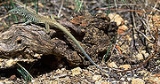
Cnemidophorus tigris

Encyclopedia
The western whiptail is a small lizard (adults average 25 to 35 cm - about a foot - in length) that ranges throughout most of the southwestern United States
. Most of its populations appear stable, and is not listed as endangered in any of the states comprising its range. It lives in a wide variety of habitats, including deserts and semiarid shrublands, usually in areas with sparse vegetation; also woodland, open dry forest, and riparian growth. It lives in burrows. Major differences between this species and the Checkered Whiptail (Aspidoscelis tesselata
) include the lack of enlarged scales anterior to the gular fold
and the presence of enlarged antebatrachial scales. It was previously known under Cnemidophorus tigris, until phylogenetic analyses concluded that the genus Cnemidophorus was polyphyletic. Since it does not migrate, a number of forms have developed in different regions, several of which have been given sub-specific
names - for example the California Whiptail, Aspidoscelis tigris munda.
An excellent, well-documented site for information on this and other American species is http://www.natureserve.org. The specific home page for the species is http://www.natureserve.org/explorer/servlet/NatureServe?searchName=Cnemidophorus+tigris .
Southwestern United States
The Southwestern United States is a region defined in different ways by different sources. Broad definitions include nearly a quarter of the United States, including Arizona, California, Colorado, Nevada, New Mexico, Oklahoma, Texas and Utah...
. Most of its populations appear stable, and is not listed as endangered in any of the states comprising its range. It lives in a wide variety of habitats, including deserts and semiarid shrublands, usually in areas with sparse vegetation; also woodland, open dry forest, and riparian growth. It lives in burrows. Major differences between this species and the Checkered Whiptail (Aspidoscelis tesselata
Cnemidophorus tesselatus
The Checkered Whiptail is a species of lizard found in the southwestern United States in Colorado, Texas and New Mexico, and in northern Mexico in Chihuahua and Coahuila...
) include the lack of enlarged scales anterior to the gular fold
Gular fold
A gular fold is a feature of the body of lizards. it is found on the ventral throat, and looks like a collar.-See also:* Gular , gular anatomical formations in other species...
and the presence of enlarged antebatrachial scales. It was previously known under Cnemidophorus tigris, until phylogenetic analyses concluded that the genus Cnemidophorus was polyphyletic. Since it does not migrate, a number of forms have developed in different regions, several of which have been given sub-specific
Subspecies
Subspecies in biological classification, is either a taxonomic rank subordinate to species, ora taxonomic unit in that rank . A subspecies cannot be recognized in isolation: a species will either be recognized as having no subspecies at all or two or more, never just one...
names - for example the California Whiptail, Aspidoscelis tigris munda.
An excellent, well-documented site for information on this and other American species is http://www.natureserve.org. The specific home page for the species is http://www.natureserve.org/explorer/servlet/NatureServe?searchName=Cnemidophorus+tigris .