
All Topics  
Claus process

 
Claus Process

   Email Print
   Bookmark   Link


Claus process


The Claus process is the most significant gas desulfurizing process, recovering elemental sulfur
Sulfur

Sulfur or sulphur is the chemical element that has the atomic number 16. It is denoted with the symbol S. It is an abundant Valence non-metal....
 from gaseous hydrogen sulfide
Hydrogen sulfide

Hydrogen sulfide is the chemical compound with the chemical formula Hydrogen2Sulfur. This colorless, toxic and flammable gas is partially responsible for the foul odor of egg and flatulence....
. First invented over 100 years ago, the Claus process has become the industry standard.

The multi-step Claus process recovers sulfur from the gaseous hydrogen sulfide found in raw natural gas
Natural gas

Natural gas is a gas consisting primarily of methane. It is found associated with fossil fuels, in coal beds, as methane clathrates, and is created by methanogenic organisms in marshes, bogs, and landfills....
 and from the by-product gases containing hydrogen sulfide derived from refining crude oil and other industrial processes.


Discussion
Ask a question about 'Claus process'
Start a new discussion about 'Claus process'
Answer questions from other users
Full Discussion Forum


Recent Posts


Encyclopedia


The Claus process is the most significant gas desulfurizing process, recovering elemental sulfur
Sulfur

Sulfur or sulphur is the chemical element that has the atomic number 16. It is denoted with the symbol S. It is an abundant Valence non-metal....
 from gaseous hydrogen sulfide
Hydrogen sulfide

Hydrogen sulfide is the chemical compound with the chemical formula Hydrogen2Sulfur. This colorless, toxic and flammable gas is partially responsible for the foul odor of egg and flatulence....
. First invented over 100 years ago, the Claus process has become the industry standard.

The multi-step Claus process recovers sulfur from the gaseous hydrogen sulfide found in raw natural gas
Natural gas

Natural gas is a gas consisting primarily of methane. It is found associated with fossil fuels, in coal beds, as methane clathrates, and is created by methanogenic organisms in marshes, bogs, and landfills....
 and from the by-product gases containing hydrogen sulfide derived from refining crude oil and other industrial processes. The by-product gases mainly originate from physical and chemical gas treatment units (Selexol
Selexol

Selexol is the trade name for an Amine gas treating solvent that can separate acid gases such as hydrogen sulfide and carbon dioxide from feed gas streams such as synthesis gas produced by gasification of coal, coke, or heavy hydrocarbon oils....
, Rectisol
Rectisol

Rectisol is the trade name for a Amine gas treating process that uses methanol as a solvent to separate acid gases such as hydrogen sulfide and carbon dioxide from valuable feed gas streams....
, Purisol and amine scrubber
Amine gas treating

Amine gas treating, also known as gas sweetening and acid gas removal, refers to a group of processes that use aqueous solutions of various alkanolamines to remove hydrogen sulfide and carbon dioxide from gases....
s) in refineries
Oil refinery

An oil refinery is an industrial process plant where crude oil is processed and refined into more useful petroleum products, such as gasoline, diesel fuel, asphalt, heating oil, kerosene, and liquefied petroleum gas....
, natural gas processing plants
Natural gas processing

Natural gas processing plants, or fractionators, are used to purify the raw natural gas extracted from underground Natural gas field and brought up to the surface by Oil well....
 and gasification
Gasification

Gasification is a process that converts carbonaceous materials, such as coal, petroleum, biofuel, or biomass, into carbon monoxide and hydrogen by reacting the raw material at high temperatures with a controlled amount of oxygen and/or steam....
 or synthesis gas plant
Syngas

Syngas is the name given to a gas mixture that contains varying amounts of carbon monoxide and hydrogen. Examples of production methods include steam reforming of natural gas or liquid hydrocarbons to produce hydrogen, the gasification of coal and in some types of waste-to-energy gasification facilities....
s. These by-product gases may also contain hydrogen cyanide
Hydrogen cyanide

Hydrogen cyanide is a chemical compound with chemical formula HCN. A solution of hydrogen cyanide in water is called hydrocyanic acid. Hydrogen cyanide is a colorless, extremely poisonous, and highly volatility liquid that boiling slightly above room temperature at 26 Celsius ....
, hydrocarbon
Hydrocarbon

In organic chemistry, a hydrocarbon is an organic compound consisting entirely of hydrogen and carbon. With relation to chemical terminology, aromatic hydrocarbons or arenes, alkanes, alkenes and alkyne-based compounds composed entirely of carbon or hydrogen are referred to as "pure" hydrocarbons, whereas other hydrocarbons with bonded com...
s, sulfur dioxide
Sulfur dioxide

Sulfur dioxide is the chemical compound with the formula SO2. It is produced by volcanoes and in various industrial processes. Since coal and petroleum often contain sulfur compounds, their combustion generates sulfur dioxide....
 or ammonia
Ammonia

Ammonia is a chemical compound with the chemical formula nitrogenhydrogen. It is normally encountered as a gas with a characteristic pungent odor....
.

Gases with an H2S
Hydrogen sulfide

Hydrogen sulfide is the chemical compound with the chemical formula Hydrogen2Sulfur. This colorless, toxic and flammable gas is partially responsible for the foul odor of egg and flatulence....
 content of over 25% are suitable for the recovery of sulfur in straight-through Claus plants while alternate configurations such as a split-flow set up or feed and air preheating can be used to process leaner feeds.

Hydrogen sulfide produced, for example, in the hydrodesulfurization
Hydrodesulfurization

Hydrodesulfurization is a catalytic chemical process widely used to remove sulfur from natural gas and from oil refinery such as gasoline, jet fuel, kerosene, diesel fuel, and fuel oils....
 of refinery naphtha
Naphtha

Naphtha normally refers to a number of different flammable liquid mixtures of hydrocarbons, i.e. a distillation product from petroleum or coal tar boiling in a certain range and containing certain hydrocarbons, a broad term encompassing any volatile, flammable liquid hydrocarbon mixture....
s and other petroleum
Petroleum

Petroleum or crude oil is a naturally occurring, flammable liquid found in rock formations in the Earth consisting of a complex mixture of hydrocarbons of various molecular weights, plus other organic compounds....
 oils, is converted to sulfur in Claus plants. The overall main reaction equation is:

2H2S + O2 ? S2 + 2H2O

In fact, the vast majority of the 64,000,000 metric tons of sulfur produced worldwide in 2005 was byproduct sulfur from refineries and other hydrocarbon processing plants. Sulfur is used for manufacturing sulfuric acid
Sulfuric acid

Sulfuric acid, hydrogen2sulfuroxygen4, is a strong mineral acid. It is soluble in water at all concentrations. Sulfuric acid has many applications, and is one of the top products of the chemical industry....
, medicine, cosmetics, fertilizers and rubber products.

History


The process was invented by Carl Friedrich Claus, a chemist working in England. A British patent was issued to him in 1883. The process was later significantly modified by a German company called I.G.Farbenindustrie A.G.
IG Farben

I.G. Farbenindustrie AG was a Germany chemical industry Conglomerate . Its name is taken from Interessen-Gemeinschaft Farbenindustrie AG . The company was formed in 1925 from a number of major companies that had been working together closely since World War I....


Process description


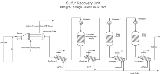
A schematic process flow diagram
Process Flow diagram

A process flow diagram is a diagram commonly used in chemical engineering and process engineering to indicate the general flow of plant processes and equipment....
 of a basic 3-Bed Claus unit is shown below:


The Claus technology can be divided into two process steps, thermal and catalytic.

In the thermal step, hydrogen sulfide-laden gas reacts in a substoichiometric
Stoichiometry

Stoichiometry is the calculation of quantitative relationships of the reactants and Product in a balanced chemical reaction .Etymology...
 combustion
Combustion

Combustion or burning is a complex sequence of exothermic chemical reactions between a fuel and an oxidant accompanied by the production of heat or both heat and light in the form of either a glow or flames, appearance of light flickering....
 at temperatures above 850 °C such that elemental sulfur precipitates in the downstream process gas cooler.

The H2S-content and the concentration of other combustible components (hydrocarbons or ammonia) determine the location where the feed gas is burned. Claus gases (acid gas) with no further combustible contents apart from H2S are burned in lances surrounding a central muffle by the following chemical reaction:

2H2S + 3O2 ? 2SO2 + 2H2O

Gases containing ammonia, such as the gas from the refinery's sour water stripper (SWS), or hydrocarbons are converted in the burner muffle. Sufficient air is injected into the muffle for the complete combustion of all hydrocarbons and ammonia. Air to the acid gas is controlled such that in total 1/3 of all hydrogen sulfide (H2S) is converted to SO2. This ensures a stoichiometric reaction for the Claus reaction (see next section below).

The separation of the combustion processes ensures an accurate dosage of the required air volume needed as a function of the feed gas composition. To reduce the process gas volume or obtain higher combustion temperatures, the air requirement can also be covered by injecting pure oxygen. Several technologies utilizing high-level and low-level oxygen enrichment are available in industry, which requires the use of a special burner in the reaction furnace for this process option.

Usually, 60 to 70% of the total amount of elemental sulfur produced in the process are obtained in the thermal process step.

The main portion of the hot gas from the combustion chamber flows through the tube of the process gas cooler and is cooled down such that the sulfur formed in the reaction step condenses
Condenser

Condenser may refer to:*Condenser , a device or unit used to Condensation vapor into liquid. More specific articles on some types include:*Condenser microphone, a device that converts sound waves into an electrical signal....
. The heat given off by the process gas and the condensation heat
Standard enthalpy change of vaporization

The enthalpy of vaporization, , also known as the heat of vaporization or heat of evaporation, is the energy required to transform a given quantity of a substance into a gas....
 evolved are utilized to produce medium or low-pressure steam
Steam

In physical chemistry, and in engineering, steam refers to vaporized water. It is a pure, completely invisible gaseous phase . At standard temperature and pressure, pure steam occupies about 1,600 times the volume of an equal mass of liquid water....
. The condensed sulfur is removed at the gas outlet section of the process gas cooler.

A small portion of the process gas can be routed through a bypass inside of the process gas cooler, as depicted in the figure. This hot bypass stream is added to the cold process gas through a three-way valve to adjust the inlet temperature required for the first reactor.

Catalytic step


The Claus reaction continues in the catalytic step with activated alumina or titanium dioxide, and serves to boost the sulfur yield. The hydrogen sulfide (H2S) reacts with the SO2 formed during combustion in the reaction furnace, and results in gaseous, elemental sulfur. This is called the Claus reaction:

2H2S + SO2 ? 3S + 2H2O

The catalytic recovery of sulfur consists of three substeps: heating, catalytic reaction and cooling plus condensation. These three steps are normally repeated a maximum of three times. Where an incineration or tail-gas treatment unit (TGTU) is added downstream of the Claus plant, only two catalytic stages are usually installed.

The first process step in the catalytic stage is the process gas heating. It is necessary to prevent sulfur condensation in the catalyst bed, which can lead to catalyst fouling. The required bed operating temperature in the individual catalytic stages is achieved by heating the process gas in a reheater until the desired operating bed temperature is reached.

Several methods of reheating are used in industry:
  • Hotgas bypass: which involves mixing the two process gas streams from the process gas cooler (cold gas) and the bypass (hot gas) from the first pass of the Wasteheat boiler.
  • Indirect Steam reheaters: the gas can also be heated with high pressure steam in a heat exchanger.
  • Gas/Gas Exchangers: whereby the cooled gas from the process gas cooler is indirectly heated from the hot gas coming out of an upstream catalytic reactor in a gas-to-gas exchanger.
  • Direct-fired Heaters: fired reheaters utilizing acid gas or fuel gas, which is burned substoichiometrically to avoid oxygen breakthrough which can damage Claus catalyst.


The typically recommended operating temperature of the first catalyst stage is 315°C to 330°C (bottom bed temperature). The high temperature in the first stage also helps to hydrolyze COS and CS2, which is formed in the furnace and would not otherwise be converted in the modified Claus process.

The catalytic conversion is maximized at lower temperatures, but care must be taken to ensure that each bed is operated above the dewpoint of sulfur. The operating temperatures of the subsequent catalytic stages are typically 240°C for the second stage and 200°C for the third stage (bottom bed temperatures).

In the sulfur condenser, the process gas coming from the catalytic reactor is cooled to between 150 and 130°C. The condensation heat is used to generate steam at the shell side of the condenser.

Before storage, liquid sulfur streams from the process gas cooler, the sulfur condensers and from the final sulfur separator are routed to the degassing unit, where the gases (primarily H2S) dissolved in the sulfur are removed.

The tail gas from the Claus process still containing combustible components and sulfur compounds (H2S, H2 and CO) is either burned in an incineration unit or further desulfurized in a downstream tail gas treatment unit.

Process performance


Using two catalytic stages, the process will typically yield over 97% of the sulfur in the input stream. Over 2.6 tons of steam will be generated for each ton of sulfur yield.

See also


  • Amine treating
  • Hydrodesulfurization
    Hydrodesulfurization

    Hydrodesulfurization is a catalytic chemical process widely used to remove sulfur from natural gas and from oil refinery such as gasoline, jet fuel, kerosene, diesel fuel, and fuel oils....
  • Hydrogenation
    Hydrogenation

    Hydrogenation is the chemical reaction that results from the addition of hydrogen . The process is usually employed to a redox or Saturation organic compounds....
  • Acid gas
    Acid gas

    Acid gas is natural gas or any other gas mixture which contains significant amounts of hydrogen sulfide , carbon dioxide , or similar contaminants....
  • Sour gas
    Sour gas

    Sour gas is natural gas or any other gas containing significant amounts of hydrogen sulfide . Natural gas is usually considered sour if there are more than 5.7 milligrams of H2S per cubic meter of natural gas, which is equivalent to approximately 4 Parts-per notation by volume....