
Home      Discussion      Topics      Dictionary      Almanac
Signup       Login
Chicago Transit Authority

Chicago Transit Authority

Overview
Chicago Transit Authority, also known as CTA, is the operator of mass transit
Public transport
Public transport is a shared passenger transportation service which is available for use by the general public, as distinct from modes such as taxicab, car pooling or hired buses which are not shared by strangers without private arrangement.Public transport modes include buses, trolleybuses, trams...

 within the City of Chicago
Chicago
Chicago is the largest city in the US state of Illinois. With nearly 2.7 million residents, it is the most populous city in the Midwestern United States and the third most populous in the US, after New York City and Los Angeles...

, Illinois
Illinois
Illinois is the fifth-most populous state of the United States of America, and is often noted for being a microcosm of the entire country. With Chicago in the northeast, small industrial cities and great agricultural productivity in central and northern Illinois, and natural resources like coal,...

 and some of its surrounding suburbs.
Discussion
Ask a question about 'Chicago Transit Authority'
Start a new discussion about 'Chicago Transit Authority'
Answer questions from other users
Full Discussion Forum
 
Unanswered Questions
Encyclopedia
Chicago Transit Authority, also known as CTA, is the operator of mass transit
Public transport
Public transport is a shared passenger transportation service which is available for use by the general public, as distinct from modes such as taxicab, car pooling or hired buses which are not shared by strangers without private arrangement.Public transport modes include buses, trolleybuses, trams...

 within the City of Chicago
Chicago
Chicago is the largest city in the US state of Illinois. With nearly 2.7 million residents, it is the most populous city in the Midwestern United States and the third most populous in the US, after New York City and Los Angeles...

, Illinois
Illinois
Illinois is the fifth-most populous state of the United States of America, and is often noted for being a microcosm of the entire country. With Chicago in the northeast, small industrial cities and great agricultural productivity in central and northern Illinois, and natural resources like coal,...

 and some of its surrounding suburbs.

The CTA is a municipal corporation that started operations on October 1, 1947 upon the purchase and combination of the transportation assets of the Chicago Rapid Transit Company
Chicago Rapid Transit Company
The Chicago Rapid Transit Company was a privately owned firm providing rapid transit rail service in Chicago, Illinois and several adjacent communities between the years 1924 and 1947...

 and the Chicago Surface Lines
Chicago Surface Lines
The Chicago Surface Lines was operator of the street railway system of Chicago, Illinois, from the years 1913 to 1947. The firm is a predecessor of today's publicly owned operator, the Chicago Transit Authority.-History:...

 streetcar system. In 1952, CTA purchased the assets of the Chicago Motor Coach Company
Chicago Motor Coach Company
The Chicago Motor Coach Company was founded in 1917 by John D. Hertz to provide Chicago's first bus transportation services, primarily in places where streetcars were not able to travel. The company grew rapidly and was purchased by the Chicago Transit Authority in 1952.-History:John D. Hertz...

, which was under the control of Yellow Cab
Yellow Cab
There are many Yellow Cabs taxicab operators around the world . The original Yellow Cab Company, based in Chicago, Illinois is one of the largest taxicab companies in the United States.- History :...

 founder John D. Hertz
John D. Hertz
John Daniel Hertz, Sr. was an American businessman, thoroughbred racehorse owner, and philanthropist.-Biography:...

, resulting in a fully unified system. Today, the CTA is one of the three service boards financially supported by the Regional Transportation Authority.

Operations


The Chicago Transit Authority provides service to Chicago and 40 surrounding suburbs. The CTA provided a total of 521.2 million rides in 2009, a 1 percent decrease (5.1 million fewer rides) over 2008 numbers.

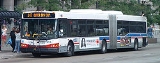
CTA operates 24 hours each day and on an average weekday provides 1.7 million rides on buses and trains. It has approximately 1,800 buses that operate over 140 routes traveling along 2,230 route miles (3,658 km). Buses provide about one million passenger trips a day and serve more than 12,000 posted bus stops. The Chicago Transit Authority's 1,190 train cars operate over eight routes and 222 miles (357.3 km) of track. Its trains provide about 650,000 customer trips each day and serve 144 stations in Chicago.

Fare collection


The CTA allows riders to board a bus and pay with cash, transit cards, or Chicago Cards. As for trains, riders are only allowed to pay with a transit card or a Chicago Card. In the past, one could pay $1.75 and receive a transit card on the bus. The card would be worth three bus rides, but as of today, it is no longer available. Today the card has to be purchased from a local currency exchange (such as Western Union and Checks Cashed), bus terminal, or subway platform.

Paying with cash


Only buses allow riders to pay with cash. The fare is $2.25 (as of January 1, 2009), and cash transfers are not available. Previously, some rail station turnstiles accepted cash but this feature has been removed in an effort to speed up boarding, except during sporting events at nearby 'L' stations, such as the Red Line
Red Line (Chicago Transit Authority)
The northern terminus of the Red Line is Howard Street in the Rogers Park neighborhood of Chicago , on the City Limits farthest north. The Red Line extends southeasterly on an elevated embankment structure about a half-mile west of the lakefront to Touhy Avenue then turns south along Glenwood...

 'L' station at Addison
Addison (CTA Red Line)
Addison is a Chicago, Illinois station of the Chicago Transit Authority elevated train line popularly called the Chicago 'L'. It is located in the Wrigleyville enclave of the Lakeview neighborhood at 940 West Addison Street with city block coordinates at 3600 North at 940 West...

 (near Wrigley Field
Wrigley Field
Wrigley Field is a baseball stadium in Chicago, Illinois, United States that has served as the home ballpark of the Chicago Cubs since 1916. It was built in 1914 as Weeghman Park for the Chicago Federal League baseball team, the Chicago Whales...

, home of the Chicago Cubs
Chicago Cubs
The Chicago Cubs are a professional baseball team located in Chicago, Illinois. They are members of the Central Division of Major League Baseball's National League. They are one of two Major League clubs based in Chicago . The Cubs are also one of the two remaining charter members of the National...

) and the station for the same line at Sox-35th (across the street from U.S. Cellular Field
U.S. Cellular Field
U.S. Cellular Field is a baseball ballpark in Chicago, Illinois. Owned by the Illinois Sports Facilities Authority, it is the home of the Chicago White Sox of Major League Baseball's American League. The park opened for the 1991 season, after the White Sox had spent 81 years at old Comiskey Park...

, home of the Chicago White Sox
Chicago White Sox
The Chicago White Sox are a Major League Baseball team located in Chicago, Illinois.The White Sox play in the American League's Central Division. Since , the White Sox have played in U.S. Cellular Field, which was originally called New Comiskey Park and nicknamed The Cell by local fans...

).

Paying with transit cards


The CTA sells transit cards online, at its headquarters, and at all rail stations. They can also be purchased at a number of retail locations around Chicago and its suburbs, and at downtown Metra
Metra
Metra is the commuter rail division of the Illinois Regional Transportation Authority. The system serves Chicago and its metropolitan area through 240 stations on 11 different rail lines. Throughout the 21st century, Metra has been the second busiest commuter rail system in the United States by...

 stations. There are two types of transit cards: stored-value and unlimited rides. the cost of a single ride fare when using a stored-value transit card is $2.25 for train journeys or $2 for bus journeys. Transfers made within 2 hours of the first ride are charged at 25 cents for the first transfer; a second transfer is free. Unlimited ride cards are available in one day ($5.75), three day ($14), seven day ($23), and thirty day ($86) increments. Reduced fare transit cards available for senior citizens, people with disabilities, Chicago Public School students, Evanston Public School students, and students of certain area universities.

Paying with the Chicago Card and Chicago Card Plus


The Chicago Card (along with the Chicago Card Plus) is a contactless smart card
Contactless smart card
A contactless smart card is any pocket-sized card with embedded integrated circuits that can process and store data, and communicate with a terminal via radio waves. There are two broad categories of contactless smart cards. Memory cards contain non-volatile memory storage components, and perhaps...

, powered by RFID, used by riders of the Chicago Transit Authority (CTA) to electronically pay for bus and train fares. The Chicago Card and Chicago Card Plus allow the riders to "tap" the card against a touchpad located on buses and train station turnstiles to allow faster and easier boarding.

Connections - CTA TV show


The Chicago Transit Authority produces a monthly television show, Connections. The show is broadcast on City of Chicago Public-access television
Public-access television
Public-access television is a form of non-commercial mass media where ordinary people can create content television programming which is cablecast through cable TV specialty channels...

 cable TV channels 23 & 49, as well as on Comcast
Comcast
Comcast Corporation is the largest cable operator, home Internet service provider, and fourth largest home telephone service provider in the United States, providing cable television, broadband Internet, and telephone service to both residential and commercial customers in 39 states and the...

's CN100 in the Chicago media market, including areas of Michigan and Indiana.
Connections features news and information about the CTA and services it provides. The program can be watched online at http://www.transitchicago.com/news_initiatives/connections.aspx. Individual segments from Connections are available on the CTA Connections YouTube channel.

Equipment history


Until 1973, CTA's fleet included a large number of electric trolley buses
Trolleybus
A trolleybus is an electric bus that draws its electricity from overhead wires using spring-loaded trolley poles. Two wires and poles are required to complete the electrical circuit...

 – or "trolley coaches", as they were commonly known at the time. In the 1950s, the fleet of around 700 trolley coaches was the largest such fleet in the U.S., and represented about one-quarter of CTA's total number of surface-transit vehicles (motor bus, trolley bus and, until 1958, streetcar). Trolley bus service was phased out in the late 1960s and early 1970s, and trolley buses ran for the last time on March 25, 1973.


CTA buses were known as the "green limousine" or the "big green" — buses were one or more shades of green from the CTA's establishment through the end of the 1980s. With the delivery of the TMC
Transportation Manufacturing Corporation
Transportation Manufacturing Corporation was a bus manufacturer based in Roswell, New Mexico.The company was formed in 1974 by Greyhound Bus Lines to manufacture Motor Coach Industries vehicles...

 RTS
Rapid Transit Series
The Rapid Transit Series bus is a long-running series of transit buses originally manufactured by General Motors and is currently produced by Millennium Transit Services as the RTS Legend. Millennium had produced the buses from 2006 until it shut down production in 2009, only to be bought back...

 buses in 1991, a more patriotic color scheme was adopted, and the green scheme was fully phased out by 1996. A notable color scheme was the "Bicentennial
United States Bicentennial
The United States Bicentennial was a series of celebrations and observances during the mid-1970s that paid tribute to the historical events leading up to the creation of the United States as an independent republic...

" of about 1974 to 1976.

CTA bought very few buses between the mid-1970s and the end of the 1980s. During this time, purchases were only made in 1979 (20 MAN/AM General
AM General
AM General is an American heavy vehicle manufacturer based in South Bend, Indiana. It is best known for the civilian Hummer and the military Humvee, that is assembled in Mishawaka, Indiana...

 articulated bus
Articulated bus
An articulated bus is an articulated vehicle used in public transportation. It is usually a single-deck design, and comprises two rigid sections linked by a pivoting joint...

es), 1982-83 (200 Flyer
New Flyer Industries
New Flyer Industries Inc. is a bus manufacturer in North America, headquartered in Winnipeg, Manitoba, Canada. It also has factories in Crookston and St. Cloud, Minnesota, USA.-History:...

 D901 buses and 125 additional MAN articulateds), and 1985 (362 MAN Americana standard-length buses). Another aspect of this period was that with the exception of the 1979 and 1983 MAN orders, none of those buses had air-conditioning, a budget saving move by the CTA. The 1972-76 fleet of GM "New Look" buses, 1870 total, which were originally air-conditioned (although there were problems with the air-conditioning systems, resulting in their eventually being disabled and sliding windows installed in the buses), comprised the majority vehicles in service into the early 1990s.

Today CTA's current fleet of buses is mostly dominated by New Flyer's D40LF, which replaced buses that were built in 1991 and some built in 1995.

The heavy rail orders of the CTA include the last railcar stock built by the Budd Company
Budd Company
The Budd Company is a metal fabricator and major supplier of body components to the automobile industry, and was formerly a manufacturer of stainless steel passenger rail cars during the 20th century....

 and one of the few examples of rail cars built by Boeing-Vertol. The next order is from Bombardier
Bombardier Transportation
Bombardier Transportation is the rail equipment division of the Canadian firm, Bombardier Inc. Bombardier Transportation is one of the world's largest companies in the rail-equipment manufacturing and servicing industry. Its headquarters are in Berlin, Germany....

.

Active bus fleet

Year Fleet Quantity Builder/Model Length Garage (s)
<<< Diesel
Diesel engine
A diesel engine is an internal combustion engine that uses the heat of compression to initiate ignition to burn the fuel, which is injected into the combustion chamber...

 >>>
2000-2002 6400-6883 480* NovaBus
LFS
40 ft (12.2 m) 74th, 77th, Chicago, Forest Glen, North Park
2006-2007 500-544 45 Optima
North American Bus Industries
North American Bus Industries, commonly known as NABI, is a major transit bus manufacturing company based in Anniston, Alabama. NABI was founded in 1992 when the Hungarian firm Ikarus Bus, a key bus supplier to Central, Eastern Europe, spun off a majority share of their American operations to...


Opus
30 ft (9.1 m) 103rd, 77th, Forest Glen
2006-2009 1000-2029 1,030 New Flyer
D40LF
40 ft (12.2 m) 103rd, 74th, 77th, Chicago, Forest Glen, Kedzie, North Park
<<< Diesel-electric Hybrid
Diesel-electric
Diesel-electric transmission or diesel-electric powertrain is used by a number of vehicle and ship types for providing locomotion.A diesel-electric transmission system includes a diesel engine connected to an electrical generator, creating electricity that powers electric traction motors...

 >>>
2006 800-809 10 New Flyer
DE40LF
40 ft (12.2 m) Kedzie
2007 900-909 10 New Flyer
DE40LF
40 ft (12.2 m) Kedzie
2008-2009 4000-4207 208 New Flyer
DE60LF
60 ft (18.3 m) 103rd, Kedzie, North Park

CTA bus garages


  • Forest Glen Garage, 5419 W. Armstrong Avenue, (Elston/Bryn Mawr)
  • North Park Garage, 112 W. Foster Avenue, (Foster/Albany)
  • Chicago Garage, 642 N. Pulaski Road, (Chicago/Pulaski)
  • Kedzie Garage, 358 S. Kedzie Avenue, (Van Buren/Kedzie)
  • 74th Garage, 1815 W. 74th Street, (74th/Wood)
  • 77th Garage, 210 W. 79th Street, (79th/Wentworth)
  • 103rd Garage, 1602 E. 103rd Street, (103rd/Stony Island)

Active 'L' rolling stock

Class Year Manufacturer Assigned Lines Quantity Notes
2200 series 1969–1970 Budd Company
Budd Company
The Budd Company is a metal fabricator and major supplier of body components to the automobile industry, and was formerly a manufacturer of stainless steel passenger rail cars during the 20th century....

Blue No 136
  • To be retired soon
2400 series 1976–1978 Boeing-Vertol Green, Purple Yes 191
  • To be retired soon
  • 2600 series 1981–1987 Budd Company
    Budd Company
    The Budd Company is a metal fabricator and major supplier of body components to the automobile industry, and was formerly a manufacturer of stainless steel passenger rail cars during the 20th century....

    Red, Blue, Yellow, Purple, Pink Yes 594
    3200 series 1992–1994 Morrison-Knudsen Orange, Brown Yes 257
    <<< On-order >>>
    5000 series
    5000 series (Chicago 'L')
    The 5000 series is a series of Chicago 'L' car built by Bombardier Transportation. An $577 million order for 406 cars was placed in 2006. In July 2011, the CTA ordered 300 more cars for $331 million as an option on the first contract....

    2009–2014 Bombardier Transportation
    Bombardier Transportation
    Bombardier Transportation is the rail equipment division of the Canadian firm, Bombardier Inc. Bombardier Transportation is one of the world's largest companies in the rail-equipment manufacturing and servicing industry. Its headquarters are in Berlin, Germany....

    Pink Yes 706
  • 10 prototypes were received in 2009, and entered passenger testing in April 2010, with 396 more to be ordered once the test were completed.
  • On July 20, 2011, CTA announced the order of 300 more railcars, bringing the total ordered to 706 at a cost of about US$1 billion.
  • For a description of the 'L' cars, see Chicago 'L' rolling stock
    Chicago 'L' rolling stock
    The rolling stock of the Chicago 'L rapid transit system consists of 1,190 rail cars dating from 1969 to 1994, delivered in four series: the 2200-series, 2400-series, 2600-series, and 3200-series, also known as the High Performance Family, because of innovative design and technological features...

    .
  • See chicago-l.org for car assignment sheets.

  • CTA Train Yards

    • Linden Avenue Yard (Purple Line) = 1912: storage for 76 cars; rehabbed 1993
    • Howard Street Yard (Red/Purple/Yellow Lines) = 1919: storage for 282 cars; rehabbed 1991-1993
    • 98th Street Yard-Dan Ryan (Red Line) = 1969: storage 234 cars; rehabbed 1993
    • Rosemont Yard (Blue Line) = 1983: storage 144 cars
    • Des Plaines Avenue Yard-Forest Park (Blue Line) = 1959: storage 122 cars; rehabbed 1964
    • 54th Avenue Yard (Pink Line) = Between 1912 and 1921: storage for 100 cars; rehabbed 2002-2003
    • Harlem Avenue Yard (Green Line) = 1962: storage for 132 cars
    • Midway Yard (Orange Line) = 1993
    • Kimball Avenue Yard (Brown Line) = 1907: storage for 136 cars; rehabbed 1990s
    • Skokie Shops (Rail Heavy Maintenance Shop) = 1926: rehabbed 2000

    Inactive

    • Racine Avenue Yard-63rd Street (Green Line) = 1907: stored 220 cars; rehabbed 1970s
    • 61st Street Yard (Green Line) = 1893: rehabbed 1993

    Security and safety


    After the September 11 attacks, CTA announced its "If you See Something, Say Something" campaign. CTA has also installed a security camera network, and a system to send real time images from cameras in buses directly to emergency responders.

    CTA has also been actively prosecuting vandals, announcing on several occasions that felony convictions were obtained against persons who spray painted authority vehicles.

    See also Chicago 'L' concerning incidents on the rapid transit system.

    Technology


    The CTA has, within the past few years, installed GPS Bus Tracker systems on all buses. The original claim justifying the addition of this technology was that it would reduce the issue of "bunching buses." The system also allows riders to be able to determine the location of buses online.

    A report prepared by the CTA claims that there was a decrease in bus bunching from 3.9% to 2.3% from 2007 to 2009, but the report neither demonstrated a direct connection between Bus Tracker and this reduction in bunching, nor did it show whether this was a temporary or permanent phenomenon.

    CTA has also made its Bus Tracker and other developer tools available, and is making Bus Tracker arrival data available through text messaging
    Text messaging
    Text messaging, or texting, refers to the exchange of brief written text messages between fixed-line phone or mobile phone and fixed or portable devices over a network...

    . One of the first applications of the Bus Tracker Developer Tools involved the installation of monitors showing the information in several businesses in Chicago's Wicker Park
    Wicker Park, Chicago
    Wicker Park is a Chicago neighborhood northwest of the Loop, south of Bucktown and west of Pulaski Park within West Town. Charles and Joel Wicker purchased of land along Milwaukee Avenue in 1870 and laid out a subdivision with a mix of lot sizes surrounding a park...

     neighborhood. Using the developer API published by CTA, some augmented CTA bus tracking applications have been developed for mobile phones, and CTA has its own Transit App Center, featuring applications developed by others. CTA also has a train tracker (Beta starting January 2011) but can only be accessed through a computer or a smart phone.

    Public art


    The CTA is home to a collection of art – including mosaics, sculptures and paintings. More than 50 pieces of art are exhibited at over 40 CTA stations.

    According to the CTA's website, the original pieces of artwork contribute to each station’s identity and enhance travel for customers. Art promotes a friendly, inviting atmosphere for these stations, which serve as gateways to the communities they serve.

    Many of the pieces are a result of the Arts in Transit Program, which is funded by the Federal Transit Administration and coordinated locally through the City of Chicago’s Office of Tourism and Culture. A number of other pieces were created through the CTA’s Adopt-A-Station program and through partnerships with organizations such as the Chicago Public Art Group.

    Arts in Transit


    In 2004, the CTA and the City of Chicago Public Art Program installed nine permanent works of art at eight renovated rail stations on what is now known as the Pink Line. The CTA has since created an ongoing program to showcase permanent works of art in conjunction with the City of Chicago Public Art Program. The Arts in Transit Program is funded by the Federal Transit Administration, and created opportunities to develop original artwork for station reconstruction projects along the CTA Red and Brown Lines. Artists were selected for each of the stations included in the Brown Line Capacity Expansion Project and select renovated Red Line stations.
    By the completion of the Brown Line Capacity Expansion Project in 2010, original artwork was installed in each of the 18 renovated stations along the CTA's Brown Line. By combining the visibility and accessibility of the city's mass transit system with the creativity of Chicago's art resources, this program resulted in a successful public display of professional works of art designed with input from nearby communities. This program provided high profile locations for public art and server as a gateway to communities served by the CTA stations. Media under consideration included, but were not limited to, mosaics, art glass, ornamental fencing, mixed-media artwork, and freestanding sculpture and furniture.
    The CTA and the City of Chicago Public Art Program, administered by the Office of Tourism and Culture, encouraged and facilitated collaborations between artists, government agencies, the community and other partners. The City of Chicago Public Art Program accepted qualifications from local and national professional artists or artist teams capable of creating permanent public works of art for the CTA Arts in Transit Program for the renovated stations.

    CTA promotes its Public Art with a video and online gallery.

    See also


    • Chicago 'L'
      Chicago 'L'
      The L is the rapid transit system serving the city of Chicago and some of its surrounding suburbs. It is operated by the Chicago Transit Authority...

    • List of Chicago Transit Authority bus routes
    • List of Chicago 'L' stations
    • List of former Chicago 'L' stations
    • Transportation in Chicago
      Transportation in Chicago
      Chicago, Illinois, is the third largest city in the United States and a major transportation hub. The city is served by two major airports, and is the main freight rail hub of North America....

    • Transit fares

    External links