
All Topics  
Camille Saint-Saëns

 
Camille Saint Saëns

   Email Print
   Bookmark   Link


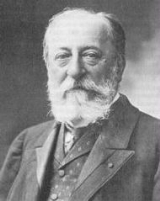
Camille Saint-Saëns


Charles-Camille Saint-Saëns (9 October 1835 – 16 December 1921) was a French composer
Composer

A composer is a person who creates music, usually in the medium of musical notation, for interpretation and performance. The level of distinction between composers and other musicians varies, which affects issues such as copyright and the deference given to individual interpretations of a particular piece of music....
, organist
Organist

An organist is a musician who plays any type of organ . An organist may play organ repertoire, play with an musical ensemble or orchestra, or accompany one or more singers or instrumentalist....
, conductor, and pianist
Pianist

A pianist is a musician who plays the piano. A professional pianist can perform solo pieces, play with an musical ensemble or orchestra, or accompany one or more singers, solo instrumentalists, or other performers....
, known especially for The Carnival of the Animals
The Carnival of the Animals

Le Carnaval des Animaux is a musical suite of fourteen movement by the France Romantic music composer Camille Saint-Sa?ns. The orchestral work has a duration between 22 and 30 minutes....
, Danse Macabre
Danse Macabre (Saint-Saëns)

Danse macabre, opus number 40 by France composer Camille Saint-Sa?ns is an art song for voice and piano with a French text by the poet Henri Cazalis which is based in an old French superstition....
, Samson and Delilah
Samson and Delilah (opera)

Samson et Dalila , Op. 47, is a Grand Opera in three acts and four tableaux by Camille Saint-Sa?ns to a French language libretto by Ferdinand Lemaire....
, Havanaise
Havanaise (Saint-Saëns)

The Havanaise in E major , opus number 83, is a composition for violin and orchestra based on the habanera rhythm, written in 1887 in music by Camille Saint-Sa?ns....
, Introduction and Rondo capriccioso
Introduction and Rondo capriccioso (Saint-Saëns)

The Introduction and Rondo Capriccioso in A minor , opus number 28, is a composition for violin and orchestra written in 1863 in music by Camille Saint-Sa?ns for the virtuoso violinist Pablo de Sarasate....
, and his Symphony No. 3 (Organ Symphony)
Symphony No. 3 (Saint-Saëns)

The Symphony No. 3 in C minor, Opus number 78, was completed by Camille Saint-Sa?ns in 1886 at what was probably the artistic zenith of his career....
.

t-Saëns was born in Paris. His father, a government clerk, died three months after his birth.


Discussion
Ask a question about 'Camille Saint-Saëns'
Start a new discussion about 'Camille Saint-Saëns'
Answer questions from other users
Full Discussion Forum


Encyclopedia


Saintsaens
Charles-Camille Saint-Saëns (9 October 1835 – 16 December 1921) was a French composer
Composer

A composer is a person who creates music, usually in the medium of musical notation, for interpretation and performance. The level of distinction between composers and other musicians varies, which affects issues such as copyright and the deference given to individual interpretations of a particular piece of music....
, organist
Organist

An organist is a musician who plays any type of organ . An organist may play organ repertoire, play with an musical ensemble or orchestra, or accompany one or more singers or instrumentalist....
, conductor, and pianist
Pianist

A pianist is a musician who plays the piano. A professional pianist can perform solo pieces, play with an musical ensemble or orchestra, or accompany one or more singers, solo instrumentalists, or other performers....
, known especially for The Carnival of the Animals
The Carnival of the Animals

Le Carnaval des Animaux is a musical suite of fourteen movement by the France Romantic music composer Camille Saint-Sa?ns. The orchestral work has a duration between 22 and 30 minutes....
, Danse Macabre
Danse Macabre (Saint-Saëns)

Danse macabre, opus number 40 by France composer Camille Saint-Sa?ns is an art song for voice and piano with a French text by the poet Henri Cazalis which is based in an old French superstition....
, Samson and Delilah
Samson and Delilah (opera)

Samson et Dalila , Op. 47, is a Grand Opera in three acts and four tableaux by Camille Saint-Sa?ns to a French language libretto by Ferdinand Lemaire....
, Havanaise
Havanaise (Saint-Saëns)

The Havanaise in E major , opus number 83, is a composition for violin and orchestra based on the habanera rhythm, written in 1887 in music by Camille Saint-Sa?ns....
, Introduction and Rondo capriccioso
Introduction and Rondo capriccioso (Saint-Saëns)

The Introduction and Rondo Capriccioso in A minor , opus number 28, is a composition for violin and orchestra written in 1863 in music by Camille Saint-Sa?ns for the virtuoso violinist Pablo de Sarasate....
, and his Symphony No. 3 (Organ Symphony)
Symphony No. 3 (Saint-Saëns)

The Symphony No. 3 in C minor, Opus number 78, was completed by Camille Saint-Sa?ns in 1886 at what was probably the artistic zenith of his career....
.

Early years

Saint-Saëns was born in Paris. His father, a government clerk, died three months after his birth. His mother, Clémence, sought the assistance of her aunt, Charlotte Masson. Masson moved in and introduced Saint-Saëns to the piano
Piano

The piano is a musical instrument played by means of a keyboard instrument. Widely used in Western music for solo performance, ensemble use, chamber music, and accompaniment, the piano is also very popular as an aid to musical composition and rehearsal....
. One of the most talented child prodigies
Child prodigy

A child prodigy is someone who at an early age masters one or more skills at an adult level. One heuristic for classifying prodigies is: a prodigy is a child, typically younger than 13 years old, who is performing at the level of a highly trained adult in a very demanding field of endeavor....
 of his time, he possessed perfect pitch
Absolute pitch

Absolute pitch , widely referred to as perfect pitch, is the ability of a person to identify or recreate a musical note without the benefit of an external reference....
 at two years of age and began piano lessons with his great-aunt at that time. He almost immediately began composing. His first composition, a little piece for the piano dated 22 March 1839, is now kept in the Bibliothèque nationale de France
Bibliothèque nationale de France

The Biblioth?que nationale de France is the National library of France, located in Paris. It is intended to be the repository of all that is published in France....
. His precociousness was not limited to music, however. He had learned to read and write by age three and mastered Latin by seven. His first public concert appearance occurred at age five, when he accompanied a Beethoven
Ludwig van Beethoven

Ludwig van Beethoven was a German composer and pianist. He was a crucial figure in the transitional period between the Classical music era and Romantic music eras in classical music, and remains one of the most acclaimed and influential composers of all time....
 violin sonata
Violin sonata

A violin sonata is a musical composition for solo violin, which is nearly always accompanied by a piano or other keyboard instrument, or by figured bass in the Baroque music....
. He went on to begin in-depth study of the full score of Don Giovanni
Don Giovanni

Don Giovanni is an opera in two acts with music by Wolfgang Amadeus Mozart and with Italian language libretto by Lorenzo Da Ponte. It was premiered in the Estates Theatre in Prague on October 29, 1787 in music....
. In 1842, Saint-Saëns began piano lessons with Camille-Marie Stamaty
Camille-Marie Stamaty

Camille-Marie Stamaty was a Graeco-French pianist, composer and teacher.He was born in Rome to a Greece father and France mother. His father died when he was 7, and his mother took him to France....
, a pupil of Friedrich Kalkbrenner
Friedrich Kalkbrenner

Friedrich Wilhelm Kalkbrenner was a Germany pianist and composer.Son of Christian Kalkbrenner , a musician of Cassel, Friedrich was educated at the Paris Conservatoire, and soon began to play in public....
, who had his students play the piano while resting their forearms on a bar situated in front of the keyboard, so that all the pianist's power came from the hand and fingers and not the arms. At ten years of age, Saint-Saëns gave his debut public recital at the Salle Pleyel
Ignaz Pleyel

Ignace Joseph Pleyel was an Austria France composer of the Classical period ....
, with a performance of Mozart
Wolfgang Amadeus Mozart

Wolfgang Amadeus Mozart Mozart showed prodigious ability from his earliest childhood in Salzburg. Already competent on keyboard and violin, he composed from the age of five and performed before European royalty; at seventeen he was engaged as a court musician in Salzburg, but grew restless and traveled in search of a better position, always...
's Piano Concerto No. 15 in B-flat major
Piano Concerto No. 15 (Mozart)

The Piano Concerto No. 15 in B flat Major, K?chel Verzeichnis. 450 is a concertante work for piano, or pianoforte, and orchestra by Wolfgang Amadeus Mozart....
 (K.
Köchel-Verzeichnis

The K?chel-Verzeichnis is a complete, chronological catalogue of compositions by Wolfgang Amadeus Mozart which was originally created by Ludwig Ritter von K?chel....
 450), and various pieces by Handel
George Frideric Handel

George Frideric Handel was an England Baroque music composer of Germany birth who is famous for his operas, oratorios, and concerto grosso. His life and music may justly be described as "cosmopolitan": he was born in Germany, trained in Italy, and spent most of his life in England....
, Kalkbrenner, Hummel
Johann Nepomuk Hummel

Johann Nepomuk Hummel or Jan Nepomuk Hummel was a composer and virtuoso pianist of Austrian origin who was born in Pressburg , but a part of Kingdom of Hungary when he was born....
, and Bach
Johann Sebastian Bach

Johann Sebastian Bach was a German composer and organ whose sacred and secular works for choir, orchestra, and solo instruments drew together the strands of the Baroque music period and brought it to its ultimate maturity....
. As an encore, Saint-Saëns offered to play any one of Beethoven's 32 piano sonatas by memory
Memorization

Memorization or memorizing is the process of committing something to memory. The act of memorization is often a deliberate mental process undertaken in order to store in memory for later recall items such as experiences, names, appointments, addresses, telephone numbers, lists, stories, poems, pictures, maps, diagrams, facts, music or o...
. Word of this incredible concert spread across Europe, and as far as the United States with an article in a Boston
Boston, Massachusetts

Boston is the State capital and largest city of the Commonwealth of Massachusetts, and is one of the oldest cities in the United States. The largest city in New England, Boston is considered the economic and cultural center of the region, and is sometimes regarded as the unofficial "Capital of New England." Boston city proper had a 2007 est...
 newspaper.

He then studied organ and composition, the latter under Jacques Halévy
Fromental Halévy

Jacques-Fran?ois-Fromental-?lie Hal?vy was a France composer. He is known today largely for his opera La Juive....
 at the Conservatoire de Paris
Conservatoire de Paris

The Conservatoire de Paris is a music college founded in 1795, based in Paris, France. It offers instruction in music and drama of the highest standards, drawing on the traditions of the "French School."...
. Saint-Saëns won many top prizes and gained a reputation that resulted in his introduction to Franz Liszt
Franz Liszt

Franz Liszt was a Kingdom of Hungary composer, virtuoso pianist and teacher.Liszt became renowned throughout Europe for his great skill as a performer during the 19th century....
, who would become one of his closest friends. At the age of sixteen, Saint-Saëns wrote his first symphony
Symphony

A symphony is a musical composition, often extended and usually for orchestra. "Symphony" does not imply a specific form. Many symphonies are tonality works in four movement with the first in sonata form, and this is often described by music theorists as the structure of a "Classical period " symphony, although even some symphonies by the ac...
; his second, published as Symphony No. 1 in E-flat major, was performed in 1853 to the astonishment of many critics and fellow-composers. Hector Berlioz
Hector Berlioz

Louis Hector Berlioz was a French Romantic music composer and guitarist, best known for his compositions Symphonie fantastique and Requiem . Berlioz made great contributions to the modern orchestra with his Treatise on Instrumentation and by utilizing huge orchestral forces for his works; as a conductor, he performed several c...
, who also became a good friend, famously remarked, Il sait tout, mais il manque d'inexpérience ("He knows everything, but lacks inexperience").

Middle years

For income, Saint-Saëns played the organ
Organ (music)

The organ is a keyboard instrument of one or more divisions, each played with its own keyboard played either Manual or Pedal clavier. The organ is one of the oldest musical instruments in the European classical music....
 at various churches in Paris, with his first appointment being at the Saint-Merri
Saint-Merri

The Church of Saint-Merri is a small church in Paris, located on the busy street Rue Saint Martin, on the Right Bank.The church is dedicated to the 8th-century Abbot of Autun Abbey, Medericus, who went to Paris on pilgrimage and later died there....
 in the Beaubourg area. In 1857, he replaced Lefébure-Wely
Louis James Alfred Lefébure-Wely

Louis James Alfred Lef?bure-W?ly was a France Organ and composer.Lef?bure-W?ly played a major role in the development of the French symphonic organ style and was a close friend of the organ builder Aristide Cavaill?-Coll, inaugurating many new Cavaill?-Coll organs....
 at the eminent position of organist at the Église de la Madeleine
Église de la Madeleine

L'?glise de la Madeleine , Madeleine Church in English, is a Church occupying a commanding position in the 8th arrondissement of Paris of Paris....
, which he kept until 1877. His weekly improvisation
Improvisation

Improvisation is the practice of acting, singing, talking and reacting, of making and creating, in the moment and in response to the stimulus of one's immediate environment and inner feelings....
s stunned the Parisian public and earned Liszt's 1866 observation that Saint-Saëns was the greatest organist in the world.

From 1861 to 1865, Saint-Saëns held his only teaching position as professor of piano at the École Niedermeyer, where he raised eyebrows by including contemporary music—Liszt, Gounod
Charles Gounod

Charles-Fran?ois Gounod was a French composer, best known for his Ave Maria as well as his operas Faust and Rom?o et Juliette....
, Schumann
Robert Schumann

Robert Schumann, sometimes given as Robert Alexander Schumann, was a German composer, aesthete and influential music critic. He is one of the most famous Romantic music composers of the 19th century....
, Berlioz, and Wagner
Richard Wagner

Wilhelm Richard Wagner was a German composer, Conducting, theatre director and essayist, primarily known for his operas . Unlike most other great opera composers, Wagner wrote both the scenario and libretto for his works....
—along with the school's otherwise conservative curriculum of Bach and Mozart. His most successful students at the Niedermeyer were André Messager
André Messager

Andr? Charles Prosper Messager , France composer and musician, was born at Montlu?on....
 and Gabriel Fauré
Gabriel Fauré

Gabriel Urbain Faur? was a French composer, organist, pianist, and teacher. He was the foremost French composer of his generation, and his musical style influenced many 20th century composers....
, who was Saint-Saëns's favourite pupil and soon his closest friend.

Saint-Saëns was a multi-faceted intellectual. From an early age, he studied geology
Geology

Geology is the science and study of the solid and liquid matter that constitute the Earth. The field of geology encompasses the study of the composition, structural geology, physical properties, dynamics, and History of the Earth of Earth materials, and the processes by which they are formed, moved, and changed....
, archaeology
Archaeology

Archaeology, archeology, or arch?ology is the science that studies Homo cultures through the recovery, documentation, analysis, and interpretation of material remains and environmental data, including architecture, Artifact , features, Biofact s, and cultural landscape....
, botany
Botany

Botany, plant science, phytology, or plant biology is a branch of biology and is the Scientific method of plant life and development....
, and lepidoptery. He was an expert at mathematics
Mathematics

Mathematics is the study of quantity, structure, space, change, and related topics of pattern and form. Mathematicians seek out patterns whether found in numbers, space, natural science, computers, imaginary abstractions, or elsewhere....
. Later, in addition to composing, performing, and writing musical criticism, he held discussions with Europe's finest scientists and wrote scholarly articles on acoustics
Acoustics

Acoustics is the interdisciplinary science that deals with the study of sound, ultrasound and infrasound . A scientist who works in the field of acoustics is an acoustician....
, occult
Occult

The word occult comes from the Latin word occultus , referring to "knowledge of the hidden". In the medical sense it is used to refer to a structure or process that is hidden, e.g....
 sciences, Roman theatre decoration, and ancient instruments. He wrote a philosophical
Philosophy

Philosophy is the study of general problems concerning matters such as existence, knowledge, truth, beauty, justice, validity, mind, and language....
 work, Problèmes et Mystères, which spoke of science and art replacing religion
Religion

A religion is an organized approach to human spirituality which usually encompasses a set of myth, symbols, beliefs and practices, often with a supernatural or transcendence quality, that give meaning to the practitioner's experiences of life through reference to a higher power or truth....
; Saint-Saëns's pessimistic
Pessimism

Pessimism, from the Latin pessimus , isa painful state of mind which negatively colours the perception of life, specially with regard to future events....
 and atheistic
Atheism

Atheism is the absence or rejection of belief in deity, or the explicit view that Existence of God.Many list of atheists are Skepticism of all supernatural beings and cite a lack of empiricism evidence for the existence of deities....
 ideas foreshadowed Existentialism
Existentialism

Existentialism is a term that has been applied to the work of a number of nineteenth and twentieth century philosophers who, despite profound doctrinal differences, took the human subject — not merely the thinking subject, but the acting, feeling, living human individual and his or her conditions of existence — as a starting point...
. Other literary achievements included Rimes familières, a volume of poetry
Poetry

Poetry is a form of literature art in which language is used for its aesthetics and evocative qualities in addition to, or in lieu of, its apparent meaning ....
, and La Crampe des écrivains, a successful farcical
Farce

A farce is a comedy written for the stage or film which aims to entertain the audience by means of unlikely, extravagant, and improbable situations, disguise and mistaken identity, verbal humour of varying degrees of sophistication, which may include sexual innuendo and word play, and a fast-paced Plot whose speed usually increases, culminat...
 play. He was also a member of the Astronomical Society of France; he gave lectures on mirage
Mirage

A mirage is a naturally occurring optical phenomenon in which light rays are bent to produce a displaced image of distant objects or the sky. The word comes to English via the French language mirage, from the Latin mirare, meaning "to look at, to wonder at"....
s, had a telescope
Telescope

A telescope is an instrument designed for the observation of remote objects by the collection of electromagnetic radiation. The first known practically functioning telescopes were invented in the Netherlands at the beginning of the 17th century....
 made to his own specifications, and even planned concerts to correspond to astronomical events such as solar eclipse
Solar eclipse

A solar eclipse occurs when the Moon passes between the Sun and the Earth so that the Sun is wholly or partially obscured. This can only happen during a new moon, when the Sun and Moon are in conjunction as seen from the Earth....
s.

In 1870, the Franco-Prussian War
Franco-Prussian War

The Franco-Prussian War or Franco-German War, often referred to in France as the 1870 War was a conflict between Second French Empire and Kingdom of Prussia, while Prussia was backed by the North German Confederation, of which it was a member, and the South German states of Grand Duchy of Baden, History of W?rttemberg#The Kingdom...
, despite being over in barely six months, left an indelible mark on the composer. He was relieved from fighting duty as one of the favourites of a relative of emperor Napoleon III, but fled nonetheless to London for several months when the Paris Commune
Paris Commune

The Paris Commune was a government that briefly ruled Paris from March 28 to May 28, 1871. It existed before the split between Anarchism and Socialism, and is hailed by both as the first seizure of power by the working class....
 broke out in the besieged Paris of winter 1871, his fame and societal status posing a threat to his survival. In the same year, he co-founded with Romain Bussine
Romain Bussine

Romain Bussine was a France poet and voice professor at the Paris Conservatory who lived during the 19th century.In 1871, together with Camille Saint-Sa?ns and Henri Duparc , he founded the Soci?t? Nationale de Musique as a forum for promoting contemporary French Chamber music and orchestral music....
 the Société Nationale de Musique
Société Nationale de Musique

The Soci?t? Nationale de Musique was founded on February 25 1871 to promote French music and to allow young composers to present their music in public....
 in order to promote a new and specifically French music. After the fall of the Paris Commune
Paris Commune

The Paris Commune was a government that briefly ruled Paris from March 28 to May 28, 1871. It existed before the split between Anarchism and Socialism, and is hailed by both as the first seizure of power by the working class....
, the Society premiered works by members such as Fauré, César Franck
César Franck

C?sar Franck , a Belgian composer, organist and music teacher who lived in France, was one of the great figures in Romantic music in the second half of the 19th century....
, Édouard Lalo
Édouard Lalo

?douard-Victoire-Antoine Lalo was a France composer of Spanish descent....
, and Saint-Saëns himself, who served as the society's co-president. In this way, Saint-Saëns became a powerful figure in shaping the future of French music.

In 1875, Saint-Saëns married Marie-Laure Truffot and they had two children, André and Jean-François, who died within six weeks of each other in 1878. Saint-Saëns left his wife three years later. The two never divorced, but lived the rest of their lives apart from one another.

Later years

In 1886 Saint-Saëns debuted two of his most renowned compositions: Le Carnaval des Animaux
The Carnival of the Animals

Le Carnaval des Animaux is a musical suite of fourteen movement by the France Romantic music composer Camille Saint-Sa?ns. The orchestral work has a duration between 22 and 30 minutes....
 and Symphony No. 3
Symphony No. 3 (Saint-Saëns)

The Symphony No. 3 in C minor, Opus number 78, was completed by Camille Saint-Sa?ns in 1886 at what was probably the artistic zenith of his career....
, dedicated to Franz Liszt
Franz Liszt

Franz Liszt was a Kingdom of Hungary composer, virtuoso pianist and teacher.Liszt became renowned throughout Europe for his great skill as a performer during the 19th century....
, who died that year. That same year, however, Vincent d'Indy
Vincent d'Indy

Paul Marie Th?odore Vincent d'Indy was a French composer and teacher....
 and his allies had Saint-Saëns removed from the Société Nationale de Musique. Two years later, Saint-Saëns's mother died, driving the mourning composer away from France to the Canary Islands
Canary Islands

The Canary Islands are a Spain archipelago which, in turn, forms one of the Spanish Autonomous Communities and an Outermost Region of the European Union....
 under the alias "Sannois". Over the next several years he travelled around the world, visiting exotic locations in Europe, North Africa, Southeast Asia
Southeast Asia

Southeast Asia or Southeastern Asia is a subregion of Asia, consisting of the countries that are geographically south of China, east of India and north of Australia....
, and South America. Saint-Saëns chronicled his travels in many popular books using his nom de plume, Sannois.

Saint-Saëns continued to write on musical, scientific and historical topics, travelling frequently before spending his last years in Algiers
Algiers

Algiers Nicknamed El-Bahdja or Alger la Blanche for the glistening white of its buildings as seen rising up from the sea, Algiers is situated on the west side of a bay of the Mediterranean Sea....
, Algeria
Algeria

Algeria , officially the People's Democratic Republic of Algeria, is a country located in North Africa. It is the largest country of the Mediterranean sea, second largest in the Arab World, and the second largest on the African continent and the eleventh-largest country in the world in terms of land area....
. In recognition of his accomplishments, the government of France awarded him the Légion d'honneur
Légion d'honneur

The L?gion d'honneur or Ordre national de la L?gion d'honneur is a France order established by Napoleon I of France, First Consul of the French First Republic, on May 19, 1802....
.

Saint-Saëns died of pneumonia on 16 December 1921 at the Hôtel de l'Oasis in Algiers. His body was repatriated to Paris, honoured by state funeral at La Madeleine
Église de la Madeleine

L'?glise de la Madeleine , Madeleine Church in English, is a Church occupying a commanding position in the 8th arrondissement of Paris of Paris....
, and interred at Cimetière du Montparnasse in Paris.

Legacy


Relationships with other composers

Saint-Saëns was either friend or enemy to some of Europe's most distinguished musicians. He stayed close to Franz Liszt
Franz Liszt

Franz Liszt was a Kingdom of Hungary composer, virtuoso pianist and teacher.Liszt became renowned throughout Europe for his great skill as a performer during the 19th century....
 and maintained a fast friendship with his pupil Gabriel Fauré
Gabriel Fauré

Gabriel Urbain Faur? was a French composer, organist, pianist, and teacher. He was the foremost French composer of his generation, and his musical style influenced many 20th century composers....
. But despite his strong advocacy of French music, Saint-Saëns openly despised many of his fellow-composers in France such as Franck
César Franck

C?sar Franck , a Belgian composer, organist and music teacher who lived in France, was one of the great figures in Romantic music in the second half of the 19th century....
, d'Indy
Vincent d'Indy

Paul Marie Th?odore Vincent d'Indy was a French composer and teacher....
, and Jules Massenet
Jules Massenet

Jules Massenet was a France composer best known for his operas. His compositions were very popular in the late 19th and early 20th centuries, and he ranks as one of the greatest melodists of his era....
. Saint-Saëns also hated the music of Claude Debussy
Claude Debussy

Achille-Claude Debussy was a French composer. Along with Maurice Ravel, he is considered one of the most prominent figures working within the field of Impressionist music, though he himself intensely disliked the term when applied to his compositions....
; he is reported to have told Pierre Lalo, music critic, and son of composer Édouard Lalo
Édouard Lalo

?douard-Victoire-Antoine Lalo was a France composer of Spanish descent....
, "I have stayed in Paris to speak ill of Pelléas et Mélisande
Pelléas et Mélisande (opera)

Pell?as et M?lisande is an opera in five acts with music by Claude Debussy. It was first performed at the Op?ra-Comique, Paris on 30 April 1902....
." The personal animosity was mutual; Debussy quipped: "I have a horror of sentimentality, and I cannot forget that its name is Saint-Saëns." On other occasions, however, Debussy acknowledged an admiration for Saint-Saëns' musical talents.

Saint-Saëns had been an early champion of Richard Wagner's music in France, teaching his pieces during his tenure at the École Niedermeyer and premiering the March from Tannhäuser
Tannhäuser (opera)

Tannh?user is an opera in three acts, music and text by Richard Wagner, based on the two Germany legends of Tannh?user and the S?ngerkrieg at Wartburg Castle....
. He had stunned even Wagner himself when he sight-read
Sight reading

Sight-reading is the reading and performing of a piece of written music, specifically when the performer has not seen it before. Sight-singing is often used to describe a singer who is sight-reading....
 the entire orchestral scores of Lohengrin
Lohengrin (opera)

Lohengrin is a romantic opera in three acts composed and written by Richard Wagner.The story of the eponymous character is taken from medieval German romance, notably the Parzival of Wolfram von Eschenbach and its sequel, Lohengrin, written by a different author, itself inspired by the epic of Garin le Loherain....
, Tristan und Isolde
Tristan und Isolde

Tristan und Isolde is an opera, or music drama, in three acts by Richard Wagner to a German language libretto by the composer, based largely on the romance by Gottfried von Stra?burg....
, and Siegfried
Siegfried (opera)

Siegfried is the third of the four operas that comprise Der Ring des Nibelungen , by Richard Wagner. It received its premiere at the Bayreuth Festspielhaus on 16 August 1876, as part of the first complete performance of The Ring....
, prompting Hans von Bülow
Hans von Bülow

Hans Guido Freiherr von B?low was a German Conducting, virtuoso pianist, and composer of the Romantic music. He was one of the most famous conductors of the 19th century, and his activity was critical for establishing the successes of several major composers of the time, including Richard Wagner....
 to refer to him as, "the greatest musical mind" of the era. However, despite admitting appreciation for the power of Wagner's work, Saint-Saëns defiantly stated that he was not an aficionado. In 1886, Saint-Saëns was punished for some particularly harsh and anti-German comments on the Paris production of Lohengrin by losing engagements and receiving negative reviews throughout Germany. Later, after World War I, Saint-Saëns angered both French and Germans with his inflammatory articles entitled Germanophilie, which ruthlessly attacked Wagner.

Saint-Saëns edited Rameau's Pièces de Clavecin, and published them in 1895 through Durand in Paris (re-edited by Dover in 1993).

On 29 May 1913, Saint-Saëns stormed out of the première of Igor Stravinsky
Igor Stravinsky

Igor Fyodorovich Stravinsky was a Russian-born composer, considered by many to be the most influential composer of 20th century music. He was a quintessentially Cosmopolitanism Russian who was named by Time as one of the 100 most influential people of the century....
's Le Sacre du printemps
The Rite of Spring

The Rite of Spring, commonly referred to by its original French language title, Le Sacre du Printemps is a ballet with music by the Russian composer Igor Stravinsky, original choreography by Vaslav Nijinsky, and original set design and costumes by archaeologist and painter Nicholas Roerich, all under impresario Serge Diaghilev....
 (The Rite of Spring)
, allegedly infuriated over what he considered the misuse of the bassoon in the ballet's opening bars.

Reputation


Saint-Saëns began his musical career as a musical pioneer, introducing to France the symphonic poem
Symphonic poem

A symphonic poem or tone poem is a piece of orchestral music in one movement in which some extramusical program provides a narrative or illustrative element....
 and championing the radical works of Liszt and Wagner at a time when Bach and Mozart were the norms. By the dawn of the 20th century, Saint-Saëns was an ultra-conservative, fighting the influence of Debussy and Richard Strauss
Richard Strauss

Richard Georg Strauss was a German composer of the late Romantic music and early modern eras, particularly of operas, Lieder and tone poems. Strauss was also a prominent Conducting....
. This is hardly surprising—Saint-Saëns' career began while Chopin
Frédéric Chopin

Fr?d?ric Chopin was a composer and virtuoso pianist of the Romantic music period. He is widely regarded as the greatest Polish composer, and one of music's greatest tone poets....
 and Mendelssohn
Felix Mendelssohn

Jakob Ludwig Felix Mendelssohn Bartholdy, born, and generally known in English-speaking countries, as Felix Mendelssohn was a Germany composer, pianist, organist and conducting of the early Romantic music period....
 were in their prime, and ended at the commencement of the Jazz
Jazz

Jazz is a primarily American musical art form which originated at the beginning of the 20th century in African American communities in the Southern United States from a confluence of African and European music traditions....
 Age; but his image endured for years after his death.

As a composer, Saint-Saëns was often criticized for his refusal to embrace romanticism and at the same time, rather paradoxically, for his adherence to the conventions of 19th-century musical language. He is remembered chiefly for works such as Le Carnaval des Animaux
The Carnival of the Animals

Le Carnaval des Animaux is a musical suite of fourteen movement by the France Romantic music composer Camille Saint-Sa?ns. The orchestral work has a duration between 22 and 30 minutes....
, which was not published in full until after his death; the Introduction and Rondo Capriccioso
Introduction and Rondo capriccioso (Saint-Saëns)

The Introduction and Rondo Capriccioso in A minor , opus number 28, is a composition for violin and orchestra written in 1863 in music by Camille Saint-Sa?ns for the virtuoso violinist Pablo de Sarasate....
 for violin and orchestra, the operas Samson and Delilah
Samson and Delilah (opera)

Samson et Dalila , Op. 47, is a Grand Opera in three acts and four tableaux by Camille Saint-Sa?ns to a French language libretto by Ferdinand Lemaire....
 and Henry VIII
Henry VIII (opera)

'Henry VIII' is an opera in four acts by Camille Saint-Sa?ns, from a libretto by L?once D?troyat and Armand Silvestre, based on El cisma en Inglaterra by Pedro Calder?n de la Barca....
 (of which only the first is frequently performed today), the Symphony No. 3
Symphony No. 3 (Saint-Saëns)

The Symphony No. 3 in C minor, Opus number 78, was completed by Camille Saint-Sa?ns in 1886 at what was probably the artistic zenith of his career....
; the second, fourth and fifth piano concertos; the third violin concerto; the first cello concerto; and the first violin sonata.

Music


Style


Saint-Saëns the composer was widely regarded by his contemporaries and some later critics as writing music that is elegant and technically flawless, but occasionally dry, uninspired, and lacking emotion. His works have been called logical and clean, polished, professional, and never excessive. His concertos and many of his chamber music works are both technically difficult and transparent, requiring the skills of a virtuoso. The later chamber music pieces, such as the second violin sonata, the second cello sonata, and the second piano trio, are less accessible to a listener than earlier pieces in the same form. They were composed and performed when Saint-Saëns was already slipping in popularity and, as a result, they are little known. They show a willingness to experiment with more progressive musical language and to abandon lyricism and charm for more profound expression.

The piano music, while not as deep or as challenging as that of some of his contemporaries, occupies the stylistic ground between Liszt and Ravel
Maurice Ravel

Joseph-Maurice Ravel was a French composer and pianist of Impressionist music known especially for the subtlety, richness, and poignancy of his melodies, orchestral and instrumental Texture and effects....
. At times brilliant, transparent and idiomatic, the music for two pianos includes the Variations on a Theme by Beethoven, the Scherzo, a palindromic piece that uses a blend of modern tonalities and conventional gestures, and the Caprice Arabe, a rhythmically inventive fantasy that pays homage to the music of northern Africa. Although Saint-Saëns was considered old-fashioned in later life, he explored many new forms and reinvigorated some older ones. His compositional approach was inspired by French classicism, which makes him an important forerunner of the neoclassicism of Ravel and others.

In performance, Saint-Saëns is said to have been "unequalled on the organ", and rivaled by only a few on the piano. However, Saint-Saëns's concert style was restrained, subtle, and cool; he sat unmoving at the piano. His playing was marked by extraordinarily even scales and passagework, great speed, and aristocratic refinement. The recordings he left at the end of his life give glimpses of these traits. He was often charged with being unemotional and business-like, less memorable than other more charismatic performers. He was probably the first pianist to publicly perform a cycle of all the Mozart
Wolfgang Amadeus Mozart

Wolfgang Amadeus Mozart Mozart showed prodigious ability from his earliest childhood in Salzburg. Already competent on keyboard and violin, he composed from the age of five and performed before European royalty; at seventeen he was engaged as a court musician in Salzburg, but grew restless and traveled in search of a better position, always...
 piano concertos. In some cases these influenced his own piano concertos; for example, the first movement of his 4th Piano Concerto in C minor
Piano Concerto No. 4 (Saint-Saëns)

Piano Concerto No. 4 in C minor , Opus number 44 by Camille Saint-Sa?ns, is the composer's most structurally innovative piano concerto. It follows the typical concerto format of three movement , but the central Andante section is usually attached seamlessly to the preceding Allegro moderato....
 strongly resembles the last movement of Mozart's 24th Concerto
Piano Concerto No. 24 (Mozart)

The Piano Concerto No. 24 in C minor, K?chel-Verzeichnis. 491 is a concertante work for piano, or pianoforte, and orchestra by Wolfgang Amadeus Mozart....
, which is in the same key. In turn, his own concertos appear to have influenced those of Sergei Rachmaninoff
Sergei Rachmaninoff

Sergei Vasilievich Rachmaninoff was a Russian composer, pianist, and conducting. He was one of the finest pianists of his day and, as a composer, the last great representative of Russian late Romantic music in classical music....
 and other later Romantic composers. Throughout his life, Saint-Saëns continued to play with the technique taught to him by Stamaty, using the strength of the hand rather than the arm. Claudio Arrau
Claudio Arrau

Claudio Arrau Le?n was a Chilean pianist known for his interpretations of a vast repertoire spanning from the baroque music to 20th century classical music composers, especially Chopin and Beethoven....
 never forgot the ease with which Saint-Saëns played (he cites Chopin's fourth Scherzo as an example).

Musical works


Saint-Saëns' early start and his long life provided him with time to write hundreds of compositions; during his career, he wrote many dramatic works, including four symphonic poem
Symphonic poem

A symphonic poem or tone poem is a piece of orchestral music in one movement in which some extramusical program provides a narrative or illustrative element....
s, and thirteen opera
Opera

Opera is an Performing arts in which singers and musicians perform a dramatic work which combines a text and a musical score. Opera is part of the Western classical music tradition....
s, of which Samson et Dalila
Samson and Delilah (opera)

Samson et Dalila , Op. 47, is a Grand Opera in three acts and four tableaux by Camille Saint-Sa?ns to a French language libretto by Ferdinand Lemaire....
 and the symphonic poem Danse Macabre
Danse Macabre (Saint-Saëns)

Danse macabre, opus number 40 by France composer Camille Saint-Sa?ns is an art song for voice and piano with a French text by the poet Henri Cazalis which is based in an old French superstition....
 are among his most famous. In all, he composed over 300 works and was the first major composer to write music specifically for the cinema, for Henri Lavedan
Henri Lavedan

Henri L?on Emile Lavedan , France dramatist and man of letters, was born at Orl?ans, the son of Hubert L?on Lavedan, a well-known Catholic and Liberalism journalist....
's film The Assassination of the Duke of Guise
The Assassination of the Duke of Guise

The Assassination of the Duke of Guise is a French historical film directed by Charles Le Bargy and Andr? Calmettes, adapted by Henri Lavedan, and featuring actors of the Com?die Fran?aise and prominent set designers....
 (Op. 128, 1908).

Saint-Saëns wrote five symphonies, although only three of these are numbered. He withdrew the first, written for a Mozartian-scale orchestra, and the third, a competition piece. His symphonies are a significant contribution to the genre during a period when the French symphonic tradition was otherwise in decline. Saint-Saëns also contributed voluminously to the French concertante literature; he wrote five piano concertos, three violin concertos, two cello concertos, and about twenty smaller concertante works for soloist and orchestra, including a colorfully orchestrated piano fantasy, Africa; the Havanaise and the Introduction and Rondo capriccioso for violin and orchestra; and the Morceau de Concert for harp and orchestra. Of the concertos, the Second Piano concerto
Piano Concerto No. 2 (Saint-Saëns)

The Piano Concerto No. 2 in G minor, Opus number 22 by Camille Saint-Sa?ns, was composed in 1868 and is probably Saint-Sa?ns' most popular piano concerto....
 is one of the most popular of virtuoso piano concertos, and the Third Violin Concerto
Violin Concerto No. 3 (Saint-Saëns)

The Violin Concerto No. 3 in B minor, Op. 61, by Camille Saint-Sa?ns, is a Romantic music piece for violin and orchestra. Saint-Sa?ns finished and dedicated the concerto in 1880 to fellow composer-virtuoso Pablo de Sarasate, who played the solo part at the premiere....
 and First Cello Concerto
Cello Concerto No. 1 (Saint-Saëns)

Camille Saint-Sa?ns composed his Cello Concerto No. 1 in A minor, Opus number 33 in 1872, when the composer was age 37. He wrote this work for the Belgian cellist, viola de gamba player and instrument maker Auguste Tolbeque....
 also remain popular.

In 1886 he wrote his final symphony, the Symphony No. 3
Symphony No. 3 (Saint-Saëns)

The Symphony No. 3 in C minor, Opus number 78, was completed by Camille Saint-Sa?ns in 1886 at what was probably the artistic zenith of his career....
, avec orgue (with organ), one of his best-known works. The motif of the third became the inspiration for the 1978 song If I Had Words
If I Had Words

"If I Had Words" was a 1977 UK hit song performed by Scott Fitzgerald as a duet with Yvonne Keeley. It reached number 3 in the UK charts and number 24 in the Australian charts in 1978....
 by Scott Fitzgerald
Scott Fitzgerald

Scott Fitzgerald may refer to:*F. Scott Fitzgerald , American author*Scott L. Fitzgerald , member of the Wisconsin State Senate*Scott Fitzgerald , former Wimbledon defender, former manager of Brentford...
 and Yvonne Keeley. Aided by the monumental symphonic organs built in France by Aristide Cavaillé-Coll
Aristide Cavaillé-Coll

Aristide Cavaill?-Coll was a France organ builder. He is considered by many to be the greatest pipe organ builder of the 19th century because he combined both science and art to make his instruments....
, at that time the world's foremost organ builder, this work demonstrates the spirit of "gigantism" and the confidence of France at the end of the 19th century, a period that also produced the Eiffel Tower
Eiffel Tower

The Eiffel Tower is an Puddle iron tower built on the Champ de Mars beside the Seine River in Paris. The tower has become a global Cultural icon of France and is one of the most recognizable structures in the world....
, the Universal Exposition at Paris
Exposition Universelle (1889)

The Exposition Universelle of 1889 was a World's Fair held in Paris, France from May 6, to October 31, 1889.It was held during the year of the 100th anniversary of the storming of the Bastille, an event traditionally considered as the symbol for the beginning of the French Revolution....
 and the Belle Époque
Belle Époque

The Belle ?poque was a period in history of Europe that began during the late 19th century and lasted until World War I. Occurring during the time of the French Third Republic and the German Empire, the "Belle ?poque" was named in retrospect, when it began to be considered a "golden age" for the upper classes, as peace prevailed among the m...
. The confident Maestoso fourth movement perhaps reflects the confidence of Europe in its technology, its science, its "age of reason". He was frequently named as "the most German of all the French composers", perhaps due to his use of counterpoint
Counterpoint

In music, counterpoint is the relationship between two or more Register that are independent in contour and rhythm, and interdependent in harmony....
.

In 1886, Saint-Saëns also completed Le Carnaval des Animaux
The Carnival of the Animals

Le Carnaval des Animaux is a musical suite of fourteen movement by the France Romantic music composer Camille Saint-Sa?ns. The orchestral work has a duration between 22 and 30 minutes....
, which was first performed privately on 9 March. In contrast with the work's later popularity, Saint-Saëns forbade complete performances of it shortly after its première, allowing only one movement, Le Cygne (The Swan) for cello
Cello

The violoncello is a bowed string instrument. A person who plays a cello is called a cellist. The cello is used as a solo instrument, in chamber music, and as a member of the string section of an orchestra....
 and two pianos, to be published in his lifetime. Carnival was written as a musical jest, and Saint-Saëns believed it would damage his reputation as a serious composer. In fact, since its posthumous publication, this work's imagination and musical brilliance have impressed listeners and critics.

Saint-Saëns also wrote six preludes
Prelude (music)

A prelude is a short Musical piece of music, the form of which may vary from piece to piece. While, during the Baroque Age, for example, it may have served as an introduction to succeeding movements of a work that were usually longer and more complex, it may also have been a stand alone piece of work during the Romantic Era....
 and fugue
Fugue

In music, a fugue is a type of counterpoint composition or technique of composition for a fixed number of melody, normally referred to as "voices"....
s for organ, three in Op. 99 and three in Op. 109, of which Op. 99, no. 3 in E flat major is most often performed.

A previously lost opera score "Helene" was composed by Saint-Saëns for the great Australian soprano, Dame
Dame

Dame meaning "lady"; entered Middle English from Latin domina, mistress, via French dame, .A Dame may be:*A female rank equivalent to a knight ....
 Nellie Melba
Nellie Melba

Dame Nellie Melba Order of the British Empire , born Helen Porter Mitchell, legendary Australian opera soprano and one of the most famous sopranos, was the first Australian to achieve international recognition in the form....
, in 1904. The score was rediscovered by a researcher in 2007 and was performed for the first time in the soprano's home city (Melbourne) during January 2008.

One of Saint-Saëns' symphonic poems, Le Rouet d'Omphale, Op. 31, became famous to a new generation of listeners beginning in 1937 through its use as the theme to the long-running radio program, The Shadow
The Shadow

The Shadow is a collection of serialized dramas, originally on 1930s radio and then in a wide variety of media, that follow the exploits of Character vigilante The Shadow....
.

Recently, "The Aquarium" from Carnival of the Animals was used in the trailer for the Academy nominee movie, The Curious Case of Benjamin Button
The Curious Case of Benjamin Button

"The Curious Case of Benjamin Button" is a short story written by F. Scott Fitzgerald and first published in Collier's Weekly Magazine during 1921....
.

Media


See also

  • Musical Memories
    Musical Memories

    Musical Memories is a book on the performing arts written using the memoirs of France composer Camille Saint-Sa?ns. It was first published by SMALL, MAYNARD & COMPANY in 1919....
    , Camille Saint-Saëns (English trans by Edwin Rich, pub. in 1969)


External links


Recordings

  • ()


Music scores