
Home      Discussion      Topics      Dictionary      Almanac
Signup       Login
Caller ID

Caller ID

Overview
Caller ID also called calling line identification (CLID) or calling number identification (CNID) or Calling Line Identification Presentation (CLIP), is a telephone
Telephone
The telephone , colloquially referred to as a phone, is a telecommunications device that transmits and receives sounds, usually the human voice. Telephones are a point-to-point communication system whose most basic function is to allow two people separated by large distances to talk to each other...

 service
Vertical service code
A vertical service code or VSC is a special code dialed prior to a telephone number that engages some type of special telephone service...

, available in analog and digital phone systems and most Voice over Internet Protocol (VoIP) applications, that transmits a caller's number to the called party
Called party
The called party is a person who answers a telephone call. The person who initiates a telephone call is the calling party....

's telephone
Telephone
The telephone , colloquially referred to as a phone, is a telecommunications device that transmits and receives sounds, usually the human voice. Telephones are a point-to-point communication system whose most basic function is to allow two people separated by large distances to talk to each other...

 equipment during the ringing signal, or when the call is being set up but before the call is answered. Where available, caller ID can also provide a name associated with the calling telephone number. The information made available to the called party may be displayed on a telephone's display or on a separately attached device.
Discussion
Ask a question about 'Caller ID'
Start a new discussion about 'Caller ID'
Answer questions from other users
Full Discussion Forum
 
Unanswered Questions
Encyclopedia
Caller ID also called calling line identification (CLID) or calling number identification (CNID) or Calling Line Identification Presentation (CLIP), is a telephone
Telephone
The telephone , colloquially referred to as a phone, is a telecommunications device that transmits and receives sounds, usually the human voice. Telephones are a point-to-point communication system whose most basic function is to allow two people separated by large distances to talk to each other...

 service
Vertical service code
A vertical service code or VSC is a special code dialed prior to a telephone number that engages some type of special telephone service...

, available in analog and digital phone systems and most Voice over Internet Protocol (VoIP) applications, that transmits a caller's number to the called party
Called party
The called party is a person who answers a telephone call. The person who initiates a telephone call is the calling party....

's telephone
Telephone
The telephone , colloquially referred to as a phone, is a telecommunications device that transmits and receives sounds, usually the human voice. Telephones are a point-to-point communication system whose most basic function is to allow two people separated by large distances to talk to each other...

 equipment during the ringing signal, or when the call is being set up but before the call is answered. Where available, caller ID can also provide a name associated with the calling telephone number. The information made available to the called party may be displayed on a telephone's display or on a separately attached device.

Caller ID may be used to display a caller's telephone number (and, in association with a database, name) on a called user's telephone. This works in most countries; although systems are incompatible, each country will have appropriate equipment. A modem
Modem
A modem is a device that modulates an analog carrier signal to encode digital information, and also demodulates such a carrier signal to decode the transmitted information. The goal is to produce a signal that can be transmitted easily and decoded to reproduce the original digital data...

 can pass CLID information to a computer
Computer
A computer is a programmable machine designed to sequentially and automatically carry out a sequence of arithmetic or logical operations. The particular sequence of operations can be changed readily, allowing the computer to solve more than one kind of problem...

 for purposes of call logging or blocking, but this can be problematic as modems in different countries have different systems, causing hardware or software incompatibilities.

Caller ID may be used to track down or limit the impact of telemarketers, prank call
Prank call
A prank call is a form of practical joke committed over the telephone. Prank phone calls began to gain an America-wide following over a period of many years, as they gradually became a staple of the obscure and amusing cassette tapes traded amongst musicians, sound engineers, and media traders...

s, and other intrusions. However, it can also impede communication by enabling users to become evasive. The concept behind caller ID is the value of informed consent
Informed consent
Informed consent is a phrase often used in law to indicate that the consent a person gives meets certain minimum standards. As a literal matter, in the absence of fraud, it is redundant. An informed consent can be said to have been given based upon a clear appreciation and understanding of the...

; however, it also poses problems for personal privacy
Privacy
Privacy is the ability of an individual or group to seclude themselves or information about themselves and thereby reveal themselves selectively...

. Another problem is that the possibility of caller ID spoofing
Caller ID spoofing
Caller ID spoofing is the practice of causing the telephone network to display a number on the recipient's Caller ID display that is not that of the actual originating station. The term is commonly used to describe situations in which the motivation is considered malicious by the speaker or writer...

 makes it unreliable.

Calling-line identification


In some countries, the terms caller display, calling line identification presentation (CLIP), call capture
Call capture
Call capture is a term used to describe a telephone based technology that captures personal data from persons who call a properly provisioned number. After the call is placed, the system notifies a client of the name, phone number and address of the person calling...

, or just calling line identity are used; call display is the predominant marketing name used in Canada
Canada
Canada is a North American country consisting of ten provinces and three territories. Located in the northern part of the continent, it extends from the Atlantic Ocean in the east to the Pacific Ocean in the west, and northward into the Arctic Ocean...

 (although some customers use the phrase caller ID). The idea of CNID as a service for POTS
Plain old telephone service
Plain old telephone service is the voice-grade telephone service that remains the basic form of residential and small business service connection to the telephone network in many parts of the world....

 subscribers originated from automatic number identification
Automatic number identification
Automatic number identification is a feature of telephony intelligent network services that permits subscribers to display or capture the billing telephone number of a calling party. In the United States it is part of Inward Wide Area Telephone Service . ANI service was created by AT&T for...

 (ANI) as a part of toll free number service in the United States
United States
The United States of America is a federal constitutional republic comprising fifty states and a federal district...

.

However, CNID and ANI are not the same thing. Caller ID is made up of two separate pieces of information: the calling number and the billing (or subscriber) name where available. When an originating phone switch sends out a phone number as caller ID, the telephone company
Telephone company
A telephone company is a service provider of telecommunications services such as telephony and data communications access. Many were at one time nationalized or state-regulated monopolies...

 receiving the call is responsible for looking up the name of the subscriber in a database. It is for this reason that mobile phone
Mobile phone
A mobile phone is a device which can make and receive telephone calls over a radio link whilst moving around a wide geographic area. It does so by connecting to a cellular network provided by a mobile network operator...

 callers appear as WIRELESS CALLER, or the location where the phone number is registered (these vary based on which company owns the block of numbers, not the provider to which a number may have been ported
Local number portability
Local number portability for fixed lines, and full mobile number portability for mobile phone lines, refers to the ability to transfer either an existing fixed-line or mobile telephone number assigned by a local exchange carrier and reassign it to another carrier...

). Additionally, nothing ensures that the number sent by a switch is the actual number where the call originated; telephone switch initiating the call may send any digit string desired as caller ID. As such, the telephone switch and, therefore, the operating entity must also be trusted to provide secure authentication.

The displayed caller ID also depends on the equipment originating the call.

If the call originates on a POTS
Plain old telephone service
Plain old telephone service is the voice-grade telephone service that remains the basic form of residential and small business service connection to the telephone network in many parts of the world....

 line (a standard loop start line) caller ID is provided by the service provider's local switch. Since the network does not connect the caller to the callee until the phone is answered generally the caller ID signal cannot be altered by the caller. Most service providers however, allow the caller to block caller ID presentation through the vertical service code
Vertical service code
A vertical service code or VSC is a special code dialed prior to a telephone number that engages some type of special telephone service...

 *67.

A call placed behind a private branch exchange (PBX) has more options. In the typical telephony environment, a PBX connects to the local service provider through Primary Rate Interface (PRI) trunks. Generally, although not absolutely, the service provider simply passes whatever calling line ID appears on those PRI access trunks transparently across the Public Switched Telephone Network
Public switched telephone network
The public switched telephone network is the network of the world's public circuit-switched telephone networks. It consists of telephone lines, fiber optic cables, microwave transmission links, cellular networks, communications satellites, and undersea telephone cables, all inter-connected by...

 (PSTN). This opens up the opportunity for the PBX administrator to program whatever number they choose in their external phone number fields.

Some IP phone services (ITSPs, or Internet Telephony Service Provider
Internet telephony service provider
An Internet telephony service provider offers digital telecommunications services based on Voice over Internet Protocol that are provisioned via the Internet....

s) support PSTN gateway installations throughout the world. These gateways egress calls to the local calling area, thus avoiding long distance toll charges. ITSPs also allow a local user to have a number located in a "foreign" exchange; the New York caller could have a Los Angeles number, for example. When that user places a call the calling line ID would be that of a Los Angeles number although they are actually located in New York. This allows a call return without having to incur long distance calling charges.

With cellphones the biggest issue appears to be in the passing of calling line ID information through the network. Cell phone companies must support interconnecting trunks to a significant number of Wireline and PSTN access carriers. In order to save money it appears that many cell phone carriers do not purchase the North American feature Group D or PRI trunks required to pass calling line ID information across the network.

History


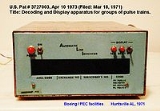
In 1968, Theodore George “Ted” Paraskevakos, while working in Athens
Athens
Athens , is the capital and largest city of Greece. Athens dominates the Attica region and is one of the world's oldest cities, as its recorded history spans around 3,400 years. Classical Athens was a powerful city-state...

, Greece
Greece
Greece , officially the Hellenic Republic , and historically Hellas or the Republic of Greece in English, is a country in southeastern Europe....

 as a communications engineer for SITA
SITA
SITA is a multinational information technology company specialising in providing IT and telecommunication services to the air transport industry...

, began developing a system to automatically identify a telephone caller to a call recipient. After several attempts and experiments, he developed the method in which the caller's number is transmitted to the called receiver's device. This method was the basis for modern-day Caller ID technology.

From 1969 through 1975, Paraskevakos was issued 20 separate patents related to automatic telephone line identification; they are listed below.
Country Patent number Issue date Description
Greece 40176 May 28, 1969 Apparatus for the decoding and display of the identification of calling telephone devices in the receiving device
Greece 37541 June 19, 1969 Apparatus for the decoding and display of the identification of calling telephone devices in the receiving device
Greece 37733 June 27, 1969 Method of automatically transferring by electrical pulses the identification of a calling device and automatic display in the receiving device in automatic urban and long distance telephony
Greece 38280 October 16, 1969 Method of automatically transferring by electrical pulses the identification of a calling device and automatic display in the receiving device in automatic urban and long distance telephony
Greece 39092 January 26, 1970 Method of automatically transferring by electrical pulses the identification of a calling device and automatic display in the receiving device in automatic urban and long distance telephony
Greece 42452 September 8, 1970 Apparatus for the decoding and display of the identification of calling telephone devices in the receiving device
France 2.133.267 April 15, 1971 Procédé et appareil pour enregistrer le numéro du poste téléphonique dont un appel provient
Japan 22983/1971 May 17, 1971 Improved apparatus for generating and transmitting digital information
France 2.152.356 September 7, 1971 Pulse train generating and selection apparatus
Greece 43263 September 10, 1971 Method of automatically transferring by electrical pulses the identification of a calling device and automatic display in the receiving device in automatic urban and long distance telephony
Greece 43999 February 10, 1972 Apparatus and method for automatically displaying the identification of a calling device in the receiving device
South Africa 71/3894 May 3, 1972 Improved apparatus for generating and transmitting digital information
Italy 935035 December 1, 1972 Apparato perfezionato per generare e trasmettere informazioni numeriche
United States 3,727,003 April 10, 1973 Decoding and display apparatus for Groups of Pulse Trains
Canada 938363 December 11, 1973 Decoding and display apparatus
France 7132207 January 4, 1974 Appareil perfectionné de production et de transmission ď information numérique
United States 3,812,296 May 21, 1974 Apparatus for generating and transmitting digital information
Great Britain 1362411 December 4, 1974 Apparatus for decoding and display of digital information
Great Britain 1362412 December 4, 1974 Pulse Train generating and selection apparatus
Australia 458,841 July 24, 1975 Telephone system


Since Paraskevakos' patents significantly predated all other similar patents, they appear as prior art
Prior art
Prior art , in most systems of patent law, constitutes all information that has been made available to the public in any form before a given date that might be relevant to a patent's claims of originality...

 in later U.S. Patents issued to Kazuo Hashimoto
Kazuo Hashimoto
was a Japanese inventor who registered over 1,000 patents throughout the world, including patents for Caller-ID system and telephone answering machine. He patented his first telephone answering machine, the Ansa Fone, in Japan in 1954, followed by the United States in 1960. He patented Caller-ID in...

 and Carolyn A. Doughty.
In 1971, Paraskevakos, working with Boeing
Boeing
The Boeing Company is an American multinational aerospace and defense corporation, founded in 1916 by William E. Boeing in Seattle, Washington. Boeing has expanded over the years, merging with McDonnell Douglas in 1997. Boeing Corporate headquarters has been in Chicago, Illinois since 2001...

 in Huntsville, Alabama
Huntsville, Alabama
Huntsville is a city located primarily in Madison County in the central part of the far northern region of the U.S. state of Alabama. Huntsville is the county seat of Madison County. The city extends west into neighboring Limestone County. Huntsville's population was 180,105 as of the 2010 Census....

, constructed and reduced to practice a transmitter and receiver, representing the world's first prototypes of caller identification devices. They were installed at Peoples' Telephone Company in Leesburg, Alabama and were demonstrated to several telephone companies with great success. These original and historic working models are still in the possession of Paraskevakos.

In the patents related to these devices, Paraskevakos also proposed to send alphanumeric
Alphanumeric
Alphanumeric is a combination of alphabetic and numeric characters, and is used to describe the collection of Latin letters and Arabic digits or a text constructed from this collection. There are either 36 or 62 alphanumeric characters. The alphanumeric character set consists of the numbers 0 to...

 information to the receiving apparatus, such as the caller's name, and also to make feasible banking by telephone. He also proposed to identify the calling telephone by special code (e.g., "PF" for public phone, "HO" for home phone, "OF" for office phone, "PL" for police).

In May 1976, Kazuo Hashimoto
Kazuo Hashimoto
was a Japanese inventor who registered over 1,000 patents throughout the world, including patents for Caller-ID system and telephone answering machine. He patented his first telephone answering machine, the Ansa Fone, in Japan in 1954, followed by the United States in 1960. He patented Caller-ID in...

, a prolific Japanese inventor with over 1000 patents worldwide, first built a prototype of a caller ID display device that could receive caller ID information. His work on caller ID devices and early prototypes was received in the Smithsonian Institution
Smithsonian Institution
The Smithsonian Institution is an educational and research institute and associated museum complex, administered and funded by the government of the United States and by funds from its endowment, contributions, and profits from its retail operations, concessions, licensing activities, and magazines...

, National Museum of American History
National Museum of American History
The National Museum of American History: Kenneth E. Behring Center collects, preserves and displays the heritage of the United States in the areas of social, political, cultural, scientific and military history. Among the items on display are the original Star-Spangled Banner and Archie Bunker's...

 in 2000. U.S. patent 4,242,539, filed originally on May 8, 1976, and a resulting patent re-examined at the patent office by AT&T, was successfully licensed to most of the major telecommunications and computer companies in the world.

Initially, the operating telephone companies wanted to have the caller ID function performed by the central office as a voice announcement and charged on a per-call basis. John Harris, an employee of Northern Telecom's telephone set manufacturing division in London
London, Ontario
London is a city in Southwestern Ontario, Canada, situated along the Quebec City – Windsor Corridor. The city has a population of 352,395, and the metropolitan area has a population of 457,720, according to the 2006 Canadian census; the metro population in 2009 was estimated at 489,274. The city...

, Ontario
Ontario
Ontario is a province of Canada, located in east-central Canada. It is Canada's most populous province and second largest in total area. It is home to the nation's most populous city, Toronto, and the nation's capital, Ottawa....

 promoted the idea of having caller ID as a telephone set display. The telephone was coded ECCS for Enhanced Custom Calling Services. A video of his prototype
Prototype
A prototype is an early sample or model built to test a concept or process or to act as a thing to be replicated or learned from.The word prototype derives from the Greek πρωτότυπον , "primitive form", neutral of πρωτότυπος , "original, primitive", from πρῶτος , "first" and τύπος ,...

 was used to leverage the feature from the central office to the telephone set.

Early in 1977 Nélio Nicolai, a Brazilian inventor, created a machine capable of identifying and displaying the caller ID, he named it BINA (B identifies number of A or Binary Identifies Number Address). He patented the invention, but lack of support from the Brazilian patent-issuer authority INPI made him pursue the judicial system to effectively collect the royalties from his invention (the lawsuit is still running). He received many proposals to drop his wish for a full patent recognition, but did not accept any. The first commercially available BINAs appeared in 1982 in the Brazilian capital, Brasília
Brasília
Brasília is the capital city of Brazil. The name is commonly spelled Brasilia in English. The city and its District are located in the Central-West region of the country, along a plateau known as Planalto Central. It has a population of about 2,557,000 as of the 2008 IBGE estimate, making it the...

. In 1996, Nélio received the WIPO (World Intellectual Property Organization) award for his invention. There is an ongoing debate on how Bell Canada
Bell Canada
Bell Canada is a major Canadian telecommunications company. Including its subsidiaries such as Bell Aliant, Northwestel, Télébec, and NorthernTel, it is the incumbent local exchange carrier for telephone and DSL Internet services in most of Canada east of Manitoba and in the northern territories,...

 approached Nélio and its former employer (Telebrasília) in the mid-80s asking for technical papers and prototypes (Nélio travelled to Canada). Experimental use of the system happened at the Canadian city of Peterborough
Peterborough, Ontario
Peterborough is a city on the Otonabee River in southern Ontario, Canada, 125 kilometres northeast of Toronto. The population of the City of Peterborough was 74,898 as of the 2006 census, while the census metropolitan area has a population of 121,428 as of a 2009 estimate. It presently ranks...

, Ontario
Ontario
Ontario is a province of Canada, located in east-central Canada. It is Canada's most populous province and second largest in total area. It is home to the nation's most populous city, Toronto, and the nation's capital, Ottawa....

. Talks ceased and surprisingly, in 1986, Bell Canada announced such tests to the general public, with following commercialization starting in 1988. Nélio says that no royalties were ever collected.

The first market trial for Caller ID and other "Custom Local Area Signaling Services" was conducted by BellSouth
BellSouth
BellSouth Corporation is an American telecommunications holding company based in Atlanta, Georgia. BellSouth was one of the seven original Regional Bell Operating Companies after the U.S...

 as one of the "TouchStar" services on July 7, 1984 in Orlando, Florida
Orlando, Florida
Orlando is a city in the central region of the U.S. state of Florida. It is the county seat of Orange County, and the center of the Greater Orlando metropolitan area. According to the 2010 US Census, the city had a population of 238,300, making Orlando the 79th largest city in the United States...

. The Lines of Business (marketing) department in BellSouth Services named the service "Caller ID". The other Regional Bell Operating Companies later adopted the name and eventually became the generally accepted name in the US. Planning for the trial was initiated by a team in Bell Laboratories, AT&T
AT&T
AT&T Inc. is an American multinational telecommunications corporation headquartered in Whitacre Tower, Dallas, Texas, United States. It is the largest provider of mobile telephony and fixed telephony in the United States, and is also a provider of broadband and subscription television services...

, and Western Electric
Western Electric
Western Electric Company was an American electrical engineering company, the manufacturing arm of AT&T from 1881 to 1995. It was the scene of a number of technological innovations and also some seminal developments in industrial management...

 before the Bell System divestiture
Bell System divestiture
The Bell System divestiture, or the breakup of AT&T, was initiated by the filing in 1974 by the U.S. Department of Justice of an antitrust lawsuit against AT&T. The case, United States v...

, with the participation of Southern Bell. The purpose of these trials was to assess the revenue potential of services that depend on deployment of the common channel signaling network needed to transmit the calling number between originating and terminating central offices. Trial results were analyzed by Bellcore members of the original team.

In 1987, Bell Atlantic (now Verizon Communications
Verizon Communications
Verizon Communications Inc. is a global broadband and telecommunications company and a component of the Dow Jones Industrial Average...

) conducted another market trial in Hudson County
Hudson County, New Jersey
Hudson County is the smallest county in New Jersey and one of the most densely populated in United States. It takes its name from the Hudson River, which creates part of its eastern border. Part of the New York metropolitan area, its county seat and largest city is Jersey City.- Municipalities...

, New Jersey
New Jersey
New Jersey is a state in the Northeastern and Middle Atlantic regions of the United States. , its population was 8,791,894. It is bordered on the north and east by the state of New York, on the southeast and south by the Atlantic Ocean, on the west by Pennsylvania and on the southwest by Delaware...

, which was followed by limited deployment. BellSouth was the first company to deploy caller ID in December 1988 in Memphis
Memphis, Tennessee
Memphis is a city in the southwestern corner of the U.S. state of Tennessee, and the county seat of Shelby County. The city is located on the 4th Chickasaw Bluff, south of the confluence of the Wolf and Mississippi rivers....

, Tennessee
Tennessee
Tennessee is a U.S. state located in the Southeastern United States. It has a population of 6,346,105, making it the nation's 17th-largest state by population, and covers , making it the 36th-largest by total land area...

, with a full deployment to its nine-state region over the next four years. Bell Atlantic was the second local telephone company to deploy Caller ID in New Jersey's Hudson County. US West Communications (now Qwest
Qwest
Qwest Communications International, Inc. was a large United States telecommunications carrier. Qwest provided local service in 14 western U.S. states: Arizona, Colorado, Idaho, Iowa, Minnesota, Montana, Nebraska, New Mexico, North Dakota, Oregon, South Dakota, Utah, Washington, and Wyoming.On April...

) was the third local telephone company to offer caller ID service in 1989.

Type II Caller ID


In 1995, Bellcore released another type of modulation
Modulation
In electronics and telecommunications, modulation is the process of varying one or more properties of a high-frequency periodic waveform, called the carrier signal, with a modulating signal which typically contains information to be transmitted...

 similar to Bell 202 in which it became possible to transmit caller ID information and even provide call-disposition options while the user was already on the telephone. This service became known in some markets as call waiting ID, or (when it was combined with call-disposition options), Call Waiting Deluxe; it is technically referred to as Analog Display Services Interface
Analog Display Services Interface
Analog Display Services Interface is a telephony technology that is currently used in POTS or computer-based PBX telephone service. It works in conjunction with a screen-based telephone or other compatible CPE to provide the user with softkey access to telephone company or internal PBX custom...

. "Call Waiting Deluxe" is the Bellcore (now Telcordia Technologies
Telcordia Technologies
Telcordia Technologies, formerly Bell Communications Research, Inc. or Bellcore, is a telecommunications research and development company based in the United States created as part of the 1982 Modification of Final Judgment that broke up American Telephone & Telegraph...

) term for Type II caller ID with Disposition Options.

This CLASS-based POTS
Plain old telephone service
Plain old telephone service is the voice-grade telephone service that remains the basic form of residential and small business service connection to the telephone network in many parts of the world....

-telephone calling feature works by combining the services of call waiting
Call waiting
Call waiting , in telephony, is a feature on some telephone networks. If a calling party places a call to a called party which is otherwise engaged, and the called party has the call waiting feature enabled, the called party is able to suspend the current telephone call and switch to the new...

 with caller ID but also introduces an "options" feature that, in conjunction with certain screen-based telephones, or other capable equipment, gives a telephone user the option to
  • Switch: Place the current call on hold to take the second call (not a new feature)
  • Hang-up: Disconnect the current call and take the second call
  • Please Hold: Send the caller either a custom or telephone-company-generated voice message asking the caller to hold
  • Forward to Voice Mail: Send the incoming caller to the recipient’s voice mail service.
  • Join: Add the incoming caller to the existing conversation.

Operation


In the United States, caller ID information is sent to the called party
Called party
The called party is a person who answers a telephone call. The person who initiates a telephone call is the calling party....

 by the telephone switch as an analogue data stream (similar to data passed between two modem
Modem
A modem is a device that modulates an analog carrier signal to encode digital information, and also demodulates such a carrier signal to decode the transmitted information. The goal is to produce a signal that can be transmitted easily and decoded to reproduce the original digital data...

s), using Bell 202 modulation between the first and second rings, while the telephone
Telephone
The telephone , colloquially referred to as a phone, is a telecommunications device that transmits and receives sounds, usually the human voice. Telephones are a point-to-point communication system whose most basic function is to allow two people separated by large distances to talk to each other...

 unit is still on hook. If the telephone call is answered too quickly after the first ring, caller ID information will not be transmitted to the recipient. There are two types of caller ID, number only and name+number. Number-only caller ID is called Single Data Message Format (SDMF), which provides the caller's telephone number, the date and time of the call. Name+number caller ID is called Multiple Data Message Format (MDMF), which in addition to the information provided by SDMF format, can also provide the directory listed name for the particular number. Caller ID readers which are compatible with MDMF can also read the simpler SDMF format, but an SDMF caller ID reader will not recognize an MDMF data stream, and will act as if there is no caller ID information present, e.g. as if the line is not equipped for caller ID.

Instead of sending the caller ID in between the first and second ring, some systems use a "line reversal" to announce the caller ID, or caller ID signals are simply sent without any announcement. Instead of Bell 202, the European alternative V.23 is sometimes used, (without the 75-baud reverse channel) or the data is sent using DTMF signalling.

In general, CID as transmitted from the origin of the call is only the calling party's 10-digit phone number. The calling party name is added by the consumer's terminating central office if the consumer has subscribed to that service. Calling name delivery is not automatic. An SS7 (or Signalling System 7
Signalling System 7
Signalling System No. 7 is a set of telephony signaling protocols which are used to set up most of the world's public switched telephone network telephone calls. The main purpose is to set up and tear down telephone calls...

) TCAP query may be launched by the called party's central office to retrieve the information for Calling Name delivery to the caller ID equipment at the consumer's location if the caller's name has not already been associated with the calling party's line at the originating central office. Canadian systems using CCS7 automatically (but not in all cases) send the calling name with the call set-up and routing information at the time of the call.

To look up the name associated with a phone number, the carrier in some instances has to access that information from a third-party database and some database providers charge a small fee for each access to such databases. To avoid such charges, some carriers will report the name as "unavailable", or will report the name as "(city), (state)" based on the phone number, particularly for wireless callers. For 800 numbers, they may report a string such as TOLLFREE NUMBER if the name is not available in a database.

Telemarketing


Telemarketing organizations often spoof caller ID. In some instances, this is done to provide a "central number" for consumers to call back, such as an 800 number, rather than having consumers call back the outbound call center where the call actually originated. However, some telemarketers block or fraudulently spoof caller ID to prevent being traced
Call tracing
In telecommunication, call tracing is a procedure that permits an entitled user to be informed about the routing of data for an established connection, identifying the entire route from the origin to the destination....

. It is against United States federal law for telemarketers to block or to send false caller ID. Individuals can bring civil suits and the Federal Communications Commission
Federal Communications Commission
The Federal Communications Commission is an independent agency of the United States government, created, Congressional statute , and with the majority of its commissioners appointed by the current President. The FCC works towards six goals in the areas of broadband, competition, the spectrum, the...

 (FCC) can fine companies or individuals that are illegally spoofing or blocking their caller ID.

Some telemarketers have used caller ID itself for marketing, such as by using an 800 number and the text string "FREE MONEY" or "FREE PLANE TICKETS" as the name to be displayed on the caller ID.

ISPs


Some Internet service provider
Internet service provider
An Internet service provider is a company that provides access to the Internet. Access ISPs directly connect customers to the Internet using copper wires, wireless or fiber-optic connections. Hosting ISPs lease server space for smaller businesses and host other people servers...

s (ISPs) providing dial-up access require the customer to use CNID to prevent abuse of the account by unauthorized callers. Some systems with dial-up access can be programmed only to accept calls with specific caller ID strings.

Mobile providers


Most mobile phone providers used the caller ID to automatically connect to voice mail when a call to the voice mail number was made from the associated mobile phone number, bypassing the need to enter a password. While this was convenient for many users, because of spoofing, this practice has been replaced by more secure authentication by many carriers.

Problems


Caller identification between countries is often not transmitted, instead with the display indicating "UNAVAILABLE" or "INTERNATIONAL", but it is becoming more widely available including the country calling code. This is usually the case with mobile phones and international roaming
Roaming
In wireless telecommunications, roaming is a general term referring to the extension of connectivity service in a location that is different from the home location where the service was registered. Roaming ensures that the wireless device is kept connected to the network, without losing the...

. However, the overseas number may be compressed into a "domestic" format and thus possibly not be recognizable: e.g. a US number 1 646 555 1212 may be displayed in the UK as 0646 555 1212, instead of 001 646 555 1212 (or as +1 646 555 1212, where the "+" represents the access code to dial international numbers).

Some callers have situations in which revealing the number being called from would invade their privacy or cause other severe problems. Calls from women's shelter
Women's shelter
A women's shelter is a place of temporary refuge and support for women escaping violent or abusive situations, such as rape, and domestic violence....

s often have outgoing caller ID blocked.

Caller ID may not give the caller's information if the caller is using a discount or travel calling program or a voice over IP
Voice over IP
Voice over Internet Protocol is a family of technologies, methodologies, communication protocols, and transmission techniques for the delivery of voice communications and multimedia sessions over Internet Protocol networks, such as the Internet...

 phone, because those systems use intermediate telephone numbers in the country being called.

Some long distance telephone card
Telephone card
A telephone card, calling card or phone card for short, is a small plastic card, sized and shaped like a credit card, used to pay for telephone services. It is not necessary to have the physical card except with a stored-value system; knowledge of the access telephone number to dial and the PIN is...

s, especially those using VOIP to carry calls, mask caller ID information. These calls are commonly displayed as "Out of Area".

Regional differences


Different countries often use different standards for transmitting caller ID. As a result, phones purchased in one country may not be compatible with the caller ID standard use when the phone is used in a different country. For example, US uses Bellcore FSK whereas Taiwan uses ETSI FSK so a phone purchased in the US will not understand Taiwan's caller ID standard. There are even cases where individual state/provinces will use different protocols within a country. There do exist, however, caller ID converters that will translate from one standard to another.
Below is a list of countries and the caller ID standard used:
Country Caller ID standard
United States Bellcore FSK
Canada Bellcore FSK
China Bellcore FSK
Hong Kong Bellcore FSK
Ireland ETSI FSK V23 (ETS 300 659-1) Ring Pulse Alert Signalling. Data sent after first short ring.
Taiwan DTMF / ETSI FSK
United Kingdom SIN227 (V23 FSK before first ring)
Japan V23 FSK
Spain ETSI FSK
Brazil Bellcore FSK (GVT) / V23 FSK / DTMF

UK


Telephone equipment usually displays CLID information with no difficulty. Modems are notoriously problematical; very few modems support the British Telecom standard in hardware; drivers for those that do often have errors
Software bug
A software bug is the common term used to describe an error, flaw, mistake, failure, or fault in a computer program or system that produces an incorrect or unexpected result, or causes it to behave in unintended ways. Most bugs arise from mistakes and errors made by people in either a program's...

 that prevent CLID information from being recognised. Other UK telephone companies use slight variations on the Bellcore standard, and CLID support is "hit and miss".

United States


In the United States, telemarketers are required to transmit caller ID. This requirement went into effect on January 29, 2004. Courts have ruled that caller ID is admissible. Providers are required by FCC rules to offer "per-call" blocking of caller ID to their customers. Legislation in the United States in would make it illegal to "spoof" caller ID for fraudulent purposes. See Caller ID Spoofing
Caller ID spoofing
Caller ID spoofing is the practice of causing the telephone network to display a number on the recipient's Caller ID display that is not that of the actual originating station. The term is commonly used to describe situations in which the motivation is considered malicious by the speaker or writer...


Blocking


Blocking is the common term for preventing the display of a calling number.

Telecommunications regulators vary in their requirements for the use and effectiveness of assorted technologies to prevent numbers from being displayed. Generally, unlisted numbers are always blocked. Non-published and regular listed numbers are not usually blocked. But there is varying treatment for the determination of call display blocking because of many factors. If desired, customers should inquire carefully to make sure their number will not be displayed.

In some locations in the United States, regulators allow (or require) blocking to be automatic, transparent to the caller.

Where blocking is applied on a call-by-call basis (at the time a call is made), subscribers can block—prevent their numbers from being displayed—by dialing a special code before making a call. In North America and some other regions, the code is *67, while the United Kingdom
United Kingdom
The United Kingdom of Great Britain and Northern IrelandIn the United Kingdom and Dependencies, other languages have been officially recognised as legitimate autochthonous languages under the European Charter for Regional or Minority Languages...

 and Ireland
Ireland
Ireland is an island to the northwest of continental Europe. It is the third-largest island in Europe and the twentieth-largest island on Earth...

 use 141. This special code does not block the information from companies using call capture
Call capture
Call capture is a term used to describe a telephone based technology that captures personal data from persons who call a properly provisioned number. After the call is placed, the system notifies a client of the name, phone number and address of the person calling...

 technology. This means that equipment with caller ID will simply display the word "PRIVATE" or "WITHHELD". When CNID is blocked at the caller's request, the number is actually transmitted through the entire telephone network, with the "presentation withheld" flag set; the destination CO is expected to honor this flag, but sometimes does not—especially when the destination phone number is served by an ISDN primary rate interface
Primary rate interface
The Primary Rate Interface is a standardized telecommunications service level within the Integrated Services Digital Network specification for carrying multiple DS0 voice and data transmissions between a network and a user....

.

Alternatively, in cases where caller ID is being blocked automatically, it can only be released on a call-by-call basis by dialing a special code (*82 in North America; 1470 in the UK). See "Enabling", below.

Similarly, some countries offer anonymous
Anonymity
Anonymity is derived from the Greek word ἀνωνυμία, anonymia, meaning "without a name" or "namelessness". In colloquial use, anonymity typically refers to the state of an individual's personal identity, or personally identifiable information, being publicly unknown.There are many reasons why a...

 caller rejection
, which rejects all calls when the subscriber's number is blocked. Some telephone companies
Telephone company
A telephone company is a service provider of telecommunications services such as telephony and data communications access. Many were at one time nationalized or state-regulated monopolies...

 protect their clients from receiving blocked information by routing anonymous calls to a service, where the caller is required to announce him or herself. The service then asks the called party if they want to accept or reject the call. Blocking the number is referred to as Calling Line Identification Restriction (CLIR). Emergency service
Emergency service
Emergency services are organizations which ensure public safety and health by addressing different emergencies. Some agencies exist solely for addressing certain types of emergencies whilst others deal with ad hoc emergencies as part of their normal responsibilities...

s will most likely be able to show the restricted number using a service called Calling Line Identification Restriction Override (CLIRO), or by using general ANI services.

These features create a cat-and-mouse game type of situation where subscribers must purchase additional services to cancel out other services.

Trapping


Adding to the cat-and-mouse game of Caller ID is the fact that even if you block your number, it can still be trapped as it is still sent through the telephone company network. In the U.S. the FCC requires the number to be transmitted to toll-free numbers regardless of whether the number is blocked. Taking advantage of another telephone company feature, call forwarding, some telephone customers have call forwarded their local phone numbers to a toll-free number. When the local number is called by a customer who is blocking their caller ID, the local number is forwarded to a toll-free number, where the number of the calling party is passed on to and the owner of the local number can receive the information. Taking advantage of this, services have popped up such as the popular TrapCall for US based cellphone users. TrapCall works by conditionally forwarding only your unanswered and rejected calls to the service. When a customer rejects an incoming blocked call it is routed to TrapCall, who in turn traps the number and reroutes the call back to the cellphone user with the Caller ID displayed giving the customer the option to answer the call or reject it once more to send it back to TrapCall where the second call will be sent to voicemail. Some questionable Competitive local exchange carrier
Competitive local exchange carrier
A competitive local exchange carrier , in the United States, is a telecommunications provider company competing with other, already established carriers ....

 (CLEC's) ignore the privacy bit altogether on their phone numbers that they offer customers.

Spoofing


Caller ID is a simple string of data that can be read and generated very simply by small computer programs and even some inexpensive devices. Although the caller ID information is transmitted in between the first and second rings, before the phone call is connected, it is possible to mislead the phone company as to the origin of the call, thus defeating caller ID. Although misleading the phone company by generating Automatic Number Identification
Automatic number identification
Automatic number identification is a feature of telephony intelligent network services that permits subscribers to display or capture the billing telephone number of a calling party. In the United States it is part of Inward Wide Area Telephone Service . ANI service was created by AT&T for...

 (ANI) code or by other electronic means is very complex, simpler means do exist. Using services like Vonage
Vonage
Vonage is a publicly held commercial voice over IP network and SIP company that provides telephone service via a broadband connection. The company's name is a play on their motto "Voice-Over-Net-AGE"....

 or Skype
Skype
Skype is a software application that allows users to make voice and video calls and chat over the Internet. Calls to other users within the Skype service are free, while calls to both traditional landline telephones and mobile phones can be made for a fee using a debit-based user account system...

, calling from a pay phone, or using a calling card are easy means to fool Caller ID. Services like Operator One and Rebtel
Rebtel
Rebtel is a Mobile VoIP provider, founded in 2006 in Sweden by Hjalmar Winbladh and Jonas Lindroth. The Rebtel offices are located in Stockholm, Sweden and Luxembourg....

 use Caller ID replacement to get around international call charges for missed calls that are returned by the dialled up party. Since most carriers charge their customers on the basis of caller ID, some VoIP providers use Caller ID replacement to save local plan minutes. In addition ISDN (PRI) based PBX's (in many cases) can send whatever number(s) they wish to be displayed at the called parties end. This may be their main switchboard number, or the dial-able (DID) extension number that placed the outgoing call.

Disabling


Prefixing the following numbers will disable Caller ID on a call-by-call basis:
  • Argentina: *31# (landlines) or *31* (most cell phone companies)
  • Australia: 1831 (landlines) or #31# (cell phones)
  • Denmark, Iceland and Switzerland: *31*
  • Germany: On most landlines and mobiles, *31#, however some mobile providers use #31#.
  • Hong Kong: 133
  • Israel: *43
  • Italy: *67# (landlines) or #31# (most cell phone companies)
  • New Zealand: 0197 (Telecom and Vodafone)
  • North America: *67, 1167 (rotary phone)
  • United Kingdom and Ireland: 141
  • South Africa *31* (Telkom)
  • Sweden #31#


Other countries and networks vary, however on GSM mobile networks, callers may dial #31# before the number they wish to call to disable it.

Enabling


Depending on the operator and country, there are a number of prefix codes that can unblock Caller ID.
  • Australia: 1832 (landlines) #32# (cell phones)
  • Denmark and Switzerland: *31*
  • Germany: *31# (Some mobile providers)
  • Ireland: 142 (Landlines)
  • Hong Kong: uses 1357.
  • New Zealand: 0196 (Telecom)
  • North America: *82 (*UB, Unblock).
  • United Kingdom: 1470.


On GSM mobile networks, callers may dial *31# before the number they wish to call to enable caller ID.

External links