
Byzantine medicine is the medicine practiced in the
Byzantine EmpireThe Byzantine Empire was the Eastern Roman Empire during the periods of Late Antiquity and the Middle Ages, centred on the capital of Constantinople. Known simply as the Roman Empire or Romania to its inhabitants and neighbours, the Empire was the direct continuation of the Ancient Roman State...
from about 400 AD to 1453 AD. Medicine was one of the sciences in which the Byzantines improved on their Greco-Roman predecessors. As a result, Byzantine Medicine had a significant influence on
Islamic medicineIn the history of medicine, Islamic medicine, Arabic medicine or Arabian medicine refers to medicine developed in the Islamic Golden Age, and written in Arabic, the lingua franca of Islamic civilization....
and the Western rebirth of Medicine during the Renaissance.
Byzantine physicians often compiled and standardized medical knowledge into textbooks. These books tended to be elaborately decorated with many fine illustrations, highlighting the particular ailment. The
Medical Compendium in Seven BooksThe Medical Compendium in Seven Books or Epitomes iatrikes biblio hepta was a medical treatise of seven books written by Paul of Aegina in the 7th century CE.-Summary:...
, written by the leading physician
Paul of AeginaPaul of Aegina or Paulus Aegineta was a 7th-century Byzantine Greek physician best known for writing the medical encyclopedia Medical Compendium in Seven Books...
, is of particular importance. The compendium was written in the late seventh century and remained in use as a standard textbook for 800 years.
Late antiquity witnessed a revolution in the medical scene and many sources mention
hospitalA hospital is a health care institution providing patient treatment by specialized staff and equipment. Hospitals often, but not always, provide for inpatient care or longer-term patient stays....
s in passing (although their own history in the Military sense can be drawn back to Imperial Rome and beyond).
ConstantinopleConstantinople was the capital of the Roman, Eastern Roman, Byzantine, Latin, and Ottoman Empires. Throughout most of the Middle Ages, Constantinople was Europe's largest and wealthiest city.-Names:...
doubtless was the center of such activities in the Middle Ages, owing to its geographical position, wealth and accumulated knowledge.
Background
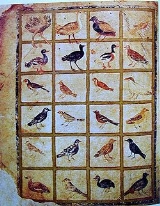
Arguably the first Byzantine Physician was the author of the
Vienna DioscuridesThe Vienna Dioscurides or Vienna Dioscorides is an early 6th century illuminated manuscript of De Materia Medica by Dioscorides in Greek. It is an important and rare example of a late antique scientific text...
manuscript, created for the daughter of Emperor
OlybriusAnicius Olybrius was Western Roman Emperor from April or May 472 to his death. He was in reality a puppet ruler, put on the throne by the Roman general of Germanic descent Ricimer, and was mainly interested in religion, while the actual power was held by Ricimer and his nephew Gundobad.-Family and...
around 515. Like most Byzantine physicians, he drew his material from ancient authorities such as
GalenAelius Galenus or Claudius Galenus , better known as Galen of Pergamon , was a prominent Roman physician, surgeon and philosopher...
and
HippocratesHippocrates of Cos or Hippokrates of Kos was an ancient Greek physician of the Age of Pericles , and is considered one of the most outstanding figures in the history of medicine...
, though this is not to say that Byzantine Physicians did not make corrections to the 'fathers of Medicine' or make original contributions.
OribasiusOribasius or Oreibasius was a Greek medical writer and the personal physician of the Roman emperor Julian the Apostate. He studied at Alexandria under physician Zeno of Cyprus before joining Julian's retinue. He was involved in Julian's coronation in 361, and remained with the emperor until...
, perhaps the greatest Byzantine compiler of medical knowledge, frequently made revisions noting where older methods had been incorrect. Several of his works, along with many other Byzantine physicians, were translated into Latin, and eventually, during the
EnlightenmentThe Age of Enlightenment was an elite cultural movement of intellectuals in 18th century Europe that sought to mobilize the power of reason in order to reform society and advance knowledge. It promoted intellectual interchange and opposed intolerance and abuses in church and state...
and
Age of ReasonAge of reason may refer to:* 17th-century philosophy, as a successor of the Renaissance and a predecessor to the Age of Enlightenment* Age of Enlightenment in its long form of 1600-1800* The Age of Reason, a book by Thomas Paine...
, into English and French.
Another Byzantine treatise, that of the thirteenth century
Nicholas MyrepsosNicholas Myrepsos was a Byzantine physician known chiefly for his compendium on medical science which is still extant.-Life:...
, remained the principal pharmaceutical code of the Parisian medical faculty until 1651, while the Byzantine tract of
Demetrios PepagomenosDemetrios Pepagomenos or Demetrius Pepagomenus was a Byzantine Greek savant who resided in Constantinople. He became a physician, a veterinary, and a naturalist.-Court physician:...
(thirteenth century) on
goutGout is a medical condition usually characterized by recurrent attacks of acute inflammatory arthritis—a red, tender, hot, swollen joint. The metatarsal-phalangeal joint at the base of the big toe is the most commonly affected . However, it may also present as tophi, kidney stones, or urate...
was translated and published in Latin by the great post-Byzantine humanist, Marcus Musurus, in Venice in 1517. Therefore it could be argued that previous misrepresentations about
ByzantiumByzantium was an ancient Greek city, founded by Greek colonists from Megara in 667 BC and named after their king Byzas . The name Byzantium is a Latinization of the original name Byzantion...
being simply a 'carrier' of Ancient Medical knowledge to the
RenaissanceThe Renaissance was a cultural movement that spanned roughly the 14th to the 17th century, beginning in Italy in the Late Middle Ages and later spreading to the rest of Europe. The term is also used more loosely to refer to the historical era, but since the changes of the Renaissance were not...
are completely factually wrong. It is already known for example that a late twelfth century Latin physician at Salerno (
Roger of SalernoRoger of Salerno was regent of the Principality of Antioch from 1112 to 1119.He was the son of Richard of the Principate and the 2nd cousin of Tancred, Prince of Galilee, both participants on the First Crusade. He became regent of Antioch when Tancred died in 1112; the actual prince, Bohemund II,...
), was influenced by the treatises of the Byzantine doctors
AetiusAetius or Aëtius may refer to:* Aetius , 1st- or 2nd-century doxographer and Eclectic philosopher* Aëtius of Antioch, 4th-century Anomean theologian, called "Aetius the Atheist" by his Trinitarian enemies...
and
Alexander of TrallesAlexander of Tralles in Lydia was one of the most eminent of the ancient physicians. His date may safely be put in the 6th century, for he mentions Aëtius Amidenus, who probably did not write until the end of the 5th or the beginning of the 6th century, and he is himself quoted by Paul of...
as well as
Paul of AeginaPaul of Aegina or Paulus Aegineta was a 7th-century Byzantine Greek physician best known for writing the medical encyclopedia Medical Compendium in Seven Books...
.
The last great Byzantine physician was John Actuarius, who lived in the early 14th Century in Constantinople. His works on
UrineUrine is a typically sterile liquid by-product of the body that is secreted by the kidneys through a process called urination and excreted through the urethra. Cellular metabolism generates numerous by-products, many rich in nitrogen, that require elimination from the bloodstream...
laid much of the foundation for later study in that field. However, from the latter 12th Century to the end in 1453, there is very little outpouring in medical knowledge, largely due to the turmoil the Empire was facing on both fronts, following its resurrection after the
Latin EmpireThe Latin Empire or Latin Empire of Constantinople is the name given by historians to the feudal Crusader state founded by the leaders of the Fourth Crusade on lands captured from the Byzantine Empire. It was established after the capture of Constantinople in 1204 and lasted until 1261...
and the dwindling population of Constantinople due to plague and war. Nevertheless, Byzantine medicine is extremely important both in terms of new discoveries made in that period (at a time when Western Europe was in turmoil), the careful protecting of Ancient Greek and Roman knowledge through compendiums as well as the revision of it and finally, the effect it had in transferring knowledge to both Renaissance Italy and Arabia.
Hospitals
An important contribution of Byzantium is that, arguably, it was the first Empire in which dedicated medical establishments—usually set up by individual Churches or the State—which parallel modern
hospitalA hospital is a health care institution providing patient treatment by specialized staff and equipment. Hospitals often, but not always, provide for inpatient care or longer-term patient stays....
s in many ways, flourished. Although similar establishments existed in Ancient Greece and Rome, they differed in that they were usually either institutions for Military use, or places were citizens went to die in a more peaceful way. Medical Institutions of this sort were common in Imperial Cities such as
ConstantinopleConstantinople was the capital of the Roman, Eastern Roman, Byzantine, Latin, and Ottoman Empires. Throughout most of the Middle Ages, Constantinople was Europe's largest and wealthiest city.-Names:...
and later Thessaloniki.
The first hospital was built by Basil of Caesarea in the late fourth century, and although these Institutions flourished, it was only throughout the 8th and 9th Centuries that they began to appear in Provincial Towns as well as Cities, (although Justinian's subsidization of private physicians to work publicly for six months of the year can be seen as the real breakthrough point). Byzantine Medicine was entirely based around Hospitals or walk-in dispensaries which formed part of the Hospital complex, there was a dedicated hierarchy including the Chief Physician (
archiatroi), professional nurses (
hypourgoi) and the orderlies (
hyperetai).
DoctorsA physician is a health care provider who practices the profession of medicine, which is concerned with promoting, maintaining or restoring human health through the study, diagnosis, and treatment of disease, injury and other physical and mental impairments...
themselves were well trained and most likely attended the University of Constantinople as Medicine had become a truly scholarly subject by the period of Byzantium (despite the prominence of the great physicians of antiquity, its status as a
ScienceScience is a systematic enterprise that builds and organizes knowledge in the form of testable explanations and predictions about the universe...
was greatly improved through its application in formal education (particularly in the University of Constantinople). This rigidity through professionalism (similar to the professionalism exhibited in the Byzantine
Civil ServiceThe term civil service has two distinct meanings:* A branch of governmental service in which individuals are employed on the basis of professional merit as proven by competitive examinations....
) bears many hallmarks of today's modern Hospitals, and comparisons are nearly always made by modern Scholars studying this particular field. Thus, we know that in the twelfth century,
ConstantinopleConstantinople was the capital of the Roman, Eastern Roman, Byzantine, Latin, and Ottoman Empires. Throughout most of the Middle Ages, Constantinople was Europe's largest and wealthiest city.-Names:...
had two well organized hospitals staffed by medical specialists (including women doctors), with special wards for various types of diseases and systematic methods of treatment.
Christianity
Christianity always played a key role in the building and maintaining of hospitals, as it did with most other areas of the Empire. Many hospitals were built and maintained by bishops in their respective prefectures. Hospitals were nearly always built near or around churches, and great importance was laid on the idea of healing through salvation. When medicine failed, doctors would always ask their patients to pray. After the iconoclastic problems had been resolved, this usually involved symbols of saints such as SS
CosmasSaint Cosmas of Maiuma, also called Cosmas Hagiopolites , Cosmas of Jerusalem, or Cosmas the Melodist, or Cosmas the Poet , was a bishop and hymnographer of the Eastern Orthodox Church.-Life:Saint Cosmas was probably born in Damascus, but he was orphaned at a young age...
and Damien, who were killed by
DiocletianDiocletian |latinized]] upon his accession to Diocletian . c. 22 December 244 – 3 December 311), was a Roman Emperor from 284 to 305....
in 303, and were the patron saints of medicine and doctors.
Christianity also played a key role in propagating the idea of charity, medicine was made, according to Oregon State University historian Gary Ferngren,
accessible to all and... simple. This idea, combined with the vast resources Byzantine physicians had at their disposal, was one of the first times in history that a state has actively sought to expend resources on a public healthcare system.
See also
- Paul of Aegina
Paul of Aegina or Paulus Aegineta was a 7th-century Byzantine Greek physician best known for writing the medical encyclopedia Medical Compendium in Seven Books...
- Medical Compendium in Seven Books
The Medical Compendium in Seven Books or Epitomes iatrikes biblio hepta was a medical treatise of seven books written by Paul of Aegina in the 7th century CE.-Summary:...
- Islamic medicine
In the history of medicine, Islamic medicine, Arabic medicine or Arabian medicine refers to medicine developed in the Islamic Golden Age, and written in Arabic, the lingua franca of Islamic civilization....
- Vienna Dioscurides
The Vienna Dioscurides or Vienna Dioscorides is an early 6th century illuminated manuscript of De Materia Medica by Dioscorides in Greek. It is an important and rare example of a late antique scientific text...
- Medieval medicine
Medieval medicine in Western Europe was composed of a mixture of existing ideas from antiquity, spiritual influences and what Claude Lévi-Strauss identifies as the "shamanistic complex" and "social consensus." In this era, there was no tradition of scientific medicine, and observations went...
- History of medicine
All human societies have medical beliefs that provide explanations for birth, death, and disease. Throughout history, illness has been attributed to witchcraft, demons, astral influence, or the will of the gods...
External links