All Topics  
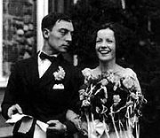
Buster Keaton

 
Buster Keaton

   Email Print
   Bookmark   Link


Buster Keaton


Joseph Frank "Buster" Keaton (October 4, 1895 – February 1, 1966) was an Academy Award-winning American
United States

The United States of America is a Federal government constitutional republic comprising U.S. state and a federal district. The country is situated mostly in central North America, where its Contiguous United States and Washington, D.C., the Capital districts and territories, lie between the Pacific Ocean and Atlantic Oceans, Borders of the U...
 comic actor
Actor

An actor or actress is a person who acting in a dramatic production and who works in film, television, theatre, or radio programming in that capacity....
 and filmmaker. Best known for his silent film
Silent film

A silent film is a film with no synchronized recorded sound, especially spoken dialogue. The idea of combining motion pictures with recorded sound is nearly as old as film itself, but because of the technical challenges involved, synchronized dialogue was only made possible in the late 1920s with the introduction of the Vitaphone system....
s, his trademark was physical comedy with a stoic
Stoicism

Stoicism was a school of Hellenistic philosophy founded in Athens by Zeno of Citium in the early third century B.C. The stoics considered passionate emotions to be the result of errors in judgment, and that a Sage , or person of "moral and intellectual perfection," would not have such emotions....
, deadpan
Deadpan

Deadpan is a form of comedy delivery in which humor is presented without a change in emotion or facial expression, usually voice in a monotonous manner....
 expression on his face, earning him the nickname "The Great Stone Face" (referencing the Nathaniel Hawthorne
Nathaniel Hawthorne

Nathaniel Hawthorne was an American novelist and short story writer.Nathaniel Hathorne was born in 1804 in the city of Salem, Massachusetts to Nathaniel Hathorne and Elizabeth Clarke Manning Hathorne....
 story about the "Old Man of the Mountain
Old Man of the Mountain

The Old Man of the Mountain, also known as the Great Stone Face or the Profile, was a series of five granite cliff ledges on Cannon Mountain in the White Mountains of New Hampshire, United States that, when viewed from the correct angle, appeared to be the jagged profile of a face....
"). He has also been called "The Michelangelo of Silent Comedy". In 1999, the American Film Institute
American Film Institute

The American Film Institute is an independent non-profit organization created by the National Endowment for the Arts, which was established in 1967 when President Lyndon B....
 ranked Keaton the 21st greatest male actor of all time
AFI's 100 Years... 100 Stars

Part of the AFI 100 Years... series, AFI's 100 Years... 100 Stars is a list of the top 50 stars of United States Cinema of the United States. They were presented by 50 stars of today, adding up to the total of 100 stars....
.

Keaton's career as a performer and director is widely considered to be among the most innovative and important work in the history of cinema.


Discussion
Ask a question about 'Buster Keaton'
Start a new discussion about 'Buster Keaton'
Answer questions from other users
Full Discussion Forum


Quotations


We used to get arrested every other week — that is, the old man would get arrested.

On his underage working in stage shows, in The Detroit News (4 December 1914)

If one more person tells me this is just like old times, I swear I'll jump out the window.

As "Calvero's Partner" in Limelight (1952)


Encyclopedia


Joseph Frank "Buster" Keaton (October 4, 1895 – February 1, 1966) was an Academy Award-winning American
United States

The United States of America is a Federal government constitutional republic comprising U.S. state and a federal district. The country is situated mostly in central North America, where its Contiguous United States and Washington, D.C., the Capital districts and territories, lie between the Pacific Ocean and Atlantic Oceans, Borders of the U...
 comic actor
Actor

An actor or actress is a person who acting in a dramatic production and who works in film, television, theatre, or radio programming in that capacity....
 and filmmaker. Best known for his silent film
Silent film

A silent film is a film with no synchronized recorded sound, especially spoken dialogue. The idea of combining motion pictures with recorded sound is nearly as old as film itself, but because of the technical challenges involved, synchronized dialogue was only made possible in the late 1920s with the introduction of the Vitaphone system....
s, his trademark was physical comedy with a stoic
Stoicism

Stoicism was a school of Hellenistic philosophy founded in Athens by Zeno of Citium in the early third century B.C. The stoics considered passionate emotions to be the result of errors in judgment, and that a Sage , or person of "moral and intellectual perfection," would not have such emotions....
, deadpan
Deadpan

Deadpan is a form of comedy delivery in which humor is presented without a change in emotion or facial expression, usually voice in a monotonous manner....
 expression on his face, earning him the nickname "The Great Stone Face" (referencing the Nathaniel Hawthorne
Nathaniel Hawthorne

Nathaniel Hawthorne was an American novelist and short story writer.Nathaniel Hathorne was born in 1804 in the city of Salem, Massachusetts to Nathaniel Hathorne and Elizabeth Clarke Manning Hathorne....
 story about the "Old Man of the Mountain
Old Man of the Mountain

The Old Man of the Mountain, also known as the Great Stone Face or the Profile, was a series of five granite cliff ledges on Cannon Mountain in the White Mountains of New Hampshire, United States that, when viewed from the correct angle, appeared to be the jagged profile of a face....
"). He has also been called "The Michelangelo of Silent Comedy". In 1999, the American Film Institute
American Film Institute

The American Film Institute is an independent non-profit organization created by the National Endowment for the Arts, which was established in 1967 when President Lyndon B....
 ranked Keaton the 21st greatest male actor of all time
AFI's 100 Years... 100 Stars

Part of the AFI 100 Years... series, AFI's 100 Years... 100 Stars is a list of the top 50 stars of United States Cinema of the United States. They were presented by 50 stars of today, adding up to the total of 100 stars....
.

Keaton's career as a performer and director is widely considered to be among the most innovative and important work in the history of cinema. He was recognized as the seventh greatest director of all time by Entertainment Weekly
Entertainment Weekly

Entertainment Weekly is a magazine published by Time Inc. in the United States which covers movies, television, music, Broadway stage productions, books, and popular culture....
.

A 2002 worldwide poll by Sight and Sound ranked Keaton's The General
The General (1927 film)

The General is a silent film comedy released by United Artists based upon the Great Locomotive Chase from 1862. Buster Keaton starred in the film and co-directed it with Clyde Bruckman....
 as the 15th best film of all time
Films that have been considered the greatest ever

While there is no agreement upon the greatest film, many publications and organizations have tried to determine the films considered the greatest ever....
. Three other Keaton films received votes in the survey: Our Hospitality
Our Hospitality

Our Hospitality is a silent comedy directed, produced, written by and starring Buster Keaton. Released in 1923 in film by Metro Pictures Corporation, the movie uses slapstick and situational comedy to tell the story of Willie McKay, a city slicker who gets caught in the middle of the infamous Canfield & McKay feud, an obvious satire of t...
, Sherlock, Jr.
Sherlock, Jr.

Sherlock, Jr. is an United States comedy silent film starring and directed by Buster Keaton and written by Clyde Bruckman, Jean Havez and Joseph A....
, and The Navigator
The Navigator (1924 film)

The Navigator is a 1924 in film comedy directed by and starring Buster Keaton. The film was written by Clyde Bruckman and co-directed by Donald Crisp....
.

Biography


Early life in vaudeville

Buster Keaton was born into a vaudeville
Vaudeville

Vaudeville was a genre of a variety show prevalent on the theatre in the United States and Canada from the early 1880s until the early 1930s. It developed from many sources, including the concert saloon, minstrel show, freak shows, dime museums, and literary burlesque....
 family. His father was Joseph Hallie Keaton, a native of Vigo County, Indiana
Vigo County, Indiana

Vigo County is a county located in the U.S. state of Indiana. As of United States 2000 census, the population was 105,848. The county seat is Terre Haute, Indiana....
. Joe Keaton owned a traveling show with Harry Houdini
Harry Houdini

Harry Houdini was a Jewish Hungarian-American magic and escapologist, stunt performer, actor and film producer, as well as a skeptic and investigator of spiritualists....
 called the Mohawk Indian Medicine Company, which performed on stage and sold patent medicine
Patent medicine

Patent medicine is the somewhat misleading term given to various medical compounds sold under a variety of names and labels, though they were, for the most part, actually medicines with trademarks, not patented medicines....
 on the side. Buster Keaton was born in Piqua, Kansas
Piqua, Kansas

Piqua is an unincorporated area in Woodson County, Kansas, Kansas, United States. The community was built as a railroad community and was named for Piqua, Ohio....
, the small town where his mother, Myra Edith Cutler, happened to be when she went into labor.

According to Keaton, in an interview that he and his wife Eleanor did with the CBC television program Telescope
Telescope (TV series)

Telescope was a Canadian television series which aired on the Canadian Broadcasting Corporation between 1963 and 1973.Telescope was a half-hour documentary film television series, hosted by Fletcher Markle, which profiled notable Canadian people from celebrity to the unknown, who made a difference....
 in 1964, Keaton acquired the nickname "Buster" at about six months of age. Keaton told interviewer Fletcher Markle
Fletcher Markle

Fletcher Markle was a Canada actor, screenwriter, television producer, and Film director....
 that Harry Houdini
Harry Houdini

Harry Houdini was a Jewish Hungarian-American magic and escapologist, stunt performer, actor and film producer, as well as a skeptic and investigator of spiritualists....
 happened to be present one day when the young Keaton took a tumble down a long flight of stairs without injury. After the infant sat up and shook off his experience, Houdini remarked, "That was a real buster!" According to Keaton, in those days, the word buster was used to refer to a spill or a fall that had the potential to produce injury. Thereafter, it was Keaton's father who began to use the nickname to refer to the youngster.

At the age of three, Buster began performing with his parents in The Three Keatons; the act was mainly a comedy sketch. Myra played the saxophone to one side while Joe and Buster performed on center stage. The young Keaton would goad his father by disobeying him, and the elder Keaton would respond by throwing him against the scenery, into the orchestra pit, or even into the audience. A suitcase handle was sewn into Keaton's clothing to aid with the constant tossing. The act evolved as Keaton learned to take trick falls safely; he was rarely injured or bruised on stage. Nevertheless, this knockabout style of comedy led to accusations of child abuse
Child abuse

Child abuse is the physical abuse, psychological abuse or child sexual abuse maltreatment of children. The Centers for Disease Control and Prevention defines child maltreatment as any act or series of acts or commission or omission by a parent or other caregiver that results in harm, potential for harm, or threat of harm to a child....
. Decades later, Keaton said that he was never hurt by his father and that the falls and physical comedy were a matter of proper technical execution. He claimed he was having so much fun that he would begin laughing as his father threw him across the stage. This drew fewer laughs from the audience, so he adopted his famous deadpan expression whenever he was working.

The act ran up against laws banning child performers in vaudeville. It is said that, when one official saw Keaton in full costume and makeup, and asked a stagehand how old he was, the stagehand then pointed to the boy's mother, saying "I don't know, ask his wife!" According to one biographer, Keaton was made to go to school while performing in New York, but only attended for one day. Despite tangles with the law and a disastrous tour of music hall
Music hall

Music hall is a form of British theatrical entertainment which was popular between 1850 and 1960. The term can refer to# A particular form of variety show entertainment involving a mixture of popular song, comedy and #Speciality Acts....
s in the UK, Keaton was such a rising star in the theater that, when his parents tried to introduce their other children into the act, he remained the focus of attention.

Keaton himself stated that he learned to read and write late, and was taught by his mother. By the time he was 21, his father's alcoholism
Alcoholism

Alcoholism is a term with multiple and sometimes conflicting definitions to describe the detrimental effects of alcohol intake.In common and historic usage, alcoholism refers to any condition that results in the continued consumption of alcoholic beverages despite health problems and negative social consequences....
 threatened the reputation of the family act, so Buster and his mother left Joe in Los Angeles. Buster travelled to New York, where his performing career moved from vaudeville to film. Although he did not see active combat, he served in World War I
World War I

World War I, or the First World War , was a global military conflict which involved the Great powers, organized into two opposing military alliances: the Allies of World War I and the Central Powers....
, during which time his hearing became impaired.

Silent film era

In February 1917, Keaton met Roscoe "Fatty" Arbuckle at the Talmadge Studios in New York City, where Arbuckle was under contract to Joseph M. Schenck
Joseph Schenck

Joseph Michael Schenck was a pioneer executive who played a key role in the development of the United States film industry.Born in Rybinsk, Yaroslavl Oblast, Russia to a Jewish household, he and his family-including younger brother Nicholas Schenck- emigrated to New York City in 1893, he and Nicholas eventually got into the entertainment b...
. Joe Keaton disapproved of films, and Buster also had reservations about the medium. During his first meeting with Arbuckle, he asked to borrow one of the cameras to get a feel for how it worked. He took the camera back to his hotel room, dismantled and reassembled it. With this rough understanding of the mechanics of the moving pictures, he returned the next day, camera in hand, asking for work. He was hired as a co-star and gag-man, making his first appearance in The Butcher Boy
The Butcher Boy (1917 film)

The Butcher Boy is a 1917 in film short comedy film starring Fatty Arbuckle and Buster Keaton. This was the first in Arbuckle's series of films with the Comique Film Corporation, and Keaton's film debut....
. Keaton later claimed that he was soon Arbuckle's second director and his entire gag department. Keaton and Arbuckle became close friends.

After Keaton's successful work with Arbuckle, Schenck gave him his own production unit, Buster Keaton Comedies. He made a series of two-reel comedies, including One Week (1920), The Playhouse
The Playhouse (film)

The Playhouse is a 1921 in film film written and directed by and starring Buster Keaton. The movie runs for 22 minutes, and is most famous for its opening sequence in which Keaton plays every role....
 (1921), Cops (1922), and The Electric House
The Electric House

The Electric House is a 1922 in film short subject comedy film directed by and featuring Buster Keaton. The known version today is actually the second version filmed....
 (1922). Based on the success of these shorts, Keaton moved to full-length features.

Keaton's silent films are characterized by clever visual gags and technical trickery. His writers included Clyde Bruckman
Clyde Bruckman

Clyde A. Bruckman , was an United States writer and director of comedy films during the late silent era as well as the early sound era of cinema....
 and Jean Havez, but the most ingenious gags were often conceived by Keaton himself. The more adventurous ideas called for dangerous stunts, also performed by Keaton at great physical risk; during the railroad-water-tank scene in Sherlock Jr., Keaton broke his neck and did not realize it until years afterward. Comedy director Leo McCarey
Leo McCarey

Thomas Leo McCarey was an Academy Awards-winning United States film director, screenwriter and film producer . During his lifetime he was involved in almost 200 movies, especially comedies, where he demonstrated his fine elegance and his great sense of humour....
, recalling the freewheeling days of making slapstick
Slapstick

Slapstick is a type of comedy involving exaggerated extreme physical violence or activities which exceed the boundaries of common sense, such as a character being hit in the face with a heavy frying pan or running into a brick wall....
 comedies, said, "All of us tried to steal each other's gagmen. But we had no luck with Keaton, because he thought up his best gags himself and we couldn't steal him!"

Buster Keaton's most enduring feature-length films include Our Hospitality
Our Hospitality

Our Hospitality is a silent comedy directed, produced, written by and starring Buster Keaton. Released in 1923 in film by Metro Pictures Corporation, the movie uses slapstick and situational comedy to tell the story of Willie McKay, a city slicker who gets caught in the middle of the infamous Canfield & McKay feud, an obvious satire of t...
 (1923), The Navigator
The Navigator (1924 film)

The Navigator is a 1924 in film comedy directed by and starring Buster Keaton. The film was written by Clyde Bruckman and co-directed by Donald Crisp....
 (1924), Sherlock Jr. (1924), Steamboat Bill Jr.
Steamboat Bill Jr.

Steamboat Bill Jr. is a feature-length comedy silent film featuring Buster Keaton. Released by United Artists, the film is the last product of Keaton's independent production team and set of gag writers....
 (1928), The Cameraman
The Cameraman (1928 film)

The Cameraman is an United States 1928 in film silent film comedy directed by Edward Sedgwick and an uncredited Buster Keaton.The picture stars Buster Keaton, Marceline Day, Harold Goodwin, and others....
 (1928), and most notably The General (1927).

The General, set during the American Civil War
American Civil War

The American Civil War , also known as the War Between the States and several Naming the American Civil War, was a civil war in the United States....
, is considered his masterpiece, combining physical comedy with Keaton's love of train
Train

A train is a connected series of vehicles that move along a track to rail transport from one place to another. The track usually consists of two rail tracks, but might also be a monorail or magnetic levitation train guideway....
s. Keaton took his crew on picturesque locations and painstakingly re-enacted an actual wartime incident, complete with epic locomotive chase. This film was Keaton's proudest achievement, but was received poorly at the time. It was too dramatic for moviegoers expecting a lightweight comedy, and reviewers thought it was "fair" and noted it only had a "few laughs." The fact that the heroes of the story were the Confederate army may have also contributed to the film's unpopularity. Later audiences have given more favorable reviews, but in its day it was an expensive misfire, and Keaton was never entrusted with total control over his movies again. His distributor, United Artists
United Artists

United Artists Entertainment LLC is an United States film studio. The current United Artists was formed in November 2006 under a partnership between producer/actor Tom Cruise and his production partner, Paula Wagner, and Metro-Goldwyn-Mayer Studios Inc., an MGM company....
, insisted on a production manager, who monitored expenses and interfered with certain story elements. Keaton endured this treatment for two more feature films, and then exchanged his independent setup for employment at Hollywood's biggest studio, Metro-Goldwyn-Mayer.

Keaton's loss of independence as a filmmaker coincided with the coming of sound films and mounting personal problems, and his career in the early sound era was hurt as a result.

Marriages

Talmadge and Keaton
In 1921, Buster Keaton married Natalie Talmadge
Natalie Talmadge

Natalie Talmadge was an occasional silent film actress who was more well-known as the middle sister of her movie star siblings Norma Talmadge and Constance Talmadge until her marriage to silent film actor and comedian Buster Keaton....
, sister-in-law of his boss, Joseph Schenck, and sister of actresses Norma Talmadge
Norma Talmadge

Norma Talmadge was an United States actress and film producer of the silent film era. A major box office draw for more than a decade, her career reached a peak in the early 1920s, when she ranked among the most popular idols of the American screen....
 and Constance Talmadge
Constance Talmadge

Constance Talmadge was a silent movie star born in Brooklyn, New York, United States, and was the sister of fellow actor Norma Talmadge and Natalie Talmadge....
. During the first three years of the marriage, the couple had two sons, James (1922-2007) and Robert (1924-), but after the birth of Robert, the relationship began to suffer.

According to Keaton in his autobiography, Natalie turned him out of their bedroom and sent detectives to follow him to see whom he was dating behind her back. Her extravagance was another factor in the breakdown of the marriage. During the 1920s, according to his autobiography, he dated actress Kathleen Key
Kathleen Key

Kathleen Key was an United States actress who achieved a brief period of fame during the silent era. She is probably best remembered for playing Tirzah in the 1925 film Ben-Hur ....
. When he ended the affair, Key flew into a rage and tore up his dressing room. After attempts at reconciliation, Natalie bitterly divorced Keaton in 1932, taking his entire fortune and refusing to allow any contact between Keaton and his sons, whose last name she had changed to Talmadge. Keaton was reunited with them about a decade later when his older son turned 18. The failure of his marriage, along with the loss of his independence as a filmmaker, led Keaton into a period of alcoholism.

During the height of his popularity, he spent $300,000 to build a home in Beverly Hills. Later owners of the property were actors James Mason
James Mason

James Neville Mason was a three-time Academy Award-nominated British People actor who attained stardom in both United Kingdom and United States films....
 and Cary Grant
Cary Grant

Archibald Alec Leach , better known by his stage name, Cary Grant, was a British-born American actor. With his distinctive yet not quite placeable accent, he was noted as perhaps the foremost exemplar of the debonair leading man, handsome, virile, charismatic and charming....
. The "Italian Villa," as Keaton called it, can also be seen in the movie The Godfather
The Godfather

The Godfather is an Cinema of the United States crime film film based on the The Godfather by Mario Puzo and directed by Francis Ford Coppola from a screenplay by Puzo, Coppola, and Robert Towne, who was not credited....
, as well as in Keaton's own film Parlor, Bedroom and Bath. Keaton later said, "I took a lot of pratfalls to build that dump." James Mason later discovered numerous cans of rare Keaton films in the house in the 1950s; the films were quickly transferred to safety film before the original silver nitrate
Silver nitrate

Silver nitrate, also known as lunar caustic, is a soluble chemical compound with chemical formula silverNitrogenOxygen3. This compound is a versatile precursor to many other silver compounds, such as those used in photography....
 prints further deteriorated.

Keaton was at one point briefly institutionalized; however, according to the TCM documentary 'So Funny it Hurt,' Keaton managed to escape a straitjacket with tricks learned during his vaudeville days. In 1933 he married his nurse, Mae Scriven, during an alcoholic binge about which he afterwards claimed to remember nothing (Keaton himself later called that period an "alcoholic blackout"). Scriven herself would later claim that she did not even know Keaton's real first name until after the marriage. When they divorced in 1936, it was again at great financial cost to Keaton.

In 1940, Keaton married Eleanor Norris, who was 23 years his junior. She has been credited with saving his life by stopping his heavy drinking, and helped to salvage his career. The marriage lasted until his death. Between 1947 and 1954, they appeared regularly in the Cirque Medrano
Cirque Medrano

The Cirque Medrano is a France circus, that was located at 63 Boulevard Rochechouart, at the corner of rue des Martyrs, on the edge of Montmartre in Paris....
 in Paris
Paris

Paris is the Capital of France and the country's largest city. It is situated on the river Seine, in northern France, at the heart of the ?le-de-France Regions of France ....
 as a double act. She came to know his routines so well that she often participated in them on TV revivals.

Sound era and television

Keaton signed with MGM in 1928, a business decision that he would later call the worst of his life. He realized too late that the studio system
Studio system

The studio system was a means of film production and distribution dominant in Cinema of the United States from the early 1920s through the early 1950s....
 MGM represented would be more restrictive than the freedom he had known, severely limiting his creative input. He would have to adhere to dialogue-laden scripts and (for the first time) would be forced to use a stunt double during some of the more dangerous scenes, as MGM wanted badly to protect its investment. He also stopped directing, but continued to perform and made some of his most financially successful films for the studio. MGM tried teaming the laconic Keaton with the rambunctious Jimmy Durante
Jimmy Durante

James Francis ?Jimmy? Durante was an United States singer, pianist, comedian and actor, whose distinctive gravel delivery, comic language butchery, jazz-influenced songs, and large nose ? his frequent jokes about it included a frequent self-reference that became his nickname: "Schnozzola" ? helped make him one of America's most familiar and...
 in a series of movies including The Passionate Plumber, Speak Easily, and What! No Beer? Although the two comedians never quite meshed as a team, the films proved popular.

In the first Keaton pictures with sound, he and his fellow actors would shoot each scene three times: one in English, one in Spanish, and one in either French or German. This was done before dubbing became commonplace. The actors would phonetically memorize the foreign-language scripts a few lines at time and shoot immediately after. This is discussed in the TCM documentary Buster Keaton: So Funny it Hurt, with Keaton complaining about having to shoot lousy movies not just once, but three times. His stage name in Spanish markets was Pamplinas ("Nonsense"), and his nickname became Cara de palo ("Wooden face"). The French know him as Malec.

Keaton's last starring feature in America was What! No Beer? Behind the scenes, Keaton's world was in chaos, with divorce proceedings contributing to his alcoholism, which in turn caused production delays and unpleasant incidents at the studio. Keaton was so depleted during the filming of What! No Beer? that MGM released him, despite the film being a resounding hit. In 1934 Keaton accepted an offer to make an independent film in Paris, Le Roi des Champs-Élysées. During this period he made one other film in Europe, The Invader (released in America as An Old Spanish Custom in 1936).

Upon his return to Hollywood, he made a screen comeback in a series of 16 two-reel comedies for Educational Pictures
Educational Pictures

Educational Pictures was a film distributor company founded in 1915 by E. W. Hammons . Educational is probably best known today for its series of 1930s comedies starring Buster Keaton....
. Most of these are simple visual comedies, with many of the gags supplied by Keaton himself. The high point in the Educational series is Grand Slam Opera, featuring Buster in his own screenplay as an amateur-hour contestant. When the series lapsed in 1937, Keaton returned to MGM as a gag writer, including the Marx Brothers
Marx Brothers

The Marx Brothers were a popular team of sibling comedians who appeared in vaudeville, stage plays, film, and television....
 films At the Circus
At the Circus

At the Circus is a 1939 in film Marx Brothers comedy film in which they save a Circus from bankruptcy. It is notable for Groucho Marx's classic rendition of "Lydia the Tattooed Lady." and co-stars include Margaret Dumont, Eve Arden, and Kenny Baker ....
 (1939) and Go West
Go West (film)

Go West was the 10th Marx Brothers comedy film, in which the three brothers, Groucho Marx, Chico Marx, and Harpo Marx, head to the American West and attempt to unite a couple by ensuring that an evil railroad baron is thwarted....
 (1940), and for Red Skelton
Red Skelton

Richard Bernard ?Red? Skelton was an United States comedian who was best known as a top old-time radio and television star from 1937 to 1971. Skelton's show business career began in his teens as a circus clown and went on to vaudeville, Broadway theatre, films, radio, TV, night clubs and casinos, while pursuing another career as a painter....
.

In 1939, Columbia Pictures
Columbia Pictures

Columbia Pictures Industries, Inc. is an United States film production company and distribution company. It was one of the so-called studio system among the eight major film studios of Hollywood Cinema of the United States#Golden Age of Hollywood....
 hired Keaton to star in two-reel comedies. The series ran for two years. The director was usually Jules White
Jules White

Jules White born Jules Weiss was a movie director and producer. He is best known for his short-subject comedies starring the Three Stooges....
, whose emphasis on slapstick
Slapstick

Slapstick is a type of comedy involving exaggerated extreme physical violence or activities which exceed the boundaries of common sense, such as a character being hit in the face with a heavy frying pan or running into a brick wall....
 made most of these films resemble White's Three Stooges
Three Stooges

The Three Stooges was an American vaudeville and comedy act of the early to mid?20th century best known for their numerous short subject films....
 comedies. Keaton's personal favorite of the 10 Columbias was directed not by White but by Mack Sennett
Mack Sennett

Mack Sennett was a Canadian -born Academy Award-winning director and was known as the innovator of slapstick comedy in film. During his lifetime he was known at times as the "King of Comedy."...
 veteran Del Lord
Del Lord

Del Lord was a film director and actor best known as a director of Three Stooges films.Lord was born in the small town of Grimsby, Ontario, Canada....
, Pest from the West (1939), a two-reel remake of Keaton's feature The Invader. Moviegoers and exhibitors welcomed Keaton's Columbia comedies, which were successful enough to be re-released again and again through the 1960s.

Keaton's personal life had stabilized with his 1940 marriage, and now he was taking life a little easier, abandoning Columbia for the less strenuous field of feature films. Throughout the 1940s Keaton played character roles in both "A" and "B" features. Critics rediscovered Keaton in 1949 and producers now hired him for bigger pictures. He guest-starred in such films as Sunset Boulevard (1950), Around the World in Eighty Days
Around the World in Eighty Days (1956 film)

Around the World in 80 Days is a 1956 in film adventure film produced by the Michael Todd Company and released by United Artists. It was directed by Michael Anderson ....
 (1956), It's a Mad, Mad, Mad, Mad World
It's a Mad, Mad, Mad, Mad World

It's a Mad, Mad, Mad, Mad World is a 1963 in film American film comedy film directed by Stanley Kramer about the madcap pursuit of $350,000 of stolen cash by a diverse and colorful group of strangers....
 (1963), and A Funny Thing Happened on the Way to the Forum
A Funny Thing Happened on the Way to the Forum (film)

A Funny Thing Happened on the Way to the Forum is a musical comedy film, based on the A Funny Thing Happened on the Way to the Forum with music and lyrics by Stephen Sondheim and a book by Burt Shevelove and Larry Gelbart....
 (1966). He appeared in Charles Chaplin's Limelight (1952), recalling the vaudeville of The Playhouse
The Playhouse (film)

The Playhouse is a 1921 in film film written and directed by and starring Buster Keaton. The movie runs for 22 minutes, and is most famous for its opening sequence in which Keaton plays every role....
. With the exception of Seeing Stars, a minor publicity film produced in 1922, Limelight was the only time in which the two giants of silent comedy would appear together on film.

Keaton had a successful series on Los Angeles television, The Buster Keaton Show (1950). An attempt to recreate the first series on film as Life with Buster Keaton (1951), which allowed it to be broadcast nationwide, was less well received, although veteran actress Marcia Mae Jones
Marcia Mae Jones

Marcia Mae Jones was an United States actress whose prolific career spanned 47 years....
 and gagman Clyde Bruckman
Clyde Bruckman

Clyde A. Bruckman , was an United States writer and director of comedy films during the late silent era as well as the early sound era of cinema....
 made contributions. A theatrical feature film, The Misadventures of Buster Keaton, was fashioned from the series. Keaton said he canceled the filmed series himself because he was unable to create enough fresh material to produce a new show each week.

Keaton also appeared on Ed Wynn
Ed Wynn

Ed Wynn was a popular United States comedian and actor noted for his Perfect Fool comedy character, his pioneering radio show of the 1930s, and his later career as a dramatic actor....
's variety show. At the age of 55, he successfully recreated one of the stunts of his youth, in which he propped one foot onto a table, then swung the second foot up next to it, and held the awkward position in midair for a moment before crashing to the stage floor. I've Got a Secret
I've Got a Secret

I've Got a Secret is a weekly panel game show produced by Mark Goodson and Bill Todman for CBS television. Created by comedy writers Allan Sherman and Howard Merrill, it was a derivative of Goodson-Todman's own panel show What's My Line?....
 host Garry Moore
Garry Moore

Garry Moore was an American entertainer, game show host and comedian best known for his work in television. Born Thomas Garrison Morfit, III, Moore entered show business as a radio personality in the 1940s and was a television host on several game show and variety show programs during the 1950s, 1960s, and 1970s....
 recalled, "I asked (Keaton) how he did all those falls, and he said, 'I'll show you'. He opened his jacket and he was all bruised. So that's how he did it — it hurt — but you had to care enough not to care."

Keaton's silent films saw a revival in the 1950s and 1960s. In 1961 he starred in The Twilight Zone
The Twilight Zone (1959 TV series)

The Twilight Zone is a science fiction anthology series United States television series created by Rod Serling. The original series ran for five seasons on CBS from 1959 to 1964 and remains television syndication to this day....
 episode "Once Upon a Time
Once Upon a Time (The Twilight Zone)

"Once Upon a Time" is an episode of the American television anthology series The Twilight Zone ....
", which included both silent and sound sequences. Keaton played time traveler Mulligan, who traveled from 1890 to 1960, then back, by means of a special helmet. Keaton also found steady work as an actor in TV commercials, including a popular series of silent ads for Simon Pure Beer in which he revisited some of the gags from his silent film days.

In 1960, Keaton returned to MGM for the final time, to participate in one of the numerous adaptations of Mark Twain
Mark Twain

Samuel Langhorne Clemens , better known by the pen name Mark Twain, was an United Statesmerican author and humorist. Twain is most noted for his novels Adventures of Huckleberry Finn, which has since been called the Great American Novel, and The Adventures of Tom Sawyer....
's The Adventures of Huckleberry Finn. Much of the film was shot on location on the Sacramento River
Sacramento River

The Sacramento River is the longest river entirely within the United States state of California. Starting at the confluence of the South Fork and Middle Fork Sacramento River, near Mount Shasta in the Cascade Range, the Sacramento flows south for , through the northern California Central Valley, between the Pacific Coast Range and the Sierr...
, which doubled for the Mississippi River
Mississippi River

The Mississippi River is the longest river in the United States, with a length of from its source in Lake Itasca in Minnesota to its mouth in the Gulf of Mexico....
 in Twain's original book.

In August 1960, Keaton accepted the role of mute King Sextimus The Silent in the national touring company of Once Upon A Mattress
Once Upon a Mattress

Once Upon a Mattress is a musical theater comedy that opened off-Broadway on May 11, 1959, and then moved to Broadway theatre. The play was written as an adaptation of the Hans Christian Andersen fairy tale The Princess and the Pea....
, already a successful Broadway musical. Eleanor Keaton was cast in the chorus, and during rehearsals she fielded questions directed at Buster, creating difficulties in communication. After a few days, Keaton warmed up to the rest of the cast with his "utterly delicious sense of humor", according to Fritzi Burr, who played opposite him as Queen Aggravaine. When the tour landed in Los Angeles, Keaton invited the entire cast and crew to a spaghetti party at his Woodland Hills
Woodland Hills, Los Angeles, California

Woodland Hills is a district in the City of Los Angeles, California, California, United States.It is located in the southwestern area of the San Fernando Valley, northeast of Calabasas, California and west of Tarzana, Los Angeles, California....
 home, and entertained them by singing vaudeville songs.

In 1964, Keaton appeared with Joan Blondell
Joan Blondell

Rose Joan Blondell, known as Joan Blondell, was an Academy Award-nominated American actress. Considered a sexy wisecracking blonde, she was a pre-Production Code staple of Warner Brothers and appeared in more than 100 film and television productions....
 and Joe E. Brown
Joe E. Brown (comedian)

Joseph Evans Brown was an United States actor and comedian. In 1902 at the age of 10, he joined a troupe of circus tumblers known as the Five Marvellous Astons which toured the country on both the circus and vaudeville circuits....
 in the final episode of ABC's circus
Circus

File:Faroe stamp 416 circus.jpgA circus is commonly a traveling company of performers that may include acrobatics, clowns, trained animals, trapeze acts, hoopers, tightrope walkers, juggling, unicyclists and other stunt-oriented artists....
 drama
Drama

Drama is the specific Mode of fiction Mimesis in performance. The term comes from a Ancient Greek word meaning "Action " , which is derived from "to do" ....
, The Greatest Show on Earth
The Greatest Show on Earth (TV series)

The Greatest Show on Earth is a 30-episode dramatic televison series starring Jack Palance about the United States circus, which aired on American Broadcasting Company television from September 17, 1963, to April 28, 1964....
 starring Jack Palance
Jack Palance

Jack Palance was an Academy Award-winning United States cinema of the United States actor. With his rugged facial features, Palance was best known to modern movie audiences as both the characters of Curly and Duke in the two City Slickers movies, but his career spanned half a century of film and television appearances....
.

At seventy, he suggested that for his appearance in the 1965 film Sergeant Deadhead that he run past the end of a firehose into a six-foot-high flip and crash. When director Norman Taurog
Norman Taurog

Norman Rae Taurog was an Academy Award-winning American film director born in Chicago, Illinois.Between 1920 and 1968, Taurog directed over 140 films....
 balked, expressing concerns for Keaton's health, Keaton said, "I won't hurt myself, Norm, I've done it for years!" Keaton also starred in three other movies for American International Pictures (Beach Blanket Bingo
Beach Blanket Bingo

Beach Blanket Bingo is an American International Pictures Beach Party film, released in 1965 and was directed by William Asher. It is the fifth film in the Beach Party film series....
, Pajama Party
Pajama Party (film)

Pajama Party is a beach party film starring Tommy Kirk and Annette Funicello. This is the fourth in a series of seven beach films produced by American International Pictures....
, and How to Stuff a Wild Bikini
How to Stuff a Wild Bikini

How to Stuff a Wild Bikini is a 1965 in film Beach Party film from American International Pictures. The sixth entry in a seven-film series, the movie features Mickey Rooney, Annette Funicello, Dwayne Hickman, Brian Donlevy, and Beverly Adams....
).

Keaton starred in a short film called The Railrodder
The Railrodder

The Railrodder is a 1965 short film comedy film released by the National Film Board of Canada and starring Buster Keaton in one of his final film roles....
 (1965) for the National Film Board of Canada
National Film Board of Canada

The National Film Board of Canada is Canada's public film producer and distributor. An agency of the Government of Canada, the NFB produces and distributes innovative, socially relevant documentary, animation, alternative drama and digital media productions....
. Wearing his traditional porkpie hat, he travelled from one end of Canada
Canada

Canada is a country occupying most of northern North America, extending from the Atlantic Ocean in the east to the Pacific Ocean in the west and northward into the Arctic Ocean....
 to the other on a motorized handcar, performing gags similar to those in films he made 50 years before. The film is also notable for being Keaton's last silent screen performance. The Railrodder was made in tandem with a behind-the-scenes documentary about Keaton's life and times, called Buster Keaton Rides Again — also made for the National Film Board. He played the central role in Samuel Beckett
Samuel Beckett

Samuel Barclay Beckett was an Irish people writer, dramatist and poet. Beckett's work offers a bleak outlook on human culture and both formally and philosophically became increasingly minimalism....
's Film (1965), directed by Alan Schneider
Alan Schneider

'Alan Schneider' was an United States theatre direction and mentor responsible for more than 100 theatre productions. He directed the 1956 American premiere of Waiting for Godot; Edward Albee's Who?s Afraid of Virginia Woolf? and Tiny Alice; Michael Weller's Moonchildren and Loose Ends ; Harold Pinter's The Birthday Part...
. Keaton's last film appearance was in the musical farce A Funny Thing Happened on the Way to the Forum
A Funny Thing Happened on the Way to the Forum (film)

A Funny Thing Happened on the Way to the Forum is a musical comedy film, based on the A Funny Thing Happened on the Way to the Forum with music and lyrics by Stephen Sondheim and a book by Burt Shevelove and Larry Gelbart....
 (1966). He amazed the cast and crew by doing many of his own stunts in the film, although Thames Television said his ill health did force the use of a stunt double for some scenes.

Death

Keaton died of lung cancer
Lung cancer

Lung cancer is a disease of uncontrolled cell growth in tissue of the lung. This growth may lead to metastasis, which is the invasion of adjacent tissue and infiltration beyond the lungs....
 on February 1 1966 in Woodland Hills, California, at the age of 70. He was never told that he was terminally ill
Terminal illness

Terminal illness is a medical terminology popularized in the 20th century to describe an active and malignant disease that cannot be cured or adequately treated and that is reasonably expected to result in the death of the patient....
, thinking that he had bronchitis. Confined to a hospital in his final days, Keaton was restless and paced the room endlessly. In a documentary on his career, his widow Eleanor told Thames Television
Thames Television

Thames Television was a Broadcast license of the United Kingdom ITV television network, covering Greater London and parts of Home counties on weekdays from 30 July 1968 until 31 December 1992....
 that Keaton played cards with friends the night before he died. Eleanor herself died in 1998, also of lung cancer.

Legacy and contribution

Buster Keaton, Charlie Chaplin
Charlie Chaplin

Sir Charles Spencer Chaplin, Jr. Order of the British Empire , better known as Charlie Chaplin, was an Academy Award-winning England comedy film actor and filmmaker....
 and Harold Lloyd
Harold Lloyd

Harold Clayton Lloyd, Sr. was an United States film actor and film producer, most famous for his silent film comedies.Harold Lloyd ranks alongside Charlie Chaplin and Buster Keaton as one of the most popular and influential film comedians of the silent film era....
 are remembered as the great comic innovators of the silent era. Keaton enjoyed Lloyd's films highly and often praised Chaplin.

Keaton has two stars on the Hollywood Walk of Fame
Hollywood Walk of Fame

The Hollywood Walk of Fame is a sidewalk along Hollywood Boulevard and Vine Street in Hollywood, Los Angeles, California, USA, that serves as an entertainment hall of fame....
: 6619 Hollywood Boulevard (for motion pictures); and 6321 Hollywood Boulevard (for television).

A 1957 film biography, The Buster Keaton Story, starred Donald O'Connor
Donald O'Connor

Donald David Dixon Ronald O?Connor was an American dancer, singer, and actor who came to fame in a series of movies in which he co-starred alternately with Gloria Jean, Peggy Ryan, and Francis the Talking Mule....
 as Keaton. The screenplay was vaguely based on his life, but contained many factual errors and merged his three wives into one character. Most of the story centered on his drinking problem, in the producer's attempt to imitate the success of I'll Cry Tomorrow, a sudsy biography about another alcoholic celebrity (Lillian Roth
Lillian Roth

Lillian Roth was an United States singer and actress....
). The 1987 documentary Buster Keaton: A Hard Act to Follow, which won 2 Emmy Award
Emmy Award

The Emmy Award, also known as the 'Emmy', is a television production award, similar in nature to the Peabody Awards but more focused on entertainment, and is considered the television equivalent to the Academy Awards....
s and was directed by Kevin Brownlow
Kevin Brownlow

Kevin Brownlow is a filmmaker, History of film, television documentary-maker, and author. Brownlow is best known for his work documenting the history of the silent era....
 and David Gill
David Gill (film historian)

David Ian Gill was born in Papua New Guinea, the son of Cecil Gill, a missionary doctor. His uncle was the sculptor Eric Gill. The family returned to England in 1933 where Gill attended the Belmont Abbey School, Hereford....
, is considered a much more accurate telling of Keaton’s story.

Buster Keaton's physical comedy is cited by Jackie Chan
Jackie Chan

Jackie Chan, Silver Bauhinia Star, Member of the Order of the British Empire is an actor, Stage combat, film director, film producer, martial artist, screenwriter, entrepreneur, singer and stunt performer from Hong Kong....
 in his autobiography documentary Jackie Chan: My Story as being the primary source of inspiration for his own brand of self-deprecating physical comedy.

Porkpie hats

Keaton designed and fabricated many of his own porkpie hats during his career. In 1964, he told an interviewer that in making the porkpie he started with a good Stetson
Stetson

Stetson hats or Stetsons refers to the brand of hat manufactered by the John B. Stetson Company of St. Joseph, Missouri. The word 'Stetson' is sometimes used as a Genericized trademark term for a cowboy hat....
 hat and cut it down, stiffening the brim with concentrated sugar water. The hats were often destroyed during Keaton's wild movie antics; some were given away as gifts and some were snatched by souvenir hunters. Keaton said he was lucky if he used only six hats in making a film. Keaton estimated that he and his wife Eleanor made thousands of the hats during his career.

Filmography


Further reading


See also

  • Camille Keaton
    Camille Keaton

    Camille Keaton is an United States actress, perhaps best known for her role in the 1978 film I Spit on Your Grave....
  • Harry Keaton
    Harry Keaton

    Harry Keaton was an United States film actor, was also the younger brother of silent film actor Buster Keaton.Harry Keaton was the son of Joe Keaton and Myra Keaton....
  • Joe Keaton
    Joe Keaton

    Joe Keaton was an United States silent film actor and the father of actor Buster Keaton....
  • Myra Keaton
    Myra Keaton

    Myra Keaton was an United States silent film actress and film actress, also was the mother of actor Buster Keaton....
  • Louise Keaton
    Louise Keaton

    Louise Keaton was an United States actress appearing in the silent film industry. She is the sister of Buster Keaton and Harry Keaton....
  • Jackie Chan
    Jackie Chan

    Jackie Chan, Silver Bauhinia Star, Member of the Order of the British Empire is an actor, Stage combat, film director, film producer, martial artist, screenwriter, entrepreneur, singer and stunt performer from Hong Kong....
  • Natalie Talmadge
    Natalie Talmadge

    Natalie Talmadge was an occasional silent film actress who was more well-known as the middle sister of her movie star siblings Norma Talmadge and Constance Talmadge until her marriage to silent film actor and comedian Buster Keaton....
  • List of United States comedy films
    List of United States comedy films

    This is a list of United States comedy films.It is separated into two categories: short films and feature films. Any film over 40 minutes long is considered to be of feature-length ....


External links

  • (includes rare images of BK smiling and laughing)
  • , an online seminar from Columbia University
    Columbia University

    Columbia University in the City of New York , is a private university in the United States and a member of the Ivy League. Columbia's main campus lies in the Morningside Heights, Manhattan neighborhood in the borough of Manhattan, in New York City....
  • at Time
    Time (magazine)

    Time is a weekly United States newsmagazine, similar to Newsweek and U.S. News & World Report. A European edition is published from London....
     online.