
Home      Discussion      Topics      Dictionary      Almanac
Signup       Login
Burke and Wills expedition

Burke and Wills expedition

Discussion
Ask a question about 'Burke and Wills expedition'
Start a new discussion about 'Burke and Wills expedition'
Answer questions from other users
Full Discussion Forum
 
Encyclopedia
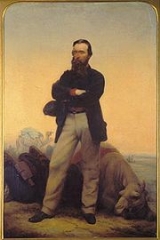
In 1860-61 Robert O'Hara Burke
Robert O'Hara Burke
Robert O'Hara Burke was an Irish soldier and police officer, who achieved fame as an Australian explorer. He was the leader of the ill-fated Burke and Wills expedition, which was the first expedition to cross Australia from south to north, finding a route across the continent from the settled...

 and William John Wills
William John Wills
William John Wills was an English surveyor who also trained for a while as a surgeon. He achieved fame as the second-in-command of the ill-fated Burke and Wills expedition, which was the first expedition to cross Australia from south to north, finding a route across the continent from the settled...

 led an expedition of 19 men with the intention of crossing Australia
Australia
Australia , officially the Commonwealth of Australia, is a country in the Southern Hemisphere comprising the mainland of the Australian continent , the island of Tasmania and numerous smaller islands in the Indian and Pacific Oceans...

 from Melbourne
Melbourne
Melbourne is the capital and most populous city in the state of Victoria, and also the second most populous city in Australia. The Melbourne City Centre is the hub of the greater geographical area and the Census statistical division—of which "Melbourne" is the common name...

 in the south to the Gulf of Carpentaria
Gulf of Carpentaria
The Gulf of Carpentaria is a large, shallow sea enclosed on three sides by northern Australia and bounded on the north by the Arafura Sea...

 in the north, a distance of around 3,250 kilometres (≈2,000 miles). At that time most of the inland of Australia
Australia
Australia , officially the Commonwealth of Australia, is a country in the Southern Hemisphere comprising the mainland of the Australian continent , the island of Tasmania and numerous smaller islands in the Indian and Pacific Oceans...

 had not been explored by non-indigenous people and was completely unknown to the European settlers.

The south-north leg was successfully completed (except they were stopped by swampland 5 kilometres (3 miles) from the northern coastline) but owing to poor leadership and bad luck, both of the expedition's leaders died on the return journey. Altogether, seven men lost their lives, and only one man, John King
John King (explorer)
John King was an Irish soldier who achieved fame as an Australian explorer. He was the sole survivor of the four men from the ill-fated Burke and Wills expedition who reached the Gulf of Carpentaria...

, travelled the entire expedition and returned alive to Melbourne.

Beginning


Gold was discovered in Victoria in 1851 and the subsequent gold rush
Victorian gold rush
The Victorian gold rush was a period in the history of Victoria, Australia approximately between 1851 and the late 1860s. In 10 years the Australian population nearly tripled.- Overview :During this era Victoria dominated the world's gold output...

 led to a huge influx of migrants. The colony became fantastically wealthy and Melbourne grew rapidly to become Australia's largest city and the second largest city of the British Empire
British Empire
The British Empire comprised the dominions, colonies, protectorates, mandates, and other territories ruled or administered by the United Kingdom, that had originated with the overseas colonies and trading posts established by England in the late 16th and early 17th centuries. At its height it was...

. The boom
Boom and bust
The term boom and bust refers to a great buildup in the price of a particular commodity or, alternately, the localized rise in an economy, often based upon the value of a single commodity, followed by a downturn as the commodity price falls due to a change in economic circumstances or the collapse...

 lasted forty years and ushered in the era known as "marvellous Melbourne
History of Melbourne
The history of Melbourne details the city's growth from a fledging settlement into a modern commercial and financial centre as Australia's second largest city.-Pre-European settlement:...

". The influx of educated gold seekers from England
England
England is a country that is part of the United Kingdom. It shares land borders with Scotland to the north and Wales to the west; the Irish Sea is to the north west, the Celtic Sea to the south west and the North Sea to the east, with the English Channel to the south separating it from continental...

, Ireland
Ireland
Ireland is the third largest island in Europe and the twentieth largest island in the world. It lies to the northwest of continental Europe and is surrounded by hundreds of islands and islets. To the east of Ireland is Great Britain, separated from it by the Irish Sea. The Republic of Ireland...

 and Germany
Germany
Germany , officially the Federal Republic of Germany , is a country in Central Europe. It is bordered to the north by the North Sea, Denmark, and the Baltic Sea; to the east by Poland and the Czech Republic; to the south by Austria and Switzerland; and to the west by France, Luxembourg, Belgium,...

 led to rapid growth of schools, churches, learned societies, libraries and art galleries. The University of Melbourne
University of Melbourne
The University of Melbourne is a public university located in Melbourne, Victoria. Founded in 1853, it is the second oldest university in Australia, and the oldest in Victoria...

 was founded in 1855 and the State Library of Victoria
State Library of Victoria
The State Library of Victoria is the central library of the state of Victoria, Australia, located in Melbourne. It is on the block bounded by Swanston, La Trobe, Russell, and Little Lonsdale Streets, in the northern centre of the central business district...

 in 1856. The Philosophical Institute of Victoria was founded in 1854 and became the Royal Society of Victoria
Royal Society of Victoria
The Royal Society of Victoria is the oldest learned society in the state of Victoria in Australia.The Royal Society of Victoria was formed in 1859 from a merger between The Philosophical Society of Victoria and The Victorian Institute for the Advancement of Science , both founded...

 after receiving a Royal Charter in 1859.

Exploration Committee


In 1857 the Philosophical Institute formed an Exploration Committee with the aim of investigating the practicability of fitting out an exploring expedition. While interest in inland exploration was strong in the neighbouring colonies of New South Wales
New South Wales
New South Wales , Australia's most populous state, is located in the south-east of the country, north of Victoria, south of Queensland, east of South Australia and encompasses the whole of the Australian Capital Territory...

 and South Australia
South Australia
South Australia is a state of Australia in the southern central part of the country. It covers some of the most arid parts of the continent; with a total land area of , it is the fourth largest of Australia's six states and two territories....

, in Victoria enthusiasm was limited. Even the anonymous donation of £1,000 to the Fund Raising Committee of the Royal Society failed to generate much interest and it was 1860 before sufficient money was raised and the expedition was assembled.

The Exploration Committee called for offers of interest for a leader for the Victorian Exploring Expedition. Only two members of the Committee, Ferdinand von Mueller
Ferdinand von Mueller
Baron Sir Ferdinand Jacob Heinrich von Mueller, KCMG was a German-Australian physician, geographer, and most notably, a botanist.-Early life:...

 and Wilhelm Blandowski
William Blandowski
Wilhelm Blandowski , a German zoologist and mining engineer, was born in Gleiwitz, Upper Silesia, Kingdom of Prussia . In 1849 he moved to Australia where he made a small fortune in the goldfields near Castlemaine, Victoria. He was a founder of the Geological Society of Victoria in 1852...

, had any experience in exploration but due to factionalism
Political faction
A political faction is a grouping of individuals, especially within a political organization, such as a political party, a trade union, or other group with a political purpose. It may also be referred to as a power bloc, or a voting bloc...

 both were consistently outvoted. Several people were considered for the post of leader and the Society held a range of meetings in early 1860. Burke
Robert O'Hara Burke
Robert O'Hara Burke was an Irish soldier and police officer, who achieved fame as an Australian explorer. He was the leader of the ill-fated Burke and Wills expedition, which was the first expedition to cross Australia from south to north, finding a route across the continent from the settled...

 was selected by committee ballot as the leader, and Wills
William John Wills
William John Wills was an English surveyor who also trained for a while as a surgeon. He achieved fame as the second-in-command of the ill-fated Burke and Wills expedition, which was the first expedition to cross Australia from south to north, finding a route across the continent from the settled...

 was recommended as surveyor, navigator and third-in-command. Burke had no experience in exploration and it is strange that he was chosen to lead the expedition. Burke was an Irish
Ireland
Ireland is the third largest island in Europe and the twentieth largest island in the world. It lies to the northwest of continental Europe and is surrounded by hundreds of islands and islets. To the east of Ireland is Great Britain, separated from it by the Irish Sea. The Republic of Ireland...

-born ex-officer with the Austria
Austria
Austria or , officially the Republic of Austria , is a landlocked country of roughly 8.3 million people in Central Europe. It borders Germany and the Czech Republic to the north, Slovakia and Hungary to the east, Slovenia and Italy to the south, and Switzerland and Liechtenstein to the west. The...

n army, and later became police superintendent with virtually no skills in bushcraft. Wills was more adept than Burke at living in the wilderness, but it was Burke's leadership that was especially detrimental to the mission.

Rather than take cattle to be slaughtered during the trip the Committee decided to experiment with dried meat instead. The extra weight required three extra wagons and was to slow the expedition down significantly.

Camels


Camels had been used successfully in desert
Desert
Not to be confused with dessert.A desert is a landscape or region that receives an extremely low amount of precipitation, less than enough to support growth of most plants. Deserts are defined as areas with an average annual precipitation of less than per year, or as areas where more water is lost...

 exploration in other parts of the world, but by 1859 only seven camels had been imported into Australia
Australia
Australia , officially the Commonwealth of Australia, is a country in the Southern Hemisphere comprising the mainland of the Australian continent , the island of Tasmania and numerous smaller islands in the Indian and Pacific Oceans...

.

The Victorian Government appointed George James Landells to purchase 24 camels
Dromedary
The dromedary or Arabian camel is a large even-toed ungulate with one hump on its back. Its native range is unclear, but it was probably the Arabian Peninsula...

 in India
India
India, officially the Republic of India , is a country in South Asia. It is the seventh-largest country by geographical area, the second-most populous country with 1.18 billion people, and the most populous democracy in the world...

 for use in desert
Desert
Not to be confused with dessert.A desert is a landscape or region that receives an extremely low amount of precipitation, less than enough to support growth of most plants. Deserts are defined as areas with an average annual precipitation of less than per year, or as areas where more water is lost...

 exploration. The camels arrived in Melbourne
Melbourne
Melbourne is the capital and most populous city in the state of Victoria, and also the second most populous city in Australia. The Melbourne City Centre is the hub of the greater geographical area and the Census statistical division—of which "Melbourne" is the common name...

 in June 1860 and the Exploration Committee purchased an additional six camels from George Coppin's
George Selth Coppin
George Selth Coppin was a comic actor, entrepreneur and politician, active in Australia.-Early life:Coppin was born at Steyning, Sussex, England, son of George Selth Coppin and Elizabeth Jane, née Jackson. His grandfather had been a well-known clergyman at Norwich...

 Cremorne Gardens
Cremorne Gardens, Melbourne
Cremorne Gardens were a pleasure garden established in 1853 on the banks of the Yarra River at Richmond in Melbourne, Australia. The gardens were established by James Ellis who had earlier managed and leased similar gardens of the same name on the banks of the River Thames at Chelsea in London...

. The camels were initially housed in the stables at Parliament House and later moved to Royal Park
Royal Park, Melbourne
Royal Park is the largest of Melbourne's inner city parks . It is located north of the Melbourne Central Business District, Victoria, Australia, in the suburb of Parkville....

. Twenty-six camels were taken on the expedition, with six camels (two females with their two young calves and two male camels) being left in Royal Park.

Members of the Exploration Committee


The Exploration Committee of the Royal Society of Victoria included the following prominent Victorians;
  • Sir William Foster Stawell, Chief Justice of Victoria,
  • Dr David Elliott Wilkie MD., Treasurer.
  • Dr John Macadam
    John Macadam
    Dr. John Macadam , was an Australian chemist, medical teacher and politician. The genus Macadamia was named after him in 1857 by his colleague Ferdinand von Mueller....

    , Honorary Secretary.
  • Professor Georg Neumayer
    Georg von Neumayer
    Georg Balthazar von Neumayer , was a German polar explorer and scientist who conceived the idea of international cooperation for meteorology and scientific observation....

    ,
  • Dr Ferdinand von Mueller
    Ferdinand von Mueller
    Baron Sir Ferdinand Jacob Heinrich von Mueller, KCMG was a German-Australian physician, geographer, and most notably, a botanist.-Early life:...

    , Government Botaninst,
  • Sir Frederick McCoy
    Frederick McCoy
    Sir Frederick McCoy, FRS was an Irish palaeontologist and museum administrator, active in Australia.-Early life:McCoy was the son of Dr Simon McCoy, M.D. and was born in Dublin; some sources have his year of birth as 1823, but 1817 is the most likely...

    , Melbourne University's first professor,
  • The Hon. Captain Andrew Clarke
    Andrew Clarke (administrator)
    Lieutenant-General Sir Andrew Clarke, GCMG, CB, CIE was a British soldier and governor as well as politician in Australia.-Background and education:...

    ,
  • Dr Richard Eades, Mayor of Melbourne,
  • Charles Whybrow Ligar, Government Surveyor General,
  • The Hon Sir Francis Murphy, Speaker of the Legislative Assembly,
  • Lieutenant John Randall Pascoe, JP.,
  • Captain Francis Cadell
    Francis Cadell (explorer)
    Francis Cadell was a European explorer of Australia.Cadell was born in Cockenzie, Haddingtonshire, Scotland, the second son of Hew Francis Cadell, mine-owner and shipbuilder. Educated in Edinburgh and at Cuxhaven, Germany...

    ,
  • Alfred Selwyn Esq.
    Alfred Richard Cecil Selwyn
    Alfred Richard Cecil Selwyn, FRS, was a British geologist, director of the Geological Survey of Victoria from 1852–1869, director of Geological Survey of Canada 1869–1894 and President of the Royal Society of Canada 1895-1896....

    , Government Geologist,
  • Reverend Father Dr John Ignatius Bleasdale
    John Bleasdale
    Rev. Dr. John Ignatius Bleasdale was an English-born Priest, Chemist and Mineralogist active in Australia and President of the Royal Society of Victoria in 1865....

    ,
  • Clement Hodgkinson Esq
    Clement Hodgkinson
    Clement Hodgkinson was a notable English naturalist, explorer and surveyor of Australia. He was Victorian Assistant Commissioner of Crown Lands and Survey from 1861 to 1874.- Exploration in New South Wales :...

    ,
  • Dr J William McKenna,
  • Mr Edward Wilson
    Edward Wilson (journalist)
    Edward Wilson was an English Australian journalist and philanthropist.Wilson was born at Hampstead, London. He was educated at a private school and then entered a business house at Manchester. He went to London and in 1842 emigrated to Australia...

    , Editor of the Argus
    The Argus (Australia)
    The Argus was a morning daily newspaper in Melbourne established in 1846 and closed in 1957. Widely known as a conservative newspaper for most of its history, it adopted a left leaning approach from 1949...

    ,
  • Dr William Gilbee,
  • Sizar Elliott Esq,
  • Dr Solomon Iffla,
  • Angus McMillan Esq,
  • James Smith Esq,
  • John Watson Esq.

Departure


The expedition set off from Royal Park, Melbourne
Royal Park, Melbourne
Royal Park is the largest of Melbourne's inner city parks . It is located north of the Melbourne Central Business District, Victoria, Australia, in the suburb of Parkville....

 at about 4pm on 20 August 1860 watched by around 15,000 spectators. The 19 men of the expedition included five Englishmen
England
England is a country that is part of the United Kingdom. It shares land borders with Scotland to the north and Wales to the west; the Irish Sea is to the north west, the Celtic Sea to the south west and the North Sea to the east, with the English Channel to the south separating it from continental...

, six Irishmen
Ireland
Ireland is the third largest island in Europe and the twentieth largest island in the world. It lies to the northwest of continental Europe and is surrounded by hundreds of islands and islets. To the east of Ireland is Great Britain, separated from it by the Irish Sea. The Republic of Ireland...

, four India
India
India, officially the Republic of India , is a country in South Asia. It is the seventh-largest country by geographical area, the second-most populous country with 1.18 billion people, and the most populous democracy in the world...

n sepoy
Sepoy
A sepoy was formerly the designation given to an Indian soldier in the service of a European power...

s, three Germans
Germany
Germany , officially the Federal Republic of Germany , is a country in Central Europe. It is bordered to the north by the North Sea, Denmark, and the Baltic Sea; to the east by Poland and the Czech Republic; to the south by Austria and Switzerland; and to the west by France, Luxembourg, Belgium,...

 and an American
United States
The United States of America is a federal constitutional republic comprising fifty states and a federal district. The country is situated mostly in central North America, where its forty-eight contiguous states and Washington, D...

. They took twenty-three horses, six wagons and twenty-six camels
Dromedary
The dromedary or Arabian camel is a large even-toed ungulate with one hump on its back. Its native range is unclear, but it was probably the Arabian Peninsula...

.

The expedition took a large amount of equipment; including enough food to last two years, a cedar-topped oak camp table with two chairs, rockets, flags and a Chinese gong; the equipment all together weighed as much as 20 tonnes. As committee member Captain Francis Cadell
Francis Cadell (explorer)
Francis Cadell was a European explorer of Australia.Cadell was born in Cockenzie, Haddingtonshire, Scotland, the second son of Hew Francis Cadell, mine-owner and shipbuilder. Educated in Edinburgh and at Cuxhaven, Germany...

 had opposed his appointment as leader of the expedition, Burke refused his offer to transport the supplies to Adelaide
Adelaide
Adelaide is the capital and most populous city of the Australian state of South Australia, and is the fifth-largest city in Australia, with a population of more than 1.28 million. It is a coastal city situated on the eastern shores of Gulf St Vincent, on the Adelaide Plains, north of the...

 by ship and then up the Murray
Murray River
The Murray River is Australia's longest river. At in length, the Murray rises in the Australian Alps, draining the western side of Australia's highest mountains and, for most of its length, meanders across Australia's inland plains, forming the border between New South Wales and Victoria as it...

 and Darling
Darling River
The Darling River is the fourth longest river in Australia, measuring from its source in northern New South Wales to its confluence with the Murray River at Wentworth, New South Wales...

 Rivers to be collected on the way, everything was instead loaded onto six wagons. One wagon broke down before it had even left Royal Park and by midnight of the first day the expedition had only reached Essendon
Essendon, Victoria
Essendon is a suburb in Melbourne, Victoria, Australia, 10 km north-west from Melbourne's central business district. Its Local Government Area is the City of Moonee Valley...

 on the edge of Melbourne. At Essendon two more wagons broke down. Heavy rains and bad roads made travelling through Victoria difficult and time-consuming. The party arrived at Lancefield
Lancefield, Victoria
Lancefield is a town in the Shire of Macedon Ranges Local government area in Victoria, Australia. The town is located north of the state capital, Melbourne and had a population of 1,184 at the 2006 census.-History:...

 on 23 August and set up their fourth camp. The first day off was taken on Sunday, 26 August 1860 at Camp VI in Mia Mia
Mia Mia, Victoria
Mia Mia is a picturesque area of Central Victoria, Australia, north of Melbourne and south of Bendigo. It is largely an area of broadacre farms raising cattle and sheep. It is a part of the Heathcote wine region Wine District and a number of vineyards have been established in the area, most...

.

The expedition reached Swan Hill on 6 September 1860 and arrived in Balranald on 15 September 1860. There, to lighten the load, they left behind their sugar, lime juice and some of their guns and ammunition. At Gambala on 24 September, Burke decided to load some of the provisions onto the camels for the first time, and to lessen the burden on the horses ordered the men to walk. He also ordered personal luggage be restricted to . At Bilbarka on the Darling
Darling River
The Darling River is the fourth longest river in Australia, measuring from its source in northern New South Wales to its confluence with the Murray River at Wentworth, New South Wales...

 Burke and his second-in-command, Landells, argued after Burke decided to dump the 60 gallons (≈270 litres) of rum that Landells had brought to feed to the camels in the belief that it prevented them from getting scurvy
Scurvy
Scurvy is a disease resulting from a deficiency of vitamin C, which is required for the synthesis of collagen in humans. The chemical name for vitamin C, ascorbic acid, is derived from the Latin name of scurvy, scorbutus, which also provides the adjective scorbutic...

. At Kinchega
Kinchega National Park
Kinchega is a national park in New South Wales , covering an area of approximately 443 km². It is located 839 km west of Sydney and 111 kilometres south-east of Broken Hill...

 on the Darling, Landells resigned from the expedition, followed by the expedition's surgeon
Physician
A physician—also known as doctor of medicine, medical doctor, or simply doctor—practices the ancient profession of medicine, which is concerned with maintaining or restoring human health through the study, diagnosis, and treatment of disease or injury...

, Dr Hermann Beckler. Third-in-command Wills was promoted to second-in-command. They reached Menindee on October 12 having taken two months to travel from Melbourne - the regular mail coach did the journey in little more than a week. Two of the expedition's five officers had resigned, thirteen members of the expedition had been fired and eight new men had been hired.

In July 1859 the South Australian government
Government of South Australia
The form of the Government of South Australia is prescribed in its Constitution, which dates from 1856, although it has been amended many times since then...

 offered a reward of £2000 (about A$
Australian dollar
The Australian dollar is the currency of the Commonwealth of Australia, including Christmas Island, Cocos Islands, and Norfolk Island, as well as the independent Pacific Island states of Kiribati, Nauru and Tuvalu...

230,000 in 2003 dollars) for the first successful south-north crossing of the continent west of the 143rd line of longitude
Longitude
Longitude , identified by the Greek letter lambda , is the geographic coordinate most commonly used in cartography and global navigation for east-west measurement. Constant longitude is represented by lines running from north to south...

. The experienced explorer John McDouall Stuart
John McDouall Stuart
John McDouall Stuart was the most accomplished and most famous of all Australia's inland explorers. Stuart led the second expedition to traverse the Australian mainland from south to north, and the first to do so from a starting point in South Australia, achieving this despite poor backing from...

 had taken up the challenge. Burke was concerned Stuart might beat him to the north coast and he soon grew impatient with their slow progress often averaging only an hour. Burke split the group, taking the strongest horses, seven of the fittest men and a small amount of equipment, with plans to push on quickly to Cooper Creek
Cooper Creek
Cooper Creek is one of the most famous and yet least visited rivers in Australia. It is sometimes known as the Barcoo River from one of its tributaries and is one of three major Queensland river systems that flow into the Lake Eyre Basin...

 and then wait for the others to catch up. They left Menindee on 19 October, guided by William Wright who was appointed third-in-command. Travel was relatively easy because recent rain made water abundant while unusually mild weather saw temperatures exceed only twice before reaching Cooper Creek
Cooper Creek
Cooper Creek is one of the most famous and yet least visited rivers in Australia. It is sometimes known as the Barcoo River from one of its tributaries and is one of three major Queensland river systems that flow into the Lake Eyre Basin...

. At Torowotto Swamp
Swamp
A swamp is a wetland featuring flooding of large areas of land by shallow bodies of water. A swamp generally has a substantial number of hammocks, or dry-land protrusions, covered by aquatic vegetation, or vegetation that tolerates periodical inundation. The two main types of swamp are "true" or...

 Wright was sent back to Menindee alone to bring up the remainder of the men and supplies and Burke continued on to Cooper Creek.

Cooper Creek


In 1860 Cooper Creek
Cooper Creek
Cooper Creek is one of the most famous and yet least visited rivers in Australia. It is sometimes known as the Barcoo River from one of its tributaries and is one of three major Queensland river systems that flow into the Lake Eyre Basin...

 was the edge of the land that had been explored by Europeans; the river having been visited by Captain Charles Sturt
Charles Sturt
Captain Charles Napier Sturt was an English explorer of Australia, and part of the European Exploration of Australia. He led several expeditions into the interior of the continent, starting from both Sydney and later from Adelaide. His expeditions traced several of the westward-flowing rivers,...

 in 1845 and Augustus Charles Gregory
Augustus Gregory
Sir Augustus Charles Gregory was an English-born Australian explorer. Between 1846 and 1858 he undertook four major expeditions.-Early years:...

 in 1858. Burke arrived at the Cooper on 11 November and they formed a depôt at Camp LXIII (Camp 63) while they conducted reconnaissance to the north. A plague of rats forced the men to move camp and they formed a second depôt further downstream at Bullah Bullah Waterhole. This was Camp LXV (Camp 65) and they erected a stockade and named the place Fort Wills.

It was thought that Burke would wait at Cooper Creek until Autumn (March the next year) so they would avoid having to travel during the hot Australian summer. However, Burke only waited until Sunday, 16 December before deciding to make a dash for the Gulf of Carpentaria
Gulf of Carpentaria
The Gulf of Carpentaria is a large, shallow sea enclosed on three sides by northern Australia and bounded on the north by the Arafura Sea...

. He split the group again, leaving William Brahe in charge of the Depôt, with Dost Mahomet, William Patton and Thomas McDonough. Burke, Wills, John King
John King (explorer)
John King was an Irish soldier who achieved fame as an Australian explorer. He was the sole survivor of the four men from the ill-fated Burke and Wills expedition who reached the Gulf of Carpentaria...

 and Charles Gray set off for the Gulf with six camels, one horse and enough food for just three months. By now it was mid-summer and the daily temperature often reached in the shade, and in the Strzelecki and Sturt Stony Deserts there was very little shade to be found. Brahe was ordered by Burke to wait for three months however, Wills secretly instructed him to extend it to four months.

The Gulf of Carpentaria


Except for the heat, travel was easy. As a result of recent rains water was still easy to find and the Aborigines
Indigenous Australians
Indigenous Australians are the original inhabitants of the Australian continent and nearby islands and the descendants of these peoples. Indigenous Australians are distinguished as either Aboriginal people or Torres Strait Islanders, who currently together make up about 2.7% of Australia's...

, contrary to expectations, were peaceful. On 9 February 1861 they reached the Little Bynoe River, an arm of the Flinders River
Flinders River
TheFlinders River is the longest river in Queensland, Australia at about 1004 km. The river rises in the Great Dividing Range northeast of Hughenden and flows past Hughenden, Richmond and Julia Creek then northwest to the Gulf of Carpentaria near Karumba, Queensland and 2nd longest in Australia.The...

 delta where they found they could not reach the ocean because of the Mangrove
Mangrove
Mangroves are trees and shrubs that grow in saline coastal habitats in the tropics and subtropics – mainly between latitudes N and S. The saline conditions tolerated by various species range from brackish water, through pure seawater , to water of over twice the salinity of ocean seawater,...

 swamps in their way. Burke and Wills left the camels behind with King and Gray at Camp CXIX (Camp 119), and set off through the swamps, although after they decided to turn back. When they turned back they were by this stage desperately short of supplies. They had food left for 27 days, however it had already taken them 59 days to travel from Cooper Creek
Cooper Creek
Cooper Creek is one of the most famous and yet least visited rivers in Australia. It is sometimes known as the Barcoo River from one of its tributaries and is one of three major Queensland river systems that flow into the Lake Eyre Basin...

.

On their way north, the weather had been hot and dry, but on the way back the wet season
Wet season
The wet season, or rainy season, is the time of year, covering one or more months, when most of the average annual rainfall in a region falls. The term green season is also sometimes used as a euphemism by tourist authorities. Areas with wet seasons are dispersed across portions of the tropics...

 broke and the tropical monsoonal
Monsoon
Monsoon is traditionally defined as a seasonal reversing wind accompanied by seasonal changes in precipitation, but is now used to describe seasonal changes in atmospheric circulation and precipitation. The major monsoon systems of the world consist of the West African and Asia-Australian monsoons...

 rains began. A camel named Golah Sing was abandoned on 4 March when it was unable to continue. Three other camels were shot and eaten along the way and they shot their only horse, Billy, on 10 April on the Diamantina River
Diamantina River
The Diamantina River is a river in south west Queensland and the far north of South Australia. Rising north-west of Longreach in the Swords Range, it flows in a south-westerly direction through central Queensland and the Channel Country to form the Warburton River at its confluence with the...

, south of today's town of Birdsville. Equipment was abandoned at a number of locations as the number of pack animals was reduced. One of these locations, Return Camp 32, was relocated in 1994 and The Burke and Wills Historical Society mounted an expedition to verify the discovery of camel bones in 2005.

To extend their food supply they ate portulaca
Portulaca
Portulaca is the type genus of the flowering plant family Portulacaceae, comprising about 40-100 species found in the tropics and warm temperate regions. They are also sometimes known as Rose Moss or more commonly Moss Roses.Common Purslane is widely considered an edible plant, and in some areas...

, Gray also caught an Python (probably Aspidites melanocephalus, a black-headed python), which they ate. Both Burke and Gray immediately came down with dysentery
Dysentery
Dysentery is an inflammatory disorder of the intestine, especially of the colon, that results in severe diarrhea containing mucus and/or blood in the feces with fever and abdominal pain...

. Gray was ill, but Burke thought he was "gammoning" (pretending). On 25 March on the Burke River
Burke River (Queensland)
The Burke River is an ephemeral river in southwest Queensland, Australia. The river was named in memory of Robert O'Hara Burke of the Burke and Wills expedition....

 (just south of today's town of Boulia), Gray was caught stealing skilligolee (a type of watery porridge) and Burke beat him. By 8 April Gray couldn't walk and he died on 17 April of dysentery
Dysentery
Dysentery is an inflammatory disorder of the intestine, especially of the colon, that results in severe diarrhea containing mucus and/or blood in the feces with fever and abdominal pain...

 at a place they called Polygonum Swamp. The location of Gray's death is unknown, although it is generally believed to be Lake Massacre in South Australia
South Australia
South Australia is a state of Australia in the southern central part of the country. It covers some of the most arid parts of the continent; with a total land area of , it is the fourth largest of Australia's six states and two territories....

. While the possibility that Burke killed Gray has been discounted, the severity of the beating Burke gave has been widely debated. The three surviving men stopped for a day to bury Gray, and to recover their strength – they were by this stage very weak from hunger and exhaustion. They finally reached Cooper Creek on 21 April, only to find the camp had been abandoned several hours earlier.

Return to Cooper Creek


Burke had asked Brahe and the depôt party to remain at the depôt camp on the Cooper for 13 weeks. The depôt party actually waited for 18 weeks and was running low on supplies and starting to feel the effects of scurvy; they had come to believe that Burke would never return from the Gulf. After one of his men injured his leg, Brahe decided to leave Cooper Creek and return to Menindee, but before leaving buried some provisions in case Burke did return, and blazed (cut or carved) a message on a tree to mark the spot.

Brahe left the depôt on Cooper Creek on Sunday, 21 April 1861. Burke, Wills and King returned that evening. Finding the depôt camp deserted, they dug up the cache of supplies, and a letter explaining that the party had given up waiting and had left only that morning. Burke's team had missed them by only 9 hours. The three men and two remaining camels were exhausted; they had no hope of catching up to the main party.

They decided to rest and recuperate, living off the supplies which had been left in the cache. Wills and King wanted to follow their outward back to Menindee, but Burke overuled them and decided to attempt to reach the furthest outpost of pastoral settlement in South Australia
South Australia
South Australia is a state of Australia in the southern central part of the country. It covers some of the most arid parts of the continent; with a total land area of , it is the fourth largest of Australia's six states and two territories....

, a Cattle station
Cattle station
Cattle station is an Australian term for a large farm , whose main activity is the rearing of cattle. In Australia, the owner of a cattle station is called a grazier...

 near Mount Hopeless
Mount Hopeless (South Australia)
Mount Hopeless is in the Flinders Ranges in South Australia, south-west of Lake Blanche. It was named by Edward John Eyre in 1840 when he failed to discover an inland sea. It is little more than a stony rise of 127 metres....

. This would mean travelling southwest through the desert for 240 kilometres (150 miles). They wrote a letter explaining their intentions and reburied it in the cache under the marked tree in case a rescue party visited the area. Unfortunately, they did not change the mark on the tree or alter the date. On 23 April they set off from the depôt, following the Cooper downstream and then heading out into the Strzelecki Desert
Strzelecki Desert
The Strzelecki Desert is located in the Far North Region of South Australia, southwest Queensland and western New South Wales. It is positioned in the northeast of the Lake Eyre Basin, and north of the Flinders Ranges. Two other deserts occupy the Lake Eyre Basin—the Tirari Desert and the...

 towards Mount Hopeless in an attempt to effect their own rescue.

Meanwhile, while returning to Menindee, Brahe had met with Wright trying to reach the Cooper with the supplies. The two men decided to go back to the depôt camp on Cooper Creek and check to see if Burke had returned. When they arrived on Sunday, 8 May, Burke had already left for Mount Hopeless, and the camp was again deserted. Burke and Wills were 35 miles (56 km) away by this point. As the mark and date on the tree were unaltered, Brahe and Wright assumed that Burke had not returned, and did not think to check to see if the supplies were still buried. They left to rejoin the main party and return to Menindee.

Controversy


Brahe may have stayed at Cooper Creek longer but one of his men, the blacksmith
Farrier
A farrier is a specialist in equine hoof care, including the trimming and balancing of a horse's hoof and the placing of shoes to the horse's foot...

 Patton, had injured his leg after being thrown from his horse and they decided to leave for Menindee that morning. Patton was to die from complications six weeks later. Burke and Wills discussed catching up with them but they were too exhausted and decided to wait.

Meanwhile the other mission led by William Wright was having terrible problems of its own. Wright was supposed to bring supplies up from Menindee to Cooper Creek, but it was the end of January 1861 before he managed to set out from Menindee. Wright's delay subsequently resulted in him being blamed for the deaths of Burke and Wills. Alan Moorehead
Alan Moorehead
Alan McCrae Moorehead OBE was a war correspondent and author of popular histories, most notably two books on the exploration of the Nile, The White Nile and The Blue Nile . Australian-born, he lived in England from 1937.-Biography:Alan Moorehead was born in Melbourne, Australia...

 wrote of the 'mystery' surrounding Wright's delay;
"There was no basis here for criminal proceedings against Wright, but he had been publicly condemned as the man on whom the guilt chiefly lay, and that was a reputation that he was unlikely ever to lie down. He retired to obscurity in Adelaide, leaving behind him still a slight, persistent mystery: why had he really delayed? Was it only because he wanted to make sure of his salary? Was it because he did not want to leave his wife and family and the comforts of the settled districts? Was it merely that he was stupid, lazy and indifferent: a man too mean-spirited to think of anyone but himself? Or was it just posible that he was the victim of that same fated chain of errors that had bedevilled the expedition from the beginning? These were questions that would never be fully answered." Cooper's Creek, p. 192.


An in-depth study of Wright's action formed a part of Dr Tom Bergin's 1982 MA Thesis at the University of New England. Dr Bergin showed a lack of money and too few pack animals to carry the supplies meant Wright was placed in an unenviable position. His requests to the Exploration Committee were not acted on until early January, by which time the hot weather and lack of water meant the party moved incredibly slowly. They were harassed by the Bandjigali and Karenggapa Murris, and three of the men, Dr Ludwig Becker, Charles Stone and William Purcell, died from malnutrition on the trip. On his way north, Wright camped at Koorliatto Waterhole on the Bulloo River
Bulloo River
The Bulloo River is an isolated drainage system in western Queensland, central Australia. It is the only river in this region not part of either the Murray-Darling Basin or the Lake Eyre Basin; instead it flows into a number of ephemeral lakes blocked by low hills from reaching either Lake Frome or...

 while he tried to find Burke's tracks to Cooper Creek. While he was there he met Brahe who was on his way back from the Cooper to Menindee.

The Dig Tree


The tree at the depôt camp that Brahe blazed to mark the location of the buried supplies on the banks of Bullah Bullah Waterhole on Cooper Creek
Cooper Creek
Cooper Creek is one of the most famous and yet least visited rivers in Australia. It is sometimes known as the Barcoo River from one of its tributaries and is one of three major Queensland river systems that flow into the Lake Eyre Basin...

 in south-west Queensland
Queensland
Queensland is a state of Australia that occupies the north-eastern section of the mainland continent. It is bordered by the Northern Territory to the west, South Australia to the south-west and New South Wales to the south. To the east, Queensland is bordered by the Coral Sea and Pacific Ocean...

 is a coolibah
Eucalyptus
Eucalyptus is a diverse genus of flowering trees in the myrtle family, Myrtaceae. Members of the genus dominate the tree flora of Australia. There are more than 700 species of Eucalyptus, mostly native to Australia, and a very small number are found in adjacent areas of New Guinea and Indonesia...

, (Eucalyptus coolibah formerly Eucalyptus microtheca) estimated to be around 250 years old. Initially the tree was known as "Brahe's Tree" or the "Depôt Tree" and the tree under which Burke died attracted most attention and interest. As a result of the blaze on the tree and the subsequent popularity of the book "Dig" written in 1935 by Frank Clune
Frank Clune
Francis Patrick Clune was a best-selling Australian travel writer and popular historian in the mould of Ion Idriess, John Stephens, George Blaikie and Cyril Pearl.- Life :...

, the tree became known as the "Dig Tree". There are three separate blazes on the tree; the camp number, a date blaze and the instruction to dig. Two of the blazes have grown closed and only the camp number blaze remains visible today.

The date blaze indicated the date of arrival and the date of departure "DEC-6-60" carved over "APR-21-61". The camp number blaze shows the initial "B" (for Burke) carved over the Roman numerals for (camp) 65; "B" over "LXV". The exact "DIG" inscription that Brahe carved is not known. It is variously recalled to be "DIG under" or "DIG 3 FEET N.W." or "DIG 40 FEET N.E." or "DIG 21 APR 61" or a combination of these.

In 1899 John Dick carved a likeness of Burke's face in a nearby tree along with his initials, his wife's initials and the date.

Burke, Wills and King alone at Cooper Creek


After leaving the Dig Tree they rarely travelled more than a day. One of the two remaining camels, Landa, became bogged in a waterhole and the other, Rajah was shot when he could travel no further. Without pack animals, Burke, Wills and King were unable to carry enough water to leave Cooper Creek
Cooper Creek
Cooper Creek is one of the most famous and yet least visited rivers in Australia. It is sometimes known as the Barcoo River from one of its tributaries and is one of three major Queensland river systems that flow into the Lake Eyre Basin...

 and cross the Strzelecki Desert
Strzelecki Desert
The Strzelecki Desert is located in the Far North Region of South Australia, southwest Queensland and western New South Wales. It is positioned in the northeast of the Lake Eyre Basin, and north of the Flinders Ranges. Two other deserts occupy the Lake Eyre Basin—the Tirari Desert and the...

 to Mount Hopeless, and so the three men were unable to leave the creek. Their supplies were running low, they were malnourished and exhausted. The Cooper Creek Aborigines, the Yandruwandha people, gave them fish, beans called 'padlu' and a type of damper
Bush bread
Bush bread, or seedcakes, refers to the bread made by Australian Aborigines for many thousands of years. The bread was high in protein and carbohydrate, and helped form part of a balanced traditional diet....

 made from the ground sporocarps of the ngardu (nardoo) plant (Marsilea drummondii) in exchange for sugar.

At the end of May 1861, Wills returned to the Dig Tree to put his diary, notebook and journals in the cache for safekeeping. Burke bitterly criticised Brahe in his journal for not leaving behind any supplies or animals. While Wills was away from camp, Burke foolishly shot his pistol at one of the Aborigines, causing the whole group to flee. Within a month of the Aborigines' departure, Burke and Wills both perished.

Death


The three men lived on Cooper Creek, collecting ngardu sporocarps and accepting gifts of fish and baked rats from the Yandruwandha. Towards the end of June 1861 as the three men were following the Cooper upstream to find the Yandruwandha campsite, Wills became too weak to continue. He was left behind at his own insistence at Breerily Waterhole with some food, water and shelter. Burke and King continued upstream for another two days until Burke became too weak to continue. The next morning Burke died. King stayed with his body for two days and then returned downstream to Breerily Waterhole, where he found that Wills had died as well.

The exact date that Burke and Wills died is unknown and different dates are given on various memorials in Victoria. The Exploration Committee fixed 28 June 1861 as the date both explorers died. King found a tribe of Yandruwandha willing to give him food and shelter and in return he shot birds to contribute to their supplies.

In Melbourne, several rescue parties had been mounted. John McKinlay
John McKinlay
John McKinlay , was a grazier and explorer of Australia and leader of the search party for the Burke and Wills expedition .-Early life:...

 led the South Australian Burke Relief Expedition, William Landsborough
William Landsborough
William Landsborough was an explorer of Australia.Landsborough was born in Ayrshire, Scotland, the son of Dr David Landsborough and his wife Margaret, née McLeish. William Landsborough was educated in Irvine and migrated to Australia in 1841...

 led the Queensland Relief Expedition, Captain William Henry Norman sailed the sloop-of-war HMS Victoria
HMS Victoria (1855)
HMS Victoria was a 580-ton combined steam/sail sloop-of-war built in England in the 1850s for the colony of Victoria, Australia.She was the second warship to be built for an Australian colonial navy, the first British-built ship to be given to a colony of...

 to the Albert River on the Gulf of Carpentaria, Frederick Walker
Frederick Walker (explorer)
Frederick Walker was an Australian explorer.Walker was born in England and emigrated to Australia as a young man...

 led the Victorian Relief Expedition and Alfred William Howitt
Alfred William Howitt
Alfred William Howitt was an Australian anthropologist and naturalist.-Background:Howitt was born in Nottingham, England, the son of authors William Howitt and Mary Botham. He came to the Victorian gold fields in 1852 with his father and brother to visit his uncle, Dr. Godfrey Howitt...

 set off from Melbourne for Cooper Creek
Cooper Creek
Cooper Creek is one of the most famous and yet least visited rivers in Australia. It is sometimes known as the Barcoo River from one of its tributaries and is one of three major Queensland river systems that flow into the Lake Eyre Basin...

.

Howitt arrived at the Dig Tree on 11 September 1861 and four days later found King living with the Yandruwandha. In pitiful condition, King survived the slow trip back to Melbourne, and died eleven years later, aged 33, having never recovered his health. He is buried in the Melbourne General Cemetery
Melbourne General Cemetery
The Melbourne General Cemetery is a large necropolis located 2 km north of the city of Melbourne in the suburb of Carlton North.-History:...

.

Cause of Death


Unbeknown to the explorers, ngardu sporocarps contain thiaminase
Thiaminase
Thiaminase is an enzyme that metabolizes or breaks down thiamine into two molecular parts.The old name was "Aneurinase". There are two types: -Sources:Source include:* Bracken , Nardoo and other plants....

 which depletes the body of vitamin B1 (thiamin). It is probable that they were not preparing the seedcakes in accordance with Aboriginal food preparation methods, as the food was a staple among the local people. It has been argued that they did not make the food into the requisite paste to begin with, which may have nullified deleterious effects they suffered. Despite eating the men got weaker and weaker. Wills wrote in his diary:
"My pulse is at 48 and very weak and my legs and arms are nearly skin and bone. I can only look out like Mr Micawber
Wilkins Micawber
Wilkins Micawber is a fictional character from Charles Dickens' novel David Copperfield. He was modelled on Dickens' father, John Dickens, who also ended up in a debtor's prison after failing to meet the demands of his creditors.His long-suffering wife, Emma, stands by him through thick and thin,...

 for something to turn up, but starvation on nardoo is by no means unpleasant, but for the weakness one feels, and the utter inability to move oneself, for as the appetite is concerned, it gives me the greatest satisfaction
."


As a result, it is likely that the deaths of Burke and Wills resulted in part from a Thiamin deficiency called Beriberi
Beriberi
Beriberi is a nervous system ailment caused by a deficiency of thiamine in the diet. Thiamine is involved in the breakdown of energy molecules such as glucose and is also found on the membranes of neurons...

. Evidence to this effect is further provided by King's account, in which it is revealed that Burke complained of leg and back pain shortly before his death.

Cooper Creek summary

  • 11 November 1860. Burke, Wills, King, Gray, Brahe, Mahomet, Patton and McDonough made their first camp on what they thought was Cooper Creek, but which was actually the Wilson River. This was Camp LVII (Camp 57).
  • 20 November 1860. The first Depôt Camp was established at Camp LXIII (Camp 63).
  • 6 December 1860. The Depôt Camp was moved downstream to Camp LXV - The Dig Tree (Camp 65).
  • 16 December 1860. Burke, Wills, King and Gray left the Depôt for the Gulf of Carpentaria.
  • 16 December 1860-21 April 1861. Brahe is left in charge of the Depôt at Cooper Creek.
  • 21 April 1861. Brahe buried a cache of supplies, carved a message in the Dig Tree and headed back to Menindee. Later that day, Burke, Wills and King returned from the Gulf to find the Depôt deserted.
  • 23 April 1861. Burke, Wills and King followed the Cooper downstream heading towards Mount Hopeless in South Australia.
  • 7 May 1861. The last camel, Rajah, died. The men cannot carry enough supplies to leave the creek.
  • 8 May 1861. Brahe and Wright return to the Dig Tree. They stayed only 15 minutes and did not dig up Burke's note in the cache.
  • 30 May 1861. Wills, having failed to reach Mount Hopeless, returned to the Dig Tree to bury his notebooks in the cache for safe-keeping.
  • End of June/ early July 1861. Burke and Wills died.
  • 11 September 1861. Howitt
    Alfred William Howitt
    Alfred William Howitt was an Australian anthropologist and naturalist.-Background:Howitt was born in Nottingham, England, the son of authors William Howitt and Mary Botham. He came to the Victorian gold fields in 1852 with his father and brother to visit his uncle, Dr. Godfrey Howitt...

    , leader of the Burke Relief Expedition arrived at the Dig Tree.
  • 15 September 1861. Howitt found King
    John King (explorer)
    John King was an Irish soldier who achieved fame as an Australian explorer. He was the sole survivor of the four men from the ill-fated Burke and Wills expedition who reached the Gulf of Carpentaria...

     the only survivor of the four men who reached the Gulf.
  • 28 September 1861. Howitt dug up the cache at the 'Dig Tree' and recovered Wills' notebooks.

Deaths on the Victorian Exploring Expedition

  • Charley Gray, Wednesday, 17 April 1861 at Polygonum Swamp.
  • Charles Stone, Monday, 22 April 1861 at Koorliatto Waterhole, Bulloo River
    Bulloo River
    The Bulloo River is an isolated drainage system in western Queensland, central Australia. It is the only river in this region not part of either the Murray-Darling Basin or the Lake Eyre Basin; instead it flows into a number of ephemeral lakes blocked by low hills from reaching either Lake Frome or...

    .
  • William Purcell, Tuesday, 23 April 1861 at Koorliatto Waterhole, Bulloo River
    Bulloo River
    The Bulloo River is an isolated drainage system in western Queensland, central Australia. It is the only river in this region not part of either the Murray-Darling Basin or the Lake Eyre Basin; instead it flows into a number of ephemeral lakes blocked by low hills from reaching either Lake Frome or...

    .
  • Dr Ludwig Becker, Monday, 29 April 1861 at Koorliatto Waterhole, Bulloo River
    Bulloo River
    The Bulloo River is an isolated drainage system in western Queensland, central Australia. It is the only river in this region not part of either the Murray-Darling Basin or the Lake Eyre Basin; instead it flows into a number of ephemeral lakes blocked by low hills from reaching either Lake Frome or...

    .
  • William Patten, Wednesday, 5 June 1861 near Desolation Camp, Rat Point.
  • William John Wills
    William John Wills
    William John Wills was an English surveyor who also trained for a while as a surgeon. He achieved fame as the second-in-command of the ill-fated Burke and Wills expedition, which was the first expedition to cross Australia from south to north, finding a route across the continent from the settled...

    , the official date of death adopted by the Exploration Committee was Wednesday, 28 June 1861, but Wills probably died around Friday, 30 June or Saturday, 1 July 1861 at Breerily Waterhole, Cooper Creek
    Cooper Creek
    Cooper Creek is one of the most famous and yet least visited rivers in Australia. It is sometimes known as the Barcoo River from one of its tributaries and is one of three major Queensland river systems that flow into the Lake Eyre Basin...

    .
  • Robert O'Hara Burke
    Robert O'Hara Burke
    Robert O'Hara Burke was an Irish soldier and police officer, who achieved fame as an Australian explorer. He was the leader of the ill-fated Burke and Wills expedition, which was the first expedition to cross Australia from south to north, finding a route across the continent from the settled...

    , the official date of death adopted by the Exploration Committee was Wednesday, 28 June 1861, but Burke probably died on Saturday, 1 July 1861 at Burke's Waterhole, Cooper Creek
    Cooper Creek
    Cooper Creek is one of the most famous and yet least visited rivers in Australia. It is sometimes known as the Barcoo River from one of its tributaries and is one of three major Queensland river systems that flow into the Lake Eyre Basin...

    .

Afterwards


The Victorian Government held a Commission of Enquiry into the deaths of Burke and Wills. Howitt was sent back to Cooper Creek to recover the bodies of Burke and Wills and the explorers were given a state funeral in Melbourne on Wednesday, 21 January 1863. The funeral car was modelled on the design used for the Duke of Wellington
Arthur Wellesley, 1st Duke of Wellington
Field Marshal Arthur Wellesley, 1st Duke of Wellington, KG, KP, GCB, GCH, PC, FRS , was an Anglo-Irish soldier and statesman, and one of the leading military and political figures of the nineteenth century...

 ten years earlier. There were reported to have been 40,000 spectators. Burke and Wills were buried at the Melbourne General Cemetery
Melbourne General Cemetery
The Melbourne General Cemetery is a large necropolis located 2 km north of the city of Melbourne in the suburb of Carlton North.-History:...

.

In some ways the tragic expedition was not a waste. It had completed the picture of inland Australia, and proved that there was no inland sea. More importantly, each of the rescue parties sent from different parts of the continent added in some way to the understanding of the land it crossed.

In 1862 monuments were erected in Back Creek Cemetery, Bendigo
Bendigo, Victoria
Bendigo is a regional city in central Victoria, Australia, located in the City of Greater Bendigo municipality. It is approximately 131 kilometres from the state capital of Melbourne...

, and also on the hill overlooking Castlemaine
Castlemaine, Victoria
Castlemaine is a city in Victoria, Australia, in the "Goldfields" region about 120 kilometres northwest by road from Melbourne, and about 40 kilometres from the major provincial centre of Bendigo...

 where Burke had been stationed before leading the expedition. The Victorian towns of Beechworth
Beechworth, Victoria
Beechworth is a well-preserved historical town located in the north-east of Victoria, Australia, famous for its major growth during the gold rush days of the mid-1850s...

 and Fryerstown
Fryerstown, Victoria
Fryerstown is a small town in the "goldfields" region of Victoria, Australia.At the 2006 Census, Fryerstown and the surrounding area had a population of 476, which peaked at 15,000 during the Victorian gold rush....

 also unveiled memorials. In 1867 Ballarat
Ballarat, Victoria
Ballarat is a regional city and the largest inland centre in the state of Victoria, Australia, located approximately north-west of the state capital Melbourne. The city is part of the wider municipality of the City of Ballarat, which encompasses both the suburbs and outlying towns spanning an...

 erected the Explorer's Fountain on Sturt and Lydiard Streets. Wills, his brother Tom and their father, Dr William Wills, had all lived in Ballarat.

In 1890 a monument was erected at Royal Park
Royal Park, Melbourne
Royal Park is the largest of Melbourne's inner city parks . It is located north of the Melbourne Central Business District, Victoria, Australia, in the suburb of Parkville....

, the expedition's departure point in Melbourne. The plaque on the monument states:
This memorial has been erected to mark the spot from whence the Burke and Wills Expedition started on 20 August 1860. After successfully accomplishing their mission the two brave leaders perished on their return journey at Coopers Creek in June 1861.


In 1983 they were honoured on a postage stamp
Postage stamp
A postage stamp is adhesive paper evidence of a fee paid for postal services. Usually a small rectangle attached to an envelope, a postage stamp signifies that the person sending an item of mail has fully or partly paid for delivery...

 depicting their portraits issued by Australia Post
Australia Post
Australia Post is the trading name of the Australian Government-owned Australian Postal Corporation , the postal service with a monopoly in Australia.-History:...

 http://www.australianstamp.com/images/large/0014580.jpg.

A 1985 film, Burke & Wills
Burke & Wills
Burke & Wills is a 1985 Australian adventure film directed by Graeme Clifford, starring Jack Thompson and Nigel Havers. The film is based on the true story of the ill-fated Burke and Wills expedition across Australia....

, was made about the expedition with Jack Thompson
Jack Thompson (actor)
Jack Thompson, AM is an Australian actor and one of the major figures of Australian cinema. He was educated at the University of Queensland, before embarking on his acting career. In 2002, he was made an honorary member of the Australian Cinematographers Society...

 as Burke, and Nigel Havers
Nigel Havers
The Hon. Nigel Allan Havers is a BAFTA nominated English actor. He is probably best known for his BAFTA-nominated role as Lord Andrew Lindsay in the 1981 British film Chariots of Fire, and for his role as Dr...

 as Wills.

See also

  • History of Australia
    History of Australia
    Aboriginal people have lived in Australia for tens of thousands of years. During that time, oral history, some aspects dating from extreme antiquity, was passed down through the generations in the form of spoken allegories, myths, and songs....

  • Royal Society of Victoria
    Royal Society of Victoria
    The Royal Society of Victoria is the oldest learned society in the state of Victoria in Australia.The Royal Society of Victoria was formed in 1859 from a merger between The Philosophical Society of Victoria and The Victorian Institute for the Advancement of Science , both founded...

  • Robert O'Hara Burke
    Robert O'Hara Burke
    Robert O'Hara Burke was an Irish soldier and police officer, who achieved fame as an Australian explorer. He was the leader of the ill-fated Burke and Wills expedition, which was the first expedition to cross Australia from south to north, finding a route across the continent from the settled...

  • William John Wills
    William John Wills
    William John Wills was an English surveyor who also trained for a while as a surgeon. He achieved fame as the second-in-command of the ill-fated Burke and Wills expedition, which was the first expedition to cross Australia from south to north, finding a route across the continent from the settled...

  • John King (explorer)
    John King (explorer)
    John King was an Irish soldier who achieved fame as an Australian explorer. He was the sole survivor of the four men from the ill-fated Burke and Wills expedition who reached the Gulf of Carpentaria...


Further reading

  • The [Melbourne] Argus, 1861. "The Burke and Wills exploring expedition: An account of the crossing the continent of Australia from Cooper Creek to Carpentaria, with biographical sketches of Robert O'Hara Burke and William John Wills." Melbourne: Wilson and Mackinnon.
  • Bergin, Thomas John, & Australian Broadcasting Corporation, 1981. In the steps of Burke and Wills. Sydney: Australian Broadcasting Commission. ISBN 0-642-97413-6.
  • Bergin, Thomas John, & Readers Digest, 1996. Across the outback.. Surrey Hills: Readers Digest. ISBN 0-86449-019-4.
  • Bonyhady, Tim, 1991. Burke and Wills: From Melbourne to myth. Balmain: David Ell Press. ISBN 0-908197-91-8.
  • Burke and Wills Outback Conference 2003, 2005. The Inaugural Burke & Wills Outback Conference: Cloncurry 2003 : a collation of presentations. Cairns: Dave Phoenix. ISBN 0-646-44702-5
  • Clarke, Manning, 1995. Manning Clark's History of Australia. London: Pimlico, Chapter 7: "Glory, Folly and Chance", pp. 281-295. ISBN 0-7126-6205-7.
  • Clune, Frank, 1937. Dig: A drama of central Australia. Sydney: Angus and Robertson.
  • Colwell, Max, 1971. The journey of Burke and Wills. Sydney: Paul Hamlyn. ISBN 0-600-04137-9.
  • Corke, David G, 1996. The Burke and Wills Expedition: A study in evidence. Melbourne: Educational Media International. ISBN 0-909178-16-X.
  • Ferguson, Charles D, 1888. Experiences of a Forty-Niner during the thirty-four years residence in California and Australia. Cleveland, Ohio: The Williams Publishing Co.
  • Fitzpatrick, Kathleen, 1963. "The Burke and Wills Expedition and the Royal Society of Victoria." Historical Studies of Australia and New Zealand. Vol. 10 (No. 40), pp. 470-478.
  • Judge, Joseph, & Scherschel, Joseph J, 1979. "First across Australia: The journey of Burke and Wills." National Geographic Magazine, Vol. 155, February 1979, pp. 152-191.
  • Leahy, Frank, 2007. "Locating the 'Plant Camp' of the Burke and Wills expedition." Journal of Spatial Science, No. 2, December 2007, pp. 1-12.
  • Moorehead, Alan McCrae, 1963. Coopers Creek. London: Hamish Hamilton.
  • Murgatroyd, Sarah, 2002. The Dig Tree. Melbourne: Text Publishing. ISBN 1-877008-08-7.
  • Phoenix, Dave, 2003. From Melbourne to the Gulf: A brief history of the VEE of 1860-1. Cairns: Self published.
  • Victoria: Parliament, 1862. Burke and Wills Commission. Report of the Commissioners appointed to enquire into and report upon the circumstances connected with the sufferings and death of Robert O'Hara Burke and William John Wills, the Victorian Explorers. Melbourne: John Ferres Government Printer.
  • White, John, 1992. Burke and Wills: The stockade and the tree. Footscray, Vic: The Victoria University of Technology Library in association with Footprint Press.

External links