
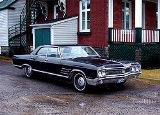
In 1966 a one-year-only Wildcat "Gran Sport Performance Group" package could be ordered by selecting the "A8/Y48" option. Two engine choices were available. The single carb 425 CID/340 hp V8 was included in the base package price but a 360 hp dual-carb set-up was also available at extra cost. Initially, this 20 hp upgrade remained a dealer installed carb/intake modification bolted to stock MT-coded engines but eventually these "Super Wildcats" could also be obtained direct from the factory with MZ-coded engines. Rounding out both the base and Super GS packages were dual exhaust, heavy-duty suspension, posi-traction and updated rear quarter-panel "GS" badging in the new, initials-only format employed on all post-1965 Gran Sports. A total of 1244 Wildcat GS's were built by Buick during the model year. Of those 242 were convertibles and the rest were hardtops. A mere 22 (consisting of an unknown mix of both body styles) earned Super Wildcat decals.
The year 1967 brought an all new engine to the Wildcat line (along with the Riviera and Electra 225) - a 430 cubic inch V8 with four-barrel carburetor and 360 hp rating that featured larger valves for better breathing than the previous 401/425 nailhead design that dated back to Buick's first V8 in 1953. The 430 was relatively short-lived as it was only offered through the 1969 model year. For 1970, the 430 was superseded by the largest Buick V8 engine ever - a 455 cubic-inch engine that was basically a bored and stroked version of the previous engine with the same large valve design and a horsepower rating of 370, and torque rating of more than 500 pounds.
The Wildcat, offered only in Custom trim for the final year of 1970, line was superseded by the
Buick CenturionThe Buick Centurion was sold by the Buick division of General Motors from 1971 through 1973, replacing the Buick Wildcat as the sporty rendition of Buick's full-size car. The Centurion name was inspired by a Buick concept car, that name coming from the professional officer in the Roman Army...
in 1971.
Wildcat concept cars
Buick has used the name
Wildcat for five concept vehicles, three in the early 1950s, one in 1985 and another in 1997. The 1953 Wildcat I, 1954 Wildcat II and 1955 Wildcat III were all designed under the guidance of
Harley EarlHarley J. Earl was first Vice President of Design at General Motors. He was an industrial designer and a pioneer of modern transportation design. A coachbuilder by trade, Earl pioneered the use of freeform sketching and hand sculpted clay models as design techniques...
. The I and II still exist today.
The 1985 Wildcat was a radical mid-engined, all-wheel-drive sports car with an exposed high-performance, double-overhead cam V6. The chassis was built of carbon-fiber and vinyl-ester resin and the body featured a
'lift-up' canopyA vehicle canopy is a rarely used type of door for cars. It has no official name so it is also known as an articulated canopy, bubble canopy, cockpit canopy, canopy door, or simply a canopy. A canopy is a type of door which sits on top of a car and lifts up in some way, to provide access for...
for entry/exit. This futuristic vehicle is still owned by Buick today, and is still operational.
In 1997, Buick made a Riviera Wildcat concept car. This car had carbon fiber instead of woodgrain trim inside and black chrome outside and its engine was modified.
Sources
- Flory, J. "Kelly", Jr. American Cars 1946-1959. Jefferson, NC: McFarland & Coy, 2008.