

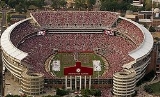
Bryant-Denny Stadium

Encyclopedia
Bryant–Denny Stadium, located in Tuscaloosa
, Alabama
, is the home stadium for the University of Alabama
football team
. The stadium opened in 1929, and was originally named Denny Stadium, in honor of former Alabama president George Hutchenson Denny. The stadium's name was amended to Bryant–Denny Stadium in 1975 after the Alabama legislature chose to honor famed Alabama coach Paul "Bear" Bryant
. It has a seating capacity
of 101,821, and is the second largest stadium in the SEC, the fifth largest stadium in the United States and the eighth largest non-racing stadium by seating in the world.
, Denny Stadium opened on September 28, 1929, with 6,000 in attendance for a 55–0 victory over Mississippi College
. It was officially dedicated the following week at Homecoming
ceremonies against Ole Miss
, a game the Tide would win 22–7. Originally, the stadium had a capacity of 12,000, though President Denny initially envisioned a full bowl stadium capable of seating 60,000 people. In 1937, the first expansion of the stadium added 6,000 seats along the east sideline to increase the capacity to 18,000. Further expansions in 1950, 1961, and 1966 raised capacity to 25,000, 43,000, and 60,000, respectively. The first upper deck was added on the west side of the stadium in 1988, adding 10,000 more seats for a capacity of 70,123. During the construction, the Tide was forced to play its entire 1987 home schedule at Legion Field
, 56 miles (90.1 km) from campus in Birmingham
.
, its construction was financed by the university and $4.65 million from Tuscaloosa, Northport
and Tuscaloosa County
. The localities contributed to construction costs in return for the university pledging to move all Bama home games to Tuscaloosa and not play any at Legion Field. The new upper deck provided 10,000 additional bleacher seats and eighty-one skyboxes
on two levels—sixty-three 16-seat and eighteen 24-seat capacity boxes. In 1999, four additional skyboxes were built to bring total number of skyboxes to 85. A JumboTron
scoreboard with video display capabilities was erected in the south endzone and was at the time the largest in collegiate sports. Additionally, a new east side entrance tower a brick facade and reception areas for the Scholarship and A-Club level patrons was also added during the 1998 expansion. On September 5, 1998, the stadium's eastern upper deck was opened, and raised its official seating capacity to 83,818 at a final cost of $35 million. In the first game in the newly expanded stadium, Alabama defeated BYU 38–31, with Shaun Alexander
scoring an Alabama single-game record five touchdowns in the win.
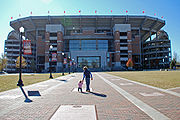
 Following the 2004 football season, the university spent approximately $47 million on an expansion to the North end zone, which was completed days before the 2006 season opener against Hawaii. The expansion added a new upper deck to the North end zone area, complete with three different levels of skyboxes, which collectively are known as "The Zone", which brought the number of skyboxes in the stadium to 123. Two large video screens made by Daktronics were placed in each corner of the North end zone, and 3.5 feet (1.1 m) high and 422 feet (128.6 m) long LCD ribbon screens were placed along the East and West upper deck facades.
Additions were made to the exterior of the stadium with the Walk of Champions. Included in the Walk of Champions are five bronze statues, one for each Alabama football coach who has led the Tide to a national championship. Each statue has a wall behind it bearing the coach's name and the year(s) he led the team to a national championship. The first four statues, unveiled at its opening in 2006, included Wallace Wade, Frank Thomas, Paul "Bear" Bryant
, and Gene Stallings
. The fifth statue, that of Nick Saban
, was unveiled prior to the A-Day game on April 16, 2011. The statue commemorates Saban guiding Alabama to its thirteenth National Championship with a 37 - 21 win over the Texas Longhorns. In addition, there are stones laid in the immediate pathway leading to the stadium recognizing all of Alabama's SEC and national championship teams throughout the years. Finally, there are also two bronze statues of Alabama football players at the entrance to the North end zone, and the two statues are holding a large Alabama flag. The player on the left is wearing the number 18, and the player on the right is wearing the number 92. These statues honor the entire Alabama football program, which began in 1892.
The north end zone was opened for the 2006
season opener versus Hawaii
, which set a new record attendance of 92,138. The Crimson Tide was victorious, 25–17.
On February 6, 2009, the university's Board of Trustees voted unanimously and without discussion to give the final approval construction to commence on the south end zone expansion. With the approval of the Board of Trustees, construction began in the Spring 2009 and continued throughout the 2009 football season. The expansion was finished in time for the first game of the team's 2010 season
.
The Tuscaloosa News reported on April 17, 2009 that due to the economic climate and resultant lowered construction costs, the stadium expansion cost $15 million less than expected, coming in around $65.6 million.
The expanded south end zone now includes a two level South Zone club with a total of 1,700 seats and 36 skyboxes to bring the total number of skyboxes in Bryant–Denny Stadium to 159, as well as an 8,500 seat upper deck. The entire stadium's audio/visual system was upgraded including two new video boards in both corners of the south end zone.
Prior to the 2009 season, the large south scoreboard was disassembled to make way for the construction of the new stadium expansion. During this process, some welding equipment started a fire that burned the inside of the scoreboard. Also, during this time, four new play clocks and down/distance indicators were installed (one behind each corner of the end zones) and a new LED game clock was placed behind the south goalpost.
The Expansion was completed in mid summer 2010 and held an official capacity of 101,821 making it the 5th largest college football stadium in the country. The new seats were all sold out quickly for the entire 2010 football season. In the future, the new expansion will include stores and other extras on the bottom of the end zone.
, the Crimson Tide owns a 212–50–3 all-time record at Bryant–Denny Stadium. Bear Bryant is the leader in wins at Bryant–Denny, with an all-time record of 72–2 while head coach of Alabama.
Despite its success at Bryant–Denny, much of Alabama "home" football history occurred at Birmingham's
Legion Field
. Up until the late 1990s, Legion Field hosted the more important games, including the Iron Bowl, which was considered a neutral site from 1948 through 1987; the Tide hosted Tennessee in odd-numbered years in Birmingham until 1999, and hosted LSU in even-numbered years from 1964 through 1986, except for 1980. Usually, Bryant–Denny hosted about three to four games per season. However, in 1998, when Bryant–Denny was expanded to a capacity exceeding Legion Field, the more important home games started to move to Bryant–Denny, culminating with the move of the Tennessee series to Tuscaloosa in 1999 and the Iron Bowl a year later. From 1998 to 2003, Bryant–Denny hosted the more important games while Legion Field hosted two or three minor games. Finally, in 2003, Alabama played its final game at Legion Field against the South Florida Bulls
, and now Bryant–Denny is the sole home of Alabama football.
However, despite most past big games being played at Legion Field, Bryant–Denny Stadium has hosted many memorable games, such as the 1994 shootout between Alabama's Jay Barker
and Georgia's Eric Zeier
, Marvin Constant's goal-line stop against LSU quarterback Josh Booty as time expired in 1999, Tyrone Prothro
's reception over the back of Southern Miss defensive back Jasper Faulk in 2005, a 31–3 victory over No. 5 Florida in 2005, the Roman Harper
-forced fumble against Tennessee in 2005 that helped the Tide to victory, Alabama's 36-0 shutout victory against Auburn in 2008 thus breaking the six-game losing streak and first ever Iron Bowl
victory in Bryant–Denny Stadium, and Terrence Cody
's field goal block against Tennessee as time expired in 2009. In recent years, Bryant–Denny Stadium has become a feared place to play again. Also Bryant-Denny has been put on many lists ranking it one of the best places to watch football. NCAA Football 11
ranked Alabama's Bryant–Denny as the fourth toughest place to play in the nation and third in the SEC behind Florida
and LSU
. Sporting News ranks it first while Bleacher Report has it ranked as the 5th toughest and the 2nd best stadium in the country.
The field design underwent full scale changes beginning with the 2004 season. At midfield, the large white script A was replaced with the script A logo, which is encircled by a crimson ring which has "Alabama Crimson Tide" written around it. The endzone designs, too, were changed to a crimson, block style font (though different than the block style font used in the earlier design) that was outlined in white.
For the 2006 season, two identical logos commemorating the 175th anniversary of the founding of the University of Alabama were also added to the field on the twenty-five yard lines. One was added on the south end of the stadium, on the west side of the playing field, while the other was on the north end of the stadium, on the east side of the playing field.
For the 2007 season, two identical logos commemorating the 75th anniversary of the founding of the Southeastern Conference were added to home field of every Southeastern Conference team. These were in the same places as the 175th logos were during the 2006 season.
For the 2008 season, two identical Southeastern Conference logos were added to the home field of every Southeastern Conference team. These are in the same places as the previous logos.
For the 2009 A-day game, the endzones were changed back to the original white block style font that was used prior to the 2004 season, except the background will be shaded Crimson. The north endzone says "ALABAMA", while the south endzone says "CRIMSON TIDE". This design has been kept since the 2009 season.
For the 2011 season, two identical houndstooth
awareness ribbon
s recognizing the on-going relief efforts from the April 27, 2011 tornado were added to the field on the twenty-five yard lines.
. Fail commented, "Earlier this year, when I saw the visitors' locker room as a potential naming right, I figured it was the most appropriate opportunity I would ever have to use my name."
's Jordan-Hare Stadium
became the homes of the Alabama High School Athletic Association
state football championship games, known as the Super Six. Bryant-Denny hosts the Super Six in odd-numbered years, with Jordan-Hare taking the games in even-numbered years. Previously, the Super Six was held at Legion Field
in Birmingham
.
Tuscaloosa, Alabama
Tuscaloosa is a city in and the seat of Tuscaloosa County in west central Alabama . Located on the Black Warrior River, it is the fifth-largest city in Alabama, with a population of 90,468 in 2010...
, Alabama
Alabama
Alabama is a state located in the southeastern region of the United States. It is bordered by Tennessee to the north, Georgia to the east, Florida and the Gulf of Mexico to the south, and Mississippi to the west. Alabama ranks 30th in total land area and ranks second in the size of its inland...
, is the home stadium for the University of Alabama
University of Alabama
The University of Alabama is a public coeducational university located in Tuscaloosa, Alabama, United States....
football team
Alabama Crimson Tide football
|TeamName = Alabama football |Image = Alabama Crimson Tide Logo.svg |ImageSize = 110 |Helmet = Alabama Football.png |ImageSize2 = 150 |CurrentSeason = 2011 Alabama Crimson Tide football team...
. The stadium opened in 1929, and was originally named Denny Stadium, in honor of former Alabama president George Hutchenson Denny. The stadium's name was amended to Bryant–Denny Stadium in 1975 after the Alabama legislature chose to honor famed Alabama coach Paul "Bear" Bryant
Bear Bryant
Paul William "Bear" Bryant was an American college football player and coach. He was best known as the longtime head coach of the University of Alabama football team. During his 25-year tenure as Alabama's head coach, he amassed six national championships and thirteen conference championships...
. It has a seating capacity
Seating capacity
Seating capacity refers to the number of people who can be seated in a specific space, both in terms of the physical space available, and in terms of limitations set by law. Seating capacity can be used in the description of anything ranging from an automobile that seats two to a stadium that seats...
of 101,821, and is the second largest stadium in the SEC, the fifth largest stadium in the United States and the eighth largest non-racing stadium by seating in the world.
Construction
Serving as a replacement for Denny FieldDenny Field
Denny Field was located in Tuscaloosa, Alabama, and served as the home stadium for the University of Alabama football team from 1915 through the 1928 seasons, excluding 1918 when a team was not fielded due to World War I. The stadium opened in 1915, and was originally named University Field...
, Denny Stadium opened on September 28, 1929, with 6,000 in attendance for a 55–0 victory over Mississippi College
Mississippi College Choctaws
The Mississippi College Choctaws are the athletic teams of Mississippi College. They participate in NCAA's Division III in the competitive 12-member American Southwest Conference under the mascot Choctaws and the school colors of blue and gold...
. It was officially dedicated the following week at Homecoming
Homecoming
Homecoming is the tradition of welcoming back alumni of a school. It most commonly refers to a tradition in many universities, colleges and high schools in North America...
ceremonies against Ole Miss
Ole Miss Rebels football
The football history of the University of Mississippi , includes the formation of the first football team in the state and is 26th on the list of college football's all-time winning programs...
, a game the Tide would win 22–7. Originally, the stadium had a capacity of 12,000, though President Denny initially envisioned a full bowl stadium capable of seating 60,000 people. In 1937, the first expansion of the stadium added 6,000 seats along the east sideline to increase the capacity to 18,000. Further expansions in 1950, 1961, and 1966 raised capacity to 25,000, 43,000, and 60,000, respectively. The first upper deck was added on the west side of the stadium in 1988, adding 10,000 more seats for a capacity of 70,123. During the construction, the Tide was forced to play its entire 1987 home schedule at Legion Field
Legion Field
Legion Field is a large stadium in Birmingham, Alabama, United States, primarily designed to be used as a venue for American football, but is occasionally used for other large outdoor events. The stadium is named in honor of the American Legion, a U.S. organization of military veterans. At its peak...
, 56 miles (90.1 km) from campus in Birmingham
Birmingham, Alabama
Birmingham is the largest city in Alabama. The city is the county seat of Jefferson County. According to the 2010 United States Census, Birmingham had a population of 212,237. The Birmingham-Hoover Metropolitan Area, in estimate by the U.S...
.
East upper deck (1998)
In September 1995, the University of Alabama System Board of Trustees approved the construction of the east upper deck. Designed by the architectural firm of Heery/Chambless/AdamsHeery International
Heery International, Inc. is an architectural firm that was founded in 1952 by George T. Heery and his father C. Wilmer Heery, Jr., and is currently headquartered in Atlanta, Georgia...
, its construction was financed by the university and $4.65 million from Tuscaloosa, Northport
Northport, Alabama
Northport is a city in Tuscaloosa County in the west central part of the U.S. state of Alabama. Located on the Black Warrior River across from downtown Tuscaloosa, it is currently the 24th largest city in Alabama with an estimated population of 23,442 in 2009...
and Tuscaloosa County
Tuscaloosa County, Alabama
Tuscaloosa County is a county of the U.S. state of Alabama.It is named in honor of the pre-Choctaw chief Tuskaloosa. In 2010, the population was 194,656...
. The localities contributed to construction costs in return for the university pledging to move all Bama home games to Tuscaloosa and not play any at Legion Field. The new upper deck provided 10,000 additional bleacher seats and eighty-one skyboxes
Luxury box
A Luxury box is a special seating section located within stadiums, arenas and other sporting and entertainment venues. They are typically located in the midsection of a stadium grandstand, usually providing the best views of the event...
on two levels—sixty-three 16-seat and eighteen 24-seat capacity boxes. In 1999, four additional skyboxes were built to bring total number of skyboxes to 85. A JumboTron
Jumbotron
A JumboTron is a large-screen television using technology developed by Sony, typically used in sports stadiums and concert venues to show close-up shots of the event. Although JumboTron is a registered trademark owned by the Sony Corporation, the word jumbotron is often used by the public as a...
scoreboard with video display capabilities was erected in the south endzone and was at the time the largest in collegiate sports. Additionally, a new east side entrance tower a brick facade and reception areas for the Scholarship and A-Club level patrons was also added during the 1998 expansion. On September 5, 1998, the stadium's eastern upper deck was opened, and raised its official seating capacity to 83,818 at a final cost of $35 million. In the first game in the newly expanded stadium, Alabama defeated BYU 38–31, with Shaun Alexander
Shaun Alexander
Shaun Edward Alexander is a former American football running back who played for the Seattle Seahawks and the Washington Redskins. He was drafted by the Seahawks 19th overall in the 2000 NFL Draft. He played college football at the University of Alabama.- Early career :Alexander was born and...
scoring an Alabama single-game record five touchdowns in the win.
North end zone expansion (2006)
Additions were made to the exterior of the stadium with the Walk of Champions. Included in the Walk of Champions are five bronze statues, one for each Alabama football coach who has led the Tide to a national championship. Each statue has a wall behind it bearing the coach's name and the year(s) he led the team to a national championship. The first four statues, unveiled at its opening in 2006, included Wallace Wade, Frank Thomas, Paul "Bear" Bryant
Bear Bryant
Paul William "Bear" Bryant was an American college football player and coach. He was best known as the longtime head coach of the University of Alabama football team. During his 25-year tenure as Alabama's head coach, he amassed six national championships and thirteen conference championships...
, and Gene Stallings
Gene Stallings
Eugene Clifton Stallings, Jr. is a former American football player and coach. He played college football at Texas A&M University , where he was one of the "Junction Boys", and later served as the head coach at his alma mater from 1965 to 1971. Stallings was also the head coach of the St...
. The fifth statue, that of Nick Saban
Nick Saban
Nicholas Lou "Nick" Saban is the head coach of the University of Alabama's Crimson Tide football team. Saban has previously served as head coach of the National Football League's Miami Dolphins and three other NCAA universities: LSU, Michigan State and Toledo...
, was unveiled prior to the A-Day game on April 16, 2011. The statue commemorates Saban guiding Alabama to its thirteenth National Championship with a 37 - 21 win over the Texas Longhorns. In addition, there are stones laid in the immediate pathway leading to the stadium recognizing all of Alabama's SEC and national championship teams throughout the years. Finally, there are also two bronze statues of Alabama football players at the entrance to the North end zone, and the two statues are holding a large Alabama flag. The player on the left is wearing the number 18, and the player on the right is wearing the number 92. These statues honor the entire Alabama football program, which began in 1892.
The north end zone was opened for the 2006
2006 Alabama Crimson Tide football team
The 2006 Alabama Crimson Tide football team represented the University of Alabama for the 2006 NCAA Division I FBS football season trying to improve from a 10–2 record in the 2005 season. The Tide was led by head coach Mike Shula entering his fourth year at Alabama. Despite a strong 5–2 start, they...
season opener versus Hawaii
Hawaii Warriors football
The Hawaii Warriors football team represents the University of Hawaii at Mānoa in NCAA Division I FBS college football. The team, which is currently coached by Greg McMackin, is part of the Western Athletic Conference until 2012, when the team joins the Mountain West Conference.The Hawaii Warriors...
, which set a new record attendance of 92,138. The Crimson Tide was victorious, 25–17.
South end zone expansion (2010)
The University of Alabama Board of Trustees approved a study for further expansion of Bryant-Denny on September 19, 2008. The Physical Properties Committee of the University of Alabama Board of Trustees heard a presentation from UA athletic department on November 13, 2008 regarding the proposed $80.6 million expansion of the south end zone upper deck and suite level of Bryant–Denny Stadium. The proposed expansion would bring the stadium's capacity to approximately 101,600, therefore making it the second largest stadium in the Southeastern Conference (SEC), and the fifth largest stadium in college football. The committee unanimously approved the project to move into the third of four stages, the fourth being final approval to begin construction.On February 6, 2009, the university's Board of Trustees voted unanimously and without discussion to give the final approval construction to commence on the south end zone expansion. With the approval of the Board of Trustees, construction began in the Spring 2009 and continued throughout the 2009 football season. The expansion was finished in time for the first game of the team's 2010 season
2010 Alabama Crimson Tide football team
The 2010 Alabama Crimson Tide football team represented the University of Alabama in the 2010 NCAA Division I FBS football season. It was the Crimson Tide's 118th overall season, 78th as a member of the Southeastern Conference and its 19th within the SEC Western Division...
.
The Tuscaloosa News reported on April 17, 2009 that due to the economic climate and resultant lowered construction costs, the stadium expansion cost $15 million less than expected, coming in around $65.6 million.
The expanded south end zone now includes a two level South Zone club with a total of 1,700 seats and 36 skyboxes to bring the total number of skyboxes in Bryant–Denny Stadium to 159, as well as an 8,500 seat upper deck. The entire stadium's audio/visual system was upgraded including two new video boards in both corners of the south end zone.
Prior to the 2009 season, the large south scoreboard was disassembled to make way for the construction of the new stadium expansion. During this process, some welding equipment started a fire that burned the inside of the scoreboard. Also, during this time, four new play clocks and down/distance indicators were installed (one behind each corner of the end zones) and a new LED game clock was placed behind the south goalpost.
The Expansion was completed in mid summer 2010 and held an official capacity of 101,821 making it the 5th largest college football stadium in the country. The new seats were all sold out quickly for the entire 2010 football season. In the future, the new expansion will include stores and other extras on the bottom of the end zone.
Football lore
Since its opening for the 1929 season through the 2010 season2010 Alabama Crimson Tide football team
The 2010 Alabama Crimson Tide football team represented the University of Alabama in the 2010 NCAA Division I FBS football season. It was the Crimson Tide's 118th overall season, 78th as a member of the Southeastern Conference and its 19th within the SEC Western Division...
, the Crimson Tide owns a 212–50–3 all-time record at Bryant–Denny Stadium. Bear Bryant is the leader in wins at Bryant–Denny, with an all-time record of 72–2 while head coach of Alabama.
Despite its success at Bryant–Denny, much of Alabama "home" football history occurred at Birmingham's
Birmingham, Alabama
Birmingham is the largest city in Alabama. The city is the county seat of Jefferson County. According to the 2010 United States Census, Birmingham had a population of 212,237. The Birmingham-Hoover Metropolitan Area, in estimate by the U.S...
Legion Field
Legion Field
Legion Field is a large stadium in Birmingham, Alabama, United States, primarily designed to be used as a venue for American football, but is occasionally used for other large outdoor events. The stadium is named in honor of the American Legion, a U.S. organization of military veterans. At its peak...
. Up until the late 1990s, Legion Field hosted the more important games, including the Iron Bowl, which was considered a neutral site from 1948 through 1987; the Tide hosted Tennessee in odd-numbered years in Birmingham until 1999, and hosted LSU in even-numbered years from 1964 through 1986, except for 1980. Usually, Bryant–Denny hosted about three to four games per season. However, in 1998, when Bryant–Denny was expanded to a capacity exceeding Legion Field, the more important home games started to move to Bryant–Denny, culminating with the move of the Tennessee series to Tuscaloosa in 1999 and the Iron Bowl a year later. From 1998 to 2003, Bryant–Denny hosted the more important games while Legion Field hosted two or three minor games. Finally, in 2003, Alabama played its final game at Legion Field against the South Florida Bulls
South Florida Bulls
The South Florida Bulls are the athletic teams for the University of South Florida. The university competes in NCAA Division I, USF is a member of the Big East Conference, and has been since 2005...
, and now Bryant–Denny is the sole home of Alabama football.
However, despite most past big games being played at Legion Field, Bryant–Denny Stadium has hosted many memorable games, such as the 1994 shootout between Alabama's Jay Barker
Jay Barker
Jay Barker is a former professional American football quarterback, and a current Birmingham radio personality.- Football career :...
and Georgia's Eric Zeier
Eric Zeier
Eric Royce Zeier is a former American football quarterback. In his five years in the NFL, he played for the Cleveland Browns , Baltimore Ravens , and the Tampa Bay Buccaneers . Zeier started his career at Heidelberg American High School in Heidelberg, Germany where he led them to a championship...
, Marvin Constant's goal-line stop against LSU quarterback Josh Booty as time expired in 1999, Tyrone Prothro
Tyrone Prothro
Tyrone Prothro is a former American football wide receiver who played for the University of Alabama between 2003–2005.- Collegiate career :...
's reception over the back of Southern Miss defensive back Jasper Faulk in 2005, a 31–3 victory over No. 5 Florida in 2005, the Roman Harper
Roman Harper
Roman Harper is an American football safety with the New Orleans Saints of the NFL. He was drafted in the second round of the 2006 NFL Draft. He played college football at the University of Alabama...
-forced fumble against Tennessee in 2005 that helped the Tide to victory, Alabama's 36-0 shutout victory against Auburn in 2008 thus breaking the six-game losing streak and first ever Iron Bowl
Iron Bowl
The Iron Bowl is an American college football rivalry game played annually by the Alabama Crimson Tide football team of the University of Alabama and the Auburn Tigers football team of Auburn University. The series is considered one of the best and most hard-fought rivalries in all of sports...
victory in Bryant–Denny Stadium, and Terrence Cody
Terrence Cody
Terrence Bernard Cody, Jr. is an American football nose tackle for the Baltimore Ravens of the National Football League. He was selected by the Ravens in the second round of the 2010 NFL Draft out of the University of Alabama, where he was given the nickname "Mount Cody" for his gargantuan,...
's field goal block against Tennessee as time expired in 2009. In recent years, Bryant–Denny Stadium has become a feared place to play again. Also Bryant-Denny has been put on many lists ranking it one of the best places to watch football. NCAA Football 11
NCAA Football 11
NCAA Football 11 is a college football video game created by EA Sports and developed by EA Tiburon. It was released on July 13, 2010 for the PlayStation 2 PlayStation 3, Xbox 360...
ranked Alabama's Bryant–Denny as the fourth toughest place to play in the nation and third in the SEC behind Florida
Ben Hill Griffin Stadium
Ben Hill Griffin Stadium at Florida Field is the football stadium for the University of Florida and the home field of the university's Florida Gators football team. It is located on the university's Gainesville, Florida campus. The stadium was originally built in 1930, and has been regularly...
and LSU
Tiger Stadium (LSU)
Tiger Stadium is an outdoor stadium located in Baton Rouge, Louisiana. It is best known as the home stadium of the Louisiana State University football team.Tiger Stadium opened with a capacity of 12,000 in 1924...
. Sporting News ranks it first while Bleacher Report has it ranked as the 5th toughest and the 2nd best stadium in the country.
Field design
Traditionally speaking, the field design of Bryant–Denny Stadium was much like the field designs of most football stadiums, which generally involved only the necessary field markings required for play. However, as more and more stadiums began to add other designs to the field aside from those required for play, such as logos, Bryant–Denny Stadium chose to remain traditional, having very few field markings. In fact, even on into the 2002 season, Bryant-Denny had no logo at midfield and no logos at the twenty-five yard lines, which are commonplace in many stadiums. The endzones were simply designed as such that the name "ALABAMA" was spelled out in a white, block style font. During the 2002 season, however, a rather large white script A was added to midfield.The field design underwent full scale changes beginning with the 2004 season. At midfield, the large white script A was replaced with the script A logo, which is encircled by a crimson ring which has "Alabama Crimson Tide" written around it. The endzone designs, too, were changed to a crimson, block style font (though different than the block style font used in the earlier design) that was outlined in white.
For the 2006 season, two identical logos commemorating the 175th anniversary of the founding of the University of Alabama were also added to the field on the twenty-five yard lines. One was added on the south end of the stadium, on the west side of the playing field, while the other was on the north end of the stadium, on the east side of the playing field.
For the 2007 season, two identical logos commemorating the 75th anniversary of the founding of the Southeastern Conference were added to home field of every Southeastern Conference team. These were in the same places as the 175th logos were during the 2006 season.
For the 2008 season, two identical Southeastern Conference logos were added to the home field of every Southeastern Conference team. These are in the same places as the previous logos.
For the 2009 A-day game, the endzones were changed back to the original white block style font that was used prior to the 2004 season, except the background will be shaded Crimson. The north endzone says "ALABAMA", while the south endzone says "CRIMSON TIDE". This design has been kept since the 2009 season.
For the 2011 season, two identical houndstooth
Houndstooth
Houndstooth, houndstooth check or hound's tooth , also known as dogstooth, dogtooth or dog's tooth, is a duotone textile pattern characterized by broken checks or abstract four-pointed shapes, often in black and white, although other colours are used...
awareness ribbon
Awareness ribbon
Awareness ribbons, due to their ubiquitous nature, have come to symbolize various concerns depending on the colours or the patterns used. For example, black ribbons may be used for mourning....
s recognizing the on-going relief efforts from the April 27, 2011 tornado were added to the field on the twenty-five yard lines.
Locker rooms
In 2008, the visitors' locker room was officially named "The Fail Room" after alumnus and donor James M. FailJames M. Fail
James M. Fail is an American financial executive, the chairman of Stone Holdings, Inc. and Bluebonnet Savings Bank. A native of Mobile, Alabama, he attended Murphy High Schooland served for three years in the U.S. Navy....
. Fail commented, "Earlier this year, when I saw the visitors' locker room as a potential naming right, I figured it was the most appropriate opportunity I would ever have to use my name."
High school championships
Beginning in 2009, Bryant-Denny Stadium and Auburn UniversityAuburn University
Auburn University is a public university located in Auburn, Alabama, United States. With more than 25,000 students and 1,200 faculty members, it is one of the largest universities in the state. Auburn was chartered on February 7, 1856, as the East Alabama Male College, a private liberal arts...
's Jordan-Hare Stadium
Jordan-Hare Stadium
Jordan–Hare Stadium is the playing venue for Auburn University's football team located on campus in Auburn, Alabama, USA. The stadium is named for Ralph "Shug" Jordan, the University's winningest football coach, and Cliff Hare, a member of Auburn's first football team as well as Dean of the Auburn...
became the homes of the Alabama High School Athletic Association
Alabama High School Athletic Association
The Alabama High School Athletic Association , based in Montgomery, is the agency which oversees interscholastic athletic programs for public schools in Alabama....
state football championship games, known as the Super Six. Bryant-Denny hosts the Super Six in odd-numbered years, with Jordan-Hare taking the games in even-numbered years. Previously, the Super Six was held at Legion Field
Legion Field
Legion Field is a large stadium in Birmingham, Alabama, United States, primarily designed to be used as a venue for American football, but is occasionally used for other large outdoor events. The stadium is named in honor of the American Legion, a U.S. organization of military veterans. At its peak...
in Birmingham
Birmingham, Alabama
Birmingham is the largest city in Alabama. The city is the county seat of Jefferson County. According to the 2010 United States Census, Birmingham had a population of 212,237. The Birmingham-Hoover Metropolitan Area, in estimate by the U.S...
.