
All Topics  
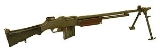
Browning Automatic Rifle

 
Browning Automatic Rifle

   Email Print
   Bookmark   Link


Browning Automatic Rifle


The BAR (short for Browning Automatic Rifle) is a family of American
United States

The United States of America is a Federal government constitutional republic comprising U.S. state and a federal district. The country is situated mostly in central North America, where its Contiguous United States and Washington, D.C., the Capital districts and territories, lie between the Pacific Ocean and Atlantic Oceans, Borders of the U...
 7.62 mm
7.62 mm caliber

There are many cartridge which use 7.62 mm caliber bullets. Historically, this class of cartridge was commonly known as .30 caliber, and was most commonly used for indicating a class of full power military Main Battle Rifle cartridges....
 automatic rifle
Automatic rifle

Automatic rifle is a term generally used to describe a self-loading rifle chambered for a rifle cartridge, capable of delivering both Semi-automatic firearm- and Automatic firearm fire....
s (or machine rifles) and light machine gun
Light machine gun

A light machine gun or LMG is a machine gun that is generally lighter than other machine guns of the same period, and is usually designed to be carried by an individual soldier, with or without an assistant....
s used by the United States and numerous other countries during the 20th century. The primary variant of the BAR series is the M1918, chambered for the .30-06 Springfield (7.62x63mm)
.30-06 Springfield

The .30-06 Springfield cartridge or 7.62 x 63 mm in metric notation, was introduced to the United States Army in 1906 and standardized, used until the 1960s and early 1970s....
 rifle
Rifle

A rifle is a firearm designed to be fired from the shoulder, with a barrel that has a helical groove or pattern of grooves cut into the barrel walls....
 cartridge
Cartridge (firearms)

A cartridge, also called a round, packages the bullet, gunpowder and Percussion cap into a single metallic case precisely made to fit the firing chamber of a firearm....
 and designed by John Browning
John Browning

John Moses Browning , born in Ogden, Utah, was an United States firearms designer who developed many varieties of firearms, Cartridge , and gun mechanisms, many of which are still in use around the world....
 in 1917 for the U.S. Expeditionary Corps in Europe
Europe

Europe is, conventionally, one of the world's seven continents. Comprising the westernmost peninsula of Eurasia, Europe is generally divided from Asia to its east by the water divide of the Ural Mountains, the Ural , the Caspian Sea, and by the Caucasus Mountains to the southeast....
 as a replacement for (and improvement on) the French
France

France , officially the French Republic , is a country whose Metropolitan France is located in Western Europe and that also comprises various Overseas departments and territories of France....
-made Chauchat
Chauchat

The Chauchat was a light machine gun used mainly by the France Army but also by seven other nations, including the USA, during and after World War I....
 and Hotchkiss M1909
Hotchkiss M1909 Benet-Mercie machine gun

The Hotchkiss M1909 machine gun was a French designed light machine gun of the early 20th century, developed and built by Hotchkiss et Cie. It was also known as the Hotchkiss Mark I and M1909 Benet-Mercie....
 machine guns.

Development
Development prototypes of the BAR were presented to a United States Army
United States Army

The United States Army is the branch of the United States Armed Forces responsible for Army operations. It is the largest and oldest established branch of the U.S....
 Ordnance Board in February 1917, testing was then conducted at Springfield Armory
Springfield Armory

This is an article about the US Government Arsenal. For the contemporary commercial manufacturer see Springfield Armory, Inc.The Springfield Armory was the primary center for the manufacture of United States military small arms and the site of many important technological advances in gun manufacture....
 in May 1917 and on 16 July 1917 12,000 weapons known at that time as the BMR (Browning Machine Rifle) were duly ordered from Colt’s Patent Firearms Manufacturing Company
Colt's Manufacturing Company

Colt's Manufacturing Company is a United States firearms manufacturer founded in 1847. It is best known for the engineering, production, and marketing of dozens of different firearms over the later half of the 19th and the 20th century....
 who had secured the production rights.


Discussion
Ask a question about 'Browning Automatic Rifle'
Start a new discussion about 'Browning Automatic Rifle'
Answer questions from other users
Full Discussion Forum


Recent Posts


Encyclopedia


The BAR (short for Browning Automatic Rifle) is a family of American
United States

The United States of America is a Federal government constitutional republic comprising U.S. state and a federal district. The country is situated mostly in central North America, where its Contiguous United States and Washington, D.C., the Capital districts and territories, lie between the Pacific Ocean and Atlantic Oceans, Borders of the U...
 7.62 mm
7.62 mm caliber

There are many cartridge which use 7.62 mm caliber bullets. Historically, this class of cartridge was commonly known as .30 caliber, and was most commonly used for indicating a class of full power military Main Battle Rifle cartridges....
 automatic rifle
Automatic rifle

Automatic rifle is a term generally used to describe a self-loading rifle chambered for a rifle cartridge, capable of delivering both Semi-automatic firearm- and Automatic firearm fire....
s (or machine rifles) and light machine gun
Light machine gun

A light machine gun or LMG is a machine gun that is generally lighter than other machine guns of the same period, and is usually designed to be carried by an individual soldier, with or without an assistant....
s used by the United States and numerous other countries during the 20th century. The primary variant of the BAR series is the M1918, chambered for the .30-06 Springfield (7.62x63mm)
.30-06 Springfield

The .30-06 Springfield cartridge or 7.62 x 63 mm in metric notation, was introduced to the United States Army in 1906 and standardized, used until the 1960s and early 1970s....
 rifle
Rifle

A rifle is a firearm designed to be fired from the shoulder, with a barrel that has a helical groove or pattern of grooves cut into the barrel walls....
 cartridge
Cartridge (firearms)

A cartridge, also called a round, packages the bullet, gunpowder and Percussion cap into a single metallic case precisely made to fit the firing chamber of a firearm....
 and designed by John Browning
John Browning

John Moses Browning , born in Ogden, Utah, was an United States firearms designer who developed many varieties of firearms, Cartridge , and gun mechanisms, many of which are still in use around the world....
 in 1917 for the U.S. Expeditionary Corps in Europe
Europe

Europe is, conventionally, one of the world's seven continents. Comprising the westernmost peninsula of Eurasia, Europe is generally divided from Asia to its east by the water divide of the Ural Mountains, the Ural , the Caspian Sea, and by the Caucasus Mountains to the southeast....
 as a replacement for (and improvement on) the French
France

France , officially the French Republic , is a country whose Metropolitan France is located in Western Europe and that also comprises various Overseas departments and territories of France....
-made Chauchat
Chauchat

The Chauchat was a light machine gun used mainly by the France Army but also by seven other nations, including the USA, during and after World War I....
 and Hotchkiss M1909
Hotchkiss M1909 Benet-Mercie machine gun

The Hotchkiss M1909 machine gun was a French designed light machine gun of the early 20th century, developed and built by Hotchkiss et Cie. It was also known as the Hotchkiss Mark I and M1909 Benet-Mercie....
 machine guns.

Development


Development prototypes of the BAR were presented to a United States Army
United States Army

The United States Army is the branch of the United States Armed Forces responsible for Army operations. It is the largest and oldest established branch of the U.S....
 Ordnance Board in February 1917, testing was then conducted at Springfield Armory
Springfield Armory

This is an article about the US Government Arsenal. For the contemporary commercial manufacturer see Springfield Armory, Inc.The Springfield Armory was the primary center for the manufacture of United States military small arms and the site of many important technological advances in gun manufacture....
 in May 1917 and on 16 July 1917 12,000 weapons known at that time as the BMR (Browning Machine Rifle) were duly ordered from Colt’s Patent Firearms Manufacturing Company
Colt's Manufacturing Company

Colt's Manufacturing Company is a United States firearms manufacturer founded in 1847. It is best known for the engineering, production, and marketing of dozens of different firearms over the later half of the 19th and the 20th century....
 who had secured the production rights. However, Colt was already producing at peak capacity and requested for a delay in production while they expanded their manufacturing output with a new facility in Meriden
Meriden, Connecticut

Meriden is a city in New Haven County, Connecticut, Connecticut, United States. According to 2005 Census Bureau estimates, the population of the city is 59,653....
, Connecticut
Connecticut

Connecticut is a U.S. state located in the New England region of the northeastern United States. The state borders New York to the west and south , Massachusetts to the north, and Rhode Island to the east....
. Due to the urgent need for the weapon, the request was denied and the Winchester Repeating Arms Company
Winchester Repeating Arms Company

The Winchester Repeating Arms Company was a prominent United States maker of semi-automatic firearm during the late nineteenth and early twentieth century....
 (WRAC) was designated as the prime contractor. The initial contract with Winchester called for 25,000 BARs. They were in full production by June 1918, delivering 4,000 guns and in July were turning out 9,000 units. Colt and Marlin-Rockwell Corporation
Marlin Firearms

The Marlin Firearms Company of North Haven, Connecticut manufactures Marlin Rifles.Over the company's 130+ years of firearms production, it has been best known for its manufacture of high power, center fire, Lever-action, and .22 caliber rimfire rifles, as well as shotguns, derringers and revolvers....
 also began production shortly after Winchester got into full production. By July 1918, the BAR began to arrive in France and the first unit to receive them was the U.S. Army’s 79th Infantry Division. Despite being introduced very late in the war, the BAR saw some combat use; it was used extensively during the Meuse-Argonne Offensive
Meuse-Argonne Offensive

The Meuse-Argonne Offensive, also called the Battle of the Argonne Forest, was a part of the final Allied offensive of World War I that stretched along the entire western front and also involved troops from Britain, its dominion/commonwealth armies , Belgium and France in other major attacks in other sectors....
.

In order to avoid confusion with the belt-fed Browning M1917 heavy machine gun, the BAR came to be known as the M1918 or Rifle, Caliber .30, Automatic, Browning, M1918 according to official nomenclature. Almost immediately after its introduction into service, John Browning modified the design by changing the BAR’s ejection pattern (to the right side of the weapon – instead of straight up). Between 1918–1919, 102,125 BARs had been manufactured jointly by Colt (16,000 weapons), Winchester (47,123) and Marlin-Rockwell (39,002 units). Browning's was owned by Colt.

The BAR was originally intended as a light automatic rifle, but spent much of its service life in various guises used in the light machine gun role with a bipod. The original M1918 version was and remains the lightest machine gun to fire the .30-06 Springfield cartridge, though the limited capacity of its standard 20-round magazine tended to hamper its utility in that role.

Design details

The M1918 is a selective fire
Selective fire

A selective fire firearm can be fired in both Semi-automatic firearm and any number of Automatic firearm modes by means of a selector. Some selective fire weapons utilize burst fire mechanisms that limit the maximum or total number of shots fired when in this mode....
, air-cooled automatic rifle using a gas-operated
Gas-operated reloading

Gas-operation is a system of operation used to provide energy to operate autoloading firearms. In gas-operation, a portion of high pressure gas from the Cartridge being fired is used to power a mechanism to extract the spent Casing and chamber a new cartridge....
 long-stroke piston rod actuated by propellant gases bled through a vent in the barrel and locked with a tilting breechblock; it fires from an open bolt
Open bolt

A Semi-automatic firearm or Automatic firearm firearm is said to fire from an open bolt if, when ready to fire, the Bolt and working parts are held to the rear....
. The spring-powered cartridge casing extractor is contained in the bolt and a fixed ejector is installed in the trigger group. The BAR is striker fired (the bolt carrier serves as the striker) and uses a trigger mechanism with a fire selector lever that enables operating in either semi-automatic or fully automatic firing modes. The selector lever is located on the left side of the receiver
Receiver (firearms)

In firearms terminology, the receiver is the part of a firearm that houses the operating parts. It is sometimes called the body of the firearm, and especially in the context of handguns it is often called the frame....
 and is simultaneously the manual safety (selector lever in the “S” position – weapon is safe, “F” – single fire, “A” – continuous fire). The “safe” setting blocks the trigger.

The weapon’s barrel is screwed into the receiver and is not quickly detachable. The M1918 feeds using double-column 20-round box magazines, although 40-round magazines were also used in an anti-aircraft role; these were withdrawn from use in 1927. The M1918 has a cylindrical flash suppressor
Flash suppressor

A flash suppressor, also known as a flash guard, flash eliminator, flash hider, or flash cone, is a device attached to the muzzle of a rifle or other gun that directs the hot gases as they leave the barrel....
 fitted to the muzzle end. The weapon was equipped with a fixed wooden buttstock
Stock (firearm)

A stock, also known as a buttstock or shoulder stock, is present in many firearms and some crossbows . The stock provides a means for the shooter to firmly support the device and easily aim it....
 and closed-type adjustable iron sights, consisting of a forward post and a rear leaf sight with 100 to 1,500 yard range graduations. Bayonet
Bayonet

A bayonet is a knife-, dagger-, sword-' or spike-shaped weapon designed to fit on or over the muzzle of a rifle barrel or similar weapon, effectively turning the gun into a spear....
s for the BAR were not manufactured in great quantity and are thus extremely rare. They consisted of a spike form with a slat on the top side, attaching to the bottom of the barrel in the conventional fashion.

Variants

During its lengthy service life, the BAR underwent continuous development, receiving many improvements and modifications. The first major attempt at improving the M1918 resulted in the M1922 light machine gun, adopted by the United States Cavalry in 1922. The weapon uses a new heavy profile ribbed barrel, an adjustable spiked bipod (mounted to a swiveling collar on the barrel) with a rear, stock-mounted monopod, a side-mounted sling swivel and a new rear endplate, fixed to the stock retaining sleeve. The handguard was changed, and in 1926, the BAR's sights were redesigned to accommodate the heavy-bullet 172-grain M1 .30-06 ball ammunition then coming into service for machine gun use.

The second significant modification of the M1918 was intended to increase the weapon’s effectiveness and controllability firing in bursts and took place in 1937, which saw the introduction of the M1918A1 into U.S. Army inventories. Compared to the original M1918, the newer model includes a lightweight spiked bipod attached to the gas cylinder with a leg height adjustment feature and a new hinged steel butt plate. Relatively few M1918s were rebuilt to the new M1918A1 standard.

In 1938–1939, work was begun on what would become the new M1918A2, accepted into service in 1941. One of the most important aspects of this modification involved removal of the semi-automatic firing capabilities of the weapon and using a rate-reducing buffer mechanism, activated by engaging the “F” position on the selector toggle. Furthermore, a new skid-footed bipod was fitted to the muzzle end of the barrel, magazine guides were added to the front of the trigger guard, the handguard was shortened, a heat shield was added to help the cooling process, a small monopod was hinged from and folded into the butt, and the weapon's role was changed to that of a squad light machine gun. The BAR's rear sight scales were also modified to accommodate the newly-standardized M2 Ball ammunition with its lighter flat-base bullet. In 1942, a fiberglass buttstock replaced the wood version, and late in the war – a barrel-mounted carrying handle was added. Initially, M1918A2s were obtained by converting older M1918 rifles (remaining in surplus) and a limited number of M1922s and M1918A1s; later, their production was undertaken at the New England Small Arms Corp. and International Business Machines Corp.
IBM

International Business Machines Corporation, abbreviated IBM and nicknamed "Big Blue" , is a multinational corporation computer technology and consulting corporation headquartered in Armonk, New York, New York, United States....
 (a total of 168,000 new weapons were manufactured). During the Korean War
Korean War

The Korean War refers to a period of military conflict between North Korea and South Korea regimes, with major hostilities lasting from June 25, 1950 until the armistice signed on July 27, 1953....
, production was again launched, this time contracted to the Royal McBee Typewriter Co.
Royal Typewriter Company

The Royal Typewriter Company was a manufacturer of typewriters headquartered in Hartford, Connecticut....
 responsible for a further 61,000 M1918A2 light machine guns.

The M1918A2 is an automatic weapon which uses a trigger and fire control mechanism that permits fully automatic fire only but with two variable rates of fire: a normal rate (500–650 rounds/min) and a reduced rate (300–450 rounds/min), achieved by engaging a device which reduces the weapon’s cyclic rate of fire, installed inside the buttstock (together with the buffer). The safety and fire selector lever is placed on the left side of the trigger group and has three positions: “S” – weapon safe, “F” – automatic fire with a mechanically reduced rate and “A” – continuous fire at the normal cyclic rate. The weapon’s barrel has a new slotted flash suppressor (introduced during the Korean War), an adjustable bipod, a fixed stock with a folding shoulder rest, carry handle and fully adjustable iron sights, with a post foresight and a leaf rear sight (can be adjusted with windage and elevation corrections) with an elevation ladder graduated from 100 to 1,600 yd and a notch for immediate firing up to 300 yd.

The BAR family of light machine guns also found a ready market overseas and were widely exported. In 1919, the Colt’s company developed and produced a commercial variant called the Automatic Machine Rifle Model 1919 (company designation: Model U), which has a different return mechanism compared to the M1918 (it is installed in the stock rather than the gas tube) and lacks a flash hider. Later the Model 1924 rifle was offered for a short period of time, featuring a pistol grip
Pistol grip

On a firearm or other tool, the pistol grip is that portion of the mechanism that is held by the hand and orients the hand in a manner similar to the position one would take with a conventional pistol such as the M1911 pistol....
 and a redesigned handguard. However, the following Model 1925 (R75) would achieve the highest popularity in export sales. It is based on the Model 1924 but uses a heavy, finned barrel, a lightweight bipod and is equipped with dust covers in the magazine well and ejection port (some of these features were patented: refer to US patents 1548709 and 1533968). The Model 1925 was produced in various calibers, including .30-06 Springfield (7.62x63mm), 7.65x53mm Belgian Mauser, 7x57mm Mauser, 6.5x55mm, 7.92x57mm Mauser
7.92x57mm Mauser

The 7.92x57mm Cartridge was designed by the Germany Gewehr-Pr?fungskommission for the Model 1888 Commission Rifle and later used in Mauser bolt-action rifles....
 and .303 British (7.7x56mmR)
.303 British

.303 British, or 7.7mmx56R, is a .311 inch calibre rifle and machine gun Cartridge first developed in United Kingdom in the 1880s as a blackpowder round, later adapted to use cordite and then smokeless powder propellant....
. A minor variant of the Model 1925 (R75) was the R75A light machine gun with a quick-change barrel (produced in 1924 in small quantities for the Dutch Army
Royal Netherlands Army

The Royal Netherlands Army is the land forces element of the military of the Netherlands. The core fighting element of the army is divided into three separate brigades: two mechanised brigades and one airborne brigade....
) and the Monitor (R80) automatic rifle, which was adopted by various US security services (including the FBI
Federal Bureau of Investigation

The Federal Bureau of Investigation is the primary unit in the United States United States Department of Justice, serving as both a Law enforcement agency body and a domestic intelligence agency....
) in 1931. The R80 lacks a bipod and uses a lightweight receiver and a lightweight short barrel fitted with a Cutts compensator.

In 1920, the Belgian
Belgium

* A small German-speaking Community of Belgium exists in eastern Wallonia. Belgium's linguistic diversity and related political and cultural conflicts are reflected in the history of Belgium and a complex Communities and regions of Belgium....
 arms manufacturer Fabrique Nationale
Fabrique Nationale de Herstal

Fabrique Nationale de Herstal, more often abbreviated as Fabrique Nationale or simply FN, is a Belgium manufacturer of firearms. The official company name is FN Herstal....
 (FN) acquired sales and production rights to the BAR series of firearms in Europe from Colt’s. The first BAR model sold by FN was the Kg m/21 (Kg – Kulsprutegevär – “machine rifle”) chambered for the 6.5x55mm m/94 cartridge. The m/21 is a variant of the Model 1919 designed to Swedish
Sweden

Sweden , officially the Kingdom of Sweden , is a Nordic countries on the Scandinavian Peninsula in Northern Europe. Sweden has land borders with Norway to the west and Finland to the northeast, and it is connected to Denmark by the ?resund Bridge in the south....
 specifications and manufactured initially by Colt’s and later under license at the Carl Gustafs Stads Gevärsfaktori in Eskilstuna
Eskilstuna

Eskilstuna is a city in S?dermanland, Sweden and the seat of Eskilstuna Municipality. About 60,200 of the municipality's 94,645 inhabitants live in the seat....
. Compared to the Model 1919, the Swedish weapon has – apart from the different caliber – a spiked bipod and pistol grip. The m/21 would become one of Sweden’s main support weapons in the interwar years together with the water-cooled belt-fed Ksp m/1914 medium machine gun (Swedish adaptation of the Austrian M07/12). Dissatisfied with the rapidly overheating fixed barrel of the m/21, Carl Gustaf began to design a new quick-detach mechanism for the barrel which mates the externally grooved chamber to a series of rotating flanges in the receiver operated by a locking lever. The barrel also received cooling fins throughout its entire length. These enhancements were incorporated into the fm/1935 prototype trialed successfully in 1935, which in turn led to the m/37 variant that lacks the finned barrel, selected into service in 1937 and remaining in first-line use until 1980. Carl Gustaf also developed a belt-fed version of the weapon; however it was never adopted.

Production of the BAR in Belgium began only after signing an agreement with Poland
Poland

Poland , officially the Republic of Poland , is a country in Central Europe. Poland is bordered by Germany to the west; the Czech Republic and Slovakia to the south; Ukraine, Belarus and Lithuania to the east; and the Baltic Sea and Kaliningrad Oblast, a Russian Enclave and exclave, to the north....
 (on December 10 1927) involving the procurement of 10,000 wz. 1928 light machine guns chambered in 7.92x57mm Mauser, which are similar to the R75 variant but designed specifically to meet the requirements of the Polish Army. Changes to the base design include a pistol grip, different type of bipod, open-type V-notch rear sight and a slightly longer barrel. Subsequent rifles were assembled locally in Poland under license by the State Rifle Factory (Panstwowa Fabryka Karabinów) in Warsaw
Warsaw

Warsaw is the Capital and World's largest cities of Poland. It is located on the Vistula River roughly from both the Baltic Sea coast and the Carpathian Mountains....
. The wz. 1928 was accepted into service with the Polish Army
Polish Land Forces

Polish Land Forces is a branch of Poland's Polish Armed Forces....
 in 1927 under the formal name 7,92 mm rkm Browning wz. 1928 (“7.92 mm Browning hand-held machine gun model 1928”) and – until the outbreak of World War II – was the primary light support weapon of Polish infantry and cavalry formations (in 1939 Poland had a total of approx. 20,000 wz. 1928 rifles in service). Additional detail modifications were introduced on the production line. Among them was the replacement of the iron sights with a smaller version and reshaping the butt to a fish tail.

In the mid 1930s Polish small arms designer Wawrzyniec Lewandowski was tasked with developing a flexible aircraft-mounted machine gun based on the Browning wz.1928. This resulted in the wz. 1937. Changes included increasing the weapon's rate of fire to 1100 rounds/min, eliminating the buttstock, adding a spade-type grip to the rear of receiver, moving the main drive spring under the barrel and most importantly – changing the feed system. Sustained fire was practically impossible with the standard 20-round box magazine thus a new feed mechanism was developed, which was added to the receiver as a module. It contains a spring-loaded bolt-actuated lever, which would feed a round from a 91-round pan magazine located above the receiver and force the round into the feed path during unlocking. The machine gun was accepted in 1937 and ordered by the Polish Air Force
Polish Air Force

Polish Air Force is the air force branch of the Polish Armed Forces. Until 1 July 2004 it was officially known as Wojska Lotnicze i Obrony Powietrznej ....
 as the karabin maszynowy obserwatora wz. 1937 ("observers machine gun model 1937"). Three hundred thirty-nine machine guns were eventuality acquired and used as armament in the PZL.37 Los
PZL.37 Los

The PZL.37 Los was a Poland twin-engine medium bomber, used in the Invasion of Poland in 1939. Thanks to the Laminar flow wing it was one of the most modern bomber aircraft in the world before World War II....
 medium bomber and the LWS-3 Mewa
LWS-3 Mewa

The LWS-3 Mewa was the Poland observation and close reconnaissance aircraft, designed in the late-1930s by the LWS factory. It was ordered by the Polish Air Force, but did not manage to enter service before the outbreak of the World War II....
 reconnaissance aircraft

Based on the wz. 1928 a variant known as the FN Mle 1930 was developed in 7.65x53mm Belgian Mauser and adopted by the Belgian Army. This model has a different gas valve; it too uses a rate-reducing fire control mechanism. The weapon also has a hinged shoulder plate and is adapted for use on a tripod mount. In 1932 Belgium adopted a new version of the FN Mle 1930 allocated the service designation FN Mle D (D – Demontable or “removable”) which has a quick-change barrel, shoulder rest and a simplified take-down method for eased cleaning and maintenance. The Mle D was produced even after World War II
World War II

World War II, or the Second World War , was a global military conflict which involved a Participants in World War II, including all of the great powers, organised into two opposing military alliances: the Allies of World War II and the Axis powers....
 in versions adapted for .30-06 Springfield and NATO
NATO

The North Atlantic Treaty Organization , also called the Atlantic Alliance, is a military alliance established by the signing of the North Atlantic Treaty on 4 April 1949....
-standard 7.62x51mm
7.62x51mm NATO

The 7.62x51mm NATO is a rifle Cartridge developed in the 1940s and 50s as a standard for small arms among NATO countries. Specifications for the 7.62x51mm NATO cartridge are not identical to the commercial .308 Winchester though they are safely interchangeable....
 ammunition.

Deployment


From its inception, the M1918 was an automatic rifle. First issued in September 1918 to the AEF, it was based on the concept of "walking fire", a French practice in use since 1916 for which the CSRG 1915 (Chauchat
Chauchat

The Chauchat was a light machine gun used mainly by the France Army but also by seven other nations, including the USA, during and after World War I....
) had been used accompanying advancing squads of riflemen toward the enemy trenches, since the machine guns were too heavy to follow the troops during an assault. In addition to shoulder-fired operation, BAR gunners were issued a belt with magazine pouches for the BAR and sidearm along with a "cup" to support the stock of the rifle when held at the hip. In theory, this allowed the soldier to lay suppressive fire
Suppressive fire

Suppressive fire is a term used in military science for firing weapons at or in the direction of enemy forces with the primary goal of reducing their ability to defend themselves or return fire, by forcing them to remain under cover....
 while walking forward, keeping the enemy's head down, a practice known as "marching fire". The idea would resurface in the submachine gun
Submachine gun

A submachine gun is a firearm that combines the automatic firearm of a machine gun with the cartridge of a pistol, and is usually between the two in weight and size....
 and ultimately the assault rifle
Assault rifle

An assault rifle is a rifle designed for combat, with selective fire . Assault rifles are the standard small arms in most modern Army, having largely superseded or supplemented battle rifles such as the World War II-era M1 Garand rifle and SVT-40....
. It is not known if any of the belt-cup devices actually saw combat use. The BAR saw little action in WWI, in part due to the Armistice
Armistice

An armistice is a situation in a war where the warring parties agree to stop fighting. It is not necessarily the end of a war, but may be just a cessation of hostilities while an attempt is made to negotiate a lasting peace....
, and also because the U.S. Army was reluctant to have the BAR fall into enemy hands, its first action being in September of 1918. Eighty-five thousand BARs were built by the war's end.

After the outbreak of World War II
World War II

World War II, or the Second World War , was a global military conflict which involved a Participants in World War II, including all of the great powers, organised into two opposing military alliances: the Allies of World War II and the Axis powers....
, the U.S. Army had belatedly realized it had no portable squad light machine gun, and attempted to convert the BAR to that role with the M1918A2. Its success in this role was mixed at best, since the BAR's fixed non-replaceable barrel and small magazine capacity greatly limited its utility in comparison to genuine light machine guns such as the Bren
Bren

The Bren , usually called the Bren Gun, was a series of light machine guns adopted by Britain in the 1930s and used in various roles until 1991....
 or the Japanese Type 96
Type 96 Light Machine Gun

The was a light machine gun used by the Imperial Japanese Army in the interwar period and in World War II. ...
. The weapon's rate-reducer mechanism proved difficult to clean and was susceptible to damage from moisture and corrosion. This in turn either rendered the weapon inoperable, or prevented it from firing in the automatic mode. The bipod and flash hider, being easily removable, were often discarded by troops to save weight and improve portability.

In combat, particularly in the Pacific Theatre
Pacific Theater of Operations

The Pacific Theater #Theater of operations was the World War II area of military activity in the Pacific Ocean and the countries bordering it, a geographic scope that reflected the operational and administrative command structures of the American forces during that period....
 of war, the BAR effectively reverted to its original role as a portable, shoulder-fired automatic rifle. The BAR was often employed at the point or tail of a patrol or infantry column, where its firepower could help break contact on a jungle trail in the event of ambush. After a period of service, ordnance personnel began to receive BARs with inoperable or malfunctioning recoil buffer mechanisms. This was eventually traced to the soldier's common practice of cleaning the BAR in a vertical position with the butt of the weapon on the ground, allowing cleaning fluid and burned powder to collect in the recoil buffer mechanism. Additionally, unlike the M1 Garand, the BAR's gas cylinder was never changed to stainless steel. Consequently, the gas cylinder frequently rusted solid from the use of corrosive-primered M2 service ammunition in a humid environment when not stripped and cleaned on a daily basis.

Issued as automatic fire support for a squad, all men were trained at the basic level how to operate and fire the weapon in case the designated BAR operator(s) were killed or wounded. In an attempt to overcome the BAR's limited continuous-fire capability, U.S. Marine and some army units used two BAR fire teams per squad. One team would typically provide covering fire until a magazine was empty, whereupon the second team would open fire, thus allowing the first team to reload. While not without design flaws (a thin-diameter, fixed barrel that quickly overheated, limited magazine capacity, complex field-strip/cleaning procedure, unreliable recoil buffer mechanism, a gas cylinder assembly made of corrosion-prone metals, and many small internal parts), the BAR proved rugged and reliable enough when regularly field-stripped and cleaned.

During World War II, the BAR saw extensive service, both official and unofficial, with many branches of service. One of the BAR's most unusual uses was as a defensive aircraft weapon. In 1944, USAAF Air Transport Command Capt. Wally A. Gayda reportedly used a BAR to return fire against a Japanese Army Nakajima fighter that had attacked his C-46 cargo plane over the Hump
The Hump

The Hump was the name given by Allied pilots in the Second World War to the eastern end of the Himalayan Mountains over which they flew from India to China to resupply the Flying Tigers and the Second Sino-Japanese War of Chiang Kai-shek....
 in Burma. Gayda shoved the rifle out his forward cabin window, emptying the magazine and apparently killing the Japanese pilot.

After World War II, the BAR continued in service in the Korean War
Korean War

The Korean War refers to a period of military conflict between North Korea and South Korea regimes, with major hostilities lasting from June 25, 1950 until the armistice signed on July 27, 1953....
, and the early stages of the Vietnam War
Vietnam War

The Vietnam War, also known as the Second Indochina Wars, the Vietnam Conflict, or often in Vietnam the American War occurred in Vietnam, Laos and Cambodia from 1959 to April 30, 1975....
, when the U.S. delivered a quantity of weapons to the South Vietnam
South Vietnam

South Vietnam refers to an internationally recognized state which governed Vietnam south of the Vietnamese Demilitarized Zone until 1975. Its capital was Saigon and its origin can be traced to the French colony of Cochinchina, which consisted of the southern third of Vietnam....
ese. Quantities of the BAR remained in use by the Army National Guard up until the mid-1970s. Many nations in NATO and recipients of U.S. foreign aid adopted the BAR and used it into the 1990s.

The BAR proved a popular civilian weapon in the U.S., although fully automatic models were greatly restricted in the 1930s, which made them much harder to own and transfer. Importation of machine guns for U.S. civilian transfer was banned in 1968, and U.S. production of machine guns for civilian transfer was banned in 1986. Transferable civilian-owned BAR models remain, however.

Clyde Barrow of Bonnie and Clyde
Bonnie and Clyde

Bonnie Parker and Clyde Barrow were notorious outlaws, robbers, and criminals who, with their gang, traveled the Central United States during the Great Depression....
 used a shortened BAR (stolen from National Guard
United States National Guard

The National Guard of the United States is a Military reserve force composed of U.S. state National Guard militia members or units under federally recognized active or inactive Military of the United States service for the United States ....
 armories) during his spree in the 1930s. The six lawmen who killed Bonnie and Clyde used a variant of the BAR called the Colt Monitor in their ambush.

A modern manufacturer of firearms has produced a semi-automatic version of the Browning Automatic Rifle known as the 1918A3 SLR ("self-loading rifle").

The BAR hunting rifle currently offered by Browning
Browning Arms Company

Browning Arms Company was founded in Utah in 1927. It offers a wide variety of firearms, including shotguns, rifles, pistols, and rimfire firearms....
 is a completely different firearm, unrelated in design to the Browning military weapons.

Users


  • **
  • The Wehrmacht
    Wehrmacht

    Wehrmacht was the name of the unified armed forces of Germany from 1935 to 1945. It consisted of the Heer , the Kriegsmarine and the Luftwaffe ....
     captured a number of Polish-made Browning wz. 1928 guns and used them until the end of World War II under the designation of IMG 28(p).
  • A number of wz. 1928s were seized from the Poles by the Red Army
    Red Army

    The Red Army was the armed force first organized by the Bolsheviks during the Russian Civil War in 1918 and, in 1922, became the army of the Soviet Union....
     and used during the war.
  • : Locally known as the ???.88 or ????????? 88.
    Issued to the Home Guard in WW2*


See also

  • Kg m/40 light machine gun
  • Mendoza RM2
    Mendoza RM2

    The Mendoza RM2 was Mexican light Machine Gun first developed in 1925 It was chambered in .30-06 Calibre and had a 30 round magazine fed from the top....
  • FM24/29
  • Bren gun


External links

  • – Reference manual page including 4 BAR manuals
  • the Colt Monitor http://www.smallarmsreview.com/pdf/Monitor.pdf