

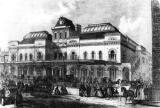
Broad Street railway station

Encyclopedia
Broad Street railway station was a major terminal station in the City of London
, England. It opened in 1865 and closed in 1986. It was the main terminus of the North London Railway
network of suburban services and was adjacent to station.
(NLR) to Broad Street (via the Kingsland Viaduct
) was authorised by the North London Railway Act of 22 July 1861. The station was opened on 1 November 1865. It was the terminus of a network of commuter railways linking east and west London via the looping route of the NLR, originally with 7 platforms, and three approach lines. Broad Street goods station
was next to the passenger station, and opened for traffic on 18 May 1868. It was built on a deck
, and a lift was provided to move wagons down to warehouses below. The deck was not strong enough to carry locomotives, so shunting
was done by rope and capstan
.
, immediately adjacent, and Victoria). At the start of the 20th century, more than one train a minute arrived or left the station during the morning rush hour
, with over 27 million passengers in 1902. The Great Northern Railway
also used Broad Street, as a supplement to its King's Cross terminal some miles to the west.
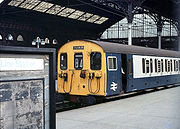 In the early years of the 20th century the North London Line suffered a drastic loss in passengers and, especially, revenue, owing to the expansion of the bus
, tram
and Tube
networks. For example, from 1900 to 1905, passengers dropped by 4 percent and 13.4 percent; by 1913 numbers had dropped to 44.6 percent of the 1900 total, and by 1921 to only 23.3 percent. The patronage of Broad Street station declined accordingly. This was not helped by the fact that on 8 September 1915 the station was damaged by a Zeppelin
attack.
In the face of the competition, the governing board finally decided to electrify the NLR, on the two conductor rail at 600 V DC system, and electrified services started on 1 October 1916, using Oerlikon stock, though the Watford service was not electrified until 10 July 1922. At the terminus only the western five lines were ever electrified. After 1922 the NLR was fully absorbed into the London and North Western Company, and disaggregated figures are not available; however, electrification appears to have at least stemmed the tide of passenger losses.
The station was badly damaged in World War II and was never fully repaired. Local services to Poplar
were withdrawn on 14 May 1944 and never reinstated. The main station building closed in 1956, passengers being directed to a new concourse level building at the platform entrance to buy tickets.
In 1960, 41 trains carrying 6,400 passengers arrived at Broad Street in the three morning peak hours.
The line and station were earmarked for closure under the Beeching Axe
of 1963, but local opposition persuaded the government to give it a reprieve. However, the station was gradually run down and the level of service was steadily reduced. In 1967 the major part of the train shed
roof was removed, having become unsafe, whilst four of the nine platforms were taken out of use in 1969, the same year that the goods yard closed. In 1976, peak hour services to the Eastern Region
via the Canonbury Spur, were withdrawn with the opening of the Northern City Line
, and a further platform was disconnected. The station was now very dilapidated, with trees growing in between the disused platforms. The crumbling facade and the cavernous,dark interior (including a disused buffet and ticket office) were fascinating yet forbidding.
s per week were using Broad Street station and only about 300 arrived daily in the morning peak. From 13 May 1985 the service to Richmond was diverted away from Broad Street, leaving only the peak hour Watford Junction
services. It was agreed that Broad Street would be closed with the last remaining trains diverted to Liverpool Street once a new connecting chord was built from the North London line. Until this was done, it was possible to accommodate this last service from the outer end of one platform, and therefore in November that year demolition of the station began. The remaining single platform was used until the last train left on 27 June 1986, when the station was finally closed along with Dalston Junction
, the other remaining station on the North London Line's City branch. Broad Street has been the only true terminal "main line" station in London to have closed permanently in modern times.
 Broad Street station was replaced with the giant Broadgate
office and shopping complex, and nothing remains of the station. However, three giant girders which formerly supported a now demolished part of the Kingsland Viaduct
approaching Broad Street now form a feature at the Broadgate entrance to Liverpool Street (on the corner of Eldon Street and Blomfield Street). Nonetheless, most of this viaduct, leading to the North London Line, remains largely intact, and has been restored to carry the East London Line
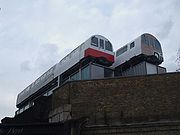
along the old trackbed as far as station. The former line over the Great Eastern Street viaduct to Broad Street has been utilised as a location for artists' studios, housed in converted Jubilee line Underground trains
The Crossrail
project, which will see a brand new underground railway line built through central London, will have one of its new stations at Liverpool Street. A brand new ticket hall serving the Crossrail station will be built within the old London Underground
ticket hall with its entrance at 100 Liverpool Street
, the old entrance to the Underground that served Broad Street, with the platforms themselves under the Broadgate complex.
An often overlooked feature of the concourse was a War Memorial
10 feet (c. 3 metres) high of white marble, installed 10 February 1921, containing 64 names) to the workers of the North London Railway company who lost their lives in 'The Great War' (1914-18). Upon closure the memorial was put in store at Richmond Station
in 1989. On 7 June 2011 it was rededicated outside Hoxton Overground Station by Rev James Westcott of St Chad's Church and London's Transport Commissioner Peter Hendy
. The Bishop of Stepney
, Rt Rev
Adrian Newman and Meg Hillier
MP
, together with Rev Graham Hunter, Vicar
of St John's Hoxton
and various other local clergy
, were in attendance at Hoxton War Memorial's inaugural Armistice Day
service on 11 November 2011.
's 1984 feature film and album of the same name, Give My Regards to Broad Street
, was inspired by the station. In one of the last scenes of the film, Paul walks into the station and sits alone on one of its benches. The Spooks
episode "Lesser Of Two Evils" depicts an attack on the station, which is portrayed as being a busy commuting point. It is also shown as containing a London Underground station.
City of London
The City of London is a small area within Greater London, England. It is the historic core of London around which the modern conurbation grew and has held city status since time immemorial. The City’s boundaries have remained almost unchanged since the Middle Ages, and it is now only a tiny part of...
, England. It opened in 1865 and closed in 1986. It was the main terminus of the North London Railway
North London Railway
The North London Railway was a railway company that opened lines connecting the north of London to the East and West India Docks. The main east to west route is now part the North London Line. Other lines operated by the company fell into disuse, but were later revived as part of the Docklands...
network of suburban services and was adjacent to station.
Opening
The extension of the North London RailwayNorth London Railway
The North London Railway was a railway company that opened lines connecting the north of London to the East and West India Docks. The main east to west route is now part the North London Line. Other lines operated by the company fell into disuse, but were later revived as part of the Docklands...
(NLR) to Broad Street (via the Kingsland Viaduct
Kingsland Viaduct
Kingsland Viaduct is a railway viaduct about 2 miles in length, almost wholly within the present London Borough of Hackney in the north-east part of Inner London. It was built in the 1860s but closed in the 1980s until it was reopened to carry the London Overground in 2010...
) was authorised by the North London Railway Act of 22 July 1861. The station was opened on 1 November 1865. It was the terminus of a network of commuter railways linking east and west London via the looping route of the NLR, originally with 7 platforms, and three approach lines. Broad Street goods station
Goods station
A goods station is, in the widest sense, a railway station which is exclusively or predominantly where goods of any description are loaded or unloaded from ships or road vehicles and/or where goods wagons are transferred to local sidings.A station where goods are not specifically received or...
was next to the passenger station, and opened for traffic on 18 May 1868. It was built on a deck
Deck (building)
In architecture, a deck is a flat surface capable of supporting weight, similar to a floor, but typically constructed outdoors, often elevated from the ground, and usually connected to a building...
, and a lift was provided to move wagons down to warehouses below. The deck was not strong enough to carry locomotives, so shunting
Shunt (railway operations)
Shunting, in railway operations, involves the process of sorting items of rolling stock into complete train sets or consists. The United States terminology is "switching"....
was done by rope and capstan
Capstan (nautical)
A capstan is a vertical-axled rotating machine developed for use on sailing ships to apply force to ropes, cables, and hawsers. The principle is similar to that of the windlass, which has a horizontal axle.- History :...
.
Expansion and development
A fourth approach line was added in 1874, a further (eighth) platform in 1891, and a final (ninth) platform in 1913. At its peak, it became the third busiest London station (after Liverpool StreetLiverpool Street station
Liverpool Street railway station, also known as London Liverpool Street or simply Liverpool Street, is both a central London railway terminus and a connected London Underground station in the north-eastern corner of the City of London, England...
, immediately adjacent, and Victoria). At the start of the 20th century, more than one train a minute arrived or left the station during the morning rush hour
Rush hour
A rush hour or peak hour is a part of the day during which traffic congestion on roads and crowding on public transport is at its highest. Normally, this happens twice a day—once in the morning and once in the evening, the times during when the most people commute...
, with over 27 million passengers in 1902. The Great Northern Railway
Great Northern Railway (Great Britain)
The Great Northern Railway was a British railway company established by the Great Northern Railway Act of 1846. On 1 January 1923 the company lost its identity as a constituent of the newly formed London and North Eastern Railway....
also used Broad Street, as a supplement to its King's Cross terminal some miles to the west.
Rundown
Buses in London
The London Bus is one of London's principal icons, the archetypal red rear-entrance double-deck Routemaster being recognised worldwide. Although the Routemaster has now been largely phased out of service, with only two heritage routes still using the vehicles, the majority of buses in London are...
, tram
Trams in London
There have been two separate generations of trams in London, from 1860 to 1952 and from 2000. Between 1952 and 2000, no trams ran at all in London.- Horse trams :...
and Tube
London Underground
The London Underground is a rapid transit system serving a large part of Greater London and some parts of Buckinghamshire, Hertfordshire and Essex in England...
networks. For example, from 1900 to 1905, passengers dropped by 4 percent and 13.4 percent; by 1913 numbers had dropped to 44.6 percent of the 1900 total, and by 1921 to only 23.3 percent. The patronage of Broad Street station declined accordingly. This was not helped by the fact that on 8 September 1915 the station was damaged by a Zeppelin
Zeppelin
A Zeppelin is a type of rigid airship pioneered by the German Count Ferdinand von Zeppelin in the early 20th century. It was based on designs he had outlined in 1874 and detailed in 1893. His plans were reviewed by committee in 1894 and patented in the United States on 14 March 1899...
attack.
In the face of the competition, the governing board finally decided to electrify the NLR, on the two conductor rail at 600 V DC system, and electrified services started on 1 October 1916, using Oerlikon stock, though the Watford service was not electrified until 10 July 1922. At the terminus only the western five lines were ever electrified. After 1922 the NLR was fully absorbed into the London and North Western Company, and disaggregated figures are not available; however, electrification appears to have at least stemmed the tide of passenger losses.
The station was badly damaged in World War II and was never fully repaired. Local services to Poplar
Poplar, London
Poplar is a historic, mainly residential area of the East End of London in the London Borough of Tower Hamlets. It is about east of Charing Cross. Historically a hamlet in the parish of Stepney, Middlesex, in 1817 Poplar became a civil parish. In 1855 the Poplar District of the Metropolis was...
were withdrawn on 14 May 1944 and never reinstated. The main station building closed in 1956, passengers being directed to a new concourse level building at the platform entrance to buy tickets.
In 1960, 41 trains carrying 6,400 passengers arrived at Broad Street in the three morning peak hours.
The line and station were earmarked for closure under the Beeching Axe
Beeching Axe
The Beeching Axe or the Beeching Cuts are informal names for the British Government's attempt in the 1960s to reduce the cost of running British Railways, the nationalised railway system in the United Kingdom. The name is that of the main author of The Reshaping of British Railways, Dr Richard...
of 1963, but local opposition persuaded the government to give it a reprieve. However, the station was gradually run down and the level of service was steadily reduced. In 1967 the major part of the train shed
Train shed
A train shed is an adjacent building to a railway station where the tracks and platforms are covered by a roof. It is also known as an overall roof...
roof was removed, having become unsafe, whilst four of the nine platforms were taken out of use in 1969, the same year that the goods yard closed. In 1976, peak hour services to the Eastern Region
Eastern Region of British Railways
The Eastern Region was a region of British Railways from 1948. The region ceased to be an operating unit in its own right in the 1980s and was wound up at the end of 1992...
via the Canonbury Spur, were withdrawn with the opening of the Northern City Line
Northern City Line
The Northern City Line is a railway line from Moorgate to Finsbury Park in London, once part of the Great Northern Electrics line. It should not be confused with the City branch of the Northern line, nor with the North London Line...
, and a further platform was disconnected. The station was now very dilapidated, with trees growing in between the disused platforms. The crumbling facade and the cavernous,dark interior (including a disused buffet and ticket office) were fascinating yet forbidding.
Closure
By 1985, only 6,000 passengerPassenger
A passenger is a term broadly used to describe any person who travels in a vehicle, but bears little or no responsibility for the tasks required for that vehicle to arrive at its destination....
s per week were using Broad Street station and only about 300 arrived daily in the morning peak. From 13 May 1985 the service to Richmond was diverted away from Broad Street, leaving only the peak hour Watford Junction
Watford Junction railway station
On 23 January 1975, an express train from Manchester to Euston derailed just south of Watford Junction after striking some stillages that had fallen on to the track. It then collided with a sleeper service from Euston to Glasgow. The driver of the Manchester train was killed, and eight passengers...
services. It was agreed that Broad Street would be closed with the last remaining trains diverted to Liverpool Street once a new connecting chord was built from the North London line. Until this was done, it was possible to accommodate this last service from the outer end of one platform, and therefore in November that year demolition of the station began. The remaining single platform was used until the last train left on 27 June 1986, when the station was finally closed along with Dalston Junction
Dalston Junction railway station
Dalston Junction railway station is in the Dalston area of the London Borough of Hackney at the crossroad of Dalston Lane, Kingsland Road and Balls Pond Road...
, the other remaining station on the North London Line's City branch. Broad Street has been the only true terminal "main line" station in London to have closed permanently in modern times.
Reuse
Broadgate
Broadgate is a large, office and retail estate in the City of London, owned by British Land and the Blackstone Group and managed by Broadgate Estates...
office and shopping complex, and nothing remains of the station. However, three giant girders which formerly supported a now demolished part of the Kingsland Viaduct
Kingsland Viaduct
Kingsland Viaduct is a railway viaduct about 2 miles in length, almost wholly within the present London Borough of Hackney in the north-east part of Inner London. It was built in the 1860s but closed in the 1980s until it was reopened to carry the London Overground in 2010...
approaching Broad Street now form a feature at the Broadgate entrance to Liverpool Street (on the corner of Eldon Street and Blomfield Street). Nonetheless, most of this viaduct, leading to the North London Line, remains largely intact, and has been restored to carry the East London Line
East London Line
The East London Line is a London Overground line which runs north to south through the East End, Docklands and South areas of London.Built in 1869 by the East London Railway Company, which reused the Thames Tunnel, originally intended for horse-drawn carriages, the line became part of the London...
along the old trackbed as far as station. The former line over the Great Eastern Street viaduct to Broad Street has been utilised as a location for artists' studios, housed in converted Jubilee line Underground trains
London Underground 1983 Stock
The London Underground 1983 Stock was a class of electric multiple unit designed for the Jubilee Line.The 1983 Tube Stock could be considered the last train to be designed by London Underground; it was the last conventional Tube train in the long line of evolving design since the 1938 Tube...
The Crossrail
Crossrail
Crossrail is a project to build a major new railway link under central London. The name refers to the first of two routes which are the responsibility of Crossrail Ltd. It is based on an entirely new east-west tunnel with a central section from to Liverpool Street station...
project, which will see a brand new underground railway line built through central London, will have one of its new stations at Liverpool Street. A brand new ticket hall serving the Crossrail station will be built within the old London Underground
London Underground
The London Underground is a rapid transit system serving a large part of Greater London and some parts of Buckinghamshire, Hertfordshire and Essex in England...
ticket hall with its entrance at 100 Liverpool Street
Liverpool Street
Liverpool Street can refer to:*Liverpool Street station, a major mainline railway station in Central London, England*Liverpool Street, Hobart, a major street in the Hobart city centre....
, the old entrance to the Underground that served Broad Street, with the platforms themselves under the Broadgate complex.
An often overlooked feature of the concourse was a War Memorial
War memorial
A war memorial is a building, monument, statue or other edifice to celebrate a war or victory, or to commemorate those who died or were injured in war.-Historic usage:...
10 feet (c. 3 metres) high of white marble, installed 10 February 1921, containing 64 names) to the workers of the North London Railway company who lost their lives in 'The Great War' (1914-18). Upon closure the memorial was put in store at Richmond Station
Richmond station (London)
Richmond station is a National Rail and London Underground station in the London Borough of Richmond upon Thames in south west London which is managed by South West Trains....
in 1989. On 7 June 2011 it was rededicated outside Hoxton Overground Station by Rev James Westcott of St Chad's Church and London's Transport Commissioner Peter Hendy
Peter Hendy
Peter Hendy, CBE is the current Commissioner of Transport for London.-Early career:He started his career in the public transport industry in 1975 as a London Transport graduate trainee...
. The Bishop of Stepney
Bishop of Stepney
The Bishop of Stepney is an episcopal title used by a suffragan bishop of the Church of England Diocese of London, in the Province of Canterbury, England. The title takes its name after Stepney, an inner-city district in the London Borough of Tower Hamlets...
, Rt Rev
Right Reverend
The Right Reverend is a style applied to certain religious figures.*In the Anglican Communion and the Roman Catholic Church in Great Britain it applies to bishops except that The Most Reverend is used for archbishops .*In some churches with a...
Adrian Newman and Meg Hillier
Meg Hillier
Margaret Olivia Hillier is a British Labour Co-operative politician who has been the Member of Parliament for Hackney South and Shoreditch since 2005, and was a junior Minister in HM Government from 2007 to 2010...
MP
MP
MP or mp may refer to:*Machine pistol*Malayo-Polynesian languages*Manu propria, a Latin expression for with one's own hand*Martinair IATA airline designator or reservation code*Maximum parsimony, a term used in statistical analyses...
, together with Rev Graham Hunter, Vicar
Vicar
In the broadest sense, a vicar is a representative, deputy or substitute; anyone acting "in the person of" or agent for a superior . In this sense, the title is comparable to lieutenant...
of St John's Hoxton
St John the Baptist, Hoxton
The Church of St John the Baptist, Hoxton, usually known as St John's Hoxton, is an urban Anglican church in Hoxton, Hackney, a host borough of London2012....
and various other local clergy
Clergy
Clergy is the generic term used to describe the formal religious leadership within a given religion. A clergyman, churchman or cleric is a member of the clergy, especially one who is a priest, preacher, pastor, or other religious professional....
, were in attendance at Hoxton War Memorial's inaugural Armistice Day
Armistice Day
Armistice Day is on 11 November and commemorates the armistice signed between the Allies of World War I and Germany at Compiègne, France, for the cessation of hostilities on the Western Front of World War I, which took effect at eleven o'clock in the morning—the "eleventh hour of the eleventh day...
service on 11 November 2011.
In popular culture
Paul McCartneyPaul McCartney
Sir James Paul McCartney, MBE, Hon RAM, FRCM is an English musician, singer-songwriter and composer. Formerly of The Beatles and Wings , McCartney is listed in Guinness World Records as the "most successful musician and composer in popular music history", with 60 gold discs and sales of 100...
's 1984 feature film and album of the same name, Give My Regards to Broad Street
Give My Regards to Broad Street
Give My Regards to Broad Street is the soundtrack album to the 1984 film of the same name. Unlike the film, the album was successful, achieving #1 in the UK chart and its lead single "No More Lonely Nights" was BAFTA and Golden Globe award nominated....
, was inspired by the station. In one of the last scenes of the film, Paul walks into the station and sits alone on one of its benches. The Spooks
Spooks
Spooks is a British television drama series that originally aired on BBC One from 13 May 2002 – 23 October 2011, consisting of 10 series. The title is a popular colloquialism for spies, as the series follows the work of a group of MI5 officers based at the service's Thames House headquarters, in a...
episode "Lesser Of Two Evils" depicts an attack on the station, which is portrayed as being a busy commuting point. It is also shown as containing a London Underground station.
External links
- London Destruction Tribute to the demolished station.
- Broad Street railway station at Subterranea Britannica