

Brachaeluridae

Encyclopedia
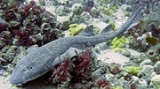
The Brachaeluridae, or blind sharks, are a small family
of sharks in the order Orectolobiformes. There are only two species of blind shark, both of which are native to shallow coastal waters up to 110 metres (360.9 ft) depth, off the eastern coast of Australia
.
They are distinguished by the presence of long barbels
, large spiracle
s, and groove around the nostrils. They have two dorsal fin
s, placed close together on the back, and a relatively short tail. Despite the name, blind sharks do have eyes.
Blind sharks feed on small fish, cuttlefish
, sea anemone
s, and crustacean
s. The female retains the eggs in her body until they hatch (ovoviviparity
), during which time the embryos feed solely on the egg yolk.
Family (biology)
In biological classification, family is* a taxonomic rank. Other well-known ranks are life, domain, kingdom, phylum, class, order, genus, and species, with family fitting between order and genus. As for the other well-known ranks, there is the option of an immediately lower rank, indicated by the...
of sharks in the order Orectolobiformes. There are only two species of blind shark, both of which are native to shallow coastal waters up to 110 metres (360.9 ft) depth, off the eastern coast of Australia
Australia
Australia , officially the Commonwealth of Australia, is a country in the Southern Hemisphere comprising the mainland of the Australian continent, the island of Tasmania, and numerous smaller islands in the Indian and Pacific Oceans. It is the world's sixth-largest country by total area...
.
They are distinguished by the presence of long barbels
Barbel (anatomy)
A barbel on a fish is a slender, whiskerlike tactile organ near the mouth. Fish that have barbels include the catfish, the carp, the goatfish, sturgeon, the zebrafish and some species of shark...
, large spiracle
Spiracle
Spiracles are openings on the surface of some animals that usually lead to respiratory systems.-Vertebrates:The spiracle is a small hole behind each eye that opens to the mouth in some fishes. In the primitive jawless fish the first gill opening immediately behind the mouth is essentially similar...
s, and groove around the nostrils. They have two dorsal fin
Dorsal fin
A dorsal fin is a fin located on the backs of various unrelated marine and freshwater vertebrates, including most fishes, marine mammals , and the ichthyosaurs...
s, placed close together on the back, and a relatively short tail. Despite the name, blind sharks do have eyes.
Blind sharks feed on small fish, cuttlefish
Cuttlefish
Cuttlefish are marine animals of the order Sepiida. They belong to the class Cephalopoda . Despite their name, cuttlefish are not fish but molluscs....
, sea anemone
Sea anemone
Sea anemones are a group of water-dwelling, predatory animals of the order Actiniaria; they are named after the anemone, a terrestrial flower. Sea anemones are classified in the phylum Cnidaria, class Anthozoa, subclass Zoantharia. Anthozoa often have large polyps that allow for digestion of larger...
s, and crustacean
Crustacean
Crustaceans form a very large group of arthropods, usually treated as a subphylum, which includes such familiar animals as crabs, lobsters, crayfish, shrimp, krill and barnacles. The 50,000 described species range in size from Stygotantulus stocki at , to the Japanese spider crab with a leg span...
s. The female retains the eggs in her body until they hatch (ovoviviparity
Ovoviviparity
Ovoviviparity, ovovivipary, or ovivipary, is a mode of reproduction in animals in which embryos develop inside eggs that are retained within the mother's body until they are ready to hatch...
), during which time the embryos feed solely on the egg yolk.
Genera and species
There are just two species of blind shark, each in their own genus:- Genus Brachaelurus OgilbyJames Douglas OgilbyJames Douglas Ogilby was an Australian ichthyologist.Ogilby was born in Belfast, Ireland, and was the son of zoologist William Ogilby. He received his education at Winchester College, England, and Trinity College, Dublin.Ogilby worked for the British Museum before joining the Australian Museum in...
, 1908- Brachaelurus waddi (BlochMarcus Elieser BlochMarcus Elieser Bloch was a German medical doctor and naturalist. He is generally considered one of the most important ichthyologists of the 18th century.- Life :...
& J. G. SchneiderJohann Gottlob SchneiderJohann Gottlob Theaenus Schneider was a German classicist and naturalist.-Biography:Schneider was born at Collm in Saxony...
, 1801) (Blind shark)
- Brachaelurus waddi (Bloch
- Genus Heteroscyllium Regan, 1908
- Heteroscyllium colcloughi (OgilbyJames Douglas OgilbyJames Douglas Ogilby was an Australian ichthyologist.Ogilby was born in Belfast, Ireland, and was the son of zoologist William Ogilby. He received his education at Winchester College, England, and Trinity College, Dublin.Ogilby worked for the British Museum before joining the Australian Museum in...
, 1908) (Bluegrey carpetshark)
- Heteroscyllium colcloughi (Ogilby