


Bordure

Encyclopedia

Heraldry
Heraldry is the profession, study, or art of creating, granting, and blazoning arms and ruling on questions of rank or protocol, as exercised by an officer of arms. Heraldry comes from Anglo-Norman herald, from the Germanic compound harja-waldaz, "army commander"...
, a bordure is a band of contrasting tincture
Tincture (heraldry)
In heraldry, tinctures are the colours used to emblazon a coat of arms. These can be divided into several categories including light tinctures called metals, dark tinctures called colours, nonstandard colours called stains, furs, and "proper". A charge tinctured proper is coloured as it would be...
forming a border around the edge of a shield, traditionally one-sixth as wide as the shield itself. It is sometimes reckoned as an ordinary
Ordinary (heraldry)
In heraldry, an ordinary is a simple geometrical figure, bounded by straight lines and running from side to side or top to bottom of the shield. There are also some geometric charges known as subordinaries, which have been given lesser status by some heraldic writers, though most have been in use...
and sometimes as a subordinary.
A bordure encloses the whole shield, with two exceptions:
- When two coats of arms are combined by impalementImpalement (heraldry)In heraldry, impalement is the combination of two coats of arms side-by-side in one shield or escutcheon to denote union, most often that of a husband and wife, but also for ecclesiastical use...
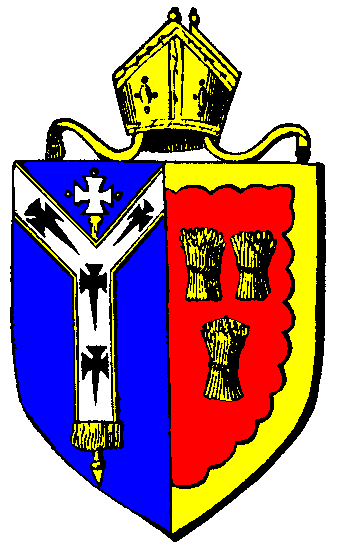
, the bordure usually stops at the partition line and does not run down it, as shown in the arms of Kemp as Archbishop of Canterbury in the 15th century; this rule is considered a relic of the older practice of dimidiationDimidiationIn heraldry, dimidiation is a method of joining two coats of arms.For a time, dimidiation preceded the method known as impalement. Whereas impalement involves placing the whole of both coats of arms side by side in the same shield, dimidiation involves placing the dexter half of one coat of arms...
. However, a notable exception to this rule can be seen in the arms of Thomas de Holland, Duke of SurreyThomas Holland, 1st Duke of SurreyThomas Holland, 1st Duke of Surrey, 3rd Earl of Kent, 4th Baron Holland, KG, Earl Marshal was an English nobleman.-Early life and family:...
(a nephew of Richard IIRichard II of EnglandRichard II was King of England, a member of the House of Plantagenet and the last of its main-line kings. He ruled from 1377 until he was deposed in 1399. Richard was a son of Edward, the Black Prince, and was born during the reign of his grandfather, Edward III...
) from a drawing of his seal, 1399, showing a differencing of a full bordure ermine, and a full bordure argent. - A chiefChief (heraldry)In heraldic blazon, a chief is a charge on a coat of arms that takes the form of a band running horizontally across the top edge of the shield. Writers disagree in how much of the shield's surface is to be covered by the chief, ranging from one-fourth to one-third. The former is more likely if the...
overlies a bordure, unless the bordure is added to a coat that previously included a chief, or so it is often said. In practice, the order in which things are to overlie each other can usually be inferred from the blazon. For example, in the arms of Amber Valley Borough Council, the blazon describes the bordure before the chief, and the bordure does not surround the chief; while in the arms of the British Columbia Institute of Technology, the blazon specifies a chief ... within a bordure.
Like any ordinary or other charge, a bordure may be of a single plain tincture
Tincture (heraldry)
In heraldry, tinctures are the colours used to emblazon a coat of arms. These can be divided into several categories including light tinctures called metals, dark tinctures called colours, nonstandard colours called stains, furs, and "proper". A charge tinctured proper is coloured as it would be...
or divided
Variation of the field
In heraldry, variations of the field are any of a number of ways that a field may be covered with a pattern, rather than a flat tincture or a simple division of the field.- Patterning with ordinaries and subordinaries :...
. Like any ordinary, it may be smooth or subjected to any of the lines of variation
Line (heraldry)
The lines of partition used to divide and vary fields and charges in heraldry are by default straight, but may have many different shapes. Care must sometimes be taken to distinguish these types of lines from the extremely unusual and non-traditional use of lines as charges, and to distinguish...
; it may form a field for other charges. These variations are effectively exploited in the Scottish system of cadency
Cadency
In heraldry, cadency is any systematic way of distinguishing similar coats of arms belonging to members of the same family. Cadency is necessary in heraldic systems in which a given design may be owned by only one person at once...
.
Since it is very often used for cadency
Cadency
In heraldry, cadency is any systematic way of distinguishing similar coats of arms belonging to members of the same family. Cadency is necessary in heraldic systems in which a given design may be owned by only one person at once...
rather than to distinguish between original coats, the bordure is not strictly held to the rule of tincture
Rule of tincture
The first rule of heraldic design is the rule of tincture: metal should not be put on metal, nor colour on colour . This means that Or and argent may not be placed on each other; nor may any of the colours be placed on another colour...
; for example, many cadets of the French royal house, for example, bore red bordures on a blue field. Rarely a bordure is of the same tincture as the field on which it lies; in this case the term "embordured" is employed. This was a very unusual practice even centuries ago and is all but unheard-of today.
A bordure semy of some charge is shown as if it were charged with a great number of those charges, rather than the practice typical with a field, in which some of the charges are shown as "cut off" by the edges of the field. This large number is to be taken as semy, and not as the precise number shown.
The bordure has no diminutive, though a bordure diminished is occasionally employed - as in 'Or; a diminished bordure vert; on a chief indented azure, two fleurs de lys or' (127th Field Artillery, USA). There is an example in blazon of "a narrow bordure" - Or; representations of two San human figures of red ochre, statant respectant, the hands of the innermost arms clasped, with upper arm, inner wrist, waist and knee bands argent; and a narrow border of red ochre (Republic of South Africa)