
All Topics  
Bonus Army

 
Bonus Army

   Email Print
   Bookmark   Link


Bonus Army


The self-named Bonus Expeditionary Force was an assemblage of some 43,000 marchers — 17,000 World War I
World War I

World War I, or the First World War , was a global military conflict which involved the Great powers, organized into two opposing military alliances: the Allies of World War I and the Central Powers....
 veterans, their families, and affiliated groups, who protested in Washington, D.C., in spring and summer of 1932. Called the Bonus March by the news media, the Bonus Marchers were more popularly known as the Bonus Army. The war veterans sought immediate, cash payment of Service Certificates granted them eight years earlier via the Adjusted Service Certificate Law
Adjusted Service Certificate Law

The Adjusted Service Certificate Law is a United States federal law passed in 1924 that granted veterans of World War I "bonus" certificates the following year that would be redeemable after a maturation period of 20 years for United States dollar1 dollar in cash for each day served in the United States and $1.25 dollars for each day served a...
 of 1924.


Discussion
Ask a question about 'Bonus Army'
Start a new discussion about 'Bonus Army'
Answer questions from other users
Full Discussion Forum


Recent Posts


Encyclopedia


The self-named Bonus Expeditionary Force was an assemblage of some 43,000 marchers — 17,000 World War I
World War I

World War I, or the First World War , was a global military conflict which involved the Great powers, organized into two opposing military alliances: the Allies of World War I and the Central Powers....
 veterans, their families, and affiliated groups, who protested in Washington, D.C., in spring and summer of 1932. Called the Bonus March by the news media, the Bonus Marchers were more popularly known as the Bonus Army. The war veterans sought immediate, cash payment of Service Certificates granted them eight years earlier via the Adjusted Service Certificate Law
Adjusted Service Certificate Law

The Adjusted Service Certificate Law is a United States federal law passed in 1924 that granted veterans of World War I "bonus" certificates the following year that would be redeemable after a maturation period of 20 years for United States dollar1 dollar in cash for each day served in the United States and $1.25 dollars for each day served a...
 of 1924. Each Service Certificate, issued to a qualified veteran soldier, bore a face value equal to the soldier's promised payment, plus compound interest
Compound interest

Compound interest is the concept of adding accumulated interest back to the principal, so that interest is earned on interest from that moment on....
. The problem was that the certificates (like bonds), matured twenty years from the date of original issuance, thus, under extant law, the Service Certificates were un-redeemable until 1945.

The Bonus Army was led by Walter W. Waters
Walter W. Waters

Walter W. Waters of Portland, Oregon, was a former Army Sergeant in the United States Army who, in May 1932, led the 10,000-strong army of World War I veterans called the Bonus Army on their march to Washington, D.C.....
, a former Army sergeant, and was encouraged in their demand for immediate cash-payment redemption of their service certificates by retired U.S.M.C. Maj. Gen. Smedley Butler
Smedley Butler

Smedley Darlington Butler , nicknamed "The Fighting Quaker" and "Old Gimlet Eye", was a Major general in the United States Marine Corps and, at the time of his death, the most decorated Marine in U.S....
, one of the most popular military figures of the time.

The practice of war-time military bonuses began in 1776, as payment for the difference between what a soldier earned and what he could have earned had he not enlisted. Before World War One, the soldier's military service bonus (adjusted for rank) was land and money — a Continental Army
Continental Army

The American Continental Army was an army formed after the outbreak of the American Revolutionary War by the colonies that became the United States. Established by a resolution of the Continental Congress on June 15, 1775, the army was created to coordinate the military efforts of the Thirteen Colonies in their struggle against the rule of Kingdom...
 private received and $80.00 at war's end while a Maj. Gen. received . In 1855, Congress increased the land-grant minimum to , and reduced the eligibility requirements to fourteen days of military service, or one battle; moreover, the bonus also applied to veterans of any Indian war. Breaking with tradition, the veterans of the Spanish-American War
Spanish-American War

The Spanish?American War was an armed military conflict between Spain and the United States that took place between April and August 1898, over the issues of the liberation of Cuba....
 did not receive a bonus, and, after World War One, their not receiving a military service bonus became a political matter when WWI veterans received only a $60 bonus. In 1919, the American Legion
American Legion

The American Legion was chartered by the U.S. Congress as a patriotic, mutual-help, wartime veterans list of veterans' organizations of the Military of the United States who served during a wartime period as defined by Congress....
 was created, and led a political movement for an additional bonus.

In 1924, over-riding President Calvin Coolidge
Calvin Coolidge

John Calvin Coolidge, Jr. was the List of Presidents of the United States President of the United States . A Republican Party lawyer from Vermont, Coolidge worked his way up the ladder of Massachusetts state politics, eventually becoming governor of that state....
's veto, Congress legislated compensation for veterans to recognize their war-time suffering: receive a dollar for each day of domestic service, to a maximum of $500; and $1.25 for each day of overseas service, to a maximum of $625. Amounts owed of $50 or less were immediately paid; greater sums were issued as certificates of service maturing in 20 years.

Some 3,662,374 military service certificates were issued, with a face value of $3.638 billion. Congress established a trust fund to receive 20 annual payments of $112 million that, with interest, would finance the $3.638 billion dollars owed to the veterans in 1945. Meanwhile, veterans could borrow up to 22.5% of the certificate's face value from the fund. In 1931, because of the Great Economic Depression, Congress increased the loan value to 50 per cent of the certificate's face value; yet, by April 1932, loans amounting to $1.248 billion dollars had been paid, leaving a $2.36-billion-dollar deficit. Although there was Congressional support for the immediate redemption (payment) of the military service certificates, President Hoover and Republican congressmen opposed that, because it would negatively affect the Federal Government's budget and Depression-relief programmes. Meanwhile, veterans organisations pressed the Federal Government to allow the early redemption of their military service certificates.

Arrival in Washington

The Bonus Army massed at the United States Capitol
United States Capitol

The United States Capitol serves as the seat of government for the United States Congress, the legislature of the federal government of the United States....
 on June 17 as the U.S. Senate
United States Senate

The United States Senate is the upper house of the Bicameralism United States Congress, the lower house being the United States House of Representatives....
 voted on the Patman
Wright Patman

John William Wright Patman was a U.S. Congressman from Texas in Texas's 1st congressional district and chair of the United States House Committee on Banking and Currency....
 Bonus Bill, which would have moved forward the date when World War I veterans received a cash bonus. Most of the Bonus Army camped in a Hooverville
Hooverville

A Hooverville was the popular name for shanty towns built by homeless men during the Great Depression. They were named after the President of the United States at the time, Herbert Hoover, because he allegedly let the nation slide into depression....
 on the Anacostia Flats, then a swampy, muddy area across the Anacostia River
Anacostia River

The Anacostia River is a river that flows about 8.4 mi from Prince George's County, Maryland in Maryland, United States and through Washington, D.C....
 from the federal core of Washington. The camps, built from materials scavenged from a nearby rubbish dump, were tightly controlled by the veterans with streets laid out, sanitation facilities built and parades held daily. To live in the camps, veterans were required to register and prove they had been honorably discharged. The protesters had hoped that they could convince Congress
United States Congress

The United States Congress is the Bicameralism legislature of the Federal government of the United States of the United States of America, consisting of two houses, the United States Senate and the United States House of Representatives....
 to make payments that would be granted to veterans immediately, which would have provided relief for the marchers who were unemployed due to the Depression. The bill had passed the House of Representatives on June 15 but was blocked in the Senate.

The U.S. Army intervenes


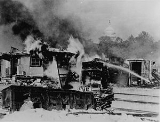
On 28 July, 1932, Attorney General Mitchell ordered the police evacuation of the Bonus Army veterans, who resisted; the police shot at them, and killed two. When told of the killings, President Hoover ordered the U.S. Army to effect the evacuation of the Bonus Army from Washington, D.C.

At 4:45 p.m., commanded by Gen. Douglas MacArthur
Douglas MacArthur

General of the Army Douglas MacArthur, Order of the Bath was an United States General officer, United Nations general and Field Marshal of the Philippine Army....
, the 12th Infantry Regiment
U.S. 12th Infantry Regiment

The 12th Infantry Regiment is a regiment of the United States Army. The Regiment has fought in seven wars from the American Civil War to Iraq War and has been awarded three Presidential Unit Citations, three Valorous Unit Awards and the Belgian Fourragere....
, Fort Howard, Maryland
Fort Howard (Maryland)

Fort Howard is the name of a former military installation in Baltimore County, Maryland, Maryland, near the present-day settlement of Fort Howard, Maryland....
, and the 3rd Cavalry Regiment, supported by six battle tanks commanded by Maj. George S. Patton
George S. Patton

George Smith Patton, Jr. was a distinguished though controversial United States Army officer.Commissioned in the army in 1909, Patton participated in the Pancho Villa Expedition to capture Pancho Villa in 1916-17....
, Fort Myer
Fort Myer

Fort Myer is a U.S. Army Military base adjacent to Arlington National Cemetery in Arlington County, Virginia, across the Potomac River from Washington, DC....
, Virginia, formed in Pennsylvania Avenue while thousands of Civil Service employees left work to line the street and watch the U.S. Army attack its own veterans. The Bonus Marchers, believing the display was in their honour, cheered the troops until Maj. Patton charged the cavalry against them — an action which prompted the Civil Service employee spectators to yell, "Shame! Shame!"

After the cavalry charge, infantry, with fixed bayonets and adamsite
Adamsite

Adamsite or DM is an organic compound; technically, an arsenical diphenylaminechlorarsine, that can be used as a riot control agent....
 gas, entered the Bonus Army camps, evicting veterans, families, and camp followers. The veterans fled across the Anacostia River, to their largest camp; President Hoover ordered the Army assault stopped, however, Gen. MacArthur—feeling this free-speech exercise was a Communist
Communism

Communism is a socioeconomic structure and political ideology that promotes the establishment of an egalitarianism, classlessness, stateless society based on common ownership and control of the means of production and property in general....
 attempt at overthrowing the U.S. Government—ignored the President and ordered a new attack. Hundreds of veterans were injured, several were killed — including William Hushka
William Hushka

William Hushka was an immigration to the United States from Lithuania. When the U.S. entered World War I in 1917, he sold his butcher shop in St....
 and Eric Carlson
Eric Carlson

Eric Carlson was a US veteran from Oakland, California. He fought in the trenches of France in World War I. He participated during the height of the Depression in a rally for veterans benefits in Washington DC called the Bonus march....
; a veteran's wife miscarried; and many other veterans were hurt.

The Posse Comitatus Act
Posse Comitatus Act

The Posse Comitatus Act is a United States federal law passed on June 16, 1878 after the end of Reconstruction era of the United States, with the intention of substantially limiting the powers of the federal government to use the military for law enforcement....
 — forbidding civilian police work by the U.S. military — did not apply to Washington, D.C., because it is the federal district directly governed by the U.S. Congress (U.S. Constitution, Article I. Section 8. Clause 17)
Article One of the United States Constitution

Article One of the United States Constitution describes the powers of the legislature of the Federal government of the United States, known as United States Congress, which includes the United States House of Representatives and the United States Senate....
. The exemption was created because of an earlier "Bonus March". In 1781, most of the Continental Army
Continental Army

The American Continental Army was an army formed after the outbreak of the American Revolutionary War by the colonies that became the United States. Established by a resolution of the Continental Congress on June 15, 1775, the army was created to coordinate the military efforts of the Thirteen Colonies in their struggle against the rule of Kingdom...
 was demobilised
Demobilization

Demobilization is the process of standing down a nation's armed forces from combat-ready status. This may be as a result of victory in war, or because a crisis has been peacefully resolved and military force will not be necessary....
 without pay, two years later, in 1783, hundreds of Pennsylvania war veterans marched on Philadelphia, surrounded the State House wherein Congress was in session, and demanded their pay. The U.S. Congress fled to Princeton, New Jersey, and, several weeks later, the U.S. Army expelled the war veterans back to home, out of the national capital.

An infant, Bernard Myers, later died in the hospital after the incident but reports indicated the death was not caused by the evacuation of the BEF.

Aftermath

A movie, Gabriel Over the White House
Gabriel Over the White House

Gabriel Over the White House is a 1933 in film film depicting a fictional President of the United States who has a religious experience and attempts to solve his country's problems through authoritarianism means....
, was released by MGM in March 1933 that depicted the Bonus March, but with a more positive outcome. Produced by William Randolph Hearst
William Randolph Hearst

William Randolph Hearst I was an United States History of American newspapers Business magnate and leading newspaper publisher. The son of self-made millionaire George Hearst, he became aware that his father received a northern California newspaper, The San Francisco Examiner, as payment of a gambling debt....
’s Cosmopolitan Pictures, it concerned the actions of "President Hammond" who ends the depression and solves the marchers' problems through authoritarian means, which result in a stable economy, elimination of crime, and creation of world peace.

Following his election, President Franklin D. Roosevelt
Franklin D. Roosevelt

Franklin Delano Roosevelt , often referred to by his initials FDR, was the List of Presidents of the United States President of the United States....
 did not want to pay the bonus early either, but handled the veterans with more skill. In March 1933, Roosevelt issued an executive order allowing the enrollment of 25,000 veterans in the Civilian Conservation Corps
Civilian Conservation Corps

File:CCC constructing road.gifThe Civilian Conservation Corps was a public work relief program for unemployed men, focused on natural resource conservation from 1933 to 1942....
 for work in forests. When they marched on Washington again in May 1933, he sent his wife Eleanor
Eleanor Roosevelt

Anna Eleanor Roosevelt was First Lady of the United States from 1933 to 1945. She supported the New Deal policies of her husband, President Franklin D....
 to chat with the vets and pour coffee with them, and she persuaded many of them to sign up for jobs making a roadway to the Florida Keys
Florida Keys

The Florida Keys are an archipelago of about 1700 islands in the southeast United States. They begin at the southeastern tip of the Florida peninsula, about south of Miami, Florida, and extend in a gentle arc south-southwest and then westward to Key West, Florida, the westernmost of the inhabited islands, and on to the uninhabited Dry Tort...
, which was to become the Overseas Highway
Overseas Highway

The Overseas Highway is a long road carrying U.S. Route 1 through the Florida Keys. Large parts of it were built on the former Right-of-way of the Overseas Railroad, the Key West, Florida Extension of the Florida East Coast Railway....
, the southernmost portion of U.S. 1
U.S. Route 1 in Florida

U.S. Route 1 in Florida runs along that state's east coast from Key West to Jacksonville, FL. At Jacksonville it turns northwest, crossing the St....
. On September 2, the disastrous Labor Day Hurricane of 1935
Labor Day Hurricane of 1935

The Labor Day Hurricane of 1935 was the strongest tropical cyclone during the 1935 Atlantic hurricane season. The second tropical cyclone, second hurricane, and second Saffir-Simpson Hurricane Scale of the season was the most intense List of Category 5 Atlantic hurricanes that affected the United States, and it was the first of three Category...
 killed 258 veterans working on the Highway. After seeing more newsreels of veterans giving their lives for a government that had taken them for granted, public sentiment built up so much that Congress could no longer afford to ignore it in an election year (1936). Roosevelt's veto
Veto

A veto, Latin for "I forbid", is used to denote that a certain party has the right to stop unilaterally a piece of legislation. In practice, the veto can be absolute or limited ...
 was overridden, making the bonus a reality.

Perhaps the Bonus Army's greatest accomplishment was the piece of legislation known as the G. I. Bill of Rights. Passed in July, 1944, it immensely helped veterans from the Second World War
World War II

World War II, or the Second World War , was a global military conflict which involved a Participants in World War II, including all of the great powers, organised into two opposing military alliances: the Allies of World War II and the Axis powers....
 to secure needed assistance from the federal government to help them fit back into civilian life, something the World War I veterans of the Bonus Army had not received. The Bonus Army's activities can also be seen as a template for the March on Washington for Jobs and Freedom in 1963, and popular political demonstrations and activism that took place in the U.S. later in the 20th century.

See also

  • The Great Depression
  • General Smedley Butler
    Smedley Butler

    Smedley Darlington Butler , nicknamed "The Fighting Quaker" and "Old Gimlet Eye", was a Major general in the United States Marine Corps and, at the time of his death, the most decorated Marine in U.S....
     (spoke in favor of the Bonus Army)
  • Adjusted Service Certificate Law
    Adjusted Service Certificate Law

    The Adjusted Service Certificate Law is a United States federal law passed in 1924 that granted veterans of World War I "bonus" certificates the following year that would be redeemable after a maturation period of 20 years for United States dollar1 dollar in cash for each day served in the United States and $1.25 dollars for each day served a...
  • List of protest marches on Washington, DC
  • On-to-Ottawa Trek
    On-to-Ottawa Trek

    The On-to-Ottawa Trek was a 1935 social movement of unemployed men protesting the dismal conditions in federal relief camps scattered in remote areas across Western Canada....
  • Whiskey Rebellion
    Whiskey Rebellion

    The Whiskey Rebellion, less commonly known as the Whiskey Insurrection, was a popular uprising that had its beginnings in 1791 and culminated in an insurrection in 1794 in the locality of Washington, Pennsylvania, in the Monongahela River....
  • Tiananmen Square protests of 1989
    Tiananmen Square protests of 1989

    The Tiananmen Square protests of 1989 culminating in the Tiananmen Square Massacre were a series of demonstrations in and near Tiananmen Square in Beijing in the People's Republic of China beginning on April 14....
  • Dames
    Dames

    Dames is a Warner Bros. musical film comedy film directed by Ray Enright with dance numbers created by Busby Berkeley and George M. Cohan. The film stars Ruby Keeler, Dick Powell, Joan Blondell, Guy Kibbee, Zasu Pitts, and Hugh Herbert....


Further reading

  • Collins, Dennis (2006). Nora's Army, Washington Writers' Publishing House. ISBN 0-931846-83-8.
  • Dickson, Paul and Thomas B. Allen (2004). The Bonus Army: An American Epic, Walker and Company. ISBN 0-8027-1440-4.
  • Dickson, Paul and Thomas B. Allen. "Marching On History". Smithsonian, February 2003.


External links

  • from
  • , a call for a "new Bonus Army"
  • from
  • , Library of Congress