


Bocal

Encyclopedia
Mouthpiece (woodwind)
The mouthpiece of a woodwind instrument is that part of the instrument which is placed partly in the player's mouth. Single-reed instruments, capped double-reed instruments, and fipple flutes have mouthpieces while exposed double-reed instruments and open flutes do not.-Single-reed instruments:On...
of a woodwind instrument
Woodwind instrument
A woodwind instrument is a musical instrument which produces sound when the player blows air against a sharp edge or through a reed, causing the air within its resonator to vibrate...
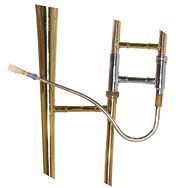
. It's a curved, tapered tube
Cylinder (geometry)
A cylinder is one of the most basic curvilinear geometric shapes, the surface formed by the points at a fixed distance from a given line segment, the axis of the cylinder. The solid enclosed by this surface and by two planes perpendicular to the axis is also called a cylinder...
, which is an integral part of certain woodwind instruments, including double reed instruments such as the bassoon
Bassoon
The bassoon is a woodwind instrument in the double reed family that typically plays music written in the bass and tenor registers, and occasionally higher. Appearing in its modern form in the 19th century, the bassoon figures prominently in orchestral, concert band and chamber music literature...
, contrabassoon
Contrabassoon
The contrabassoon, also known as the double bassoon or double-bassoon, is a larger version of the bassoon, sounding an octave lower...
, English horn
Cor anglais
The cor anglais , or English horn , is a double-reed woodwind instrument in the oboe family....
, and oboe d'amore
Oboe d'amore
The oboe d'amore , less commonly oboe d'amour, is a double reed woodwind musical instrument in the oboe family. Slightly larger than the oboe, it has a less assertive and more tranquil and serene tone, and is considered the mezzo-soprano of the oboe family, between the oboe itself and the cor...
, as well as the larger recorder
Recorder
The recorder is a woodwind musical instrument of the family known as fipple flutes or internal duct flutes—whistle-like instruments which include the tin whistle. The recorder is end-blown and the mouth of the instrument is constricted by a wooden plug, known as a block or fipple...
s. In the double reed instruments, the bocal connects the reed
Reed (instrument)
A reed is a thin strip of material which vibrates to produce a sound on a musical instrument. The reeds of most Woodwind instruments are made from Arundo donax or synthetic material; tuned reeds are made of metal or synthetics.-Single reeds:Single reeds are used on the mouthpieces of clarinets...
to the rest of the instrument; in the case of larger recorders, the bocal directs air from the player's mouth to the fipple
Fipple
A fipple is a constricted mouthpiece common to many end-blown woodwind instruments, such as the tin whistle and the recorder. These instruments are known variously as fipple flutes, duct flutes, or tubular-ducted flutes.-How it works:...
. Bocals can be made from a variety of metals, including nickel silver
Nickel silver
Nickel silver, also known as German silver, Argentann, new silver, nickel brass, albata,, or alpacca, is a copper alloy with nickel and often zinc. The usual formulation is 60% copper, 20% nickel and 20% zinc. Nickel silver is named for its silvery appearance, but it contains no elemental silver...
, brass
Brass
Brass is an alloy of copper and zinc; the proportions of zinc and copper can be varied to create a range of brasses with varying properties.In comparison, bronze is principally an alloy of copper and tin...
, sterling silver
Silver
Silver is a metallic chemical element with the chemical symbol Ag and atomic number 47. A soft, white, lustrous transition metal, it has the highest electrical conductivity of any element and the highest thermal conductivity of any metal...
, or even gold
Gold
Gold is a chemical element with the symbol Au and an atomic number of 79. Gold is a dense, soft, shiny, malleable and ductile metal. Pure gold has a bright yellow color and luster traditionally considered attractive, which it maintains without oxidizing in air or water. Chemically, gold is a...
, and are covered at the lower end with a cork
Cork (material)
Cork is an impermeable, buoyant material, a prime-subset of bark tissue that is harvested for commercial use primarily from Quercus suber , which is endemic to southwest Europe and northwest Africa...
sleeve, allowing the bocal to fit tightly in the socket at the top of the instrument. More recently, at least one maker is producing bocals made of hardwood . The reed either fits directly on to the tapered end of the bocal (as with the bassoon) or is tied to a metal tube which fits to the bocal (as with the English horn).
Since the early days, the bassoon bocal invariably has had a small hole drilled in the side just above the cork to assist in overblowing
Overblowing
Overblowing A technique used while playing a wind instrument which, primarily through manipulation of the supplied air , causes the sounded pitch to jump to a higher one...
at the octave
Octave
In music, an octave is the interval between one musical pitch and another with half or double its frequency. The octave relationship is a natural phenomenon that has been referred to as the "basic miracle of music", the use of which is "common in most musical systems"...
. On baroque and Classical-era bassoons, this hole is very small in diameter and remains open all the time. On bassoons fitted with a "whisper" or "pianissimo" key (post 1900), the hole vents through a raised "nipple" and can be closed as needed to facilitate the response in the lower register.
Bocals are made in varying lengths, often with markings such as "1", "2" and "3", which allow the instrument to be played at higher or lower pitch levels.
Bocals for larger sizes of recorder sometimes include a valve to remove condensation and sometimes are adjustable to permit playing while seated or standing. Recorder players blow directly into a bocal and its length has no influence on pitch
Pitch (music)
Pitch is an auditory perceptual property that allows the ordering of sounds on a frequency-related scale.Pitches are compared as "higher" and "lower" in the sense associated with musical melodies,...
.
In England, the term crook is much more commonly used (see: Crook (music)
Crook (music)
A crook, also sometimes called a shank, is an exchangeable segment of tubing in a natural horn which is used to change the length of the pipe, altering the fundamental pitch and harmonic series which the instrument can sound, and thus the key in which it plays.-Master crook and coupler...
).