
Home      Discussion      Topics      Dictionary      Almanac
Signup       Login
Blue-tongued lizard

Blue-tongued lizard

Discussion
Ask a question about 'Blue-tongued lizard'
Start a new discussion about 'Blue-tongued lizard'
Answer questions from other users
Full Discussion Forum
 
Encyclopedia
Blue-tongued skinks comprise the Australasian genus
Genus
In biology, a genus is a taxonomic unit used in the classification of living and fossil organisms. The term comes from Latin genus "descent, family, type, gender" , cognate with – genos, "race, stock, kin" ..In addition, genus is a taxonomic rank in the hierarchy In biology, a genus (plural:...

, Tiliqua, which contains some of the largest members of the skink
Skink
Skinks are the most diverse group of lizards. They make up the family Scincidae which shares the superfamily or infraorder Scincomorpha with several other lizard families, including Lacertidae...

 family
Family (biology)
In biological classification, family is* a taxonomic rank. Other well-known ranks are life, domain, kingdom, phylum, class, order, genus, and species, with family fitting between order and genus...

 (Scincidae). They are commonly called blue-tongued lizards or simply blue-tongues in Australia
Australia
Australia , officially the Commonwealth of Australia, is a country in the Southern Hemisphere comprising the continental mainland , the island of Tasmania, and numerous smaller islands in the Indian and Pacific Oceans...

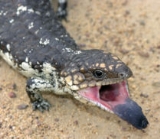
. As suggested by these common names, a prominent characteristic of the genus is a large blue tongue that can be bared as a bluff-warning to potential enemies.

Systematics


Blue-tongued skinks are closely related to the genera Cyclodomorphus
Cyclodomorphus
Cyclodomorphus is a genus of small to medium-sized skinks . It belongs to the Egernia group which also includes the Blue-tongued skinks .-Species:*Cyclodomorphus branchialis...

and Hemisphaeriodon
Hemisphaeriodon
Pink-tongued skinks are the genus Hemisphaeriodon, which contains some of the largest members of the skink family . They are called commonly pink-tongued lizards in Australia, where true lizards do not naturally occur...

. All species are found on mainland Australia with the exception of Tiliqua gigas which occurs in New Guinea
New Guinea
New Guinea, located north of Australia, is the world's second largest island. It became separated from the Australian mainland when the area now known as the Torres Strait flooded after the last glacial period. The name Papua has long been associated with the island...

 and various islands of Indonesia
Indonesia
The Republic of Indonesia is a country in Southeast Asia and Oceania. Indonesia comprises 17,508 islands. With an estimated population of around 237 million people, it is the world's fourth most populous country, with the world's largest population of Muslims.Indonesia is a republic, with an...

. One subspecies
Subspecies
Subspecies in biological classification, is 1) a taxonomic rank subordinate to species, or 2) a taxonomic unit, a taxon in that rank...

 of Tiliqua scincoides is also found on several small Indonesian islands between Australia and New Guinea
New Guinea
New Guinea, located north of Australia, is the world's second largest island. It became separated from the Australian mainland when the area now known as the Torres Strait flooded after the last glacial period. The name Papua has long been associated with the island...

. Tiliqua nigrolutea is the only species present in Tasmania
Tasmania
Tasmania is an Australian island and state. It is located south of the eastern side of the continent, from which it is separated by Bass Strait. The state includes the island of Tasmania – the 26th largest island in the world – and the surrounding islands. The state has a population of 500,000 ,...

. With the exception of the pygmy blue-tongue, they are relatively large lizards (up to 37 cm total length), light-bodied, short-limbed, broad with a distinct head and dull teeth.

Ecology


Most species are diurnal
Diurnal
Diurnal may refer to:* Diurnality, the behavior of an animal that is active in the daytime* Diurnal motion, the apparent motion of stars around the Earth* Diurnal phase shift, a phase shift of electromagnetic signals...

 ground-foraging omnivores, feeding on a wide variety of insects, gastropods, flowers, fruits and berries . The pygmy blue-tongue is again the exception, being primarily an ambush predator of terrestrial arthropods . All are viviparous, with litter sizes ranging from 1-4 in the pygmy blue-tongue and shingleback to 5-24 in the eastern and northern blue-tongues .

Species and subspecies

  • Tiliqua adelaidensis, (Adelaide) Pygmy Blue-tongued Skink
  • Tiliqua gigas, Indonesian Blue-tongued Skink
    • Tiliqua gigas evanescens, Merakue Blue-tongued Skink
    • Tiliqua gigas keyensis, Key Island Blue-tongued Skink
  • Tiliqua multifasciata, Centralian Blue-tongued Skink
  • Tiliqua nigrolutea, Blotched Blue-tongued Skink
  • Tiliqua occipitalis, Western Blue-tongued Skink
  • Tiliqua rugosa, Shingleback (or Bobtail) Skink
    • Tiliqua rugosa rugosa, Common Shingleback Skink
    • Tiliqua rugosa aspera, Eastern Shingleback Skink
    • Tiliqua rugosa palarra, Shark Bay
      Shark Bay, Western Australia
      Shark Bay is a world heritage site in the Gascoyne region of Western Australia. It is an area centered approximately on , 800 kilometres north of Perth, on the westernmost point of Australia. An expedition led by Dirk Hartog happened upon the area in 1616, becoming the second group of Europeans...

       Shingleback Skink
    • Tiliqua rugosa konowi, Rottnest Island
      Rottnest Island
      Rottnest Island is located 18 km off the coast of Western Australia, near Fremantle. It is called Wadjemup by the Noongar people, meaning "place across the water". The island is 11 kilometres long, and 4.5 kilometres at its widest point with a total land area of 19 km². It is classified as an A...

       Shingleback Skink
  • Tiliqua scincoides, Australian Blue-tongued Skink
    • Tiliqua scincoides scincoides, Eastern Blue-tongued Skink
    • Tiliqua scincoides intermedia, Northern Blue-tongued Skink
      Northern Blue-tongued Skink
      Northern Blue-tongued Skinks are the largest and heaviest of the Blue-tongued Lizards . They are native to Australia and found almost exclusively in the Northern Region...

    • Tiliqua scincoides chimaerea, Tanimbar Blue-tongued Skink

External links