
All Topics  
Black Eye Galaxy

 
Black Eye Galaxy

   Email Print
   Bookmark   Link


Black Eye Galaxy


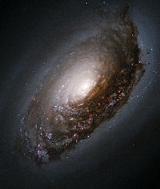
The Black Eye Galaxy (also called Sleeping Beauty Galaxy; designated Messier 64, M64, or NGC 4826) was discovered by Edward Pigott
Edward Pigott

Edward Pigott was an England astronomer, and the son of astronomer Nathaniel Pigott and Anna Mathurine de B?riot . Probably born in Whitton, Middlesex, his elder brother, Charles Gregory, died in young age....
 in March 1779, and independently by Johann Elert Bode
Johann Elert Bode

Johann Elert Bode was a Germany astronomer known for his reformulation and popularization of the Titius-Bode law. Bode determined the orbit of Uranus and suggested the planet's name....
 in April of the same year, as well as by Charles Messier
Charles Messier

Charles Messier was a France astronomy most notable for publishing an astronomical catalog consisting of deep sky objects such as nebulae and star clusters that came to be known as the 103 "Messier objects"....
 in 1780. It has a spectacular dark band of absorbing dust in front of the galaxy's bright nucleus, giving rise to its nicknames of the "Black Eye" or "Evil Eye" galaxy.


Discussion
Ask a question about 'Black Eye Galaxy'
Start a new discussion about 'Black Eye Galaxy'
Answer questions from other users
Full Discussion Forum


Encyclopedia


The Black Eye Galaxy (also called Sleeping Beauty Galaxy; designated Messier 64, M64, or NGC 4826) was discovered by Edward Pigott
Edward Pigott

Edward Pigott was an England astronomer, and the son of astronomer Nathaniel Pigott and Anna Mathurine de B?riot . Probably born in Whitton, Middlesex, his elder brother, Charles Gregory, died in young age....
 in March 1779, and independently by Johann Elert Bode
Johann Elert Bode

Johann Elert Bode was a Germany astronomer known for his reformulation and popularization of the Titius-Bode law. Bode determined the orbit of Uranus and suggested the planet's name....
 in April of the same year, as well as by Charles Messier
Charles Messier

Charles Messier was a France astronomy most notable for publishing an astronomical catalog consisting of deep sky objects such as nebulae and star clusters that came to be known as the 103 "Messier objects"....
 in 1780. It has a spectacular dark band of absorbing dust in front of the galaxy's bright nucleus, giving rise to its nicknames of the "Black Eye" or "Evil Eye" galaxy. M64 is well known among amateur astronomer
Amateur astronomy

Amateur astronomy, a subset of astronomy, is a hobby whose participants enjoy studying and observing celestial objects....
s because of its appearance in small telescope
Telescope

A telescope is an instrument designed for the observation of remote objects by the collection of electromagnetic radiation. The first known practically functioning telescopes were invented in the Netherlands at the beginning of the 17th century....
s. It is a spiral galaxy
Spiral galaxy

A spiral galaxy is a galaxy belonging to one of the three main galaxy morphological classification originally described by Edwin Hubble in his 1936 work ?The Realm of the Nebulae? and, as such, forms part of the Hubble sequence....
 in the Coma Berenices constellation
Coma Berenices

Coma Berenices...
.

General information

At first glance, M64 seems to be a fairly normal spiral galaxy. As in the majority of galaxies, all of the stars in M64 are orbiting in the same direction, clockwise as seen in the Hubble image.

However, recent detailed studies have led to the remarkable discovery that the interstellar gas in the outer regions of M64 rotates in the opposite direction from the gas and stars in the inner regions. The inner region has a radius of only approximately 3,000 light-years, while the outer section extends another 40,000 light-years. This pattern is believed to trigger the creation of many new stars around the boundary separating the two regions.

A collision of two galaxies has left a merged star system with an unusual appearance as well as bizarre internal motions. Astronomers believe that the oppositely rotating gas arose when M64 absorbed a satellite galaxy that collided with it, perhaps more than one billion years ago. Active formation of new stars is occurring in the shear region where the oppositely rotating gases collide, are compressed, and contract.

Particularly noticeable in the image are hot, blue young stars that have just formed, along with pink clouds of glowing hydrogen gas that fluoresce when exposed to ultraviolet
Ultraviolet

Ultraviolet light is electromagnetic radiation with a wavelength shorter than that of visible light, but longer than x-rays, in the range 400 nanometer to 10 nm, and energies from 3 Electron volt to 124 eV....
 light from newly formed stars. It is approximately 17 million light years from earth.

The small galaxy that impinged on its neighbour has now been almost completely destroyed, its stars either merged with the main galaxy or scattered into space, but signs of the collision persist in the backward motion of gas at the outer edge of M64.

External links