
Home      Discussion      Topics      Dictionary      Almanac
Signup       Login
Bill Sikes

Bill Sikes

Overview
William "Bill" Sikes is a fictional character
Fictional character
A character is the representation of a person in a narrative work of art . Derived from the ancient Greek word kharaktêr , the earliest use in English, in this sense, dates from the Restoration, although it became widely used after its appearance in Tom Jones in 1749. From this, the sense of...

 in the novel
Novel
A novel is a book of long narrative in literary prose. The genre has historical roots both in the fields of the medieval and early modern romance and in the tradition of the novella. The latter supplied the present generic term in the late 18th century....

 Oliver Twist
Oliver Twist
Oliver Twist; or, The Parish Boy's Progress is the second novel by English author Charles Dickens, published by Richard Bentley in 1838. The story is about an orphan Oliver Twist, who endures a miserable existence in a workhouse and then is placed with an undertaker. He escapes and travels to...

by Charles Dickens
Charles Dickens
Charles John Huffam Dickens was an English novelist, generally considered the greatest of the Victorian period. Dickens enjoyed a wider popularity and fame than had any previous author during his lifetime, and he remains popular, having been responsible for some of English literature's most iconic...

.
Discussion
Ask a question about 'Bill Sikes'
Start a new discussion about 'Bill Sikes'
Answer questions from other users
Full Discussion Forum
 
Unanswered Questions
Encyclopedia
William "Bill" Sikes is a fictional character
Fictional character
A character is the representation of a person in a narrative work of art . Derived from the ancient Greek word kharaktêr , the earliest use in English, in this sense, dates from the Restoration, although it became widely used after its appearance in Tom Jones in 1749. From this, the sense of...

 in the novel
Novel
A novel is a book of long narrative in literary prose. The genre has historical roots both in the fields of the medieval and early modern romance and in the tradition of the novella. The latter supplied the present generic term in the late 18th century....

 Oliver Twist
Oliver Twist
Oliver Twist; or, The Parish Boy's Progress is the second novel by English author Charles Dickens, published by Richard Bentley in 1838. The story is about an orphan Oliver Twist, who endures a miserable existence in a workhouse and then is placed with an undertaker. He escapes and travels to...

by Charles Dickens
Charles Dickens
Charles John Huffam Dickens was an English novelist, generally considered the greatest of the Victorian period. Dickens enjoyed a wider popularity and fame than had any previous author during his lifetime, and he remains popular, having been responsible for some of English literature's most iconic...

.

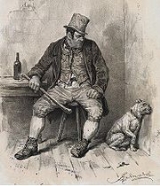
He is one of Dickens's most vicious characters and a very strong force in the novel when it comes to having control over somebody or harming others. He is portrayed as a rough and barbaric man. He is a career criminal
Crime
Crime is the breach of rules or laws for which some governing authority can ultimately prescribe a conviction...

 associated with Fagin
Fagin
Fagin is a fictional character who appears as an antagonist of the Charles Dickens novel Oliver Twist, referred to in the preface of the novel as a "receiver of stolen goods", but referred to more frequently within the actual story as the "merry old gentleman" or simply the "Jew".-Character:Born...

, and an eventual murderer. He is very violent and aggressive, prone to sudden bursts of extreme behaviour. He owns a bull terrier
Bull Terrier
The Bull Terrier or English Bull Terrier is a breed of dog in the terrier family. They are known for their large, egg-shaped head, small triangular eyes, and "jaunty gait." Their temperament has been described as generally fun-loving, active and clownish...

 named Bull's Eye, whom he beats until the dog needs stitches.

Dickens describes his first appearance:
His prostitute girlfriend Nancy tolerates his violent and lawless behaviour, perhaps because she, being a thief since the age of six, needs stability in her life, and because she believes that she loves him. However when he thinks Nancy has betrayed him, Sikes viciously murders her. The murder is especially gruesome and one of the most graphic, frightening scenes Dickens ever wrote. In the end a mob hounds him through the streets of London until he hangs himself while trying to escape. It is left ambiguous as to whether or not this was intentional
Suicide
Suicide is the act of intentionally causing one's own death. Suicide is often committed out of despair or attributed to some underlying mental disorder, such as depression, bipolar disorder, schizophrenia, alcoholism, or drug abuse...

.

Bill Sikes has almost no redeeming qualities, although Dickens does give him some shading: at the robbery in the countryside, Sikes, rather than leave Oliver at the scene of his botched burglary of Rose Maylie
Rose Maylie
Rose Fleming Maylie is a character in Charles Dickens's novel Oliver Twist. She is Oliver's maternal aunt.-Biography:Rose is an orphan raised from young childhood by Mrs. Maylie. Bill Sikes and Toby Crackit, two thieves, break into the Maylies' house, accompanied by Oliver. Oliver is shot by the...

's house, picks him up and bottles him in the face, he then rams him in his unconscious state. This, however, was as much for his own self-preservation, as he eventually does abandon the seriously wounded boy and shows absolutely no remorse about doing so. After he brutally beats Nancy to death, he apparently is capable of feeling guilt—although this is essentially suspicion that Fagin lied to him about her betrayal, and fear of the possibility of being caught. Sikes lives in Bethnal Green
Bethnal Green
Bethnal Green is a district of the East End of London, England and part of the London Borough of Tower Hamlets, with the far northern parts falling within the London Borough of Hackney. Located northeast of Charing Cross, it was historically an agrarian hamlet in the ancient parish of Stepney,...

 and later moves to the squalid rookery
Rookery (slum)
A rookery was the colloquial British English term given in the 18th and 19th centuries to a city slum occupied by poor people...

 area of London then called Jacob's Island
Jacob's Island
Jacob's Island was a notorious rookery in Bermondsey, on the south bank of the River Thames in London. It was separated from Shad Thames to the west by St Saviour's Dock, the point where the subterranean River Neckinger enters the Thames, and on the other two sides by tidal ditches, one just west...

, east of present-day Shad Thames
Shad Thames
Shad Thames is an historic riverside street next to Tower Bridge in Bermondsey, London, England, and is also an informal name for the surrounding area...

.

Bill Sikes sometimes has his name spelled Bill Sykes; it is unclear which spelling is correct according to Mr. Dickens. In the musical Oliver!
Oliver!
Oliver! is a British musical, with script, music and lyrics by Lionel Bart. The musical is based upon the novel Oliver Twist by Charles Dickens....

his name is spelled Sikes.