
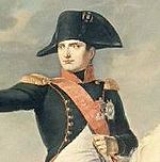
The
bicorne or
bicorn (two-cornered) is an archaic form of hat associated with the late 18th and early 19th centuries. Much worn by
EuropeEurope is, by convention, one of the world's seven continents. Comprising the westernmost peninsula of Eurasia, Europe is generally divided from Asia to its east by the water divide of the Ural Mountains, the Ural River, the Caspian Sea, the Caucasus Mountains , and the Black Sea to the southeast...
an and later American
militaryAn army An army An army (from Latin armata "armed (things)" via Old French armée, "armed" (feminine), in the broadest sense, is the land-based Military of a nation. It may also include other branches of the military such as the air force via means of aviation corps...
and
navalA navy is the branch of a nation's armed forces principally designated for naval warfare and amphibious warfare; namely, lake- or ocean-borne combat operations and related functions...
officersAn officer is a member of an armed force who holds a position of authority. Commissioned officers derive authority directly from a sovereign power and, as such, hold a commission charging them with the duties and responsibilities of a specific office or position...
, it is most readily associated with Napoléon Bonaparte. In practice most generals and staff officers of the Napoleonic period wore bicornes, and it survived as a widely worn full-dress headdress until at least 1914.
Descended from the
tricorneThe tricorne is a style of hat that was popular during the late 17th century and 18th century, falling out of style shortly before the French Revolution. At the peak of its popularity, the tricorne was worn as civilian dress and as part of military and naval uniforms...
, the black-coloured bicorne originally had a rather broad brim, with the front and the rear halves turned up and pinned together, forming a semi-circular fan shape; there was usually a
cockadeA cockade is a knot of ribbons, or other circular- or oval-shaped symbol of distinctive colors which is usually worn on a hat.-Cockades of the revolutionaries:...
in the national colours at the front. Later, the hat became more triangular in shape, its two ends became more pointed, and it was worn with the cockade at the right side. This kind of bicorne eventually became known in the English language as the
cocked hatThe cocked hat is a style of formal headgear, or hat, worn by certain civilian, military and naval officials from the early 19th century until the beginning of World War II....
, although to this day it is still known in the French language as the
bicorne.
Some forms of bicorne were designed to be folded flat, so that they could be conveniently tucked under the arm when not being worn. A bicorne of this style is also known as a
chapeau-bras or
chapeau-de-bras.
The bicorne was widely worn until
World War IWorld War I , also known as the First World War, the Great War, and the War to End All Wars, was a global military conflict which involved most of the world's great powers, assembled in two opposing alliances: the Triple Entente and the Triple Alliance...
as part of the full dress of officers of most of the world's navies. It survived to a more limited extent between the wars for wear by senior naval officers but has now almost disappeared in this context.
In addition to its military/naval uses, the bicorne was widely worn during the nineteenth and early twentieth centuries by civilian officials in European monarchies and Japan, when required to wear uniforms on formal occasions. This practice generally ceased after World War I but British colonial governors in temperate climates and governors general in some countries of the
CommonwealthThe Commonwealth of Nations, often referred to as the Commonwealth and previously as the British Commonwealth, is an intergovernmental organisation of fifty-three independent member states. Most of them were formerly part of the British Empire. They co-operate within a framework of common values...
(notably Australia, Canada and New Zealand) continued to wear bicornes with ceremonial dress until the second half of the twentieth century.
Current use
On formal occasions such as a prorogation speech, the
Lord ChancellorThe Lord High Chancellor of Great Britain, or Lord Chancellor, is a senior and important functionary in the government of the United Kingdom. He is the second highest ranking of the Great Officers of State, ranking only after the Lord High Steward. The Lord Chancellor is appointed by the Sovereign...
of the
United KingdomThe United Kingdom of Great Britain and Northern Ireland is a sovereign state located off the northwestern coast of continental Europe. It is an island country, spanning an archipelago including Great Britain, the northeastern part of Ireland, and many small islands...
wears a
tricorneThe tricorne is a style of hat that was popular during the late 17th century and 18th century, falling out of style shortly before the French Revolution. At the peak of its popularity, the tricorne was worn as civilian dress and as part of military and naval uniforms...
hat, but the other
Lords CommissionersThe Lords Commissioners are Privy Counsellors appointed by the Monarch of the United Kingdom to exercise, on his or her behalf, certain functions relating to Parliament, including the opening and prorogation of Parliament, the confirmation of a newly elected Speaker of the House of Commons and the...
wear bicorne hats.
Members of the
Académie françaiseL'Académie française, or the French Academy, is the pre-eminent French learned body on matters pertaining to the French language. The Académie was officially established in 1635 by Cardinal Richelieu, the chief minister to King Louis XIII. Suppressed in 1793 during the French Revolution, it was...
wear the
habit vert (green habit) at the Académie's ceremonies. The habit includes a black jacket and a
bicorne in the cocked-hat style, each embroidered in green.
Students at the
Ecole PolytechniqueThe École Polytechnique is the foremost French engineering school. Known for its extremely competitive entrance exam, it produces graduates that occupy outstanding positions in industry and research...
wear a bicorne as part of their
Grand Uniforme (GU). Female students used to wear a
tricorne hatThe tricorne is a style of hat that was popular during the late 17th century and 18th century, falling out of style shortly before the French Revolution. At the peak of its popularity, the tricorne was worn as civilian dress and as part of military and naval uniforms...
but now also wear a bicorne. The bicorne also formed part of the historic black and red full dress of cadets at the French Military Medical School ("Ecole de Sante des Armes") until this uniform was withdrawn in 1971, except for limited use on special occasions.
The uniform of the horsemen of the Spanish Riding School of Vienna includes a bicorne.
Diplomatic uniforms worn on such occasions as the presentation of credentials by
ambassadorAn ambassador is the highest ranking diplomat who represents their country. They are usually accredited to a foreign sovereign or government, or to an international organization, to serve as the official representative of their country....
s normally included bicornes worn with feathers and gold or silver braiding. Until
World War IIWorld War II, or the Second World War , was a global military conflict which involved a majority of the world's nations, including all great powers, organized into two opposing military alliances: the Allies and the Axis...
such uniforms were worn by even junior embassy staff but now survive only for ambassadors in a few long-established
diplomatic serviceDiplomatic service is the body of diplomats and foreign policy officers maintained by the government of a country to communicate with the governments of other countries. Diplomatic personnel enjoy diplomatic immunity when they are accredited to other countries...
s such as those of Britain, France, Belgium (see photo taken in 1994 of Ambassador Beyens with the Pope at http://www.klm-mra.be/klm-new/frans/pdf/vizier27/Cibles_27.pdf) and Spain.
At the annual
Trooping the ColourTrooping the Colour is a ceremony performed by regiments of the Commonwealth and the British Army. It has been a tradition of British infantry regiments since the 17th century, although the roots go back much earlier. On battlefields, a regiment's colours, or flags, were used as rallying points...
in London, British generals taking part in the ceremony wear the scarlet-and-blue full dress of their rank, which includes a bicorne. Certain officers of the
Brigade of GuardsThe Brigade of Guards is a historical elite unit of the British Army, which has existed sporadically since the 18th century....
who hold administrative positions such as that of quartermaster wear bicornes (described as
cocked hatThe cocked hat is a style of formal headgear, or hat, worn by certain civilian, military and naval officials from the early 19th century until the beginning of World War II....
s) in full dress instead of the usual
bearskinA bearskin is a tall fur cap, usually worn as part of a ceremonial military uniform. Traditionally, the bearskin was the headgear of grenadiers, and is still worn by grenadier and guards regiments in various armies.-Origins:...
.
See also
- List of hats and headgear
- Chapeau
"Chapeau" is a French term signifying a hat or other covering for the head. In heraldry, it is used as a mark of ecclesiastical dignity, especially that of cardinals, which is called the red chapeau...
- Tricorne
The tricorne is a style of hat that was popular during the late 17th century and 18th century, falling out of style shortly before the French Revolution. At the peak of its popularity, the tricorne was worn as civilian dress and as part of military and naval uniforms...
- Cocked hat
The cocked hat is a style of formal headgear, or hat, worn by certain civilian, military and naval officials from the early 19th century until the beginning of World War II....
- 1813 cartoon showing men with collapsible bicornes tucked under their arms