
| |
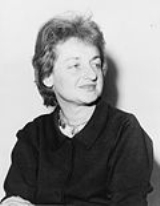
Betty Naomi Friedan (February 4, 1921 – February 4, 2006) was an American feminist activist and writer, best known for starting the "second wave of the Women's Movement" through the writing of her book The Feminine Mystique in 1963, which attacked the 1950s notion, spread through society by advertising and strict enforcement of traditional gender roles, that women could only find fulfilment in child bearing, doing housework, and serving husbands.

Discussion
Ask a question about 'Betty Friedan'
Start a new discussion about 'Betty Friedan'
Answer questions from other users
|
Quotations
It is easier to live through someone else than to become complete yourself.
Ch. 14 "A New Life Plan for Women"
The feminine mystique has succeeded in burying millions of American women alive.
Ch 13 "The Forfeited Self"
Instead of fulfilling the promise of infinite orgastic bliss, sex in the America of the feminine mystique is becoming a strangely joyless national compulsion, if not a contemptuous mockery.
Ch. 11 The Sex-Seekers
The problem that has no name (which is simply the fact that American women are kept from growing to their full human capacities) is taking a far greater toll on the physical and mental health of our country than any known disease.
Ch. 14 "A New Life Plan for Women"
A woman is handicapped by her sex, and handicaps society, either by slavishly copying the pattern of mans advance in the professions, or by refusing to compete with man at all.
Ch. 14 "A New Life Plan for Women"

Encyclopedia
Betty Naomi Friedan (February 4, 1921 – February 4, 2006) was an American feminist activist and writer, best known for starting the "second wave of the Women's Movement" through the writing of her book The Feminine Mystique in 1963, which attacked the 1950s notion, spread through society by advertising and strict enforcement of traditional gender roles, that women could only find fulfilment in child bearing, doing housework, and serving husbands. The book's success, and the reaction from dissatsfied women, led to the launching of consciousness-raising group among women and the formation grassroots women's groups.
Friedan was the primary founder of the National Organization for Women in 1966 which aimed to bring women into the mainstream of American society in "fully equal partnership with men". After stepping down as NOW's first president in 1969, in 1970 Friedan organized the nation-wide Women's Strike for Equality on August 26, the 50th anniversary of the Nineteenth Amendment to the United States Constitution granting women the right to vote. The national strike was successful, beyond expectations, in broadening the feminist movement, the New York City march, alone, attracting over 50,000 women.
Friedan joined other leading feminists, such as Gloria Steinem, Shirley Chisholm, Fannie Lou Hamer, Bella Abzug, and Myrlie Evers-Williams in founding the National Women's Political Caucus in 1971. In 1977 she joined some of the movement's most visible and influential leaders, and 20,000 other women, at the International Women's Year federally-funded convnetion, the National Women's Conference, a legislative conference which sent a report to President Jimmy Carter, the United States Congress, and all the states on how to achieve equality.
Friedan was a strong proponent of the repeal of abortion laws, founding the National Association for the Repeal of Abortion Laws, which after abortion was legalized in 1973, became the National Abortion Rights Action League. She was also a strong supporter of the Equal Rights Amendment to the Constitution.
After the movement, she continued to be an influential author and intellectual and remained active in politics and advocacy for the rest of her life, authoring six books.
Early life
Friedan was born Betty Naomi Goldstein on February 4, 1921 in Peoria, Illinois, to Harry and Miriam Goldstein. Harry owned a jewelry palace
in Peoria, and Miriam wrote for the society page of a newspaper when Betty's father fell ill. Her mother's new life outside the home seemed much more gratifying.
As a young girl, Betty was active in Marxist and Jewish circles; she later wrote how she felt isolated from the community at times, and felt her "passion against injustice...originated from my feelings of the injustice of anti-Semitism". She attended Peoria High School where she became involved in the school newspaper. When she was turned down for a column, she and six other friends launched a literary magazine called Tide. In this magazine, Betty and her friends talked about home life as opposed to school life.
She attended the all-female Smith College in 1938. She won a scholarship prize in her first year for outstanding academic performance. In her second year, she became interested in poetry, and had many poems published in campus publications. In 1941, she became editor-in-chief of the college newspaper. The editorials became more political under her leadership, taking a strong anti-war stance and occasionally causing controversy. She graduated summa cum laude in 1942, majoring in psychology.
In 1943, she spent a year at the University of California, Berkeley having won a fellowship to undertake graduate work in psychology with Erik Erikson
. She became more politically active, continuing to mix with Marxists (many of her friends were investigated by the FBI). Friedan claims in her memoirs that her boyfriend at the time pressured her into turning down a Ph.D fellowship for further study, and abandoned her academic career.
Career
After leaving Berkeley, Friedan became a journalist for leftist and union publications. Between 1943-46 she wrote for The Federated Press and between 1946-52 she worked for the United Electrical Workers' UE News. One of her assignments was to report on the House Un-American Activities Committee.
Friedan claimed she was dismissed from the union newspaper UE News in 1952, because she was pregnant with her second child. This claim has been disputed and the true cause of her firing is not clear. After leaving UE News, she became a freelance writer, and wrote for various magazines, including Cosmopolitan.
For her 15th college reunion in 1957, Friedan conducted a survey of College graduates, focusing on their education, their subsequent experiences and satisfaction with their current lives. She started publishing articles about what she called "the problem with no name," and got passionate responses from many housewives grateful that they were not alone in experiencing this problem.
The Feminine Mystique Friedan then decided to rework and expand this topic into a book, The Feminine Mystique. Published in 1963, it depicted the roles of women in industrial societies, especially the full-time homemaker role, which Friedan deemed stifling. Friedan speaks of her own 'terror' at being alone, and observes in her life never once seeing a positive female role-model who worked and also kept a family. She provides numerous accounts of housewives who feel similarly trapped. With her psychology background, Friedan offers a critique of Freud's penis envy theory, noting a lot of paradoxes in his work. And she attempts to offer some answers to women who wish to pursue an education.
The book became a bestseller, which some people suggest was the impetus for the second wave of feminism, and significantly spurred the women's movement
.
Other works
Friedan's other books include The Second Stage, It Changed My Life: Writings on the Women's Movement, and The Fountain of Age. Her autobiography, Life so Far, was published in 2000.
Politics
Friedan co-founded the U.S. National Organization for Women with 27 other people. She wrote its statement of purpose with Pauli Murray, the first black female Episcopal priest. Friedan was its first president, serving from 1966 to 1970. In 1972, Friedan unsuccessfully ran as a delegate to the 1972 Democratic National Convention in support of Shirley Chisholm.
One of the most influential feminists of the late 20th century, Friedan opposed "equating feminism with lesbianism." She later acknowledged that she had been "very square" and was uncomfortable about homosexuality.
Personal life
Betty married Carl Friedan, a theatre-producer, in 1947 whilst working at UE News. Betty Friedan continued to work after marriage, first as a paid employee and, after 1952, as a freelance journalist. Betty and Carl divorced in May 1969. Betty claimed in her memoir, Life So Far (2000), that Carl had beaten her during their marriage; friends such as Dolores Alexander recalled having to cover up black eyes from Carl's abuse in time for press conferences (Brownmiller 1999, p. 70). Carl Friedan denied abusing her in an interview with Time magazine shortly after the book was published, describing the claim as a "complete fabrication". She later said, on Good Morning America, "I almost wish I hadn't even written about it, because it's been sensationalized out of context. My husband was not a wife-beater, and I was no passive victim of a wife-beater. We fought a lot, and he was bigger than me." Carl Friedan died in December, 2005.
The Friedans had three children: Emily, Daniel and Jonathan. They had nine grandchildren: Laura, Birgitta, and Benyamin children of Daniel, Rafael, Caleb, and Nataya, children of Jonathan, and David, Isabel, and Meira children of Emily. One of their sons, Daniel Friedan, is a noted theoretical physicist.
Friedan died of congestive heart failure at her home in Washington, D.C., on February 4, 2006, her 85th birthday.
Personality
The New York Times obituary for Friedan noted that she was "famously abrasive" and that she could be "thin-skinned and imperious, subject to screaming fits of temperament." And in February 2006, shortly after Friedan's death, the feminist writer Germaine Greer published an article in The Guardian, in which she described Friedan as pompous and egotistic, somewhat demanding, and sometimes selfish, as evidenced by repeated incidents during a tour of Iran in 1972.
Indeed, Carl has been quoted as saying "She changed the course of history almost singlehandedly. It took a driven, super aggressive, egocentric, almost lunatic dynamo to rock the world the way she did. Unfortunately, she was that same person at home, where that kind of conduct doesn't work. She simply never understood this."
Writer Camille Paglia, who had been denounced by Friedan in a Playboy interview, wrote a brief obituary for her in Entertainment Weekly:
Influence
Betty Friedan’s activist work and her book The Feminine Mystique have influenced many individuals like authors, educators, writers, anthropologists, journalist, activist, organizations, unions, and your everyday woman to take part in the feminist movement. Betty Friedan’s book The Feminine Mystique has inspired many people for her active role during the 60’s in the feminist movement to write books, be activist and join part in feminism. She is credited for starting the contemporary feminist movement and writing one of the most powerful works in America. Allan Wolf is an author very much inspired by Friedan’s and writes about Friedan’s life and individuals who have studied The Feminine Mystique in great detail in his article The Mystique of Betty Friedan. Wolf states that “She helped to change not only the thinking but the lives of many American women, but recent books throw into question the intellectual and personal sources of her work.” His work, like the works of Judith Hennessee's Betty Friedan: Her Life and Daniel Horowitz's Betty Friedan and the Making of the Feminine Mystique: the American Left, the Cold War, and Modern Feminism, go into detail of Friedan’s works and life. Although there have been some debates on Friedan’s work in The Feminine Mystique her work for equality for women was sincere and committed.
Allan Wolf, Judith Hennessee, and Daniel Horowitz are three individuals who have looked closely into Friedan’s work in "The Feminine Mystique" and have studied her ideals and concepts. Daniel Horowitz’s a labor journalist and author has created works that have been greatly influenced by Betty Friedan than any other individual. Daniel Horowitz book, "Betty Friedan and the Making of "The Feminine Mystique"" studies Friedan’s life and feminism. In his book he focuses on Friedan’s appearance into feminism. Horowitz is also trying to explain how thorough and deep Friedan’s engagement was with women’s issue before she began to work on her book, The Feminine Mystique. Horowitz argues that Friedan’s feminism did not start in the 1950’s but rather before that in the 1940’s. Horowitz goes deep into Friedan’s life not her personal life but rather her ideas in feminism. Horowitz’s over all book is trying to connect Friedan’s life to the history of American Feminism.
Justine Blau was also greatly influenced by Betty Friedan and wrote Betty Friedan: Feminist. Blau writes about the personal and professional life of Friedan through the feminist movement. Lisa Fredenksen Bohannon also wrote about Friedan’s life in her book Woman’s work: The story of Betty Friedan. In this book Bohannon goes deep into Friedan’s personal life and writes about her relationship with her mother. There are also individuals like Sandra Henry, Emily Taitz who wrote Betty Friedan, Fighter for Woman’s Rights and Susan Taylor Boyd who wrote Betty Friedan: Voice of Woman’s Right, Advocates of Human Rights who wrote biographies on Friedan’s life and works like The Feminine Mystique. Janann Sheman a journalist was very influenced by Friedan and got to work with Betty Friedan while she was still alive and wrote a book on her twenty- two interviews she had with Friedan. Her book took thirty-six years in publication. Her book Interviews with Betty Friedan has interviews with the New York Times, Working Women, and Playboy. Sheman has interviews that relate to her views on men, women and the American Family and traces her life and interviews on The Feminine Mystique. Betty Friedan has influenced many individuals into writing about her and topics about women's rights and equality.
Books authored
- The Feminine Mystique (1963)
- It Changed My Life (1976)
- The Second Stage (1981)
- The Fountain of Age (1993)
- Beyond Gender (1997)
- Life So Far (2000)
Further reading
- Blau, Justine. Betty Friedan: Feminist (Women of Achievement), Paperback Edition, Chelsea House Publications 1990 ISBN 1-55546-653-2
- Bohannon, Lisa Frederikson. Women's Work: The Story of Betty Friedan, Hardcover Edition, Morgan Reynolds Publishing 2004 ISBN 1-931798-41-9
- Brownmiller, Susan. The Dial Press 1999 ISBN 0-385-31486-8
- Friedan, Betty. Fountain of Age, Paperback Edition, Simon and Schuster 1994 ISBN 0-671-89853-1
- Friedan, Betty. It Changed My Life: Writings on the Women's Movement, Hardcover Edition, Random House Inc. 1978 ISBN 0-394-46398-6
- Friedan, Betty. Life So Far, Paperback Edition, Simon and Schuster 2000 ISBN 0-684-80789-0
- Friedan, Betty. The Feminine Mystique, Hardcover Edition, W.W. Norton and Company Inc. 1963 ISBN 0-393-08436-1
- Friedan, Betty. The Second Stage, Paperback Edition, Abacus 1983 ASIN B000BGRCRC
- Horowitz, Daniel. "Rethinking Betty Friedan and The Feminine Mystique: Labor Union Radicalism and Feminism in Cold War America" American Quarterly, Volume 48, Number 1, March 1996, pp. 1-42
- Horowitz, Daniel. , University of Massachusetts Press, 1998, ISBN 1-55849-168-6
- Hennessee, Judith. Betty Friedan: Her Life, Hardcover Edition, Random House 1999 ISBN 0-679-43203-5
- Henry, Sondra. Taitz, Emily. Betty Friedan: Fighter For Women's Rights, Hardcover Edition, Enslow Publishers 1990 ISBN 0-89490-292-X
- Meltzer, Milton. Betty Friedan: A Voice For Women's Rights, Hardcover Edition, Viking Press 1985 ISBN 0-670-80786-9
- Sherman, Janann. Interviews With Betty Friedan, Paperback Edition, University Press of Mississippi 2002 ISBN 1-57806-480-5
- Taylor-Boyd, Susan. Betty Friedan: Voice For Women's Rights, Advocate of Human Rights, Hardcover Edition, Gareth Stevens Publishing 1990 ISBN 0-8368-0104-0
Obituaries
External links
|