


Bed load

Encyclopedia
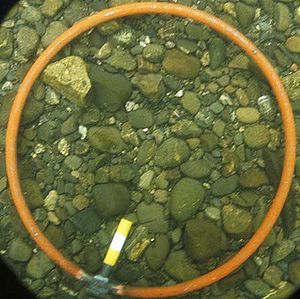
Stream bed
A stream bed is the channel bottom of a stream, river or creek; the physical confine of the normal water flow. The lateral confines or channel margins, during all but flood stage, are known as the stream banks or river banks. In fact, a flood occurs when a stream overflows its banks and flows onto...
. Bed load is complementary to suspended load
Suspended load
Suspended load is the portion of the sediment that is carried by a fluid flow which settle slowly enough such that it almost never touches the bed...
and wash load
Wash load
Wash load is the portion of sediment that is carried by a fluid flow, usually in a river, such that it always remains close the free surface . It is in near-permanent suspension and is transported without deposition, essentially passing straight through the stream...
.
Bed load moves by rolling, sliding, and/or saltating
Saltation (geology)
In geology, saltation is a specific type of particle transport by fluids such as wind or water. It occurs when loose material is removed from a bed and carried by the fluid, before being transported back to the surface...
(hopping).
Generally, bed load downstream will be smaller and more rounded than bed load upstream (a process known as downstream fining). This is due in part to attrition
Wear
In materials science, wear is erosion or sideways displacement of material from its "derivative" and original position on a solid surface performed by the action of another surface....
and abrasion
Abrasion (geology)
Abrasion is the mechanical scraping of a rock surface by friction between rocks and moving particles during their transport by wind, glacier, waves, gravity, running water or erosion. After friction, the moving particles dislodge loose and weak debris from the side of the rock...
which results from the stones colliding with each other and against the river channel, thus removing the rough texture (rounding) and reducing the size of the particles. However, selective transport of sediments also plays a role in relation to downstream fining: smaller-than average particles are more easily entrained
Entrainment (physical geography)
In physical geography, entrainment is the process by which surface sediment is incorporated into a fluid flow as part of the operation of erosion....
than larger-than average particles, since the shear stress required to entrain a grain is linearly proportional to the diameter of the grain. However, the degree of size selectivity is restricted by the hiding effect described by Parker and Klingeman (1982), wherein larger particles protrude from the bed whereas small particles are shielded and hidden by larger particles, with the result that nearly all grain sizes become entrained at nearly the same shear stress.