
All Topics  
Battle of Charleroi


   Email Print
   Bookmark   Link


Battle of Charleroi


The Battle of Charleroi
Charleroi

Charleroi is the largest city and Municipalities in Belgium of Wallonia, located in the Provinces of Belgium of Hainaut , Belgium. On 1 January 2008, Charleroi had a total population of 201,593....
, or the Battle of the Sambre
Sambre

The Sambre is a river in northern France and southern Belgium, left tributary of the Meuse River. The ancient Romans called the river Sabis....
 (1914), was fought on August 21, 1914, between French and German forces and was part of the Battle of the Frontiers
Battle of the Frontiers

The Battle of the Frontiers was a series of battles fought along the eastern frontier of France and in southern Belgium shortly after the outbreak of World War I....
. The French were planning an attack across the Sambre River, when the Germans launched an attack of their own. The Germans were victorious.

0 August, Lanrezac's Fifth Army had begun to concentrate on a 40 km front along the Sambre, centred on Charleroi
Charleroi

Charleroi is the largest city and Municipalities in Belgium of Wallonia, located in the Provinces of Belgium of Hainaut , Belgium. On 1 January 2008, Charleroi had a total population of 201,593....
 and extending east to the Belgian fortress of Namur
Namur (city)

Namur is a city and Municipalities in Belgium in Wallonia, in southern Belgium. It is both the capital of the Provinces of Belgium of Namur and of the Walloon Region ....
.


Discussion
Ask a question about 'Battle of Charleroi'
Start a new discussion about 'Battle of Charleroi'
Answer questions from other users
Full Discussion Forum


Encyclopedia


The Battle of Charleroi
Charleroi

Charleroi is the largest city and Municipalities in Belgium of Wallonia, located in the Provinces of Belgium of Hainaut , Belgium. On 1 January 2008, Charleroi had a total population of 201,593....
, or the Battle of the Sambre
Sambre

The Sambre is a river in northern France and southern Belgium, left tributary of the Meuse River. The ancient Romans called the river Sabis....
 (1914), was fought on August 21, 1914, between French and German forces and was part of the Battle of the Frontiers
Battle of the Frontiers

The Battle of the Frontiers was a series of battles fought along the eastern frontier of France and in southern Belgium shortly after the outbreak of World War I....
. The French were planning an attack across the Sambre River, when the Germans launched an attack of their own. The Germans were victorious.

Battle of Charleroi

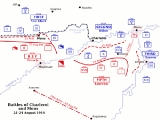
By 20 August, Lanrezac's Fifth Army had begun to concentrate on a 40 km front along the Sambre, centred on Charleroi
Charleroi

Charleroi is the largest city and Municipalities in Belgium of Wallonia, located in the Provinces of Belgium of Hainaut , Belgium. On 1 January 2008, Charleroi had a total population of 201,593....
 and extending east to the Belgian fortress of Namur
Namur (city)

Namur is a city and Municipalities in Belgium in Wallonia, in southern Belgium. It is both the capital of the Provinces of Belgium of Namur and of the Walloon Region ....
. On his left, the Cavalry Corps of General Sordet linked the Fifth Army with the British Expeditionary Force at Mons
Mons

Mons is a Walloon Region city and Municipalities in Belgium located in the Belgium Provinces of Belgium of Hainaut , of which it is the capital....
. Lanrezac's army of 15 divisions, weakened by the transfer of troops to Lorraine, was confronted by the 38 German divisions from the Second Army
German Second Army

The 2nd Army was a World War I and World War II field army....
 (General Karl von Bülow
Karl von Bülow

Karl von B?low was a Germany Field Marshal commanding the German Second Army during World War I from 1914 to 1918....
) and Third Army
German Third Army

The 3rd Army was a Germany field army that fought during World War I and World War II....
 moving south-west.

Although Lanrezac knew retreat to be necessary from the beginning of the war and warned against the danger of the German sweep through Belgium, his superior, General Joseph Joffre
Joseph Joffre

Joseph Jacques C?saire Joffre was a France general who was Commander-in-Chief of the French Army between 1914 and 1916 during the First World War....
, believed that France should follow the offensive Plan XVII
Plan XVII

Plan XVII was the name of the battle plan adopted by the French General Staff in 1913, to be put into effect by the French Army in the event of war between France and Germany....
, regardless of what happened in Belgium, and discounted Lanrezac's warnings and ordered Lanrezac to attack across the Sambre. Before Lanrezac could act on the morning of 21 August, the German Second Army launched the Battle of Charleroi with assaults across the Sambre, establishing two bridgehead
Bridgehead

A 'bridgehead' is a military fortification that protects the end of a bridge that is closest to the enemy. The term has been generalized in news coverage and the vernacular to also mean any kind of defended area that is extended into hostile territory , in particular the area on the farside of a 'defended river bank' or a segment of a lake o...
s which the French, lacking artillery, were unable to reduce. Bülow attacked again on 22 August with three corps
Corps

A Corps is either a large formation , or an administrative grouping of troops within an armed force with a common function such as Artillery or Signals representing an arm of service....
 against the entire Fifth Army front. Fighting continued on 23 August when the French centre around Charleroi began to fall back.

Meanwhile the German Third Army had crossed the Meuse and launched a frontal attack against the French right, held by a corps commanded by General Louis Franchet d'Esperey
Louis Franchet d'Esperey

Louis F?lix Marie Fran?ois Franchet d'Esp?rey was a France general during World War I....
. The Third Army attack threatened to cut off Lanrezac's line of retreat but Franchet d'Esperey's force stopped the German advance and delivered a successful counter-attack. However, with the evacuation of Namur and news of the French Fourth Army retreating from the Ardennes, Lanrezac ordered a withdrawal lest he be encircled and cut of from the rest of the French army.

Aftermath

His retreat after the Battle of Charleroi arguably saved the French army from decisive defeat as it prevented the much sought envelopment of the Schlieffen plan
Schlieffen Plan

The Schlieffen Plan was the German General Staff's early 20th century overall strategic plan for victory both on the Western Front against France and against Russia in the east, taking advantage of expected differences in the three countries' speed in preparing for war....
. After fighting another defensive action in the Battle of St. Quentin
Battle of St. Quentin (1914)

The Battle of St. Quentin is also called the Battle of Guise, and was fought during World War I.On the night of 26 August 1914, the Allies withdrew from Le Cateau-Cambr?sis to Saint Quentin....
, the French were pushed to within miles of Paris
Paris

Paris is the Capital of France and the country's largest city. It is situated on the river Seine, in northern France, at the heart of the ?le-de-France Regions of France ....
, but the line held at the sacrifice of Lanrezac's career.