
All Topics  
Bathsheba


   Email Print
   Bookmark   Link


Bathsheba


According to the Hebrew Bible
Hebrew Bible

The term Hebrew Bible is a generic reference to those books of the Bible originally written mostly in Biblical Hebrew with some Biblical Aramaic....
, Bathsheba (Bat Sheva) was the wife of Uriah the Hittite
Uriah the Hittite

File:Medallion Death of Uriah.jpgUriah the Hittite was a soldier in King David?s army mentioned in the Hebrew Bible. He was the husband of Bathsheba, and was murdered by order of David by having the soldiers retreat from him in battle....
 and later of David, king of the United Kingdom of Israel and Judah. She was the mother of Solomon
Solomon

Solomon is a figure described in the Hebrew Bible and the Qur'an. The biblical accounts identify Solomon as the son of David. He is also called Jedidiah in the Tanakh , and is described as the third king of the United Monarchy, and the final king before the northern Kingdom of Israel and the southern Kingdom of Judah split; following th...
, who succeeded David as king.

meaning of the Hebrew
Hebrew language

Hebrew is a Semitic languages of the Afro-Asiatic languages. Modern Hebrew is spoken by more than seven million people in Israel and Classical Hebrew is used for prayer or study in Jews communities around the world....
 form of the name "Bathsheba" is not clear, and may be from Hittite
Hittite language

Hittite or Nesili is the extinct language once spoken by the Hittites, a people who created an empire centered on ancient Hattusas in north-central Anatolia ....
, a Canaan
Canaan

Canaan is an ancient term for a region encompassing modern-day Israel and Lebanon, the Palestinian Territories, plus adjoining coastal lands and parts of Jordan, Syria and northeastern Egypt....
ite/Indo-European language. The second part of the name appears in as "shua" (compare ).

Bathsheba was the daughter of Eliam (who is called Ammiel in ).


Discussion
Ask a question about 'Bathsheba'
Start a new discussion about 'Bathsheba'
Answer questions from other users
Full Discussion Forum


Encyclopedia


According to the Hebrew Bible
Hebrew Bible

The term Hebrew Bible is a generic reference to those books of the Bible originally written mostly in Biblical Hebrew with some Biblical Aramaic....
, Bathsheba (Bat Sheva) was the wife of Uriah the Hittite
Uriah the Hittite

File:Medallion Death of Uriah.jpgUriah the Hittite was a soldier in King David?s army mentioned in the Hebrew Bible. He was the husband of Bathsheba, and was murdered by order of David by having the soldiers retreat from him in battle....
 and later of David, king of the United Kingdom of Israel and Judah. She was the mother of Solomon
Solomon

Solomon is a figure described in the Hebrew Bible and the Qur'an. The biblical accounts identify Solomon as the son of David. He is also called Jedidiah in the Tanakh , and is described as the third king of the United Monarchy, and the final king before the northern Kingdom of Israel and the southern Kingdom of Judah split; following th...
, who succeeded David as king.

Biblical narrative

The meaning of the Hebrew
Hebrew language

Hebrew is a Semitic languages of the Afro-Asiatic languages. Modern Hebrew is spoken by more than seven million people in Israel and Classical Hebrew is used for prayer or study in Jews communities around the world....
 form of the name "Bathsheba" is not clear, and may be from Hittite
Hittite language

Hittite or Nesili is the extinct language once spoken by the Hittites, a people who created an empire centered on ancient Hattusas in north-central Anatolia ....
, a Canaan
Canaan

Canaan is an ancient term for a region encompassing modern-day Israel and Lebanon, the Palestinian Territories, plus adjoining coastal lands and parts of Jordan, Syria and northeastern Egypt....
ite/Indo-European language. The second part of the name appears in as "shua" (compare ).

Bathsheba was the daughter of Eliam (who is called Ammiel in ). Her father is identified by some scholars with Eliam mentioned in as the son of Ahithophel, who is described as the Gilonite. (See King David's Warriors
King David's Warriors

King David's Warriors are a group of biblical characters explicitly singled out by an appendix of the Books of Samuel. The text divides them into The Three, of which there are 3, and The Thirty, of which there is somewhere between 30 and 37....
.)

Bathsheba was the wife of Uriah
Uriah

Uriah or Urijah was the name of several men in the Hebrew Bible. The word means "the Lord is my light". It may refer to:*Uriah, Alabama, a town in the United States...
 the Hittite
Biblical Hittites

The Hittites and Children of Heth, translating Hebrew language HTY and BNY-HT are the second of the eleven Canaanite nations in the Hebrew Bible....
, and afterward of David, by whom she gave birth to Solomon, who succeeded David as king of the United Kingdom of Israel and Judah.

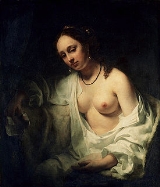
The story of David's seduction of Bathsheba, told in , is omitted in Chronicles. The story is told that David, while walking on the roof of his house, saw Bathsheba, who was then the wife of Uriah, taking a bath. He immediately desired her and later made her pregnant.

In an effort to conceal his sin, David summoned Uriah from the army (with whom he was on campaign) in the hope that Uriah would reconsummate his marriage and think the child his. Uriah was unwilling to violate the ancient kingdom rule applying to warriors in active service. Rather than go home to his own bed, he preferred to remain with the palace troops.

After repeated efforts to convince Uriah to fertilize Bathsheba, the king gave the order to his general, Joab
Joab

Joab was the nephew of King David, the son of Zeruiah in the Bible. He was made the captain of David's army . He had two brothers, Abishai and Asahel....
, that Uriah should be abandoned during a heated battle and left to the hands of the enemy. Ironically, David had Uriah himself carry the message that ordered his death. After Uriah was dead, David made the now widowed Bathsheba his wife.

According to the account in Samuel, David's action was displeasing to the Lord, who accordingly sent Nathan the prophet
Nathan (Prophet)

Nathan the Prophet was a court prophet who lived in the time of King David and his wife Bathsheba. He came to David to reprimand him over his committing adultery with Bathsheba while she was the wife of Uriah....
 to reprove the king.

After relating the parable of the rich man who took away the one little ewe lamb of his poor neighbor (II Samuel 12:1-6), and exciting the king's anger against the unrighteous act, the prophet applied the case directly to David's action with regard to Bathsheba.

The king at once confessed his sin and expressed sincere repentance. Bathsheba's child by David was smitten with a severe illness and died at a few days after birth, which the king accepted as his punishment.

Nathan also noted that David's house would be cursed with turmoil because of this murder. This came to pass years later when one of David's much-loved sons, Absalom
Absalom

Absalom or Avshalom was the third son of David , king of Israel with Maachah, daughter of Talmai, king of Geshur. He had no sons. describes him as the most handsome man in the kingdom....
, led an insurrection that plunged the kingdom into civil war
Civil war

A civil war is a war between organized groups to take control of a nation or region, or to change government policies. It is high-intensity conflict, often involving Regular Army, that is sustained, organized and large-scale....
. Moreover, to manifest his claim to be the new king, Absalom had sexual intercourse in public with ten of his father's concubines, which could be considered a direct, tenfold divine retribution for David's taking the woman of another man.

In David's old age, Bathsheba secured the succession to the throne of her son Solomon, instead of David's eldest surviving son Adonijah
Adonijah

Adonijah was the fourth son of King David according to the book of Samuel , which is contained in the Bible....
. .

In rabbinical literature


Bathsheba was the granddaughter of Ahithophel, David's famous counselor.

The Midrash
Midrash

Midrash is a Hebrew language term referring to the not exact, but comparative method of exegesis of Biblical texts, which is one of four methods cumulatively called Pardes ....
 portrays the influence of Satan
Satan

Satan is a term that originates from the Abrahamic religions, being traditionally applied to an angel in Judeo-Christian belief, and to a Genie in Islamic belief....
 bringing about the sinful relation of David and Bathsheba as follows: Bathsheba was on the roof of her house, perhaps behind a screen of wickerwork.

Satan is depicted as coming in the disguise of a bird. David, shooting at the bird, strikes the screen, splitting it; thus Bathsheba is revealed in her beauty to David (Sanhedrin 107a).

Bathsheba may have been providentially destined from the Creation to become in due time the legitimate wife of David; but this relation was prematurely precipitated by David's impetuous act.

Christianity


In the Gospel
Gospel

In Christianity, a gospel is generally one of the first four books of the New Testament that describe the birth, life, ministry, crucifixion, and resurrection of Jesus....
 of she is indirectly mentioned as an ancestor of Jesus
Jesus

Jesus of Nazareth , also known as Jesus Christ, is the central figure of Christianity and is revered by most Christian churches as the Son of God and the Incarnation ....
.

In Qur'an and Islamic tradition

The only passage in the Qur'an
Qur'an

The Qur?an is the central religious text of Islam. Muslims believe the Qur?an to be the book of divine guidance and direction for mankind, and consider the original Arabic text to be the final revelation of God....
 connected to the story of Bathsheba is sura xxxviii. 20-25:

"And has the story of the antagonists come to you; when they climbed the wall of the upper chamber, when they came in to David? And when he feared them, they said, 'Fear not; we are two antagonists, one of us hath wronged the other, so judge justly between us. . . . This my brother had ninety-nine ewes and I had one. Then he said, "Give me control of her," and he overcame me in his plea.' David said, 'Verily he hath wronged thee by asking for thy ewe as an addition to his ewes, and verily most partners act injuriously the one to the other, except those who believe and work righteous works; and such are few.' And David supposed that we had tried him; so he sought pardon of his Lord and fell, worshiping, and repented. And we forgave him that fault, and he hath near approach unto us and beauty of ultimate abode."


From this passage one can judge only some similarities of Nathan's parable. The Muslim world has shown an indisposition, to a certain extent, to go further, and especially to ascribe sin to David.

Baidawi
Baidawi

Baidawi , was a Muslim scholar, was born in Fars, where his father was chief judge, in the time of the Atabek ruler Abu Bakr ibn Sa'd . He himself became judge in Shiraz, Iran, and died in Tabriz about 1286....
 would seem to favor that view, but other commentators reject it. Baidawi (in loc.) remarks that this passage signifies only that David desired something which belonged to another, and that God rebuked him by this parable.

At the very most, Baidawi continues, he may have asked in marriage a woman who had been asked in marriage by another, or he may have desired that another should abandon his wife to him, a circumstance which was customary at that time.

The Biblical story of Uriah is then regarded as a slander, filled with unnecessary violence and immorality, not the sort of thing that would happen to a man who is close to God.

According to some sources of Islamic tradition, David marries Bathsheba after the death of Uriah, and she becomes the mother of Solomon. To Muslims, the legendary Bathsheba herself is a not a very known figure, being generally called simply the wife of Uriah. See Al-Tha'labi, "?i?a?-anbiyya," pp. 243 et seq., ed. Cairo, 1298; and Ibn al-Athir, i. 95 et seq., ed. Cairo, 1301.

Critical view

Her name, which perhaps means "daughter of the oath", is in I Chronicles 3:5 spelled "Bath-shua", the form becomes merely a variant reading of "Bath-sheba". The passages in which Bath-sheba is mentioned are II Samuel 11:2-12:24, and I Kings 1, 2.—both of which are parts of the oldest stratum of the books of Samuel and Kings. It is part of that court history of David
Court History of David

The Court History of David is one of the two hypothetical main source documents of the Books of Samuel . The text is believed to cover most of 2 Samuel except for the first few chapters and a few more minor parts....
, written by someone who stood very near the events and who did not idealize David. The material contained in it is of higher historical value than that in the later strata of these books. Budde would connect it with the J document of the Hexateuch.

The only interpolations in it which concern the story of Bathsheba are some verses in the early part of the twelfth chapter, that heighten the moral tone of Nathan's rebuke of David; according to Karl Budde
Karl Budde

Karl Ferdinand Reinhard Budde was a Germans theology, born at Bensberg. He was inspector of the Evangelisches Theologisches Stift at Bonn from 1878 to 1885, professor at University of Bonn in 1879, at University of Strasbourg in 1889, and in 1900 was made professor of Old Testament exegesis and the Hebrew language at University of Marburg....
 ("S. B. O. T."), the interpolated portion is xii. 7, 8, and 10-12; according to Friedrich Schwally (Stade's "Zeitschrift," xii. 154 et seq.) and H. P. Smith ("Samuel," in "International Critical Commentary"), the whole of xii. 1-15a is an interpolation, and xii. 15b should be joined directly to xi. 27. This does not directly affect the narrative concerning Bathsheba herself. Chronicles, which draws a veil over David's faults, omits all reference to the way in which Bathsheba became David's wife, and gives only the names of her children: Shimea, Shobab, Nathan
Nathan (son of David)

Nathan was the son of King David and Bathsheba, the older brother of Solomon. He was David's third son born in Jerusalem [1 Chronicles 3:5]....
, and Solomon.

The father of Bathsheba was Eliam (spelled "Ammiel" in I Chronicles 3:5). As this was also the name of a son of Ahithophel, one of David's heroes (II Samuel 23:34), it has been conjectured that Bathsheba was a granddaughter of Ahithophel and that the latter's desertion of David at the time of Absalom's rebellion was in revenge for David's conduct toward Bathsheba.

See also

  • Bathsheba at Her Bath
    Bathsheba at Her Bath

    Bathsheba at Her Bath is an oil painting of Bathsheba by Rembrandt Harmenszoon van Rijn from 1654. The model was Rembrandt's partner Hendrickje Stoffels....


External links