
|
|
|
|
Barracuda
|
| |
|
| |
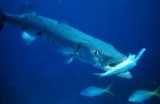
The barracuda is a ray-finned fish known for its large size (up to 6 ft in length and up to a foot in width, for some species) and fearsome appearance. Its body is long, fairly compressed, and covered with small, smooth scales. It is a salt water fish, and is found in tropical and subtropical oceans worldwide. It is of the genus Sphyraena, the only genus in the family Sphyraenidae. acudas occur both singly and in schools around reefs, but also appear in open seas.

Discussion
Ask a question about 'Barracuda'
Start a new discussion about 'Barracuda'
Answer questions from other users
|
Recent Posts

Encyclopedia
The barracuda is a ray-finned fish known for its large size (up to 6 ft in length and up to a foot in width, for some species) and fearsome appearance. Its body is long, fairly compressed, and covered with small, smooth scales. It is a salt water fish, and is found in tropical and subtropical oceans worldwide. It is of the genus Sphyraena, the only genus in the family Sphyraenidae.
Behavior
Barracudas occur both singly and in schools around reefs, but also appear in open seas. They are voracious predators and hunt using a classic example of lie-in-wait or ambush. They rely on surprise and short bursts of speed (up to 28 mph or 43 km/h) to overrun their prey, sacrificing maneuverability.
Adult barracudas are more or less solitary in their habits, while young and half-grown fish frequently congregate in schools. These fish do not care for their young. A barracudas diet is composed of fish of all types. Large barracudas, when gorged, may attempt to herd a shoal of prey fish in shallow water, where they will guard over the fish until they are ready for another meal. Large barracudas have been known to eat young barracudas.
Barracudas and humans
Like sharks, barracudas have long had a bad reputation as being dangerous to humans. As barracudas are also scavengers, they may mistake snorkelers for large predators and follow them in the hopes of scavenging the remains of an attack on prey.
Being formidable hunters, they should be respected, as barracudas are perfectly capable of defending themselves against humans that harass them. Handfeeding or trying to touch them is strongly discouraged. Spearfishing around barracudas can also be quite dangerous, as they are strongly attracted by the wounded fish.
There have been isolated cases where barracudas have bitten a human, but these incidents are rare and are believed to be caused by bad visibility. Barracudas will stop after the first bite as humans are not their normal food source.
Wearing jewelry and other shiny objects is discouraged as barracudas are attracted to things that glint and shine.
As food
Barracudas are caught as both food and game fish. They are most often eaten as fillet or steak and have a strong taste like tuna or salmon. Larger species, like the great barracuda, have in some areas been implicated in cases of ciguatera food poisoning.
In southern Nigeria, West Africa they are smoked and used in the preparation of different soups. The reason for smoking is because when cooked fresh, the fish is quite soft and disintegrates in the soup.
Angling
Barracuda are prize fish and can be caught by either conventional gear or fly fishing. They are extremely powerful and require appropriately scaled tackle.
In popular culture Because of its sleek appearance and its predatory nature, the barracuda has come to symbolize speed, power, and viciousness. The Plymouth Barracuda, a muscle car, reflects this perception in its name. The song "Barracuda" by the band Heart also uses the image of the fish to represent a deceitful and sinister lover.
Species
There are 26 known species:
- Sharpfin barracuda, Sphyraena acutipinnis Day, 1876.
- Guinean barracuda, Sphyraena afra Peters, 1844.
- Pacific barracuda, Sphyraena argentea Girard, 1854.
- Great barracuda, Sphyraena barracuda (Edwards in Catesby, 1771).
- Northern sennet, Sphyraena borealis DeKay, 1842.
- Yellowstripe barracuda, Sphyraena chrysotaenia Klunzinger, 1884.
- Mexican barracuda, Sphyraena ensis Jordan & Gilbert, 1882.
- Yellowtail barracuda, Sphyraena flavicauda Rüppell, 1838.
- Bigeye barracuda, Sphyraena forsteri Cuvier, 1829.
- Guachanche barracuda, Sphyraena guachancho Cuvier, 1829.
- Heller's barracuda, Sphyraena helleri Jenkins, 1901.
- Sphyraena iburiensis Doiuchi & Nakabo, 2005.
- Pelican barracuda, Sphyraena idiastes Heller & Snodgrass, 1903.
- Japanese barracuda, Sphyraena japonica Cuvier, 1829.
- Pickhandle barracuda, Sphyraena jello Cuvier, 1829.
- Lucas barracuda, Sphyraena lucasana Gill, 1863.
- Australian barracuda, Sphyraena novaehollandiae Günther, 1860.
- Obtuse barracuda, Sphyraena obtusata Cuvier, 1829.
- Southern sennet, Sphyraena picudilla Poey, 1860.
- Red barracuda, Sphyraena pinguis Günther, 1874.
- Sawtooth barracuda, Sphyraena putnamae Jordan & Seale, 1905.
- Blackfin barracuda, Sphyraena qenie Klunzinger, 1870.
- European barracuda, Sphyraena sphyraena (Linnaeus, 1758).
- Sphyraena tome Fowler, 1903.
- Yellowmouth barracuda, Sphyraena viridensis Cuvier, 1829.
- Sphyraena waitii Ogilby, 1908.
External links
- on website of the Florida Museum of National History.
- The .
- Sphyraenidae entry on .
|
| |
|
|