

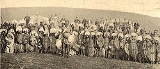
Bambatha Rebellion

Encyclopedia
The Bambatha Uprising was a Zulu revolt against British rule and taxation in Natal
, South Africa
, in 1906. The revolt was led by Bambatha kaMancinza
(ca. 1860-1906?), leader of the amaZondi clan of the Zulu people, who lived in the Mpanza Valley, a district near Greytown, KwaZulu-Natal
.
white employers in Natal had difficulty recruiting black farm workers because of increased competition from the gold
mines of the Witwatersrand
. The colonial authorities introduced a £1 poll tax
in addition to the existing hut tax to encourage black men to enter the labour market. Bambatha, who ruled about 5,500 people living in about 1,100 households, was one of the chiefs who resisted the introduction and collection of the new tax.
The government of Natal sent police officer
s to collect the tax from recalcitrant districts, and in February 1906 two white officers were killed near Richmond, KwaZulu-Natal
. In the resulting introduction of martial law, Bambatha fled north to consult King Dinizulu, who gave tacit support to Bambatha and invited him and his family to stay at the royal homestead.
Bambatha returned to the Mpanza Valley to discover that the Natal government had deposed him as chief. He gathered together a small force of supporters and began launching a series of guerrilla
attacks, using the Nkandla forest as a base. Following a series of initial successes, colonial troops under the command of Colonel
Duncan McKenzie set out on an expedition in late April 1906.
Once they succeeded in getting face to face with and surrounding the rebels at Mome Gorge, the British victory in the unequal battle was inevitable, given the vast disparity of forces. As the sun rose, colonial soldiers opened fire with machine guns and cannon, on rebels mostly armed only with traditional assegai
s (spears), knobkerries (fighting sticks) and cowhide
shield
s.
Bambatha was killed and beheaded during the battle; however, many of his supporters believed that he was still alive, and his wife refused to go into mourning. Bambatha's main ally, the 95-year-old Zulu aristocrat
Inkosi Sigananda Shezi
of the amaCube clan (cousin and near-contemporary of the Zulu king Shaka
) was captured by the colonial troops and died a few days later.
Between 3,000 and 4,000 Zulus were killed during the revolt (some of whom died fighting on the side of the Natal government). More than 7,000 were imprisoned, and 4,000 flogged. King Dinizulu was arrested and sentenced to four years imprisonment for treason.
The war cost the Natal government
GB£
883,576 (equivalent to £370,000,000 in 2010).
as a reserve force in the Army against the Zulu uprising. Gandhi actively encouraged the British to recruit Indians. He argued that Indians should support the war efforts in order to legitimise their claims to full citizenship. The British, however, refused to commission Indians as army officers. Nonetheless, they accepted Gandhi's offer to let a detachment of Indians volunteer as a stretcher bearer corps to treat wounded British soldiers. This corps of 21 was commanded by Gandhi. Gandhi urged the Indian population in South Africa to join the war through his columns in Indian Opinion: “If the Government only realised what reserve force is being wasted, they would make use of it and give Indians the opportunity of a thorough training for actual warfare.” Later in 1927 he wrote of the event as "No war but a man hunt." Gandhi's ambulance corp was the only one taking care of the wounded Zulus.
of post-Apartheid South Africa. Also, his picture appeared on a postage stamp and a street was renamed in his honor.
According to speeches in the ceremony, the beheaded body had not really been Bambatha's and the actual chief succeeded in escaping to Mozambique
. This belief is still widely current; a DNA test of his alleged body failed to give a definite answer.
Colony of Natal
The Colony of Natal was a British colony in south-eastern Africa. It was proclaimed a British colony on May 4, 1843 after the British government had annexed the Boer Republic of Natalia, and on 31 May 1910 combined with three other colonies to form the Union of South Africa, as one of its...
, South Africa
South Africa
The Republic of South Africa is a country in southern Africa. Located at the southern tip of Africa, it is divided into nine provinces, with of coastline on the Atlantic and Indian oceans...
, in 1906. The revolt was led by Bambatha kaMancinza
Bhambatha
For other articles named Bhambatha, see Bhambatha .Bambata or Bambatha kaMancinza , also known as Mbata Bhambatha, was a Zulu chief of the amaZondi clan in the Colony of Natal and son of Mancinza...
(ca. 1860-1906?), leader of the amaZondi clan of the Zulu people, who lived in the Mpanza Valley, a district near Greytown, KwaZulu-Natal
Greytown, KwaZulu-Natal
Greytown is a town situated on the banks of a tributary of the Umvoti River in a richly fertile timber-producing area of KwaZulu-Natal, South Africa.-History:...
.
Overview
In the years following the Anglo-Boer WarSecond Boer War
The Second Boer War was fought from 11 October 1899 until 31 May 1902 between the British Empire and the Afrikaans-speaking Dutch settlers of two independent Boer republics, the South African Republic and the Orange Free State...
white employers in Natal had difficulty recruiting black farm workers because of increased competition from the gold
Gold
Gold is a chemical element with the symbol Au and an atomic number of 79. Gold is a dense, soft, shiny, malleable and ductile metal. Pure gold has a bright yellow color and luster traditionally considered attractive, which it maintains without oxidizing in air or water. Chemically, gold is a...
mines of the Witwatersrand
Witwatersrand
The Witwatersrand is a low, sedimentary range of hills, at an elevation of 1700–1800 metres above sea-level, which runs in an east-west direction through Gauteng in South Africa. The word in Afrikaans means "the ridge of white waters". Geologically it is complex, but the principal formations...
. The colonial authorities introduced a £1 poll tax
Poll tax
A poll tax is a tax of a portioned, fixed amount per individual in accordance with the census . When a corvée is commuted for cash payment, in effect it becomes a poll tax...
in addition to the existing hut tax to encourage black men to enter the labour market. Bambatha, who ruled about 5,500 people living in about 1,100 households, was one of the chiefs who resisted the introduction and collection of the new tax.
The government of Natal sent police officer
Police officer
A police officer is a warranted employee of a police force...
s to collect the tax from recalcitrant districts, and in February 1906 two white officers were killed near Richmond, KwaZulu-Natal
Richmond, KwaZulu-Natal
Richmond is a town situated on the banks of the upper Illovo River in the midlands of KwaZulu-Natal, South Africa, approximately 38 km south-west of Pietermaritzburg. Timber, sugarcane, poultry, citrus fruit and dairy goods are produced here...
. In the resulting introduction of martial law, Bambatha fled north to consult King Dinizulu, who gave tacit support to Bambatha and invited him and his family to stay at the royal homestead.
Bambatha returned to the Mpanza Valley to discover that the Natal government had deposed him as chief. He gathered together a small force of supporters and began launching a series of guerrilla
Guerrilla warfare
Guerrilla warfare is a form of irregular warfare and refers to conflicts in which a small group of combatants including, but not limited to, armed civilians use military tactics, such as ambushes, sabotage, raids, the element of surprise, and extraordinary mobility to harass a larger and...
attacks, using the Nkandla forest as a base. Following a series of initial successes, colonial troops under the command of Colonel
Colonel
Colonel , abbreviated Col or COL, is a military rank of a senior commissioned officer. It or a corresponding rank exists in most armies and in many air forces; the naval equivalent rank is generally "Captain". It is also used in some police forces and other paramilitary rank structures...
Duncan McKenzie set out on an expedition in late April 1906.
Once they succeeded in getting face to face with and surrounding the rebels at Mome Gorge, the British victory in the unequal battle was inevitable, given the vast disparity of forces. As the sun rose, colonial soldiers opened fire with machine guns and cannon, on rebels mostly armed only with traditional assegai
Assegai
An assegai or assagai is a pole weapon used for throwing or hurling, usually a light spear or javelin made of wood and pointed with iron.-Iklwa:...
s (spears), knobkerries (fighting sticks) and cowhide
Cowhide
Cowhide is the natural, unbleached skin and hair of a cow. It retains the original coloring of the animal. Cowhides are a natural product/by-product of the food industry from cattle. Cowhide can also be processed into a leather, which can be used to make such things as shoes, wallets and leather...
shield
Shield
A shield is a type of personal armor, meant to intercept attacks, either by stopping projectiles such as arrows or redirecting a hit from a sword, mace or battle axe to the side of the shield-bearer....
s.
Bambatha was killed and beheaded during the battle; however, many of his supporters believed that he was still alive, and his wife refused to go into mourning. Bambatha's main ally, the 95-year-old Zulu aristocrat
Aristocracy (class)
The aristocracy are people considered to be in the highest social class in a society which has or once had a political system of Aristocracy. Aristocrats possess hereditary titles granted by a monarch, which once granted them feudal or legal privileges, or deriving, as in Ancient Greece and India,...
Inkosi Sigananda Shezi
Sigananda kaSokufa
Sigananda kaSokufa was a Zulu aristocrat whose life spanned the reigns of four Zulu kings in southeastern Africa.-Life and career:...
of the amaCube clan (cousin and near-contemporary of the Zulu king Shaka
Shaka
Shaka kaSenzangakhona , also known as Shaka Zulu , was the most influential leader of the Zulu Kingdom....
) was captured by the colonial troops and died a few days later.
Between 3,000 and 4,000 Zulus were killed during the revolt (some of whom died fighting on the side of the Natal government). More than 7,000 were imprisoned, and 4,000 flogged. King Dinizulu was arrested and sentenced to four years imprisonment for treason.
The war cost the Natal government
Colony of Natal
The Colony of Natal was a British colony in south-eastern Africa. It was proclaimed a British colony on May 4, 1843 after the British government had annexed the Boer Republic of Natalia, and on 31 May 1910 combined with three other colonies to form the Union of South Africa, as one of its...
GB£
Pound sterling
The pound sterling , commonly called the pound, is the official currency of the United Kingdom, its Crown Dependencies and the British Overseas Territories of South Georgia and the South Sandwich Islands, British Antarctic Territory and Tristan da Cunha. It is subdivided into 100 pence...
883,576 (equivalent to £370,000,000 in 2010).
Mahatma Gandhi's role
Mohandas Karamchand Gandhi, who was in South Africa at the time, felt that the Indians in South Africa would do best for themselves to serve the British EmpireBritish Empire
The British Empire comprised the dominions, colonies, protectorates, mandates and other territories ruled or administered by the United Kingdom. It originated with the overseas colonies and trading posts established by England in the late 16th and early 17th centuries. At its height, it was the...
as a reserve force in the Army against the Zulu uprising. Gandhi actively encouraged the British to recruit Indians. He argued that Indians should support the war efforts in order to legitimise their claims to full citizenship. The British, however, refused to commission Indians as army officers. Nonetheless, they accepted Gandhi's offer to let a detachment of Indians volunteer as a stretcher bearer corps to treat wounded British soldiers. This corps of 21 was commanded by Gandhi. Gandhi urged the Indian population in South Africa to join the war through his columns in Indian Opinion: “If the Government only realised what reserve force is being wasted, they would make use of it and give Indians the opportunity of a thorough training for actual warfare.” Later in 1927 he wrote of the event as "No war but a man hunt." Gandhi's ambulance corp was the only one taking care of the wounded Zulus.
Commemoration
In 2006, the hundredth anniversary of the rebellion was commemorated in a ceremony which declared Chief Bambatha a national heroFolk hero
A folk hero is a type of hero, real, fictional, or mythological. The single salient characteristic which makes a character a folk hero is the imprinting of the name, personality and deeds of the character in the popular consciousness. This presence in the popular consciousness is evidenced by...
of post-Apartheid South Africa. Also, his picture appeared on a postage stamp and a street was renamed in his honor.
According to speeches in the ceremony, the beheaded body had not really been Bambatha's and the actual chief succeeded in escaping to Mozambique
Mozambique
Mozambique, officially the Republic of Mozambique , is a country in southeastern Africa bordered by the Indian Ocean to the east, Tanzania to the north, Malawi and Zambia to the northwest, Zimbabwe to the west and Swaziland and South Africa to the southwest...
. This belief is still widely current; a DNA test of his alleged body failed to give a definite answer.
Trivia
- An account of the rebellion by famed Zulu historian Jeff Guy was carried in The Witness, a PietermaritzburgPietermaritzburgPietermaritzburg is the capital and second largest city in the province of KwaZulu-Natal, South Africa. It was founded in 1838, and is currently governed by the Msunduzi Local Municipality. Its "purist" Zulu name is umGungundlovu, and this is the name used for the district municipality...
newspaper in a series of supplements in 2006 in honour of the centenary of the rebellion.
| Amount actually collected from the poll tax between 1906-1909 | ||||
|---|---|---|---|---|
| 1906 | 1907 | 1908 | 1909 | |
| Natal Colony of Natal The Colony of Natal was a British colony in south-eastern Africa. It was proclaimed a British colony on May 4, 1843 after the British government had annexed the Boer Republic of Natalia, and on 31 May 1910 combined with three other colonies to form the Union of South Africa, as one of its... |
||||
| £68,500 | £49,637 | £45,150 | £41,498 | |
| Zululand Zulu Kingdom The Zulu Kingdom, sometimes referred to as the Zulu Empire or, rather imprecisely, Zululand, was a monarchy in Southern Africa that extended along the coast of the Indian Ocean from the Tugela River in the south to Pongola River in the north.... |
||||
| £7,990 | £4,267 | £3,940 | £3,520 | |
| Total | ||||
| £76,490 | £53,904 | £49,090 | £45,018 | |
See also
- Anglo-Zulu WarAnglo-Zulu WarThe Anglo-Zulu War was fought in 1879 between the British Empire and the Zulu Kingdom.Following the imperialist scheme by which Lord Carnarvon had successfully brought about federation in Canada, it was thought that a similar plan might succeed with the various African kingdoms, tribal areas and...
- First Boer WarFirst Boer WarThe First Boer War also known as the First Anglo-Boer War or the Transvaal War, was fought from 16 December 1880 until 23 March 1881-1877 annexation:...
(1880–1881) - Second Boer WarSecond Boer WarThe Second Boer War was fought from 11 October 1899 until 31 May 1902 between the British Empire and the Afrikaans-speaking Dutch settlers of two independent Boer republics, the South African Republic and the Orange Free State...
(1899–1902) - Natal Native Rebellion MedalNatal Native Rebellion MedalThe Natal Native Rebellion Medal was a South African campaign medal. It was authorised on 9 May 1907, for service in the Bambatha Rebellion in Natal in 1906. ....