
All Topics  
Badminton

 
Badminton

   Email Print
   Bookmark   Link


Badminton


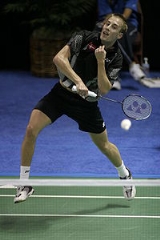
Badminton is a racquet sport
List of sports

The following is a list of sports, divided by category. There are many more sports to be added. This system has a disadvantage because some sports may fit in more than one category....
 played by either two opposing players (singles) or two opposing pairs (doubles), who take positions on opposite halves of a rectangular court that is divided by a net. Players score points by striking a shuttlecock
Shuttlecock

A shuttlecock is a high-drag projectile used in the sport of badminton. It has an open conical shape: the cone is formed from sixteen overlapping goose feathers embedded into a rounded cork base....
 with their racquet so that it passes over the net and lands in their opponents' half of the court. A rally ends once the shuttlecock has struck the ground, and the shuttlecock may only be struck once by each side before it passes over the net.

The shuttlecock (or shuttle) is a feathered projectile whose unique aerodynamic properties cause it to fly differently from the balls used in most racquet sports; in particular, the feathers create much higher drag
Drag (physics)

The term drag is widely used in Physics and Engineering and is central to the field of fluid dynamics. "Drag" refers to forces that oppose the motion of a solid object through a fluid ....
, causing the shuttlecock to decelerate more rapidly than a ball.


Discussion
Ask a question about 'Badminton'
Start a new discussion about 'Badminton'
Answer questions from other users
Full Discussion Forum


Encyclopedia


Badminton is a racquet sport
List of sports

The following is a list of sports, divided by category. There are many more sports to be added. This system has a disadvantage because some sports may fit in more than one category....
 played by either two opposing players (singles) or two opposing pairs (doubles), who take positions on opposite halves of a rectangular court that is divided by a net. Players score points by striking a shuttlecock
Shuttlecock

A shuttlecock is a high-drag projectile used in the sport of badminton. It has an open conical shape: the cone is formed from sixteen overlapping goose feathers embedded into a rounded cork base....
 with their racquet so that it passes over the net and lands in their opponents' half of the court. A rally ends once the shuttlecock has struck the ground, and the shuttlecock may only be struck once by each side before it passes over the net.

The shuttlecock (or shuttle) is a feathered projectile whose unique aerodynamic properties cause it to fly differently from the balls used in most racquet sports; in particular, the feathers create much higher drag
Drag (physics)

The term drag is widely used in Physics and Engineering and is central to the field of fluid dynamics. "Drag" refers to forces that oppose the motion of a solid object through a fluid ....
, causing the shuttlecock to decelerate more rapidly than a ball. Shuttlecocks have a much higher top speed, when compared to other racquet sports. Because shuttlecock flight is affected by wind, competitive badminton is best played indoors. Badminton is also played outdoors as a casual recreational activity, often as a garden or beach game.

Since 1992, badminton has been an Olympic sport
Olympic sports

The Olympic sports comprise all the sports contested in the Summer Olympic Games and Winter Olympic Games Olympic Games. As of 2008, the Summer Olympics include 26 sports with 36 disciplines and about 300 events, and the Winter Olympics include 7 sports with 15 disciplines and about 80 events....
 with five events
Competition

Competition is a rivalry between individuals, groups, nations, or animals, for territory, a niche, or allocation of resources. It arises whenever two or more parties strive for a goal which cannot be shared....
: men's and women's singles, men's and women's doubles, and mixed doubles, in which each pair is a man and a woman. At high levels of play, the sport demands excellent fitness: players require aerobic stamina, agility, strength, speed, and precision. It is also a technical sport, requiring good motor coordination
Motor coordination

Motor coordination is among the most fundamental aspects of everyday life, seen in reaching for the morning cup of coffee to hitting the buttons on a clock to set your morning alarm....
 and the development of sophisticated racquet movements.

History and development

Battledore and Shuttlecock
Badminton has been played since ancient times; an early form of the sport was played in ancient Greece
Ancient Greece

The term Ancient Greece refers to the period of History of Greece lasting from the Greek Dark Ages ca. 1100 BC and the Dorian invasion, to 146 BC and the Roman Republic conquest of Greece after the Battle of Corinth ....
. In Japan, the related game Hanetsuki
Hanetsuki

Hanetsuki is a Japanese traditional game, similar to badminton except there is no net, and is played with a rectangular wooden paddle, called a hagoita, and a brightly-coloured shuttlecock....
 was played as early as the 16th century. In the west, badminton came from a game called battledore and shuttlecock
Battledore and Shuttlecock

Battledore and Shuttlecock or Jeu de Volantis is an early game similar to that of modern Badminton.This game is played by two persons with small rackets, called battledores, made of parchment or rows of gut stretched across wooden frames, and shuttlecocks, made of a base of some light material, like cork, with trimmed feathers fixe...
, in which two or more players keep a feathered shuttlecock in the air with small racquets.

The modern form of Badminton however can be traced to India
India

India, officially the Republic of India , is a country in South Asia. It is the List of countries and outlying territories by total area country by geographical area, the List of countries by population country, and the most populous liberal democracy in the world....
, where British military officers stationed there in the late 19th century AD became interested in a similar local game which was known to them as Poona (derived from Pune
Pune

Pune ,Pune is the administrative capital of Pune district and the 7th Metro city of India.Pune is known to have existed as a town since 937 AD....
, an Indian garrison town). This game was taken back to England where the rules of badminton were set out. Another early version of the game was recorded in the 1850s in the southern Indian city of Tanjore, called pooppanthu vilayattam (Tamil
Tamil language

Tamil is a Dravidian language spoken predominantly by Tamil people of the Indian subcontinent. It has Official language in India, Sri Lanka and Singapore....
 for flower-ball game) in which balls made of wool and cardboard were used in the place of the modern-day shuttlecock.

Isaac Spratt
Isaac Spratt

Isaac Spratt was a London toy dealer who wrote pamphlets describing the games of croquet and badminton and was influential in the early development of both....
, a London toy dealer, published a booklet, "Badminton Battledore - a new game" in 1860, but unfortunately no copy has survived.

The new sport was definitively launched in 1873 at the Badminton House
Badminton House

File:Badminton House.jpgBadminton House is a large country house in Gloucestershire, England, and has been the principal seat of the Duke of Beaufort since the late 17th century....
, Gloucestershire
Gloucestershire

Gloucestershire is a Counties of England in South West England England. The county comprises part of the Cotswold Hills, part of the flat fertile valley of the River Severn, and the entire Forest of Dean....
, owned by the Duke of Beaufort
Duke of Beaufort

The title Duke of Beaufort in the Peerage of England was created by Charles II of England in 1682 for Henry Somerset, 1st Duke of Beaufort, a descendant of Charles Somerset, 1st Earl of Worcester, illegitimate son of Henry Beaufort, 3rd Duke of Somerset, a Lancastrian leader in the Wars of the Roses....
. During that time, the game was referred to as "The Game of Badminton," and the game's official name became Badminton.

Until 1887, the sport was played in England under the rules that prevailed in India. The Bath Badminton Club standardized the rules and made the game applicable to English ideas. The basic regulations were drawn up in 1887. In 1893, the Badminton Association of England published the first set of rules according to these regulations, similar to today's rules, and officially launched badminton in a house called "Dunbar" at 6 Waverley Grove, Portsmouth
Portsmouth

Portsmouth city status in the United Kingdom located in the Counties of England of Hampshire on the south coast of England. Portsmouth is the UK's only island city and is located on Portsea Island....
, England on September 13 of that year. They also started the All England Open Badminton Championships
All England Open Badminton Championships

The All England Open Badminton Championships, or simply All England, is one of the world's oldest and most prestigious badminton tournaments....
, the first badminton competition in the world, in 1899.

The International Badminton Federation (IBF) (now known as Badminton World Federation) was established in 1934 with Canada, Denmark
Denmark

Denmark is a Scandinavian country in northern Europe and the senior member of the Kingdom of Denmark. It is the southernmost of the Nordic countries....
, England, France, the Netherlands
Netherlands

The Netherlands is a country that is part of the Kingdom of the Netherlands. It is a parliamentary democratic constitutional monarchy. The Netherlands is located in North-West Europe, and bordered by the North Sea to the north and west, Belgium to the south, and Germany to the east....
, Ireland, New Zealand, Scotland, and Wales
Wales

native_name = Cymru|conventional_long_name = Wales|common_name = Wales|image_flag = Flag of Wales 2.svg|national_motto = ...
 as its founding members. India joined as an affiliate in 1936. The BWF now governs international badminton and develops the sport globally.

While set-out in England, international badminton has traditionally been dominated by Denmark from Europe. Indonesia
Indonesia

The Republic of Indonesia , is a transcontinental country in Southeast Asia and Oceania. Comprising Islands of Indonesia, it is the world's largest Archipelago state....
, South Korea and Malaysia
Malaysia

Malaysia is a federation that consists of States of Malaysia in Southeast Asia with a total landmass of . The capital city is Kuala Lumpur, while Putrajaya is the seat of the federal government....
 are among the nations that have consistently produced world-class players in the past few decades and dominated competitions on the international level, with China being the most dominant in recent years.

Laws of the game

The following information is a simplified summary of the Laws, not a complete reproduction. The definitive source of the Laws is the IBF Laws publication, although the digital distribution of the Laws contains poor reproductions of the diagrams.

Playing court dimensions

Badminton Court 3d Small
The court is rectangular and divided into halves by a net. Courts are almost always marked for both singles and doubles play, although the laws permit a court to be marked for singles only. The doubles court is wider than the singles court, but both are the same length. The exception, which often causes confusion to newer players is that the doubles court has a shorter serve-length dimension.

The full width of the court is 6.1 metres (20 ft), and in singles this width is reduced to 5.18 metres (17 ft). The full length of the court is 13.4 metres (44 ft). The service courts are marked by a centre line dividing the width of the court, by a short service line at a distance of 1.98 metres (6.5 ft) from the net, and by the outer side and back boundaries. In doubles, the service court is also marked by a long service line, which is 0.78 metres (2 ft 6 inch) from the back boundary.

The net is 1.55 metres (5 ft 1 inch) high at the edges and 1.524 metres (5 ft) high in the centre. The net posts are placed over the doubles side lines, even when singles is played.

There is no mention in the Laws of Badminton of a minimum height for the ceiling above the court. Nonetheless, a badminton court will not be suitable if the ceiling is likely to be hit on a high serve.

Equipment laws

The Laws specify which equipment may be used. In particular, the Laws restrict the design and size of racquets and shuttlecocks. The Laws also provide for testing a shuttlecock for the correct speed:

3.1 : To test a shuttlecock, use a full underhand stroke which makes contact with the shuttlecock over the back boundary line. The shuttlecock shall be hit at an upward angle and in a direction parallel to the side lines.

3.2 : A shuttlecock of the correct speed will land not less than 530 mm and not more than 990 mm short of the other back boundary line.


Scoring system and service


The basics
Each game is played with 21 points, with players scoring a point whenever they win a rally (this differs from the old system, where players could only win a point on their serve). A match is the best of three games.

At the start of the rally, the server and receiver stand in diagonally opposite service courts (see court dimensions). The server hits the shuttlecock so that it would land in the receiver's service court. This is similar to tennis
Tennis

Tennis is a sport played between two players or between two teams of two players each . Each player uses a strung racquet to strike a hollow rubber Tennis ball covered with felt over a net into the opponent's tennis court....
, except that a badminton serve must be hit from below the waist in underhand form (upwards), the shuttlecock is not allowed to bounce, and in badminton the players stand inside their service courts unlike Tennis.

When the serving side loses a rally, the serve passes to their opponent(s) (unlike the old system, there is no "second serve" in doubles).

In singles, the server stands in his right service court when his score is even, and in his left service court when his score is odd.

In doubles, if the serving side wins a rally, the same player continues to serve, but he changes service courts so that he serves to each opponent in turn. If the opponents win the rally and their new score is even, the player in the right service court serves; if odd, the player in the left service court serves. The players' service courts are determined by their positions at the start of the previous rally, not by where they were standing at the end of the rally. A consequence of this system is that, each time a side regains the service, the server will be the player who did not serve last time.

Details
When the server serves, the shuttlecock must pass over the short service line on the opponents' court or it will count as a fault.

If the score reaches 20-all, then the game continues until one side gains a two point lead (such as 24-22), up to a maximum of 30 points (30-29 is a winning score).

At the start of a match a coin is tossed. The winners of the coin toss may choose whether to serve or receive first, or they may choose which end of the court they wish to occupy. Their opponents make the remaining choice. In less formal settings, the coin toss is often replaced by hitting a shuttlecock into the air: whichever side the corked end points will be the side that serves first.

In subsequent games, the winners of the previous game serve first. These can also be called rubbers. If one team wins a game they play once more and if they win again they win that match, but if they lose they play one more match to find the winning team. For the first rally of any doubles game, the serving pair may decide who serves and the receiving pair may decide who receives. The players change ends at the start of the second game; if the match reaches a third game, they change ends both at the start of the game and when the leading pair's score reaches 11 points.

The server and receiver must remain within their service courts, without touching the boundary lines, until the server strikes the shuttlecock. The other two players may stand wherever they wish, so long as they do not unsight the opposing server or receiver.

Faults
Players win a rally by striking the shuttlecock over the net and onto the floor within the boundaries of their opponents' court. Players also win a rally if their opponents commit a fault. The most common fault in badminton is when the players fail to return the shuttlecock so that it passes over the net and lands inside their opponents' court, but there are also other ways that players may be faulted. The following information lists some of the more common faults.

Several faults pertain specifically to service. A serving player shall be faulted if the shuttlecock is above his waist
Waist

The waist is the part of the Human abdomen between the rib cage and Hip . On proportionate people, the waist is the narrowest part of the torso....
 (defined as his lowest rib) at point of contact, or if his racket's head is not pointing downwards at the moment of impact. This particular law was modified in 2006: previously, the server's racket had to be pointing downwards to the extent that the racket head was below the hand holding the racket; and now, any angle below the horizontal is acceptable.

Neither the server nor the receiver may lift a foot until the shuttlecock has been struck by the server. The server must also initially hit the base (cork) of the shuttlecock, although he may afterwards also hit the feathers as part of the same stroke. This law was introduced to ban an extremely effective service style known as the S-serve or Sidek serve, which allowed the server to make the shuttlecock spin chaotically in flight.

Each side may only strike the shuttlecock once before it passes back over the net; but during a single stroke movement, a player may contact a shuttlecock twice (this happens in some sliced shots). A player may not, however, hit the shuttlecock once and then hit it with a new movement, nor may he carry and sling the shuttlecock on his racket.

It is a fault if the shuttlecock hits the ceiling.

Lets
If a let is called, the rally is stopped and replayed with no change to the score. Lets may occur due to some unexpected disturbance such as a shuttlecock landing on court (having been hit there by players on an adjacent court) or in small halls the shuttle may touch an overhead rail which can be classed as a let.

If the receiver is not ready when the service is delivered, a let shall be called; yet if the receiver makes any attempt to return the shuttlecock, he shall be judged to have been ready.

There is no let if the shuttlecock hits the tape (even on service).

Equipment

Heads of Badminton Raquets

Racquets

Badminton racquet
Racquet

A racquet is a sports implement consisting of a handled frame with an open hoop across which a network of cord is stretched tightly. It is used for striking a ball in such games as squash , tennis, racquetball, and badminton....
s are light, with top quality racquets weighing between 79 and 91 grams including the strings. They are composed of many different materials ranging from carbon fibre composite (graphite reinforced plastic) to solid steel, which may be augmented by a variety of materials. Carbon fibre
Carbon fiber

Carbon fiber or is a material consisting of extremely thin fibers about 0.005?0.010 mm in diameter and composed mostly of carbon atoms. The carbon atoms are bonded together in microscopic crystals that are more or less aligned parallel to the long axis of the fiber....
 has an excellent strength to weight ratio, is stiff, and gives excellent kinetic energy
Kinetic energy

The kinetic energy of an object is the extra energy which it possesses due to its motion. It is defined as the mechanical work needed to accelerate a body of a given mass from rest to its current velocity....
 transfer. Before the adoption of carbon fibre composite, racquets were made of light metals such as aluminium. Earlier still, racquets were made of wood. Cheap racquets are still often made of metal, but wooden racquets are no longer manufactured for the ordinary market, due to their excessive mass and cost.

There is a wide variety of racquet designs, although the racquet size and shape are limited by the Laws. Different racquets have playing characteristics that appeal to different players. The traditional oval head shape is still available, but an isometric
Isometric

The term isometric comes from the Greek for "having equal measurement".isometric may mean:* Isometric projection , a method for the visual representation of three-dimensional objects in two dimensions; a form of orthographic projection, or more specifically, an axonometric projection....
 head shape is increasingly common in new racquets.

Strings

Badminton strings are thin, high performing strings in the range of about 0.65 to 0.73 millimeters thickness. Thicker strings are more durable, but many players prefer the feel of thinner strings. String tension is normally in the range of 80 to 130 newton
Newton

The newton is the International System of Units SI derived unit of force, named after Isaac Newton in recognition of his work on classical mechanics....
s (18 to 36 lbf
Pound-force

The pound-force or simply pound is a Units of measurement of force....
). Recreational players generally string at lower tensions than professionals, typically between 18 and . Professionals string between about 25 and .

It is often argued that high string tensions improve control, whereas low string tensions increase power. The arguments for this generally rely on crude mechanical reasoning, such as claiming that a lower tension string bed is more bouncy and therefore provides more power. This is in fact incorrect, for a higher string tension can cause the shuttle to slide off the racquet and hence make it harder to hit a shot accurately. An alternative view suggests that the optimum tension for power depends on the player: the faster and more accurately a player can swing their racquet, the higher the tension for maximum power. Neither view has been subjected to a rigorous mechanical analysis, nor is there clear evidence in favour of one or the other. The most effective way for a player to find a good string tension is to experiment.

Grip

The choice of grip allows a player to increase the thickness of his racquet handle and choose a comfortable surface to hold. A player may build up the handle with one or several grips before applying the final layer.

Players may choose between a variety of grip materials. The most common choices are PU
Polyurethane

A polyurethane, commonly abbreviated PU, is any polymer consisting of a chain of organic chemistry units joined by carbamate links. Polyurethane polymers are formed by reacting a monomer containing at least two isocyanate functional groups with another monomer containing at least two alcohol groups in the presence of a catalyst....
 synthetic grips or toweling grips. Grip choice is a matter of personal preference. Players often find that sweat becomes a problem; in this case, a drying agent may be applied to the grip or hands, or sweatbands may be used, or the player may choose another grip material or change his grip more frequently.

There are two main types of grip: replacement grips and overgrips. Replacement grips are thicker, and are often used to increase the size of the handle. Overgrips are thinner (less than 1 mm), and are often used as the final layer. Many players, however, prefer to use replacement grips as the final layer. Toweling grips are always replacement grips. Replacement grips have an adhesive backing, whereas overgrips have only a small patch of adhesive at the start of the tape and must be applied under tension; overgrips are more convenient for players who change grips frequently, because they may be removed more rapidly without damaging the underlying material.
Shuttlecocks Yonex Aerosensa 20
Shuttlecockphoto

Shuttlecock

A shuttlecock (often abbreviated to shuttle and also commonly known as a bird) is a high-drag
Drag (physics)

The term drag is widely used in Physics and Engineering and is central to the field of fluid dynamics. "Drag" refers to forces that oppose the motion of a solid object through a fluid ....
 projectile
Projectile

A projectile is any object propelled through space by the exertion of a force, which ceases after launch. In a general sense, even a Football or baseball may be considered a projectile....
, with an open conical shape
Cone (geometry)

A cone is a dimension geometric shape that tapers smoothly from a flat, round base to a point called the apex or vertex. More precisely, it is the solid figure bounded by a plane base and the surface formed by the locus of all straight line segments joining the apex to the perimeter of the base....
: the cone is formed from sixteen overlapping goose
Goose

Goose is the English-language name for a considerable number of birds, belonging to the family Anatidae. This family also includes swans, most of which are larger than geese, and ducks, which are smaller....
 feathers embedded into a rounded cork base. The cork
Cork (material)

Cork material is a prime-subset of generic Cork cambium, harvested for commercial use primarily from the Cork Oak tree, Quercus suber, with Portugal producing 50% of cork worldwide....
 is covered with thin leather
Leather

Leather is a material created through the tanning of rawhides and skins of animals, primarily cattlehide. The tanning process converts the putrescible skin into a durable, long-lasting and versatile natural material for various uses....
 or synthetic material.

Synthetic shuttles are often used by recreational players to reduce their costs as feathered shuttles break easily. These nylon shuttles may be produced with a cork made of a hard sponge instead of natural cork.

Additionally, nylon shuttlecocks come in three varieties, each variety for a different range of temperatures. These three varieties are known as green (slow speed), blue (middle speed), and red (fast speed). The colours, and therefore speeds, are indicated by coloured strips fastened around the cork. In colder temperatures, a faster shuttle is used, and in hotter climates, a slower one is chosen.

Shoes

Badminton shoes
Athletic shoe

An athletic shoe is a generic name for footwear designed for sporting and physical exercise, and is different in style and build than a dress shoe....
 are lightweight with soles of rubber
Rubber

Natural rubber is an elastomer?an Elasticity_ hydrocarbon polymer?that was originally derived from a milky colloidal suspension, or latex , found in the sap of some plants....
 or similar high-grip, non-marking materials.

Compared to running shoes, badminton shoes have little lateral support
Lateral support

Lateral support may mean:* Lateral support - a type of physical support to help prevent sideways movement* Lateral and subjacent support - a legal term...
. High levels of lateral support are useful for activities where lateral motion is undesirable and unexpected. Badminton, however, requires powerful lateral movements. A highly built-up lateral support will not be able to protect the foot in badminton; instead, it will encourage catastrophic collapse at the point where the shoe's support fails, and the player's ankles are not ready for the sudden loading, which can cause sprains. For this reason, players should choose badminton shoes rather than general trainers or running shoes, because proper badminton shoes will have a very thin sole, lower a person's centre of gravity, and therefore result in fewer injuries. Players should also ensure that they learn safe and proper footwork, with the knee and foot in alignment on all lunges. This is not only a safety concern, as proper footwork is critical in order to effectively move around the court.

Strokes


Forehand and backhand

Badminton offers a wide variety of basic strokes, and players require a high level of skill to perform all of them effectively. All strokes can be played either forehand or backhand. A player's forehand side is the same side as his playing hand: for a right-handed player, the forehand side is his right side and the backhand side is his left side. Forehand strokes are hit with the front of the hand leading (like hitting with the palm), whereas backhand strokes are hit with the back of the hand leading (like hitting with the knuckles). Players frequently play certain strokes on the forehand side with a backhand hitting action, and vice-versa.

In the forecourt and midcourt, most strokes can be played equally effectively on either the forehand or backhand side; but in the rearcourt, players will attempt to play as many strokes as possible on their forehands, often preferring to play a round-the-head forehand overhead (a forehand "on the backhand side") rather than attempt a backhand overhead. Playing a backhand overhead has two main disadvantages. First, the player must turn his back to his opponents, restricting his view of them and the court. Second, backhand overheads cannot be hit with as much power as forehands: the hitting action is limited by the shoulder joint, which permits a much greater range of movement for a forehand overhead than for a backhand. The backhand clear is considered by most players and coaches to be the most difficult basic stroke in the game, since precise technique is needed in order to muster enough power for the shuttlecock to travel the full length of the court. For the same reason, backhand smashes tend to be weak.

Position of the shuttlecock and receiving player

The choice of stroke depends on how near the shuttlecock is to the net, whether it is above net height, and where an opponent is currently positioned: players have much better attacking options if they can reach the shuttlecock well above net height, especially if it is also close to the net. In the forecourt, a high shuttlecock will be met with a net kill, hitting it steeply downwards and attempting to win the rally immediately. This is why it is best to drop the shuttlecock just over the net in this situation. In the midcourt, a high shuttlecock will usually be met with a powerful smash, also hitting downwards and hoping for an outright winner or a weak reply. Athletic jump smashes, where players jump upwards for a steeper smash angle, are a common and spectacular element of elite men's doubles play. In the rearcourt, players strive to hit the shuttlecock while it is still above them, rather than allowing it to drop lower. This overhead hitting allows them to play smashes, clears (hitting the shuttlecock high and to the back of the opponents' court), and dropshots (hitting the shuttlecock so that it falls softly downwards into the opponents' forecourt). If the shuttlecock has dropped lower, then a smash is impossible and a full-length, high clear is difficult.

Vertical position of the shuttlecock

When the shuttlecock is well below net height, players have no choice but to hit upwards. Lifts, where the shuttlecock is hit upwards to the back of the opponents' court, can be played from all parts of the court. If a player does not lift, his only remaining option is to push the shuttlecock softly back to the net: in the forecourt this is called a netshot; in the midcourt or rearcourt, it is often called a push or block.

When the shuttlecock is near to net height, players can hit drives, which travel flat and rapidly over the net into the opponents' rear midcourt and rearcourt. Pushes may also be hit flatter, placing the shuttlecock into the front midcourt. Drives and pushes may be played from the midcourt or forecourt, and are most often used in doubles: they are an attempt to regain the attack, rather than choosing to lift the shuttlecock and defend against smashes. After a successful drive or push, the opponents will often be forced to lift the shuttlecock.

Other factors

When defending against a smash, players have three basic options: lift, block, or drive. In singles, a block to the net is the most common reply. In doubles, a lift is the safest option but it usually allows the opponents to continue smashing; blocks and drives are counter-attacking strokes, but may be intercepted by the smasher's partner. Many players use a backhand hitting action for returning smashes on both the forehand and backhand sides, because backhands are more effective than forehands at covering smashes directed to the body.

The service presents its own array of stroke choices. Unlike in tennis
Tennis

Tennis is a sport played between two players or between two teams of two players each . Each player uses a strung racquet to strike a hollow rubber Tennis ball covered with felt over a net into the opponent's tennis court....
, the serve is restricted by the Laws so that it must be hit upwards. The server can choose a low serve into the forecourt (like a push), or a lift to the back of the service court, or a flat drive serve. Lifted serves may be either high serves, where the shuttlecock is lifted so high that it falls almost vertically at the back of the court, or flick serves, where the shuttlecock is lifted to a lesser height but falls sooner.

Deceptions

Once players have mastered these basic strokes, they can hit the shuttlecock from and to any part of the court, powerfully and softly as required. Beyond the basics, however, badminton offers rich potential for advanced stroke skills that provide a competitive advantage. Because badminton players have to cover a short distance as quickly as possible, the purpose of many advanced strokes is to deceive the opponent, so that either he is tricked into believing that a different stroke is being played, or he is forced to delay his movement until he actually sees the shuttle's direction. "Deception" in badminton is often used in both of these senses. When a player is genuinely deceived, he will often lose the point immediately because he cannot change his direction quickly enough to reach the shuttlecock. Experienced players will be aware of the trick and cautious not to move too early, but the attempted deception is still useful because it forces the opponent to delay his movement slightly. Against weaker players whose intended strokes are obvious, an experienced player will move before the shuttlecock has been hit, anticipating the stroke to gain an advantage.

Slicing and using a shortened hitting action are the two main technical devices that facilitate deception. Slicing involves hitting the shuttlecock with an angled racquet face, causing it to travel in a different direction than suggested by the body or arm movement. Slicing also causes the shuttlecock to travel much slower than the arm movement suggests. For example, a good crosscourt sliced dropshot will use a hitting action that suggests a straight clear or smash, deceiving the opponent about both the power and direction of the shuttlecock. A more sophisticated slicing action involves brushing the strings around the shuttlecock during the hit, in order to make the shuttlecock spin. This can be used to improve the shuttle's trajectory, by making it dip more rapidly as it passes the net; for example, a sliced low serve can travel slightly faster than a normal low serve, yet land on the same spot. Spinning the shuttlecock is also used to create spinning netshots (also called tumbling netshots), in which the shuttlecock turns over itself several times (tumbles) before stabilizing; sometimes the shuttlecock remains inverted instead of tumbling. The main advantage of a spinning netshot is that the opponent will be unwilling to address the shuttlecock until it has stopped tumbling, since hitting the feathers will result in an unpredictable stroke. Spinning netshots are especially important for high level singles players.

The lightness of modern racquets allows players to use a very short hitting action for many strokes, thereby maintaining the option to hit a powerful or a soft stroke until the last possible moment. For example, a singles player may hold his racquet ready for a netshot, but then flick the shuttlecock to the back instead with a shallow lift. This makes the opponent's task of covering the whole court much more difficult than if the lift was hit with a bigger, obvious swing. A short hitting action is not only useful for deception: it also allows the player to hit powerful strokes when he has no time for a big arm swing. The use of grip tightening is crucial to these techniques, and is often described as finger power. Elite players develop finger power to the extent that they can hit some power strokes, such as net kills, with less than a 10 cm racquet swing.

It is also possible to reverse this style of deception, by suggesting a powerful stroke before slowing down the hitting action to play a soft stroke. In general, this latter style of deception is more common in the rearcourt (for example, dropshots disguised as smashes), whereas the former style is more common in the forecourt and midcourt (for example, lifts disguised as netshots).

Deception is not limited to slicing and short hitting actions. Players may also use double motion, where they make an initial racquet movement in one direction before withdrawing the racquet to hit in another direction. This is typically used to suggest a crosscourt angle but then play the stroke straight, or vice-versa. Triple motion is also possible, but this is very rare in actual play. An alternative to double motion is to use a racquet head fake, where the initial motion is continued but the racquet is turned during the hit. This produces a smaller change in direction, but does not require as much time.

Strategy

To win in badminton, players need to employ a wide variety of strokes in the right situations. These range from powerful jumping smashes to delicate tumbling net returns. Often rallies finish with a smash, but setting up the smash requires subtler strokes. For example, a netshot can force the opponent to lift the shuttlecock, which gives an opportunity to smash. If the netshot is tight and tumbling, then the opponent's lift will not reach the back of the court, which makes the subsequent smash much harder to return.

Deception is also important. Expert players make the preparation for many different strokes look identical, and use slicing to deceive their opponents about the speed or direction of the stroke. If an opponent tries to anticipate the stroke, he may move in the wrong direction and may be unable to change his body momentum in time to reach the shuttlecock.

Doubles

Both pairs will try to gain and maintain the attack, smashing downwards when possible. Whenever possible, a pair will adopt an ideal attacking formation with one player hitting down from the rearcourt, and his partner in the midcourt intercepting all smash returns except the lift. If the rearcourt attacker plays a dropshot, his partner will move into the forecourt to threaten the net reply. If a pair cannot hit downwards, they will use flat strokes in an attempt to gain the attack. If a pair is forced to lift or clear the shuttlecock, then they must defend: they will adopt a side-by-side position in the rear midcourt, to cover the full width of their court against the opponents' smashes. In doubles, players generally smash to the middle ground between two players in order to take advantage of confusion and clashes.

At high levels of play, the backhand serve has become popular to the extent that forehand serves almost never appear in professional games. The straight low serve is used most frequently, in an attempt to prevent the opponents gaining the attack immediately. Flick serves are used to prevent the opponent from anticipating the low serve and attacking it decisively.

At high levels of play, doubles rallies are extremely fast. Men's doubles is the most aggressive form of badminton, with a high proportion of powerful jump smashes.
Sschools

Singles

The singles court is narrower than the doubles court, but the same length, with the exception that a serve in the single can reach the end of the court while a serve in the doubles could not. Since one person needs to cover the entire court, singles tactics are based on forcing the opponent to move as much as possible; this means that singles strokes are normally directed to the corners of the court. Players exploit the length of the court by combining lifts and clears with dropshots and netshots. Smashing is less prominent in singles than in doubles because players are rarely in the ideal position to execute a smash, and smashing often leaves the smasher vulnerable if the smash is returned.

In singles, players will often start the rally with a forehand high serve. Low serves are also used frequently, either forehand or backhand. Flick serves are less common, and drive serves are rare.

At high levels of play, singles demands extraordinary fitness. Singles is a game of patient positional maneuvering, unlike the all-out aggression of doubles.

Mixed doubles

In mixed doubles, both pairs try to maintain an attacking formation with the woman at the front and the man at the back. This is because the male players are substantially stronger, and can therefore produce more powerful smashes. As a result, mixed doubles requires greater tactical awareness and subtler positional play. Clever opponents will try to reverse the ideal position, by forcing the woman towards the back or the man towards the front. In order to protect against this danger, mixed players must be careful and systematic in their shot selection.

At high levels of play, the formations will generally be more flexible: the top women players are capable of playing powerfully from the rearcourt, and will happily do so if required. When the opportunity arises, however, the pair will switch back to the standard mixed attacking position, with the woman in front.

Governing bodies

The Badminton World Federation (BWF) is the internationally recognized governing body of the sport. Five regional confederations are associated with the BWF:
  • Asia
    Asia

    Asia is the world's largest and most populous continent. It covers 8.6% of the Earth's total surface area and, with over 4 billion people, it contains more than 60% of the world's current human population....
    : Badminton Asia Confederation (BAC)
  • Africa
    Africa

    Africa is the world's second-largest and second most-populous continent, after Asia. At about 30.2 million km? including adjacent islands, it covers 6% of the Earth's total surface area and 20.4% of the total land area....
    : Badminton Confederation of Africa (BCA)
  • Americas
    Americas

    The Americas are the region of the Western hemisphere that consists of the continents of North America and South America with their associated islands and regions....
    : Badminton Pan Am (North America and South America belong to the same confederation; BPA)
  • Europe
    Europe

    Europe is, conventionally, one of the world's seven continents. Comprising the westernmost peninsula of Eurasia, Europe is generally divided from Asia to its east by the water divide of the Ural Mountains, the Ural , the Caspian Sea, and by the Caucasus Mountains to the southeast....
    : Badminton Europe (BE)
  • Oceania
    Oceania

    Oceania is a geography, often geopolitics, region consisting of numerous lands—mostly islands in the Pacific Ocean and vicinity. The term "Oceania" was coined in 1831 by French explorer Jules Dumont d'Urville....
    : Badminton Oceania (BO)


Competitions


The BWF organizes several international competitions, including the Thomas Cup
Thomas Cup

The Thomas Cup, sometimes called the World Men's Team Championships, is an international badminton competition among teams representing member nations of the Badminton World Federation , the sport's global governing body....
, the premier men's event, and the Uber Cup
Uber Cup

The Uber Cup, sometimes called the World Team Championships for Women, is a major international badminton competition contested by women's national badminton teams....
, the women's equivalent. The competitions take place once every two years. More than 50 national teams compete in qualifying tournaments within continental confederations for a place in the finals. The final tournament involves 12 teams, following an increase from eight teams in 2004.

The Sudirman Cup
Sudirman Cup

Sudirman Cup is the world mixed team badminton championship which takes place every two years. There are five matches in every round: men and women's singles, men and women's doubles and mixed doubles....
, a mixed team event held once every two years, began in 1989. It is divided into seven groups based on the performance of each country. To win the tournament, a country must perform well across all five disciplines (men's doubles and singles, women's doubles and singles, and mixed doubles). Like association football (soccer), it features a promotion and relegation system in every group.

Individual competition in badminton was a demonstration event in the 1972
1972 Summer Olympics

The 1972 Summer Olympics, officially known as the Games of the XX Olympiad, were an international multi-sport event held in Munich, in what was then West Germany, from August 26 to September 11, 1972....
 and 1988 Summer Olympics
1988 Summer Olympics

The 1988 Summer Olympics, officially known as the Games of the XXIV Olympiad, were an international multi-sport event celebrated in 1988 in Seoul, South Korea....
. It became a Summer Olympics
Summer Olympic Games

The Summer Olympic Games or the Games of the Olympiad are an international multi-sport event, occurring every four years, organized by the International Olympic Committee....
 sport at the Barcelona Olympics
1992 Summer Olympics

The 1992 Summer Olympic Games, officially known as the Games of the XXV Olympiad, were an international multi-sport event celebrated in Barcelona, Catalonia, Spain in 1992....
 in 1992
Badminton at the 1992 Summer Olympics

Badminton had its debut as an official medal sport at the 1992 Summer Olympics. It was held from 28 July to 4 August 1992. Four events were held in the first competition of the sport: men's singles, women's singles, men's doubles, and women's doubles....
. The 32 highest ranked badminton players in the world participate in the competition, and each country submitting three players to take part. In the BWF World Championships, only the highest ranked 64 players in the world, and a maximum of three from each country, can participate in any category.

All these tournaments, along with the BWF World Junior Championships, are level one tournaments.

At the start of 2007, the BWF also introduce a new tournament structure: the BWF Super Series
BWF Super Series

The BWF Super Series is a new badminton tournament introduced by Badminton World Federation in order to improve the quality of the sport. It was launched on December 14, 2006 and implemented in 2007 in badminton....
. This level two tournament will stage twelve open tournaments around the world with 32 players (half the previous limit). The players collect points that determine whether they can play in Super Series Final held at the year end.

Level three tournaments will consist of Grand Prix Gold and Grand Prix event
BWF Grand Prix Gold and Grand Prix

The BWF Grand Prix Gold and Grand Prix is a new, third level badminton tournament structure introduced by Badminton World Federation . It is played in twelve countries a season....
. Top players can collect the world ranking points and enable them to play in the BWF Super Series open tournaments. These include the regional competitions in Asia (Badminton Asia Championships
Badminton Asia Championships

The Badminton Asia Championships is a tournament organized by the Badminton Asia Confederation to crown the best badminton players in Asia.The tournament started in 1962 Asian Badminton Championships and is held annually since 1991 Asian Badminton Championships....
) and Europe (European Badminton Championships
European Badminton Championships

The European Badminton Championships is a tournament organized by the Badminton Europe since 1968 European Badminton Championships and is held once every two years to crown the best badminton players in Europe....
), which produce the world's best players as well as the Pan America Badminton Championships
Pan Am Badminton Championships

The Pan Am Badminton Championships is a tournament organized since 1977 by the Badminton Pan Am to crown the best badminton players in the Americas....
.

The level four tournaments, known as International Challenge, International Series and Future Series, encourages participation by junior players.

Records

The most powerful stroke in badminton is the smash, which is hit steeply downwards into the opponents' midcourt. The maximum speed of a smashed shuttlecock exceeds that of any other racquet sport projectile. The recordings of this speed measure the initial speed of the shuttlecock immediately after it has left the player's racquet.

Men's doubles player Fu Haifeng
Fu Haifeng

Fu Haifeng is a Chinese badminton player from the People's Republic of China....
 of China set the official world smash record of 332 km/h (206 mph) on June 3, 2005 in the Sudirman Cup
Sudirman Cup

Sudirman Cup is the world mixed team badminton championship which takes place every two years. There are five matches in every round: men and women's singles, men and women's doubles and mixed doubles....
. The fastest smash recorded in the singles competition is 305 km/h (189 mph) by Taufik Hidayat
Taufik Hidayat

Taufik Hidayat is an Indonesian badminton player. He is a former world champion and a former Olympic champion in men's singles. He has also won the Indonesian Open six times ....
 of Indonesia.

Comparisons with other racquet sports

Badminton is frequently compared to tennis
Tennis

Tennis is a sport played between two players or between two teams of two players each . Each player uses a strung racquet to strike a hollow rubber Tennis ball covered with felt over a net into the opponent's tennis court....
. The following is a list of uncontentious comparisons:
  • In tennis, the ball may bounce once before the player hits it; in badminton, the rally ends once the shuttlecock touches the floor.
  • In tennis, the serve is dominant to the extent that the server is expected to win most of his service games; a break of service, where the server loses the game, is of major importance in a match. In badminton, however, the serving side and receiving side have approximately equal opportunity to win the rally.
  • In tennis, the server is allowed two attempts to make a correct serve; in badminton, the server is allowed only one attempt.
  • In tennis, a let is played on service if the ball hits the net tape; in badminton, there is no let on service.
  • The tennis court is larger than the badminton court.
  • Tennis racquets are about four times heavier than badminton racquets, 10-12 ounces (approximately 284-340 grams) versus 85-93 grams. Tennis balls are more than eleven times heavier than shuttlecocks, 57 grams versus 5 grams.
  • The fastest recorded tennis stroke is Andy Roddick
    Andy Roddick

    Andrew Stephen "Andy" Roddick is an United States of America professional tennis player, and a former List of ATP number 1 ranked players.He is the 6th-ranked player in the world, and top-ranked in the U.S., as of February 2, 2009....
    's serve; the fastest recorded badminton stroke is Fu Haifeng
    Fu Haifeng

    Fu Haifeng is a Chinese badminton player from the People's Republic of China....
    's smash.


Comparisons of speed and athletic requirements

Statistics such as the smash speed, above, prompt badminton enthusiasts to make other comparisons that are more contentious. For example, it is often claimed that badminton is the fastest racket sport. Although badminton holds the record for the fastest initial speed of a racket sports projectile, the shuttlecock decelerates substantially faster than other projectiles such as tennis balls. In turn, this qualification must be qualified by consideration of the distance over which the shuttlecock travels: a smashed shuttlecock travels a shorter distance than a tennis ball during a serve. Badminton's claim as the fastest racket sport might also be based on reaction time requirements, but arguably table tennis
Table tennis

Table tennis, also known as ping pong, is a sport in which two or four players hit a lightweight, hollow ball back and forth with rackets ....
 requires even faster reaction times.

There is a strong case for arguing that badminton is more physically demanding than tennis, but such comparisons are difficult to make objectively due to the differing demands of the games. Some informal studies suggest that badminton players require much greater aerobic stamina than tennis players, but this has not been the subject of rigorous research.

A more balanced approach suggests the following comparisons, although these also are subject to dispute:
  • Badminton, especially singles, requires substantially greater aerobic stamina than tennis; the level of aerobic stamina required by badminton singles is similar to squash
    Squash (sport)

    Squash is a racquet sport game played by two players in a four-walled court with a small, hollow rubber ball. Squash is characterized as a "high-impact" exercise that can place strain on the joints, notably the knees....
     singles, although squash may have slightly higher aerobic requirements.
  • Tennis requires greater upper body and core strength than badminton.
  • Badminton requires greater explosive leg strength than tennis, and badminton men's doubles probably requires much greater explosive leg strength than any other racket sport due to the demands of performing multiple consecutive jumping smashes.
  • Badminton requires much greater explosive athleticism than tennis and somewhat greater than squash, with players required to jump for height or distance.
  • Badminton requires significantly faster reaction times than either tennis or squash, although table tennis may require even faster reaction times. The fastest reactions in badminton are required in men's doubles, when returning a powerful smash.


Comparisons of technique

Badminton and tennis techniques differ substantially. The lightness of the shuttlecock and of badminton rackets allow badminton players to make use of the wrist and fingers much more than tennis players; in tennis the wrist is normally held stable, and playing with a mobile wrist may lead to injury. For the same reasons, badminton players can generate power from a short racket swing: for some strokes such as net kills, an elite player's swing may be less than 5 cm. For strokes that require more power, a longer swing will typically be used, but the badminton racket swing will rarely be as long as a typical tennis swing.

It is often asserted that power in badminton strokes comes mainly from the wrist. This is a misconception and may be criticised for two reasons. First, it is strictly speaking a category error: the wrist is a joint, not a muscle; its movement is controlled by the forearm muscles. Second, wrist movements are weak when compared to forearm or upper arm movements. Badminton biomechanics
Biomechanics

Biomechanics is the application of mechanical principles to living organisms. This includes bioengineering, the research and analysis of the mechanics of living organisms and the application of engineering principles to and from biological systems....
 have not been the subject of extensive scientific study, but some studies confirm the minor role of the wrist in power generation, and indicate that the major contributions to power come from internal and external rotations of the upper and lower arm. Modern coaching resources such as the Badminton England Technique DVD reflect these ideas by emphasising forearm rotation rather than wrist movements.

Distinctive characteristics of the shuttlecock

The shuttlecock
Shuttlecock

A shuttlecock is a high-drag projectile used in the sport of badminton. It has an open conical shape: the cone is formed from sixteen overlapping goose feathers embedded into a rounded cork base....
 differs greatly from the balls used in most other racket sports.

Aerodynamic drag and stability
The feathers impart substantial drag, causing the shuttlecock to decelerate greatly over distance. The shuttlecock is also extremely aerodynamically stable: regardless of initial orientation, it will turn to fly cork-first, and remain in the cork-first orientation.

One consequence of the shuttlecock's drag is that it requires considerable skill to hit it the full length of the court, which is not the case for most racket sports. The drag also influences the flight path of a lifted (lobbed) shuttlecock: the parabola
Parabola

In mathematics, the parabola is a conic section, the intersection of a right circular conical surface and a plane parallel to a generating straight line of that surface....
 of its flight is heavily skewed so that it falls at a steeper angle than it rises. With very high serves, the shuttlecock may even fall vertically.

Spin
Balls may be spun to alter their bounce (for example, topspin and backspin in tennis), and players may slice the ball (strike it with an angled racket face) to produce such spin; but, since the shuttlecock is not allowed to bounce, this does not apply to badminton.

Slicing the shuttlecock so that it spins, however, does have applications, and some are peculiar to badminton. (See Basic strokes for an explanation of technical terms.)
  • Slicing the shuttlecock from the side may cause it to travel in a different direction from the direction suggested by the player's racket or body movement. This is used to deceive opponents.
  • Slicing the shuttlecock from the side may cause it to follow a slightly curved path (as seen from above), and the deceleration imparted by the spin causes sliced strokes to slow down more suddenly towards the end of their flight path. This can be used to create dropshots and smashes that dip more steeply after they pass the net.
  • When playing a netshot, slicing underneath the shuttlecock may cause it to turn over itself (tumble) several times as it passes the net. This is called a spinning netshot or tumbling netshot. The opponent will be unwilling to address the shuttlecock until it has corrected its orientation.


Due to the way that its feathers overlap, a shuttlecock also has a slight natural spin about its axis of rotational symmetry. The spin is in a counter-clockwise direction as seen from above when dropping a shuttlecock. This natural spin affects certain strokes: a tumbling netshot is more effective if the slicing action is from right to left, rather than from left to right.

See also

  • Pington
    Pington

    Pington is a sport played by either two opposing players or two opposing pairs and is played indoors.The game is very similar to Badminton, but makes use of wooden Paddle instead of cord rackets....
  • Racquet sport
    Racquet sport

    Racquet sports are those where players use racquets to hit a ball or other object.* Badminton* Ball badminton* Beach tennis** Matkot* Lacrosse...
    s
  • Speed Badminton
    Speed Badminton

    Speed badminton, also known as speedminton, is a badminton variant without a net....


External links