


Bacterial growth

Encyclopedia
Asexual reproduction
Asexual reproduction is a mode of reproduction by which offspring arise from a single parent, and inherit the genes of that parent only, it is reproduction which does not involve meiosis, ploidy reduction, or fertilization. A more stringent definition is agamogenesis which is reproduction without...
of one bacterium into two daughter cells in a process called binary fission. Providing no mutational event occurs the resulting daughter cells are genetically identical to the original cell. Hence, "local doubling" of the bacterial population occurs. Both daughter cells from the division do not necessarily survive. However, if the number surviving exceeds unity on average, the bacterial population undergoes exponential growth
Exponential growth
Exponential growth occurs when the growth rate of a mathematical function is proportional to the function's current value...
. The measurement of an exponential bacterial growth curve in batch culture was traditionally a part of the training of all microbiologists; the basic means requires bacterial enumeration (cell counting) by direct and individual (microscopic, flow cytometry), direct and bulk (biomass), indirect and individual (colony counting), or indirect and bulk (most probable number, turbidity, nutrient uptake) methods. Models reconcile theory with the measurements.
Phases
In autecologicalPopulation ecology
Population ecology is a sub-field of ecology that deals with the dynamics of species populations and how these populations interact with the environment. It is the study of how the population sizes of species living together in groups change over time and space....
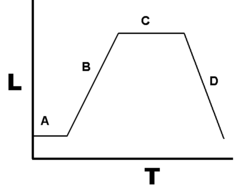
studies, bacterial growth in batch culture can be modeled with four different phases: lag phase (A), exponential or log phase (B), stationary phase (C), and death phase (D).
IN the book "black" the bacterial growth phase classified 07 stages like-(A)lag phase (B)early log phase (C) log/exponential Phase (D)Early Stationery phase (E)stationary phase (f) Early Death phase (G)Death phase..
- During lag phase, bacteria adapt themselves to growth conditions. It is the period where the individual bacteria are maturing and not yet able to divide. During the lag phase of the bacterial growth cycle, synthesis of RNA, enzymes and other molecules occurs.
- Exponential phase (sometimes called the log phase or the logarithmic phase) is a period characterized by cell doubling. The number of new bacteria appearing per unit time is proportional to the present population. If growth is not limited, doubling will continue at a constant rate so both the number of cells and the rate of population increase doubles with each consecutive time period. For this type of exponential growth, plotting the natural logarithm of cell number against time produces a straight line. The slope of this line is the specific growth rate of the organism, which is a measure of the number of divisions per cell per unit time. The actual rate of this growth (i.e. the slope of the line in the figure) depends upon the growth conditions, which affect the frequency of cell division events and the probability of both daughter cells surviving. Under controlled conditions, cyanobacteria can double their population four times a day. Exponential growth cannot continue indefinitely, however, because the medium is soon depleted of nutrients and enriched with wastes.
- During stationary phase, the growth rate slows as a result of nutrient depletion and accumulation of toxic products. This phase is reached as the bacteria begin to exhaust the resources that are available to them. This phase is a constant value as the rate of bacterial growth is equal to the rate of bacterial death.
- At death phase, bacteria run out of nutrients and die.
This basic batch culture growth model draws out and emphasizes aspects of bacterial growth which may differ from the growth of macrofauna. It emphasizes clonality, asexual binary division, the short development time relative to replication itself, the seemingly low death rate, the need to move from a dormant state to a reproductive state or to condition the media, and finally, the tendency of lab adapted strains to exhaust their nutrients.
In reality, even in batch culture, the four phases are not well defined. The cells do not reproduce in synchrony without explicit and continual prompting (as in experiments with stalked bacteria ) and their exponential phase growth is often not ever a constant rate, but instead a slowly decaying rate, a constant stochastic response to pressures both to reproduce and to go dormant in the face of declining nutrient concentrations and increasing waste concentrations.
Batch culture is the most common laboratory growth method in which bacterial growth is studied, but it is only one of many. It is ideally spatially unstructured and temporally structured. The bacterial culture is incubated in a closed vessel with a single batch of medium. In some experimental regimes, some of the bacterial culture is periodically removed and added to fresh sterile medium. In the extreme case, this leads to the continual renewal of the nutrients. This is a chemostat
Chemostat
A chemostat is a bioreactor to which fresh medium is continuously added, while culture liquid is continuously removed to keep the culture volume constant...
, also known as continuous culture. It is ideally spatially unstructured and temporally unstructured, in a steady state defined by the rates of nutrient supply and bacterial growth. In comparison to batch culture, bacteria are maintained in exponential growth phase, and the growth rate of the bacteria is known. Related devices include turbidostat
Turbidostat
A turbidostat is a continuous culture device, similar to a chemostat or an auxostat, which has feedback between the turbidity of the culture vessel and the dilution rate. The theoretical relationship between growth in a chemostat and growth in a turbidostat is somewhat complex, in part because it...
s and auxostat
Auxostat
An auxostat is a continuous culture device which, while in operation, uses feedback from a measurement taken on the growth chamber to control the media flow rate, maintaining the measurement at a constant. Auxo was the Greek goddess of spring growth, and as a prefix represents nutrients...
s.
Bacterial growth can be suppressed with bacteriostats, without necessarily killing the bacteria. In a synecological, true-to-nature situation in which more than one bacterial species is present, the growth of microbes is more dynamic and continual.
Liquid is not the only laboratory environment for bacterial growth. Spatially structured environments such as biofilms or agar
Agar
Agar or agar-agar is a gelatinous substance derived from a polysaccharide that accumulates in the cell walls of agarophyte red algae. Throughout history into modern times, agar has been chiefly used as an ingredient in desserts throughout Asia and also as a solid substrate to contain culture medium...
surfaces present additional complex growth models.
External links
- An examination of the exponential growth of bacterial populations
- Science aid: Bacterial Growth High school (GCSE, Alevel) resource.
- Microbial Growth, BioMineWiki
- From the Wolfram Demonstrations ProjectWolfram Demonstrations ProjectThe Wolfram Demonstrations Project is hosted by Wolfram Research, whose stated goal is to bring computational exploration to the widest possible audience. It consists of an organized, open-source collection of small interactive programs called Demonstrations, which are meant to visually and...
— requires CDF player (free):- The Final Number of Bacterial Cells
- Simulating Microbial Count Records with an Expanded Fermi Solution Model
- Incipient Growth Processes with Competing Mechanisms
- Modified Logistic Isothermal Microbial Growth Ratio
- Generalized Logistic (Verhulst) Isothermal Microbial Growth
- Microbial Population Growth, Mortality, and Transitions between Them
- Diauxic Growth of Bacteria on Two Substrates
This article includes material from an article posted on 26 April 2003 on Nupedia
Nupedia
Nupedia was an English-language Web-based encyclopedia whose articles were written by experts and licensed as free content. It was founded by Jimmy Wales and underwritten by Bomis, with Larry Sanger as editor-in-chief...
; written by Nagina Parmar; reviewed and approved by the Biology group; editor, Gaytha Langlois; lead reviewer, Gaytha Langlois ; lead copyeditors, Ruth Ifcher. and Jan Hogle.