


Backstroke

Encyclopedia
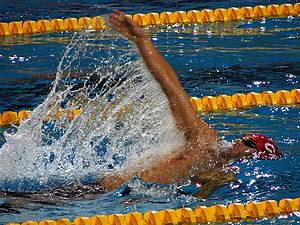
Swimming (sport)
Swimming is a sport governed by the Fédération Internationale de Natation .-History: Competitive swimming in Europe began around 1800 BCE, mostly in the form of the freestyle. In 1873 Steve Bowyer introduced the trudgen to Western swimming competitions, after copying the front crawl used by Native...
styles regulated by FINA
Fina
Fina may refer to:*Fina, a character in the Skies of Arcadia video game*FINA, the International Swimming Federation*FINA, the North American Forum on Integration...
, and the only regulated style swum on the back. This has the advantage of easy breathing, but the disadvantage of swimmers not being able to see where they are going. It is also the only competition swimming style that starts in the water. The swimming style is similar to an upside down front crawl
Front crawl
The front crawl, forward crawl, or freestyle is a swimming stroke usually regarded as the fastest of the four front primary strokes. As such, the front crawl stroke is nearly universally used during a freestyle swimming competition, hence the synonymously used term "freestyle". It is one of two...
. Both backstroke and front crawl are long-axis strokes. In Individual medley backstroke is the second style swum; in the team medley it is the first style swum.
History
Backstroke is an ancient style of swimming. It was the second stroke to be swam in competitions after the front crawlFront crawl
The front crawl, forward crawl, or freestyle is a swimming stroke usually regarded as the fastest of the four front primary strokes. As such, the front crawl stroke is nearly universally used during a freestyle swimming competition, hence the synonymously used term "freestyle". It is one of two...
. The first Olympic
Swimming at the Summer Olympics
Swimming has been a sport at every modern Summer Olympics. It has been open to women since 1912. Along with track & field athletics and gymnastics it is one of the most popular spectator sports at the Games and the one with the largest number of events....
backstroke competition was the 1900 Paris Olympics men's 200 metre.
Speed and ergonomics
Backstroke has a similar speed to butterfly. Race times for the butterfly are superior to those for the backstroke mostly because the former allows a racing start from poolside and the latter does not. In races beyond 200 meters, backstroke would actually be the faster of the two. Though it mainly depends on the stamina of the swimmer. The maximum swimming speed for backstroke is around 1.84 meter per second. Due to its position on the back, backstroke uses some different muscles in the upper body than other styles.Technique
In the initial position, the swimmer lies flat on their back; arms stretched with extended fingertips, and legs extended backwards.Arm movement
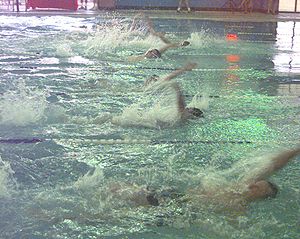
During the power phase the hand follows a semi-circular path from the Catch to the side of the hip. The palm is always facing away from the swimming direction, while remaining straight as an extension of the arm, and the elbow always points downward towards the bottom of the pool. This is done so that both the arms and the elbow can push the maximum amount of water back in order to push the body forward. At the height of the shoulders, the upper and lower arms should have their maximum angle of about 90 degrees. This is called the Mid-Pull of the power phase.
The Mid-Pull phase consists of pushing the palm of the hand as far down as possible with the fingers pointing upward. Again, the goal is to push the body forward against the water. At the very end of the Mid-Pull, the palm flaps down for a last push forward down to a depth of 45 cm, creating the Finish of the Power phase. Besides pushing the body forward, this also helps with the rolling back to the other side as part of the body movement. During the power phase, the fingers of the hand can be slightly apart, as this will increase the resistance of the hand in the water due to turbulence
Turbulence
In fluid dynamics, turbulence or turbulent flow is a flow regime characterized by chaotic and stochastic property changes. This includes low momentum diffusion, high momentum convection, and rapid variation of pressure and velocity in space and time...
.
To prepare for the recovery phase, the hand is rotated so that the palms point towards the legs and the thumb side points upwards. At the beginning of the recovery phase of the one arm, the other arm begins its power phase. The recovering arm is moved in a semicircle straight over the shoulders to the front. During this recovery, the palm rotates so that the small finger enters the water first, allowing for the least amount of resistance, and the palms point outward. After a short gliding phase, the cycle repeats with the preparation for the next power phase.
A variant is to move both arms synchronized and not alternating, similar to an upside down butterfly stroke
Butterfly stroke
The butterfly is a swimming stroke swum on the breast, with both arms moving simultaneously. The butterfly kick was developed separately, and is also known as the "dolphin kick"...
. This is easier to coordinate, and the peak speed during the combined power phase is faster, yet the speed is much slower during the combined recovery. The average speed will usually be less than the average speed of the alternating stroke.
Another variant is the old style of swimming backstroke, where the arm movement formed a complete circle in a windmill type pattern. However, this style is not commonly used for competitive swimming, as a lot of energy is spent on pushing the body up and down instead of forward. Furthermore, the added strain on the shoulder
Shoulder
The human shoulder is made up of three bones: the clavicle , the scapula , and the humerus as well as associated muscles, ligaments and tendons. The articulations between the bones of the shoulder make up the shoulder joints. The major joint of the shoulder is the glenohumeral joint, which...
is considered less than ideal and can lead to injuries.
It is also possible to move only one arm at a time, where one arm moves through the power and recovery phases while the other arm rests. This is slow, but it is used frequently to teach students the movement, as they have to concentrate on only one arm.
Leg movement
The leg movement in backstroke is similar to the flutter kick in front crawl. They make a small contribution to the forward speed, yet are very significant for stabilizing the body.The leg stroke is also alternating, with one leg sinking down straight to about 30 degrees out of the horizontal. From this position, the leg makes a fast kick upward, slightly bending the knee at the beginning and then stretching it again in the horizontal. However, there are also frequent variants with four or only two kicks per cycle. Usually, sprinters tend to use 6 kicks per cycle, whereas long distance swimmer may use less.
It is also possible to use a butterfly (dolphin) kick, although this is rare except the butterfly kick after the start and the turns. This dolphin kick is essential for many top athletes because it is the fastest part of the race. It may also constitute the majority of the race (i.e., in the 100 yard backstroke the swimmer may kick underwater dolphin for 15 yards per length which equates to as much as 60 yards kicking in a 100 yd race) A great example of this is Olympic gold medallist Natalie Coughlin
Natalie Coughlin
Natalie Anne Coughlin is an American swimmer and eleven-time Olympic medallist.At the 2008 Summer Olympics, Coughlin became the first American female athlete in modern Olympic history to win six medals in one Olympics and the first woman ever to win a 100 m backstroke gold in two consecutive...
. Breaststroke kicks are most comfortable if the arms are used synchronized, as the breaststroke kick has difficulty to compensate for a rolling movement due to alternating arm cycles. The butterfly kick can be done slightly to one side depending on the rolling of the body.
Breathing
Breathing in backstroke is easier than in other strokes, as the mouth and nose are usually over water. Competitive swimmers breathe in through the mouth during the recovery of one arm, and breathe out through the mouth and nose during the pull and push phase of the same arm. This is done to clear the nose of water. However, some backstrokers face the problem of splash on their faces due to surface tension that clings to their arms as they exit the water.Body movement
Due to the asynchronous movement of the arms, there is a roll of the body around its own axis. This is normal and helps swimming effectively. The overall position of the body is straight in the horizontal to reduce drag. Beginners frequently let their posterior sink too low and increase drag. To avoid this, the upper legs have to be moved to the extreme down position at each kick even with a little help by the back and the foot tips have to be fixed in the extreme lower position and the head is held out of the water to act as a counter-weight.Start
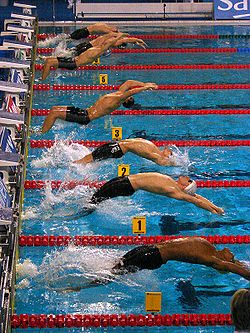
For the takeoff, the swimmer pushes his or her hands away from the block, and swings his or her arms around sideways to the front. At the same time, the swimmer throws his or her head to the back. Only a minimal delay afterwards, the swimmer pushes away from the wall with his feet. Ideally, the swimmer's back is arched during the airborne phase so that only the feet and the hands touch the water while the rest of the body is above the water line. This reduces the drag and allows the swimmer to start faster.However, swimmers are not allowed to start with their feet above the water line, or the swimmer will get disqualified.
After the start, the swimmer is completely underwater. Due to increased resistance at the surface, experienced swimmers usually swim faster underwater than at the surface. Therefore, most experienced swimmers in backstroke competitions stay under water up to the limit set by FINA (35 meters after the start and after every turn). Most swimmers use a butterfly kick underwater, as this provides more forward movement than the flutter kick. The underwater phase includes the risk of water entering the nose, which can be unpleasant. Most swimmers breathe out slightly through the nose to stop water from entering. It is also possible to use a nose clip. Some swimmers can close their nostrils with their upper lips.
The swimmer's head must break the surface before 15 m. The swimmer starts swimming with one arm, followed by the other arm with half a cycle delay. The swimmer continues in regular swimming style, staying on the back for the entire time except the turns. One part of the swimmer must break the surface at any time.
Turn and finish
Approaching the wall has the problem that the swimmer cannot see where he or she is going. Most competitive swimmers know how many strokes they need for a lane, or at least how many strokes after the signal flags or the change in color of the separating lines. Turning the head is also possible, but slows the swimmer down.When approaching the wall, the swimmer is allowed to turn to the breast and make one push/pull phase with one arm. Next, the swimmer makes half a tumble turn forward, resting the feet against the wall. The arms are in the forward position at this time, and the swimmer pushes their body off the wall. Similar to the start, the swimmer can remain up to 15 m under water, with most swimmers using a butterfly kick for speed.
For the finish, the swimmer must touch the wall while lying on his back, less than 90 degrees out of the horizontal.
Competitions
- 50 m backstroke
- 100 m backstroke
- 200 m backstroke
Backstroke is also part of the medley
Medley swimming
Medley is a combination of four different swimming styles into one race. This race is either swum by one swimmer as individual medley or by four swimmers as a medley relay...
over the following distances:
- 100 m individual medley (short 25 m pool only)
- 200 m individual medley
- 400 m individual medley
- 4×100 m medley relay
These are the official FINA rules. They apply to swimmers during official swimming competitions.
- Before the starting signal, the swimmers shall line up in the water facing the starting end, with both hands holding the starting grips. Standing in or on the gutter or bending the toes over the lip of the gutter is prohibited.
- At the signal for starting and after turning, the swimmer shall push off and swim upon his back throughout the race except when executing a turn as set forth in SW 6.4. The normal position on the back can include a roll movement of the body up to, but not including 90 degrees from horizontal. The position of the head is not relevant.
- Some part of the swimmer must break the surface of the water throughout the race. It shall be permissible for the swimmer to be completely submerged during the turn, at the finish and for a distance of not more than 15 meters after the start and each turn. By that point, the head must have broken the surface.
- During the turn, the shoulders may be turned over the vertical to the breast after which a continuous single arm pull or a continuous simultaneous double arm pull may be used to initiate the turn. Once the body has left the position on the back, any kick or arm pull must be part of the continuous turning action. The swimmer must have returned to the position on the back upon leaving the wall. When executing the turn there must be a touch of the wall with some part of the swimmer’s body.
- Upon the finish of the race, the swimmer must touch the wall while on the back. The body may be submerged at the touch.
Men
Women
External links
- Swim.ee: Detailed discussion of swimming techniques and speeds
- Backstroke Start: USA Swimming backstroke start