
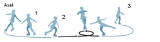
The
Axel is a
figure skating jumpFigure skating jumps are a major element of competitive figure skating. Different jumps are identified by the take-off edge and the number of revolutions completed. There are six kinds of jumps currently counted as jump elements in ISU regulations.-Technique:...
with a forward take-off. It is named after the Norwegian skater
Axel PaulsenAxel Paulsen was a Norwegian figure skater and speed skater. He is the inventor of the figure skating Axel jump.-Biography:Paulsen first publicly executed the Axel jump in 1882 at the World Championships in Vienna while wearing speed skates...
, who first performed the jump in 1882. An Axel jump has an extra ½ rotation in the air due to its forward take-off. For a jump with counterclockwise rotation, it has a takeoff from the left forward outside edge and a landing on the right back outside edge; this can be reversed for a clockwise jump. The Axel can also be done as a double jump with 2½ rotations, or as a triple with 3½ rotations. No skater has yet accomplished a
quadrupleA quad, or "quadruple", is a figure skating jump with four or more, but fewer than five, revolutions. Most quadruple jumps have exactly four revolutions; the quadruple Axel has 4½ revolutions, although no figure skater to date has completed this jump, either in practice, or, more importantly, in...
Axel in competition.
Axel technique
To perform an Axel, the skater typically approaches the jump on a right back outside edge in a strongly held check position before stepping onto a left forward outside edge. He or she vaults over the toe pick of the left skate and "steps up" into the jump with the right leg. Then the skater brings the left leg through to cross in front of the right in what is known as a back spin position (similar to that for the
loop jumpThe Loop jump is a figure skating jump that takes off from a back outside edge and lands on the same backwards outside edge. For a jump with counterclockwise rotation, this is the right back outside edge. It is named from its similarity to the loop compulsory figure. The invention is widely...
), to bring the center of rotation around the right side of the body; this is often described as a weight shift in the air. Uncrossing the legs on the landing checks the rotation and allows the skater to flow out of the jump with good speed.
It is quite common for skaters to skid the forward takeoff edge slightly, especially on double and triple Axels, rather than vaulting directly off a clean edge. The skid helps the blade grip the ice on the takeoff, and is considered acceptable technique as long as the skid is not so great that the skater pre-rotates the jump or takes off the back of the blade rather than off the toe pick. When the skater makes a mistake in the timing of the jump such that the blade does not grip at all and he or she slips completely off the edge, the result is what is called a
waxel, often resulting in a fall.
Computerized bio-mechanical studies of skaters performing double and triple Axels have shown that skaters typically do not achieve quite as much height on the triple Axel as they do on the double. This may seem counter-intuitive, since a higher jump ought to give a skater more time to complete the rotation in the air. Instead, on the triple Axel, skaters do not take such a big "step up" so that they can pull in to the rotation position more quickly.
A double axel is much more difficult than a single and some times has a completely different technique. Some people believe that a double axel is just a single with an extra rotation added on. In theory, it is, but in practice, this is most definitely not the case.
Axel history
- Axel Paulsen
Axel Paulsen was a Norwegian figure skater and speed skater. He is the inventor of the figure skating Axel jump.-Biography:Paulsen first publicly executed the Axel jump in 1882 at the World Championships in Vienna while wearing speed skates...
was the first skater to perform the jump named after him, in 1882. Curiously, he performed this feat wearing speed skatesSpeed skating, or speedskating is a competitive form of ice skating in which the competitors race each other in traveling a certain distance on skates. Types of speed skating are long track speed skating, short track speed skating, and marathon speed skating...
rather than figure skates.
- In the early years of skating, jumping was the exclusive domain of men. Sonja Henie
Sonja Henie was a Norwegian figure skater and film star. She was a three-time Olympic Champion in Ladies Singles, a ten-time World Champion and a six-time European Champion . Henie won more Olympic and World titles than any other ladies figure skater...
is generally acknowledged as the first female skater to perform an Axel jump. Today, however, her Axel technique (preserved in her many films) would be considered very poor, since her jumps were badly pre-rotated without a "step up", giving them more the character of a jumped spin.
- Dick Button
Richard Totten "Dick" Button is an American former figure skater and a well-known long-time skating television analyst. He is a two-time Olympic Champion and five-time World Champion...
was the first skater credited with a double Axel jump in competition. He performed this at the 1948 Winter OlympicsThe 1948 Winter Olympics, officially known as the V Olympic Winter Games, was a winter multi-sport event celebrated in 1948 in St. Moritz, Switzerland. The Games were the first to be celebrated after World War II; it had been twelve years since the last Winter Games in 1936...
, although video footage of the jump shows that it may have been underrotated. Button's coach Gus Lussi was responsible for developing the modern Axel jump technique. In 1953, Carol HeissCarol Elizabeth Heiss Jenkins is an American figure skater. She is the 1960 Olympic Champion in Ladies Singles, 1956 Olympic silver medalist and five-time World Champion .-Biography:...
was the first woman to perform a double Axel.
- Canadian skater Vern Taylor
Vern Taylor is a Canadian figure skater. He is the 1978 & 1979 Canadian silver medalist and 1977 bronze medalist. At the 1978 World Figure Skating Championships, he became the first person to land a triple axel jump in competition.-Competitive highlights:...
was the first to land a triple Axel in competition at the 1978 World Figure Skating ChampionshipsThe World Figure Skating Championships is an annual figure skating competition sanctioned by the International Skating Union in which elite figure skaters compete for the title of World Champion...
. It has since become a standard jump for male competitors, but it is rare for female skaters to successfully land them, or even to attempt them. The first woman to land the jump in competition was Midori Itois a former Japanese figure skater. She is the 1989 World Champion and the 1992 Olympic silver medalist. She is the first woman to land a triple/triple jump combination and a triple axel in competition. She is also the first woman to land seven triple jumps in a free program, which she did at the...
, who first performed it at the 1988 NHK TrophyThe NHK Trophy is an international, senior-level figure skating competition held as part of the ISU Grand Prix of Figure Skating series. Figure skaters compete in the disciplines of ladies' singles, men's singles, pair skating, and ice dancing....
. Since then four other women (Tonya HardingTonya Maxine Harding is an American figure skating champion. In 1991 she won the U.S. Figure Skating Championships and placed second in the World Championships. She was the second woman, and the first American woman, to complete a triple axel jump in competition...
, Ludmila NelidinaLudmila Nelidina is a Russian figure skater. She competed for Russia until 1998, when she briefly switched to competing for Azerbaijan. She switched back to skating for Russia the following year. Her highest placement at a senior-level ISU Championship was 13th at the 2003 World Championships...
, Yukari Nakanois a former competitive figure skater for Japan.She is the 2007 Asian Winter Games champion, the 2006 Four Continents silver medalist, 2003 Four Continents bronze medalist, the 2005-2006 Grand Prix Final bronze medalist, and a three-time Japanese bronze medalist.She is one of the five ladies...
and Mao Asadais a Japanese figure skater.She is the 2010 Winter Olympic silver medalist, the 2008 & 2010 World champion, the 2008 & 2010 Four Continents champion, a two-time Grand Prix Final champion, the 2005 World Junior champion, the 2004–2005 Junior Grand Prix Final champion and a four-time Japanese...
) have succeeded in completing the jump in international competition, while another woman, Kimmie MeissnerKimberly Claire "Kimmie" Meissner is an American figure skater. She is the 2006 World Champion, the 2007 U.S. National Champion, and the 2007 Four Continents Champion...
, first completed the jump at the 2005 U.S. Figure Skating Championships.
- American pair skaters Rena Inoue
is an American pair skater. With partner John Baldwin, she is the 2004 and 2006 U.S. National Champion. Inoue previously competed for Japan as both a single skater and pair skater. Inoue and Baldwin are the first skaters to perform a throw triple axel in competition.-Personal life:Rena Inoue was...
and John Baldwin, Jr.John Baldwin, Jr. is an American figure skater. With partner Rena Inoue, he is a two-time U.S. national champion. Inoue and Baldwin are the first skaters to perform a throw triple axel in competition.-Personal life:...
became the first pair to perform a throw triple Axel in competition at the 2006 U.S. Figure Skating Championships, and then made Olympic and ISU history landing it again at the 2006 Winter OlympicsThe 2006 Winter Olympics, officially known as the XX Olympic Winter Games, was a winter multi-sport event which was celebrated in Turin, Italy from February 10, 2006, through February 26, 2006. This marked the second time Italy hosted the Olympic Winter Games, the first being the VII Olympic Winter...
.
- Brian Orser
Brian Ernest Orser, OC is a Canadian retired competitive and professional figure skater. He is the 1984 and 1988 Olympic silver medalist, 1987 World champion and the 1981-1988 Canadian national champion....
of Canada was the first skater to put two triple axel jumps in the same program, and the first to accomplish this at the World level at the 1987 World Figure Skating Championships-Medalists:- Medal table :-Men:-Ladies:-Pairs:-Ice Dancing:-Reference:** Result list provided by ISU* *...
; since he also landed one in the short program, he additionally was the first skater to land three triple axel jumps in the same competition. Mao Asadais a Japanese figure skater.She is the 2010 Winter Olympic silver medalist, the 2008 & 2010 World champion, the 2008 & 2010 Four Continents champion, a two-time Grand Prix Final champion, the 2005 World Junior champion, the 2004–2005 Junior Grand Prix Final champion and a four-time Japanese...
became the first woman to duplicate this feat at the 2010 Winter OlympicsThe 2010 Winter Olympics, officially the XXI Olympic Winter Games or the 21st Winter Olympics, were a major international multi-sport event held from February 12–28, 2010, in Vancouver, British Columbia, Canada, with some events held in the suburbs of Richmond, West Vancouver and the University...
.
Axel variations
The jump with half a rotation from forward outside to backward outside is called a
waltz jump or a
three jump in some countries. Any other rotational jump with a forward takeoff is generally considered to be a variation of the Axel. These include:
- A delayed Axel is similar to a regular Axel, but the skater takes a very open body position on the ascent of the jump before pulling in to complete the rotation before landing.
- In an open Axel, the skater maintains an open body position throughout the jump without delaying the rotation.
- A tuck Axel has the same take-off and landing as a regular Axel, but the skater pulls the legs up into a tuck or sit spin position in the air.
- A half Axel is a jump with a regular Axel take-off but with only one rotation, landed forward (typically on the left toe pick and right forward inside edge, for a counterclockwise jump). This jump is sometimes also called a bell jump or a once around.
- A one-foot Axel is a 1½ rotation jump with a regular Axel take-off that lands on the back inside edge of the takeoff foot—the left foot, for a counterclockwise jump. This jump is sometimes known (especially in artistic roller skating
Artistic roller skating is a sport similar to figure skating but where constestants run on roller skates instead of ice skates. Within artistic roller skating there are several disciplines:* figures...
) as a Colledge, after 1937 World Champion Cecilia ColledgeMagdelena Cecilia Colledge was a British figure skater. She was the 1936 Olympic silver medalist, the 1937 World Champion, the 1938-1939 European Champion, and a six-time British national champion....
.
- An inside Axel is a 1½ rotation jump that takes off from a forward inside edge and lands on the back outside edge of the same foot – the right foot, for a counterclockwise jump. This jump is sometimes known as a Böckl, after its inventor Willy Böckl.
In addition, an Axel entrance can be used as a take-off for flying spins. An
Axel sit spin is also known as a
flying reverse sit spin, and is essentially an Axel jump landed in a back sit spin. Rarely, skaters may also attempt a double Axel sit spin. In a
flying open Axel sit spin, also known as a
death drop, the skater achieves an almost horizontal position in the air (by kicking the takeoff leg backwards and to the side, instead of bringing it forward) before landing in a back sit spin.
In general, the
International Skating UnionThe International Skating Union is the international governing body for competitive ice skating disciplines, including figure skating, synchronized skating, speed skating, and short track speed skating. It was founded in Scheveningen, Netherlands in 1892, making it one of the oldest international...
's new
ISU Judging SystemThe ISU Judging System , is the scoring system on the event and on the level of competition. At the senior international level, single and pairs short programs contain eight technical elements. The actual eight elements are detailed for single skaters in ISU rule 310...
discourages skaters from including variety jumps such as Axel variants in their competitive programs, because they count towards the maximum number of permitted jumps but carry a much lower point value than any double or triple jump that the skater could perform instead. Likewise, the IJS treats all flying spins equally and does not reward the additional difficulty of a double Axel sit spin.
A
toe Axel is not a real jump, but is instead the name given to a flawed double toe loop jump.