
All Topics  
Automation

 
Automation

   Email Print
   Bookmark   Link


Automation


For a hierarchical presentation of automation topics, see Outline of automation. For other uses, see Automation (disambiguation)
Automation (disambiguation)

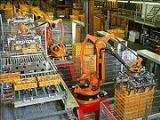
Automation is the operation of machinery without human supervision. Automation may also refer to:...
.


Automation or industrial automation or numerical control
Numerical control

Numerical control refers to the automation of machine tools that are operated by abstractly programmed commands encoded on a storage medium, as opposed to manually controlled via handwheels or levers or mechanically automated via cams alone....
 is the use of control system
Control system

A control system is a device or set of devices to manage, command, direct or regulate the behavior of other devices or systems.There are two common classes of control systems, with many variations and combinations: logic gate, and feedback or linear controls....
s such as computer
Computer

A computer is a machine that manipulates Data according to a list of Code .The first devices that resemble modern computers date to the mid-20th century , although the computer concept and various machines similar to computers existed earlier....
s to control industrial
Industry

An industry is the manufacturing of a Good or Service within a category. Although industry is a broad term for any kind of economic production, in economics and urban planning industry is a synonym for the secondary sector, which is a type of economic activity involved in the manufacturing of raw materials into goods and products....
 machinery and process
Industrial process

Industrial processes are procedures involving chemistry or mechanization steps to aid in the manufacture of an item or items, usually carried out on a very large scale....
es, reducing the need for human intervention. In the scope of industrialization
Industrialization

Industrialization is the process of social and economic change whereby a human group is transformed from a pre-industrial society into an industry one....
, automation is a step beyond mechanization
Mechanization

Mechanization or mechanisation is providing human operators with machinery to assist them with the physical requirements of work. It can also refer to the use of machines to replace manual labor or animals....
. Whereas mechanization provided human operators with machinery to assist them with the physical requirements of work, automation greatly reduces the need for human sensory and mental requirements as well.


Discussion
Ask a question about 'Automation'
Start a new discussion about 'Automation'
Answer questions from other users
Full Discussion Forum


Encyclopedia


For a hierarchical presentation of automation topics, see Outline of automation. For other uses, see Automation (disambiguation)
Automation (disambiguation)

Automation is the operation of machinery without human supervision. Automation may also refer to:...
.


Automation or industrial automation or numerical control
Numerical control

Numerical control refers to the automation of machine tools that are operated by abstractly programmed commands encoded on a storage medium, as opposed to manually controlled via handwheels or levers or mechanically automated via cams alone....
 is the use of control system
Control system

A control system is a device or set of devices to manage, command, direct or regulate the behavior of other devices or systems.There are two common classes of control systems, with many variations and combinations: logic gate, and feedback or linear controls....
s such as computer
Computer

A computer is a machine that manipulates Data according to a list of Code .The first devices that resemble modern computers date to the mid-20th century , although the computer concept and various machines similar to computers existed earlier....
s to control industrial
Industry

An industry is the manufacturing of a Good or Service within a category. Although industry is a broad term for any kind of economic production, in economics and urban planning industry is a synonym for the secondary sector, which is a type of economic activity involved in the manufacturing of raw materials into goods and products....
 machinery and process
Industrial process

Industrial processes are procedures involving chemistry or mechanization steps to aid in the manufacture of an item or items, usually carried out on a very large scale....
es, reducing the need for human intervention. In the scope of industrialization
Industrialization

Industrialization is the process of social and economic change whereby a human group is transformed from a pre-industrial society into an industry one....
, automation is a step beyond mechanization
Mechanization

Mechanization or mechanisation is providing human operators with machinery to assist them with the physical requirements of work. It can also refer to the use of machines to replace manual labor or animals....
. Whereas mechanization provided human operators with machinery to assist them with the physical requirements of work, automation greatly reduces the need for human sensory and mental requirements as well. Processes and systems can also be automated.

Automation plays an increasingly important role in the global economy and in daily experience. Engineers strive to combine automated devices with mathematical and organizational tools to create complex systems for a rapidly expanding range of applications and human activities.

Many roles for humans in industrial processes presently lie beyond the scope of automation. Human-level pattern recognition
Pattern recognition

Pattern recognition is a sub-topic of machine learning. It is "the act of taking in raw data and taking an action based on the Category of the data"....
, language recognition
Language recognition

Language recognition is a field of artificial intelligence which enables computers to recognise language of a writing. Sometimes, the term is used to describe speech recognition....
, and language production ability are well beyond the capabilities of modern mechanical and computer systems. Tasks requiring subjective assessment or synthesis of complex sensory data, such as scents and sounds, as well as high-level tasks such as strategic planning, currently require human expertise. In many cases, the use of humans is more cost-effective than mechanical approaches even where automation of industrial tasks is possible.

Specialised hardened computers, referred to as programmable logic controller
Programmable logic controller

A programmable logic controller or programmable controller is a digital computer used for automation of electromechanical processes, such as control of machinery on factory assembly lines, control of amusement rides, or control of lighting fixtures....
s (PLCs), are frequently used to synchronize the flow of inputs from (physical) sensor
Sensor

A sensor is a device that measures a physical quantity and converts it into a signal which can be read by an observer or by an instrument. For example, a mercury thermometer converts the measured temperature into expansion and contraction of a liquid which can be read on a calibrated glass tube....
s and events with the flow of outputs to actuators and events. This leads to precisely controlled actions that permit a tight control of almost any industrial process
Industrial process

Industrial processes are procedures involving chemistry or mechanization steps to aid in the manufacture of an item or items, usually carried out on a very large scale....
.

Human-machine interfaces (HMI) or computer human interfaces
User (computing)

In computing, a user is a person who uses a computer or Internet service. A user may have a user account that identifies the user by a username , screenname , or "handle", which is derived from the identical Citizen's Band radio term....
 (CHI), formerly known as man-machine interfaces, are usually employed to communicate with PLCs and other computers, such as entering and monitoring temperatures
Temperature control

Temperature control is a process in which the temperature of an object is measured and the passage of heat energy into or out of the object is adjusted to achieve a desired temperature....
 or pressures for further automated control or emergency response. Service personnel who monitor and control these interfaces are often referred to as stationary engineers.

Impact

Automation has had a notable impact in a wide range of highly visible industries beyond manufacturing. Once-ubiquitous telephone operator
Telephone operator

A telephone operator is either* a person who provides assistance to a telephone caller, usually in the placing of operator assisted telephone calls such as calls from a pay phone, collect calls , calls which are billed to a credit card, station-to-station and person-to-person calls, and certain List of country calling codess which cannot...
s have been replaced largely by automated telephone switchboard
Telephone switchboard

A switchboard was a device used to connect a group of telephones manually to one another or to an outside connection, within and between telephone exchanges or private branch exchanges ....
s and answering machines. Medical processes such as primary screening in electrocardiography or radiography
Radiography

Radiography is the use of X-rays to view unseen or hard-to-image objects. The main diagnostic purposes of X-rays are to see inside one's body, most commonly the bones which can be viewed at an optimum resolution ....
 and laboratory analysis of human genes
Gênes

G?nes is the name of a d?partement in France of the First French Empire in present Italy. It was named after the city Genoa. It was formed in 1805, when Napoleon Bonaparte occupied the Republic of Genoa....
, sera
Blood plasma

Blood plasma is the liquid component of blood, in which the blood cells are suspended. It makes up about 55% of total blood volume. It is composed of mostly water , and contains dissolved proteins, glucose, clotting factors, mineral ions, Hormone and carbon dioxide ....
, cells
Cell (biology)

The cell is the structural and functional unit of all known Life organisms. It is the smallest unit of an organism that is classified as living, and is often called the building bricks of life....
, and tissues
Biological tissue

Tissue is a cellular organizational level intermediate between cells and a complete organism. Hence, a tissue is an ensemble of cells, not necessarily identical, but from the same origin, that together carry out a specific function....
 are carried out at much greater speed and accuracy by automated systems. Automated teller machine
Automated teller machine

An automated teller machine is a computerized telecommunications device that provides the customers of a financial institution with access to financial transactions in a public space without the need for a human clerk or bank teller....
s have reduced the need for bank visits to obtain cash and carry out transactions. In general, automation has been responsible for the shift in the world economy from agrarian to industrial in the 19th century and from industrial to services in the 20th century.

The widespread impact of industrial automation raises social issues, among them its impact on employment
Employment

Employment is a contract between two party , one being the #Employer and the other being the #Employee. An employee may be defined as: "A person in the Service of another under any contract of hire, express or implied, oral contract or written, where the employer has the power or right to control and Management the employee i...
. Historical concerns about the effects of automation date back to the beginning of the industrial revolution, when a social movement of English textile machine operators in the early 1800s known as the Luddites protested against Jacquard's automated weaving looms — often by destroying such textile machines— that they felt threatened their jobs. One author made the following case. When automation was first introduced, it caused widespread fear. It was thought that the displacement of human operator
Operator

In mathematics, an operator is a function which operates on another function. Often, an "operator" is a function which acts on functions to produce other functions ; or it may be a generalization of such a function, as in linear algebra, where some of the terminology reflects the origin of the subject in operations on the functions which ar...
s by computerized systems would lead to severe unemployment
Unemployment

File:World map of countries by rate of unemployment.pngUnemployment occurs when a person is available to work and currently seeking work, but the person is without Wage labour....
.

Critics of automation contend that increased industrial automation causes increased unemployment; this was a pressing concern during the 1980s. One argument claims that this has happened invisibly in recent years, as the fact that many manufacturing jobs left the United States during the early 1990s was offset by a one-time massive increase in IT
Information technology

Information technology , as defined by the Information Technology Association of America , is "the study, design, development, implementation, support or management of computer-based information systems, particularly software applications and computer hardware." IT deals with the use of electronic computers and computer software to data conv...
 jobs at the same time. Some authors argue that the opposite has often been true, and that automation has led to higher employment. Under this point of view, the freeing up of the labour force has allowed more people to enter higher skilled managerial as well as specialised consultant/contractor jobs (like cryptographers), which are typically higher paying. One odd side effect of this shift is that "unskilled labour" is in higher demand in many first-world nations, because fewer people are available to fill such jobs.

At first glance, automation might appear to devalue labor through its replacement with less-expensive machines; however, the overall effect of this on the workforce as a whole remains unclear. Today automation of the workforce is quite advanced, and continues to advance increasingly more rapidly throughout the world and is encroaching on ever more skilled jobs, yet during the same period the general well-being and quality of life of most people in the world (where political factors have not muddied the picture) have improved dramatically. What role automation has played in these changes has not been well studied.

Current emphasis


Currently, for manufacturing companies, the purpose of automation has shifted from increasing productivity and reducing costs, to broader issues, such as increasing quality and flexibility in the manufacturing process.

The old focus on using automation simply to increase productivity and reduce costs was seen to be short-sighted, because it is also necessary to provide a skilled workforce who can make repairs and manage the machinery. Moreover, the initial costs of automation were high and often could not be recovered by the time entirely new manufacturing processes replaced the old. (Japan's "robot junkyards" were once world famous in the manufacturing industry.)

Automation is now often applied primarily to increase quality in the manufacturing process, where automation can increase quality substantially. For example, automobile and truck piston
Piston

A piston is a component of reciprocating engines, pumps and gas compressors. It is located in a Cylinder and is made gas-tight by piston rings....
s used to be installed into engines
Internal combustion engine

The internal combustion engine is an engine in which the combustion of a fuel occurs in a combustion chamber inside and integral to the engine. In an internal combustion engine it is always the expansion of the high temperature and pressure gases that are produced by the combustion which apply force to the movable component of the engine, such as...
 manually. This is rapidly being transitioned to automated machine installation, because the error rate for manual installment was around 1-1.5%, but has been reduced to 0.00001% with automation. Hazardous operations, such as oil refining, the manufacturing of industrial chemicals
Chemical industry

The chemical industry comprises the companies that produce industrial chemicals. It is central to modern world economy, converting raw materials into more than 70,000 different products....
, and all forms of metal working, were always early contenders for automation.

Another major shift in automation is the increased emphasis on flexibility and convertibility in the manufacturing process. Manufacturers are increasingly demanding the ability to easily switch from manufacturing Product A to manufacturing Product B without having to completely rebuild the production line
Production line

File:Krispy Kreme Doughnuts.jpgA production line is a set of sequential operations established in a factory whereby materials are put through a refining process to produce an end-product that is suitable for onward consumption; or components are assembled to make a finished article....
s. Flexibility and distributed processes have led to the introduction of Automated Guided Vehicle
Automated Guided Vehicle

The automated guided vehicle or automatic guided vehicle is a mobile robot used in industrial applications to move materials around a manufacturing facility or a warehouse....
s with Natural Features Navigation.

Automation tools


Different types of automation tools exist:

  • ANN - Artificial neural network
    Artificial neural network

    An artificial neural network , often just called a "neural network" , is a mathematical model or computational model based on biological neural networks....
  • DCS - Distributed Control System
    Distributed control system

    A distributed control system refers to a control system usually of a manufacturing system, process or any kind of dynamic system, in which the controller elements are not central in location but are distributed throughout the system with each component sub-system controlled by one or more controllers....
  • HMI - Human Machine Interface
  • SCADA - Supervisory Control and Data Acquisition
  • PLC - Programmable Logic Controller
    Programmable logic controller

    A programmable logic controller or programmable controller is a digital computer used for automation of electromechanical processes, such as control of machinery on factory assembly lines, control of amusement rides, or control of lighting fixtures....


See also


Further reading

  • Jeremy Rifkin
    Jeremy Rifkin

    Jeremy Rifkin , the founder and president of the Foundation on Economic Trends , is an American economist, writer, and public speaker. He is an activist who seeks to shape public policy in the United States and globally....
    : The End of Work: The Decline of the Global Labor Force and the Dawn of the Post-Market Era
  • Ramin Ramtin: Capitalism and Automation - Revolution in Technology and Capitalist Breakdown. Pluto Press, London, Concord Mass. 1991


External links