
All Topics  
Audi 100

 
Audi 100

   Email Print
   Bookmark   Link


Audi 100


The Audi 100 and Audi 200 are mid-sized automobile
Automobile

An automobile or motor car is a wheeled motor vehicle for transportation passengers, which also carries its own car engine or motor. Most definitions of the term specify that automobiles are designed to run primarily on roads, to have seating for one to eight people, to typically have four wheels, and to be constructed principally f...
s from Audi
Audi

AUDI AG, is a Germany car manufacturer which produces cars under the Audi brand, . The name Audi is based on a latin translation of the last name of the founder August "Horch", itself the German word for ?hear." Another explanation for the origin of the name is as an acronym for ?Auto Union Deutschland Ingolstadt."...
 (part of the Volkswagen Group
Volkswagen Group

Volkswagen Group, or Volkswagen Aktiengesellschaft , is a German automotive industry group, currently the automotive industry#World's largest vehicle manufacturing groups , and the largest in Europe....
), made between 1968 and 1994. The C3 model of the Audi 100 was sold in the United States as the Audi 5000 until 1988.
origins of the first Audi 100 have become legendary in Germany. When Volkswagen purchased Auto Union
Auto Union

Auto Union was an amalgamation of four Germany automobile manufacturers, established in 1932 in Chemnitz, Saxony, during the Great Depression. The company has evolved into present day Audi, as an independent subsidiary of Volkswagen Group....
 from Mercedes Benz in 1965, they seem to have been motivated by a desperate shortage of production capacity for their ’Beetle’ model which at that time was selling faster than the cars could be produced.


Discussion
Ask a question about 'Audi 100'
Start a new discussion about 'Audi 100'
Answer questions from other users
Full Discussion Forum


Encyclopedia


The Audi 100 and Audi 200 are mid-sized automobile
Automobile

An automobile or motor car is a wheeled motor vehicle for transportation passengers, which also carries its own car engine or motor. Most definitions of the term specify that automobiles are designed to run primarily on roads, to have seating for one to eight people, to typically have four wheels, and to be constructed principally f...
s from Audi
Audi

AUDI AG, is a Germany car manufacturer which produces cars under the Audi brand, . The name Audi is based on a latin translation of the last name of the founder August "Horch", itself the German word for ?hear." Another explanation for the origin of the name is as an acronym for ?Auto Union Deutschland Ingolstadt."...
 (part of the Volkswagen Group
Volkswagen Group

Volkswagen Group, or Volkswagen Aktiengesellschaft , is a German automotive industry group, currently the automotive industry#World's largest vehicle manufacturing groups , and the largest in Europe....
), made between 1968 and 1994. The C3 model of the Audi 100 was sold in the United States as the Audi 5000 until 1988.

Audi 100 (C1, 1968–1976)


The origins of the first Audi 100 have become legendary in Germany. When Volkswagen purchased Auto Union
Auto Union

Auto Union was an amalgamation of four Germany automobile manufacturers, established in 1932 in Chemnitz, Saxony, during the Great Depression. The company has evolved into present day Audi, as an independent subsidiary of Volkswagen Group....
 from Mercedes Benz in 1965, they seem to have been motivated by a desperate shortage of production capacity for their ’Beetle’ model which at that time was selling faster than the cars could be produced. The then nearly new Auto Union plant at Ingolstadt
Ingolstadt

Ingolstadt is a city in the Free State of Bavaria, Germany. It is located along the banks of the Danube River, in the center of Bavaria. As of December 31, 2005, Ingolstadt had 121,801 residents, making it the second-largest city in Upper Bavaria, after Munich....
, built under Mercedes ownership and control, was quickly adapted for Beetle assembly: Volkswagen boss Heinrich Nordhoff
Heinrich Nordhoff

Heinz Heinrich Nordhoff was a Germany engineer famous for his leadership of the Volkswagen company as it was rebuilt after World War II.Nordhoff attended technical college in Berlin, where he became a member of the Roman Catholic fraternity Askania-Burgundia, and in 1927, began work for BMW working on aircraft engines, but soon went to wor...
, mindful of the poor sales record of the DKW F102
DKW F102

The DKW F102 is a car produced by German manufacturer DKW. It succeeded the Auto Union 1000 and 1000S models in 1963. It was the last model developed before Volkswagen acquired the Auto Union brands from Mercedes-Benz in 1964, and provided the base for the later Audi F103 models ....
, and at a time when the new Audi F103 had yet to prove itself in the market place, gave instructions that no further new Auto Union (including Audi) models should be developed.

However, it was not just the Ingolstadt manufacturing facility that Volkswagen acquired from Mercedes when they purchased the Auto Union business. Among the employees inherited from the Mercedes era was engineer Ludwig Kraus. Kraus did not share Nordhoff’s apparent conviction that demand for the Beetle would remain insatiable for ever, and it was Kraus who developed the Audi 100, in direct contravention of instructions from Volkswagen management, and in secret. The first Nordhoff knew of the project was when he was presented with a production ready prototype. It is to Nordhoff’s credit that he changed his mind and gave the car the green light. The Audi 100 would be a commercial success, but it would also be the first of a series of front engined water cooled Audi based designs from the Volkswagen group that would, starting with the first Passat
Volkswagen Passat

The Volkswagen Passat is a family car built by Volkswagen through six design generations since 1973. Falling between the Volkswagen Golf/Volkswagen Jetta and Volkswagen Phaeton in the current Volkswagen line-up, the Passat has been badged variously as Dasher, Santana, Quantum, Magotan, Corsar and Carat....
 in 1973, enable the group to survive and flourish once the European and US markets began to lose their appetites for rear engined air cooled models.

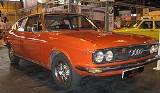
The Audi 100 was shown to the press on 26 November 1968. Its name originally denoting a power output of , the Audi 100 was the company's largest car since the revivial of the Audi brand by Volkswagen in 1965. The C1 platform spawned several variants: the Audi 100 two- and four-door saloons, and the Audi 100 Coupé S, a stylish fastback
Fastback

A fastback is a car body style whose roofline slopes continuously down at the back. The word can also designate the car itself. The style is seen on two-door coup?s as well as four-door sedan s....
 coupé, which bore a remarkable resemblance to the Aston Martin DBS released a year earlier, especially at the rear end, including details such as the louvres behind the rear side windows and shape of the rear light clusters.

Audi followed up the introduction of the four-door saloon in November 1968 with a two-door saloon in October 1969 and the 100 Coupé S in autumn 1970. The cars' four-cylinder engines
Straight-4

The straight-4 or inline-4 engine is a four cylinder internal combustion engine with all four cylinder mounted in a straight line along the crankcase....
 originally came in base (1.8 litre, ), 100 S (1.8 litre, ) and 100 LS (1.8 litre, ) guise, while the Coupé was driven by a bored-out 1.9 litre developing . From April 1970 the 100 LS could be ordered with a 3-speed automatic transmission
Automatic transmission

An automatic transmission is an automobile gearbox that can change gear ratios automatically as the vehicle moves, freeing the driver from having to shift gears manual transmission....
 sourced from Volkswagen
Volkswagen

Volkswagen Passenger Cars, also known as VW, is an automobile manufacturer based in Wolfsburg, Germany and is the original as well as the largest brand by sales volume within the Volkswagen Group....
.

Starting with model year 1972 the 80 and 90 PS versions were replaced by a new regular-petrol-variant of the 1.8 liter engine developing 85 PS (84 hp/63 kW); at the same time, the 100 GL was introduced that featured the 1.9 liter engine formerly used in the Coupé S only.

In September 1973 the 100 received a minor facelift with a somewhat smaller grille and reshuffled taillight lens patterns. The rear torsion bar was replaced by coil springs.

For model year 1975 the base 100 was re-christened the 100 L and received a 1.6 liter four cylinder engine (coming out of the Audi 80
Audi 80

The Audi 80 is a compact executive car produced by the Germany automotive industry Audi, from 1966 to 1996. It initially shared its platform with the Volkswagen Passat, and was available as a sedan and an Avant ....
).

Audi 100 and 200 (C2, 1976–1984)


The C2 Audi 100 was launched in 1976, with crisper styling and an unusual five-cylinder engine (the first gasoline 5 in the world — Mercedes-Benz
Mercedes-Benz

Mercedes-Benz is a German manufacturer of automobiles, buses, coach es, and trucks. It is currently a division of the parent company, Daimler AG , after previously being owned by Daimler-Benz....
 had shown the way in 1974 with their three litre diesel 5-cyl in the Mercedes-Benz C111
Mercedes-Benz C111

The C111 was a series of experimental automobiles produced by Mercedes-Benz in the 1960s and 1970s. The company was experimenting with new engine technologies, including Wankel engines, Diesel engines, and turbochargers, and used the basic C111 platform as a testbed....
). It was initially a 100 bhp (74 kW
WATT

WATT is a radio station broadcasting a News radio-Talk radio-Sports radio format. Licensed to Cadillac, Michigan, it first began broadcasting in 1945....
) engine offering "6-cylinder power and 4-cylinder economy", and later upgraded to 136 bhp (100 kW).

The Coupé was discontinued, but a five-door hatchback
Hatchback

Hatchback is a term designating an automobile design, containing a passenger cabin with an integrated cargo space, accessed from behind the vehicle by a single, top-hinged tailgate or large flip-up window....
 model, the 100 Avant, was launched in August 1977 as part of this generation. Two-door coupe
Coupé

A coup? or coupe is a closed car body style, the precise definition of which varies from manufacturer to manufacturer, and over time. Coup?s are often hardtopped sports cars or sporty variants of sedan body styles, with doors commonly reduced from 4 to 2, and a Close-coupled sedan interior offering either two seats or 2+2 seating ....
 and four-door sedan models continued.

Engines available included:
  • 1.6L I-4
    Straight-4

    The straight-4 or inline-4 engine is a four cylinder internal combustion engine with all four cylinder mounted in a straight line along the crankcase....
    , , carburetted (1976-1982)
  • 2.0L I-4, , carburetted (1976-1978)
  • 1.9L I-5, , carburetted (1980-1982)
  • 2.1L I-5, , carburetted (1978-1982)
  • 2.1L I-5, , fuel injection (1976-1982) (100 and 200)
  • 2.1L I-5
    Straight-5

    The straight-5 or inline-5 is an internal combustion engine with five Cylinder aligned in one row, sharing a single engine block and crankcase....
    , , fuel injection, turbo (1979-1982) (200 only)
  • 2.0L I-5 Diesel, , (1978-1982)


North America:
  • 2.1L I-5, , fuel injection (MY 1978-1983)
  • 2.1L I-5, , fuel injection, turbo (MY 1980-1983)
  • 2.0L I-5 Diesel, (MY 1980-1983)
  • 2.0L I-5 Turbodiesel
    Turbodiesel

    Turbodiesel refers to any diesel engine with a turbocharger. Turbocharging is the norm rather than the exception in modern car and truck diesel engines....
    , (MY 1983)


About 850.000 Audi 100/200 C2 were built, of which 133.512 were sold in the USA.

Right Hand Drive Audi 200 5E and 5T (type 43)

The RHD Audi 200 5E and 5T were introduced into the UK in 1979, only 500 were imported. The 5T (170 bhp) was a higher spec Turbo version of the 5E (136 bhp injection) and came with many optional extras as standard. As an attempt to lure British buyers the UK version of the 5T had opening quarter lights, electric wing mirrors, a sun roof, cruise control and heated seats. All Type 43 200's came with Automatic gearboxes, a 5 speed manual was special order only.

Audi 100, 200 & 5000 (C3, 1982–1991)


Edging out the Ford Sierra
Ford Sierra

The Ford Sierra is a large family car built by Ford Europe from 1982 until 1993. It was designed by Uwe Bahnsen, Robert Lutz and Patrick le Qu?ment....
 as Car of the Year
Car of the Year

Car of the Year is a phrase usually considered to have been invented by Motor Trend magazine in the 1950s for their annual award for best automobile....
 in Europe, the 1983 Audi 100 had a remarkable aerodynamic look, achieving a drag coefficient
Drag coefficient

The drag coefficient is a dimensionless quantity which is used to quantify the drag or resistance of an object in a fluid environment such as air or water....
 of 0.30 for its smoothest base model. The increased aerodynamic efficiency resulted in better fuel economy and consumers all over the world were waking up to this fact. This became a great marketing tool for Audi in the 1980s, and marked a huge leap forward from the boxy shape of the C2, as well as the technology it introduced, including the procon-ten
Procon-ten

procon-ten is a proprietary Safety Restraint System , used by Germany car manufacturer Audi, from 1986 until the mid-1990s.Audi was one of the last German manufacturers to employ airbags in their cars, mainly due to the high reliability, and cost effectiveness of the technology they trademarked as "procon-ten"....
 safety system.

Audi was able to follow up on the modern smooth look first seen in this segment on the 1967 NSU Ro 80
NSU Ro 80

The NSU Ro 80 was a technologically advanced large sedan -type automobile produced by the Germany firm of NSU Motorenwerke AG from 1967 until 1977....
. The Audi in turn influenced the Ford Taurus
Ford Taurus

The Ford Taurus is an automobile manufactured by the Ford Motor Company in the United States. Originally introduced in the 1986 model year, it has remained in near continuous production for more than two decades, making it the fourth oldest nameplate that is currently sold in the Ford lineup....
, an American-made sedan from 1986. This rounded look became the norm by the 1990s. It also set a styling trend of flush wheel covers, a thick black side door moulding and blacked out window frames eventually adopted by a range of cars from the 1984 Honda Accord
Honda Accord

The Honda Accord is the series of midrange automobiles manufactured by Honda since 1976, and sold in most automotive markets throughout the world....
 to the K cars
Chrysler K platform

The Chrysler Corporation's K-cars were compact-to-midsize cars designed to carry six adults on two bench seats and were aimed not only to replace Chrysler's nominally-compact Chrysler F platform Aspen and Volar?, but also to compete with midsize car like the Chevrolet Malibu and Ford Fairmont....
. Audi innovated flush windows on the C3, a key area for aerodynamic drag
Drag (physics)

The term drag is widely used in Physics and Engineering and is central to the field of fluid dynamics. "Drag" refers to forces that oppose the motion of a solid object through a fluid ....
 that has been adopted by virtually all manufacturers today.

The two-door models were no longer available, and the Audi 100 Avant was reintroduced as Audi's first attempt at a station wagon
Station wagon

A station wagon in American English, Australian English, Canadian English and New Zealand English usage and an estate car in British English usage, is a passenger automobile with a car body style similar to a sedan but with the roofline following the full, sometimes extended rear cargo area, i.e. ending with a more vertical door...
 based on the 100. The 200 continued as the upmarket variant with several versions of the 2.2l turbo 5 cylinder available in different markets over its life ranging in power outputs from 121 kW (165 bhp) MC engine, through the 136 kW (180 bhp) and 147 kW (200 bhp) versions to the final 162 kW (220 bhp) 20-valve 3B engine available from 1990. The 200 20V was distinguished by its flared front and rounded rear wheel arches instead of the flat type used for the rest of the 100-200 range. The MC turbo engine was available in the 100 as well for some markets.

The 100 also featured a 2.5L I-5 direct injection turbo-diesel (TDI) model with 118 bhp/88 kW introduced 1990.

In the United States, the 5000 name was abandoned after Audi received very negative publicity over its "unintended acceleration" incident, a problem exacerbated by a November 1986 CBS News
CBS News

CBS News is the news division of American television and radio network CBS. Its current president is Sean McManus who is also head of CBS Sports....
' 60 Minutes
60 Minutes

or 60 Minutes 60 Minutes is an United States investigative television newsmagazine on United States television, which has run on CBS News since 1968....
 program., The National Highway Traffic Safety Administration (NHTSA) concluded that the majority of unintended acceleration cases, including all the ones that prompted the 60 Minutes report, were caused by driver error such as confusion of pedals. CBS
CBS

CBS Broadcasting Inc. is an American radio network and television network. The name is derived from the initials of Columbia Broadcasting System, its former legal name....
 issued a partial retraction. A legacy of this are the intricate patterns many shifter
Gear stick

A gear stick is the lever used to change gear in a vehicle, such as an automobile, with manual transmission or several common forms of automatic transmission....
s use, and brake interlock mechanisms to prevent inadvertent shifting into forward or reverse, where the standard was a straight front-back pattern.

However, with the damage to its US reputation done, the 5000 once again became the 100, or the 200 depending on engine configuration, for the 1989 model year. Audi sales in the US would not return to the same level for 15 years. During its last year of production for the 1991 model year, the 100 and 200 featured a larger, more rounded rear wheel-well opening. This minor styling revision was something of preview of the styling of the upcoming fourth generation model that was waiting in the wings and, in appearance, further dissociated the model from that of the 5000 with its damaged reputation.

The engine range comprised the following engines:

Audi 100:
  • 1.6L I-4, , carburetted (1982-1987)
  • 1.8L I-4, , carburetted, later fuel injected (1983-1990)
  • 1.9L I-5, , carburetted (1982-1984)
  • 2.0L I-5, , fuel injection (1984-1990)
  • 2.1L I-5, , fuel injection (1982-1984)
  • 2.2L I-5, , fuel injection (1984-1986)
  • 2.2L I-5, , fuel injection, catalyst (1984-1987)
  • 2.3L I-5, , fuel injection (1986-1990)
  • 2.2L I-5, , fuel injection, turbo (1986-1990)
  • 2.0L I-5 Diesel, (1982-1989)
  • 2.0L I-5 Turbodiesel, (1983-1988)
  • 2.0L I-5 Turbodiesel, (1988-1989)
  • 2.4L I-5 Diesel, (1989-1990)
  • 2.5L I-5 TDI, (1990)


Audi 200:
  • 2.1L I-5, , fuel injection (1983-1984)
  • 2.2L I-5, , fuel injection (1984-1985)
  • 2.1L I-5, , fuel injection, turbo, catalyst (1984-1985)
  • 2.2L I-5, , fuel injection, turbo, catalyst (1985-1991)
  • 2.1L I-5, , fuel injection, turbo (1983-1985)
  • 2.2L I-5, , 20-valve turbo for 200 Quattro 20V (1989-1991)


Audi 5000/100/200 North America:
  • 2.1L I-5, (MY 1984)
  • 2.2L I-5, (MY 1985)
  • 2.2L I-5, (MY 1986-1987½)
  • 2.3L I-5, (MY 1987½-1991)
  • 2.1L I-5 Turbo, (MY 1984-1985)
  • 2.2L I-5 Turbo, (MY 1986-1987½)
  • 2.2L I-5 Turbo, (MY 1987½-1991)
  • 2.2L I-5 Turbo, (MY 1991)


At the end of the decade, the Audi V8
Audi V8

The Audi V8 is a large luxury sedan built by Audi of Germany from 1988 to 1994 as the company's range-topping model, and was the first Audi to use its namesake engine configuration....
 was announced. This was essentially a 200 quattro with an engine derived from two four-cylinder Volkswagen Golf
Volkswagen Golf Mk2

The Volkswagen Golf Mk2 succeeded the Volkswagen Golf Mk1 as Volkswagen's volume seller from 1983 and remained in production until late 1991. In comparison to its predecessor, its wheelbase grew slightly , as did exterior dimensions ....
 GTI engines put together. Although styling was similar to the 200 on which it was based, with the exception of the roof and doors, body panels were NOT shared. The V8 was available as a 3.6 L or a 4.2 L engine. It was the first quattro model to have an automatic gearbox, featuring a ZF 4-speed unit with a viscous coupling centre differential, combined with a Torsen
Torsen

Torsen is a type of limited slip differential used in automobiles. It was invented by United States of America Vernon Gleasman and manufactured by the Gleason Corporation....
 rear differential. The manual
Manual transmission

A manual transmission is a type of Transmission used in automotive applications. It generally utilizes a driver-operated clutch operated by a pedal or lever, for regulating torque transfer from the engine to the transmission, and a gear-shift either operated by hand or by foot ....
 gearbox quattro's across the range continued with a conventional rear differential, and the Torsen centre differential.

The 5000 S/Turbo was on Car and Driver
Car and Driver

Car and Driver is an United States automobile enthusiast magazine. Its total Magazine circulation is 1.31 million. It is owned by Hachette Filipacchi M?dias....
's
Ten Best list
Car and Driver Ten Best

Car and Driver magazine annually nominates a list of what it considers the Ten Best cars and Five Best trucks.All production vehicles for sale in that calendar year are considered with these restrictions:...
 for 1984 and 1985. The CS Turbo quattro was on that list for 1986 through 1988.

Production Figures
100  852,243
100 Avant  122,852
200  97,195
200 Avant  6,153
Total  1,078,443


Gallery


Audi 100 (C4, 1991–1994)


A heavily revised C3, the C4, was introduced in 1991. The C3-platform Audi V8 continued to be sold as a separate line. The major change for the C4 was the introduction of a 2.8L, 90 degree, SOHC, 12v, V6 engine. It was later joined by a 2.6L variant, though this is actually a 60 degree engine. They are essentially the same engines offered in the 1992, B4 Audi 80
Audi 80

The Audi 80 is a compact executive car produced by the Germany automotive industry Audi, from 1966 to 1996. It initially shared its platform with the Volkswagen Passat, and was available as a sedan and an Avant ....
. The option of quattro permanent four wheel drive was an option across the range, and the Audi 100 quattro was available with a ZF 4-speed automatic gearbox.

For the 1995 model year, Audi dropped the Audi 100 name, renaming it the A6
Audi A6

The Audi A6 is an executive car car produced by the Germany automaker Audi. It is available in sedan and station wagon body styles. The second and third generation A6 were also used as the basis for the Audi allroad quattro and A6 allroad quattro models respectively....
 instead. In addition, the existing 100-derived Audi S4
Audi S4

The Audi S4 name was originally used for the high performance sport version of the Audi 100 automobile and has subsequently been used for similar versions of the Audi A4 series....
 became the S6
Audi S6

The Audi S6 is a high-performance version of the Audi A6, an executive car produced by German automotive industry Audi. It went on sale in 1994, shortly after the "A6" designation was introduced, replacing the Audi 100 nameplate....
. The S4 name was later re-used for the high-performance derivative of the Audi A4
Audi A4

The Audi A4 is a compact executive car produced by the Germany automaker Audi since 1994. The first generation A4 succeeded the Audi 80.It is available as a sedan or a station wagon ....
. The Audi V8 was eventually replaced by the A8
Audi A8

The Audi A8 is a full-size luxury vehicle built by the Germany automotive industry Audi, to replace the Audi V8 as its Flagship#Automotive. First brought to the market in 1994, most versions of the A8 have featured quattro permanent four-wheel drive as standard, as well as a multitronic or Tiptronic automatic transmission....
 in 1994.

The C4-based A6 continued until early 1997, when it was replaced by an all-new A6
Audi A6

The Audi A6 is an executive car car produced by the Germany automaker Audi. It is available in sedan and station wagon body styles. The second and third generation A6 were also used as the basis for the Audi allroad quattro and A6 allroad quattro models respectively....
.

Type numbers

In addition to the C platform codes, Audi assigned type numbers to their models:
  • F104: C1; Audi 100 (1968–1976)
  • Type 43: C2; Audi 100 (1976–1982); Audi 200 (1979–1982)
  • Type 44: C3; Audi 100 (1983–1991); Audi 200 (1983–1992)
  • Type 4A: C4; Audi 100 (1991–1994); Audi S4 (1992–1994); Audi A6 (1995–1997); Audi S6 (1995–1997)


Chinese production

The C3-platform Audi 100 was also produced in Changchun
Changchun

Changchun is the capital and largest city of Jilin Provinces of China, located in the northeast of the People's Republic of China, in the centre of the Songliao Plain....
, China
China

China is a Culture of China, an ancient civilization, and, depending on perspective, a national or multinational entity extending over a large area in East Asia....
, by FAW
First Automobile Works

First Automotive Group Corporation is People's Republic of China first automobile manufacturer. FAW is one of the "Big Five" Chinese automobile manufacturers along with Dongfeng Motor Corporation, Shanghai Automotive Industry Corporation, Chang'an Motors, and Chery Automobile....
 (First Automobile Works, a Chinese automotive manufacturer), for many years during the 1990s. Since most products are for governmental usage, all of China-made 100s are front-wheel drive sedans with a 2.0l 4 cylinder engine or a 2.3l 5 cylinder one.

In 1990, Political Bureau of the Central Committee of the CPC approved a resolution to circumscribe car import and the engine displacement
Engine displacement

Engine displacement is the volume swept by the all pistons of an engine in a single movement from top dead center to bottom dead center....
 of cars equipped to officials. Furthermore, the resolution also prescribed that all cars of central departments of both Party and government must be homemade ones. As the most luxurious and advanced cars made in China in early-1990s, FAW-Audi 100 and 200 have possessed a considerable percentage in Chinese high-class market of executive cars for nearly one decade, until the C3-platform cars was replaced by Audi A6
Audi A6

The Audi A6 is an executive car car produced by the Germany automaker Audi. It is available in sedan and station wagon body styles. The second and third generation A6 were also used as the basis for the Audi allroad quattro and A6 allroad quattro models respectively....
 in 1999.

During the negotiation between FAW and Volkswagen in late-1980s, Volkswagen acceded to FAW's suggestion of combining the C3 platform with previously introduced Chrysler
Chrysler

Chrysler LLC is an American automobile manufacturer that has manufactured automobiles since 1925. From 1998 to 2007, Chrysler and its subsidiaries were part of the German based DaimlerChrysler ....
 engines in the new generation Hongqi
Hongqi

Hongqi may refer to:*Hongqi, Tibet*Hongqi District, in Xinxiang, Henan, China*FAW Hongqi...
 (Red Flag). Hongqi CA7200 series with the technology of C3 were launched in mid-1990s, while most of C3 Audi 100 parts could be made in China. CA7200 were initially equipped with Chrysler 2.0l or 2.2 l 4 cylinder 488 engines, whose product line was introduced into China in 1987. In 2000s, new Nissan VQ20 engines replaced the original 4 cylinder petrol engine.

A small number of C3 200s (with 1.8T or 2.6l V6 engine) and some early C4 100s (largely in Europe
Europe

Europe is, conventionally, one of the world's seven continents. Comprising the westernmost peninsula of Eurasia, Europe is generally divided from Asia to its east by the water divide of the Ural Mountains, the Ural , the Caspian Sea, and by the Caucasus Mountains to the southeast....
an style but with tail lights in American
United States

The United States of America is a Federal government constitutional republic comprising U.S. state and a federal district. The country is situated mostly in central North America, where its Contiguous United States and Washington, D.C., the Capital districts and territories, lie between the Pacific Ocean and Atlantic Oceans, Borders of the U...
 style) were also assembled in Changchun.

Audi Duo

At the Geneva Motor Show in March 1990 Audi presented its first iteration of the Audi Duo (or Audi 100 Avant Duo) experimental vehicle, a plug-in parallel hybrid based on the Audi 100
Audi 100

The Audi 100 and Audi 200 are mid-sized automobiles from Audi , made between 1968 and 1994. The C3 model of the Audi 100 was sold in the United States as the Audi 5000 until 1988....
 Avant quattro. This car had a 12.6 bhp
Horsepower

Horsepower is the name of several non-International System of Units units of power . It was originally defined to allow the output of steam engines to be measured and compared with the power output of draft horses....
 Siemens
Siemens

Siemens AG is a German electrical and telecommunications companysiemens may refer to*siemens , the SI unit of electrical conductance, equivalent to 1 ampere/volt...
 electric motor
Electric motor

An electric motor uses electrical energy to produce mechanical energy, nearly always by the interaction of magnetic fields and current-carrying conductors....
 which drove the rear wheels. A trunk
Trunk

Trunk may refer to:In biology:*Trunk, torso*Trunk, an Elephant#Trunk*Trunk , a tree's central superstructureIn containers:*Trunk ...
-mounted nickel-cadmium battery
Nickel-cadmium battery

The nickel-cadmium battery is a type of rechargeable battery using nickel oxide hydroxide and metallic cadmium as electrodes.The abbreviation NiCad is a registered trademark of SAFT Corporation and should not be used to refer generically to nickel-cadmium batteries, although this brand-name is genericized trademark to describe all ni...
 supplied energy
Energy

In physics, energy is a scalar physical quantity that describes the amount of Work_ that can be performed by a force. Energy is an attribute of objects and systems that is subject to a conservation law....
 to the motor that drove the rear wheels. The vehicle's front wheels were powered by a 2.3-litre five-cylinder engine with an output of . The intent was to produce a vehicle which could operate on the engine in the country and electric mode in the city. Mode of operation could be selected by the driver. Just ten vehicles are believed to have been made; one drawback
Drawback

The word drawback can mean:-*In general usage, a disadvantage.*In law in commerce, paying back a duty previously paid on exporting excise articles or on re-exporting foreign goods....
 was that due to the extra weight of the electric drive, the vehicles were less efficient when running on their engines alone than standard Audi 100s with the same engine.

In late 1991, Audi unveiled the second Duo generation - likewise based on the Audi 100 Avant quattro. Once again this featured an electric motor, a three-phase machine, driving the rear wheels. This time, however, the rear wheels were additionally powered via the Torsen
Torsen

Torsen is a type of limited slip differential used in automobiles. It was invented by United States of America Vernon Gleasman and manufactured by the Gleason Corporation....
 differential
Differential

Differential may refer to:...
 from the main engine compartment, which housed a 2.0-litre four-cylinder engine.

Sources

  • Covello, Mike, updated by, Standard Catalog of Imported Cars: 1946–2002, Krause Publications, Iola, Wisconsin, U.S.A., 2002.
  • Werner Oswald: Deutsche Autos 1945–1990, vol. 4. Motorbuch Verlag, Stuttgart 2001, ISBN 3-613-02131-5 (German).


External links