
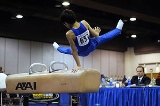
Artistic gymnastics is a discipline of
gymnasticsGymnastics is a sport involving performance of exercises requiring physical strength, flexibility, agility, coordination, and balance. Internationally, all of the gymnastic sports are governed by the Fédération Internationale de Gymnastique with each country having its own national governing body...
where gymnasts perform short routines (ranging from approximately 30 to 90
secondThe second is a unit of measurement of time, and is the International System of Units base unit of time. It may be measured using a clock....
s) on different apparatus, with less time for vaulting (see lists below). The sport is governed by the
Federation Internationale de GymnastiqueThe Fédération Internationale de Gymnastique or International Federation of Gymnastics is the governing body of competitive gymnastics. Its headquarters is in Lausanne, Switzerland. It was founded on July 23, 1881 in Liège, Belgium, making it the oldest international sport organisation...
(FIG), which designs the
Code of PointsA Code of Points is a rulebook that defines the scoring system for each level of competition in gymnastics. There is no unified, international code of points; every oversight organization—such as FIG , NCAA Gymnastics, and most national gymnastics federations—designs and employs its own unique Code...
and regulates all aspects of international elite competition. Within individual countries, gymnastics is regulated by national federations, such as BAGA in Great Britain and USA Gymnastics in the United States. Artistic gymnastics is a popular
spectator sportA spectator sport is a sport that is characterized by the presence of spectators, or watchers, at its matches. For instance, Tennis, Rugby, F-1, baseball, basketball, cricket, football , and ice hockey are spectator sports, while hunting or underwater hockey typically are not...
at the
Summer Olympic GamesThe Summer Olympic Games or the Games of the Olympiad are an international multi-sport event, occurring every four years, organized by the International Olympic Committee. Medals are awarded in each event, with gold medals for first place, silver for second and bronze for third, a tradition that...
, and in numerous other competitive environments.
History
Gymnastics as a system of harmonious sports training originated in
Ancient GreeceAncient Greece is a civilization belonging to a period of Greek history that lasted from the Archaic period of the 8th to 6th centuries BC to the end of antiquity. Immediately following this period was the beginning of the Early Middle Ages and the Byzantine era. Included in Ancient Greece is the...
more than 2,000 years ago, although gymnastic exercises and even some sort of apparatus were used in ancient China and India for medical purposes much earlier. The system was mentioned in works by ancient authors, such as
HomerIn the Western classical tradition Homer , is the author of the Iliad and the Odyssey, and is revered as the greatest ancient Greek epic poet. These epics lie at the beginning of the Western canon of literature, and have had an enormous influence on the history of literature.When he lived is...
,
AristotleAristotle was a Greek philosopher and polymath, a student of Plato and teacher of Alexander the Great. His writings cover many subjects, including physics, metaphysics, poetry, theater, music, logic, rhetoric, linguistics, politics, government, ethics, biology, and zoology...
and
PlatoPlato , was a Classical Greek philosopher, mathematician, student of Socrates, writer of philosophical dialogues, and founder of the Academy in Athens, the first institution of higher learning in the Western world. Along with his mentor, Socrates, and his student, Aristotle, Plato helped to lay the...
. It included many disciplines, which would later become separate sports: swimming, race, wrestling, boxing, riding, etc. and was also used for military training. In its present form gymnastics evolved in Germany and Czechoslovakia in the beginning of the 19th century, and the term "artistic gymnastics" was introduced at the same time to distinguish free styles from the ones used by the military. A German educator
Friedrich Ludwig JahnFriedrich Ludwig Jahn was a German gymnastics educator and nationalist. He is commonly known as Turnvater Jahn, roughly meaning "father of gymnastics" Jahn.- Life :...
, who was known as the father of gymnastics, invented several apparatus, including the horizontal bar and parallel bars which are used to this day. Two of the first gymnastics clubs were Turnvereins and
SokolThe Sokol movement is a youth sport movement and gymnastics organization first founded in Czech region of Austria-Hungary, Prague, in 1862 by Miroslav Tyrš and Jindřich Fügner...
s.
In 1881 International Gymnastics Federation was founded and remains the governing body of international gymnastics since then. It included only three countries and was called
European Gymnastics Federation until 1921, when the first non-European countries joined the federation, and it was reorganized into its present form. Gymnastics was included into the program of the
1896 Summer OlympicsThe 1896 Summer Olympics, officially known as the Games of the I Olympiad, was a multi-sport event celebrated in Athens, Greece, from April 6 to April 15, 1896. It was the first international Olympic Games held in the Modern era...
, but women were allowed to participate in the Olympics only since 1928. World Championships, held since 1903 also remained for men only until 1934. Since that time two branches of artistic gymnastics have been developing – WAG and MAG – which, unlike men's and women's branches of many other sports, are much different in apparatus used at the major competitions, in techniques and concerns.
Women's artistic gymnastics (WAG)
Women's artistic gymnastics entered the Olympics as a team event in 1928. At the twelfth (12th) gymnastics World Championships in 1950, WAG as it is known today was included, with competition in team, all-around and apparatus final events, although individual women were recognized in the all-around as early as the tenth (10th) World Championships in 1934. Two years after the full women's program (all-around and all four event finals) was introduced into the 1950 World Championships, it was introduced into the
1952 Helsinki GamesGymnastics at the 1952 Summer Olympics was represented by 15 events: 7 for women and 8 for men. All events were held between July 19 and July 24 in the Messuhalli building in Helsinki...
, and this format has remained as such to this day.
The earliest champions in women's gymnastics tended to be in their 20s; most had studied
balletBallet is a type of performance dance, that originated in the Italian Renaissance courts of the 15th century, and which was further developed in France and Russia as a concert dance form. The early portions preceded the invention of the proscenium stage and were presented in large chambers with...
for years before entering the sport. Larisa Latynina, the first great Soviet gymnast, won her first Olympic all-around medal at the age of 22 and her second at 26; she became the 1958 World Champion while pregnant with her daughter. Czech gymnast
Věra ČáslavskáVěra Čáslavská is a Czech gymnast. Blonde, cheerful and possessing impressive stage presence, she was generally popular with the public and won a total of 22 international titles...
, who followed Latynina to become a two-time Olympic all around champion, was 22 before she started winning gold medals.
In the 1970s, the average age of Olympic gymnastics competitors began gradually to decrease. While it was not unheard of to for teenagers to compete in the 1960s –
Ludmilla TourischevaLudmilla Ivanovna Tourischeva is a former Russian gymnast and a nine-time Olympic medalist for the Soviet Union.Tourischeva began gymnastics in 1965 and began competing for the Soviet team as early as in 1967...
was sixteen at her first Olympics in 1968 – they slowly became the norm, as difficulty in gymnastics increased. Smaller, lighter girls generally excelled in the more challenging acrobatic elements required by the redesigned
Code of PointsA Code of Points is a rulebook that defines the scoring system for each level of competition in gymnastics. There is no unified, international code of points; every oversight organization—such as FIG , NCAA Gymnastics, and most national gymnastics federations—designs and employs its own unique Code...
. The 58th Congress of the FIG, held in July 1980, just before the Olympics, decided to raise the minimum age limit for major international senior competition from fourteen to fifteen. The change, which came into effect two years later, didn't eliminate the problem. By the time the
1992 OlympicsThe 1992 Summer Olympic Games, officially known as the Games of the XXV Olympiad, were an international multi-sport event celebrated in Barcelona, Catalonia, Spain, in 1992. The International Olympic Committee voted in 1986 to separate the Summer and Winter Games, which had been held in the same...
rolled around, elite competitors consisted almost exclusively of "pixies" – underweight,
prepubertalPuberty is the process of physical changes by which a child's body matures into an adult body capable of reproduction, as initiated by hormonal signals from the brain to the gonads; the ovaries in a girl, the testes in a boy...
teenagers – and concerns were raised about athlete welfare.
The FIG responded to this trend by raising the minimum age requirement for international elite competition to sixteen in 1997. This, combined with changes in the Code of Points and evolving popular opinion in the sport, have seen older gymnasts return to competition. While the average elite female gymnast is still in her middle to late teens and of below-average height and weight, it is also common to see gymnasts competing well into their twenties. At the 2005 World Championships in
MelbourneMelbourne is the capital and most populous city in the state of Victoria, and the second most populous city in Australia. The Melbourne City Centre is the hub of the greater metropolitan area and the Census statistical division—of which "Melbourne" is the common name. As of June 2009, the greater...
, the silver medalist on vault,
Oksana ChusovitinaOksana Aleksandrovna Chusovitina is an Olympic medalist and World Champion gymnast who has competed for Germany since 2006. She was formerly a citizen of, and a competitor for, the Soviet Union and Uzbekistan ....
, was a thirty-year old mother, and she received another silver medal on vault at the 2008 Olympics at the age of 33. At the 2004 Olympics, both the second place American team and the third placed Russians were captained by women in their mid twenties; several other teams, including
AustraliaAustralia , officially the Commonwealth of Australia, is a country in the Southern Hemisphere comprising the mainland of the Australian continent, the island of Tasmania, and numerous smaller islands in the Indian and Pacific Oceans. It is the world's sixth-largest country by total area...
,
FranceThe French Republic , The French Republic , The French Republic , (commonly known as France , is a unitary semi-presidential republic in Western Europe with several overseas territories and islands located on other continents and in the Indian, Pacific, and Atlantic oceans. Metropolitan France...
and
CanadaCanada is a North American country consisting of ten provinces and three territories. Located in the northern part of the continent, it extends from the Atlantic Ocean in the east to the Pacific Ocean in the west, and northward into the Arctic Ocean...
, had many older gymnasts.
Apparatus
VaultThe vault is an artistic gymnastics apparatus, as well as the skill performed using that apparatus. Vaulting is also the action of performing a vault. Both male and female gymnasts perform the vault...
: The vault is an event as well as the primary piece of equipment used in that event. Unlike most of the gymnastic events employing apparatuses, the vault is a common to both men's and women's competition, with little difference between the two categories. A gymnast sprints down a runway, which is a maximum of 25 meters in length, before leaping onto a spring board. Harnessing the explosive energy of the spring, the gymnast directs his or her body hands-first towards the vault. Body position is maintained while "popping" (blocking using only a shoulder movement) the vaulting platform. The gymnast then rotates his or her body so as to land in a standing position on the far side of the vault. In advanced gymnastics, multiple twists and somersaults may be added before landing. Successful vaults depend on the speed of the run, the length of the hurdle, the power the gymnast generates from the legs and shoulder girdle, the kinesthetic awareness in the air, and the speed of rotation in the case of more difficult and complex vaults.
- In 2001 the traditional vaulting horse was replaced with a new apparatus, sometimes known as a tongue or table. The new apparatus is more stable, wider, and longer than the older vaulting horse - approx. 1m in length and 1m in width, gives gymnasts a larger blocking surface, and is therefore safer than the old vaulting horse. With the addition of this new, safer vault, gymnasts are attempting far more difficult and dangerous vaults. Younger gymnasts do not vault onto a vaulting table, though; instead, they vault onto a mat consisting of cubes of sponge with a slick outside.
Men's events
Floor exerciseIn gymnastics, the floor refers to a specially prepared exercise surface, which is considered an apparatus. It is used by both male and female gymnasts. The event in gymnastics performed on floor is called floor exercise. The English abbreviation for the event in gymnastics scoring is FX.A spring...
: Male gymnasts also perform on a 12 by 12 m (40'x40') spring floor. A series of tumbling passes is performed to demonstrate flexibility, strength, and balance. The gymnast must also show strength skills, including circles, scales, and press handstands. Men's floor routines mostly have four passes that will total between 60–70 seconds and are performed without music, unlike the women's event. Rules require that gymnasts touch each corner of the floor at least once during their routine.
Pommel horseThe pommel horse is an artistic gymnastics apparatus. Traditionally, it is used by only male gymnasts. Originally made of a metal frame with a wooden body and a leather cover, modern pommel horses have a metal body covered with foam rubber and leather, with plastic handles .- History :The pommel...
: A typical pommel horse exercise involves both single leg and double leg work. Single leg skills are generally found in the form of scissors, an element often done on the pommels. Double leg work however, is the main staple of this event. The gymnast swings both legs in a circular motion (clockwise or counterclockwise depending on preference) and performs such skills on all parts of the apparatus. To make the exercise more challenging, gymnasts will often include variations on a typical circling skill by turning (moores and spindles) or by straddling their legs (Flares). Routines end when the gymnast performs a dismount, either by swinging his body over the horse, or landing after a handstand.
Still ringsThe rings, also known as still rings , is an artistic gymnastics apparatus and the event that uses it. It is traditionally used only by male gymnasts, due to its extreme upper-body strength requirements...
:
Still Rings is arguably the most physically demanding event. The rings are suspended on wire cable from a point 5.8 meters off the floor, and adjusted in height so the gymnast has room to hang freely and swing. He must perform a routine demonstrating balance, strength, power, and dynamic motion while preventing the rings themselves from swinging. At least one static strength move is required, but some gymnasts may include two or three. A routine must begin with an impressive
mount, and must conclude with an equally impressive
dismount.
Parallel bars : Men perform on two bars slightly further than a shoulder's width apart and usually 1.75m high while executing a series of swings, balances, and releases that require great strength and coordination.
High barThe high bar, also known as the horizontal bar, is an apparatus used by male gymnasts in Artistic Gymnastics. It traditionally consists of a cylindrical metal bar that is rigidly held above and parallel to the floor by a system of cables and stiff vertical supports. Gymnasts typically wear leather...
: A 2.4 cm thick steel bar raised 2.5m above the landing area is all the gymnast has to hold onto as he performs
giants (revolutions around the bar), release skills, twists, and changes of direction. By using all of the momentum from giants and then releasing at the proper point, enough height can be achieved for spectacular dismounts, such as a triple-back salto. Leather grips are usually used to help maintain a grip on the bar.
As is the case with female gymnasts, males are also judged on all of their events, for their execution, degree of difficulty, and overall presentation skills.
Women's events
Uneven bars: On the uneven bars (also known as
asymmetric bars,
UKThe United Kingdom of Great Britain and Northern IrelandIn the United Kingdom and Dependencies, other languages have been officially recognised as legitimate autochthonous languages under the European Charter for Regional or Minority Languages...
), the gymnast navigates two horizontal bars set at different heights. The height is generally fixed, but the width may be adjusted. Gymnasts perform swinging, circling, transitional, and release moves, as well as moves that pass through the handstand. Usually in higher levels of gymnastics, leather grips are worn to ensure that the gymnast maintains a grip on the bar, and to protect the hands from blisters and tears (known as rips), Gymnasts sometimes wet their grips with water from a spray bottle and then may apply chalk to their grips to prevent the hands from slipping. Chalk may also be applied to the hands if grips are not worn and/or to the bar. The most common way to mount the uneven bars is jumping towards the lower bar.
Balance beam: The gymnast performs a choreographed routine from 70 to 90 seconds in length consisting of leaps, acrobatic skills, turns and dance elements on a padded spring beam. Apparatus norms set by the International Gymnastics Federation (used for Olympic and most elite competitions) specify the beam must be 125 cm (4') high, 500 cm (16') long, and 10 cm (4.5") wide. The event requires in particular, balance, flexibility and strength.
Floor exerciseIn gymnastics, the floor refers to a specially prepared exercise surface, which is considered an apparatus. It is used by both male and female gymnasts. The event in gymnastics performed on floor is called floor exercise. The English abbreviation for the event in gymnastics scoring is FX.A spring...
:The floor event occurs on a carpeted 12m × 12m (40'x40') square, usually consisting of hard foam over a layer of plywood, which is supported by springs or foam blocks generally called a "spring" floor. This provides a firm surface that will respond with force when compressed, allowing gymnasts to achieve extra height and a softer landing than would be possible on a regular floor. Female gymnasts perform a choreographed exercise of 70 to 90 seconds along with music. The music is instrumental and cannot include vocals. The routines consist of tumbling passes, series of jumps, dance elements, acrobatic skills, and turns. Elite gymnasts may perform up to four tumbling passes that include three or more skills or 'tricks". Gymnasts in the lower competitive levels usually only do one or two tumbling passes.
Equipment and uniforms
- Chalk
Chalk is a soft, white, porous sedimentary rock, a form of limestone composed of the mineral calcite. Calcite is calcium carbonate or CaCO3. It forms under reasonably deep marine conditions from the gradual accumulation of minute calcite plates shed from micro-organisms called coccolithophores....
- Grip
Grips are devices that are worn on the hands of artistic gymnasts when performing on various gymnastics apparatus. They are worn by female gymnasts on the uneven bars, and by male gymnasts on the high bar, still rings and parallel bars...
s
- Mats
- Uniform
Athletes competing or training artistic gymnastics wear specific attire. The standard of dress for international competition is regulated by the FIG and the Code of Points.-Women:-Leotards:For females, the standard competition uniform is a leotard...
- Braces
Hand guards are devices worn by athletes in artistic gymnastics. Various types of hand guards are used by gymnasts:* Grips are used on the uneven bars, high bar, still rings and parallel bars to enhance the gymnast's grip and, in the case of bar exercises, to reduce friction between the gymnast's...
- Apparatus
Apparatus may refer to:*Technical term for body of the Soviet and post-Soviet governments *Machine*Equipment*Critical apparatus, the critical and primary source material that accompanies an edition of a text-See also:*Fire apparatus...
Format of competition
Currently, in Olympic or World Championships competition, the meet is divided into several sessions which occur on different days: team qualifying, team finals, all-around finals and event finals.
During the
team qualifying (abbreviated TQ) round, gymnasts compete with their national squad on all four (WAG) or six (MAG) apparatus. The scores from this session are not used to award medals, but are used to determine which teams advance to the team finals and which individual gymnasts advance to the all-around and event finals. The current format of this session is 6-5-4, meaning that there are six gymnasts on the team, five compete on each event, and four of the scores count.
In the
team finals (abbreviated TF), gymnasts compete with their national squad on all four/six apparatus. The scores from the session are used to determine the medalists of the team competition. The current format is 6-3-3, meaning that there are six gymnasts on the team, three compete on each event, and all three scores count.
In the
all-around finals (abbreviated AA), the gymnasts are individual competitors and perform on all four/six apparatus. Their scores from all four/six events are added together and the gymnasts with the three highest totals are awarded all-around medals. Only two gymnasts from each country may advance to the all-around finals.
In the
event finals (abbreviated EF) or
apparatus finals, the top eight gymnasts on each event compete for medals. Only two gymnasts from each country may advance to each EF.
Other competitions are not bound by these rules, and may use other formats. For instance, the 2007 Pan American Games had only one day of team competition on a 6-5-4 format, and allowed three athletes from each country to advance to the all-around. In other meets, such as those on the World Cup circuit, the team event is not contested at all.
New Life
Competitions use the
New Life scoring rule, which was introduced in 1989. Under New Life, marks from one session do not carry over to the next. In other words, a gymnast's performance in team finals does not affect his or her scores in the all-around finals or event finals; he or she starts with a clean slate. In addition, the marks from the team qualifying round do not count toward the team finals.
Before the introduction of the New Life rule, the scores from the team competition carried over into the all-around and event finals, and could have a negative or positive effect on the gymnast's efforts in subsequent sessions. The gymnasts' final results, and medal placement, were determined by the combination of scores:
- Qualifiers for all-around and event finals: Team compulsories + team optionals
- Team competition: Team compulsories + team optionals
- All-around competition: Team results (compulsories and optionals) averaged + all-around
- Event finals: Team results (compulsories and optionals) averaged + event final
Compulsories
Before 1997, the team competition was structured differently. It still consisted of two sessions. However, gymnasts performed
compulsory exercises in the preliminaries and their optional routines on the second day. The team medals were awarded on the combined scores of both days. All-around and event final qualifiers were also determined according to the combined scores. In meets where team titles were not contested, such as the
American CupThe American Cup, is an elite senior level international gymnastics competition held in the United States, and is generally considered to be one of the first major competitions of the Gymnastics season, as it is held in March or February of each year. In 1978-79 the event was sponsored by Dial and...
, there were two days of all-around competition: one for compulsories and one for optionals.
The optionals were the gymnasts' personal routines, developed with their coaches to adhere to the requirements of the
Code of Points. They were performed in the team finals, the all-around and the event finals.
The compulsories were routines that were developed and choreographed by the FIG Technical Committee. They were performed on the first day of the team competition. Every single elite gymnast in every single FIG member nation performed the same exercises. The dance and tumbling skills of compulsory routines were generally less difficult than those of the optionals, but heavily emphasized perfect technique, form and execution. Scoring was exacting, with judges taking deductions for even slight deviations from the required choreography. For this reason, many gymnasts and coaches considered compulsories more challenging to perform than optionals.
Compulsories were eliminated at the end of 1996. The move was extremely controversial, and many successful gymnastics federations, including
RussiaRussia or , officially known as both Russia and the Russian Federation , is a country in northern Eurasia. It is a federal semi-presidential republic, comprising 83 federal subjects...
, the
United StatesThe United States of America is a federal constitutional republic comprising fifty states and a federal district...
and
ChinaChina , officially the People's Republic of China , is the most populous country in the world, with over 1.3 billion citizens. Located in East Asia, the country covers approximately 9.6 million square kilometres...
, voted against the abolition of compulsories. They argued that the exercises helped maintain a high standard of form, technique and execution among gymnasts. Opponents believed that compulsories harmed emerging gymnastics programs. Many members of the gymnastics community still argue that compulsories should be reinstated.
Many gymnastics federations have maintained compulsories in their national programs. Gymnasts competing at the lower levels of the sport – for instance, Level 4-6 in USA Gymnastics and Grade 2 in
South AfricaThe Republic of South Africa is a country in southern Africa. Located at the southern tip of Africa, it is divided into nine provinces, with of coastline on the Atlantic and Indian oceans...
– frequently only perform compulsory routines.
Age limits
The FIG imposes a minimum age limit on gymnasts competing in international meets. The term
senior, in gymnastics, refers to any world-class/elite gymnast who is age-eligible under FIG rules. The term
junior refers to any gymnast who competes at a world-class/elite level, but is too young to be classified as a senior. Juniors are judged under the same
Code of Points as the seniors, and often exhibit the same level of difficulty in their routines.
Currently, gymnasts must be at least sixteen years of age, or turning sixteen within the calendar year. For the current Olympic cycle, in order to compete in the 2012 Olympics, a gymnast must have a birthdate
before January 1, 1997. There is no maximum age restriction.
The one exception to this rule is the year before the Olympics, when gymnasts who are one year shy of the age requirement may compete as seniors at the World Championships and other meets. For instance, gymnasts born in 1988 were allowed to compete in senior events in 2003. This is permitted to allow nations to qualify to the Olympics with their best teams, and to give emerging gymnasts some experience in major competition before the Olympics.
Only senior gymnasts are allowed to compete in the Olympics, World Championships and World Cup circuit. However, many meets, such as the European Championships, have separate divisions for juniors. Additionally, some competitions, such as the Goodwill Games, the Pam Am Games, the Pacific Rim Championships and the All-Africa Games, have rules that permit seniors and juniors to compete together.
The minimum age requirement is arguably one of the most contentious rules in artistic gymnastics, and is frequently debated by coaches, gymnasts and other members of the gymnastics community. Those in favor of the age limits argue that they promote the participation of older athletes in the sport, and that they spare younger gymnasts from the stress of competition and training at a high level. Opponents of the rule point out that junior gymnasts are scored under the same
Code of Points as the seniors, and train, mostly, the same skills. They also feel that younger gymnasts need the experience of participating in major meets in order to become better athletes; and that if a junior has the skills and maturity to be competitive with seniors, he or she should be allowed that opportunity.
Another point that frequently arises in this debate is the issue of age falsification. Since stricter age limit rules were first adopted in the early 1980s, there have been several well-documented, and many more suspected, cases of juniors with falsified documents competing as seniors. In only one case – that of
Kim Gwang SukKim Gwang-Suk is a North Korean female gymnast who competed in the 1992 Summer Olympics...
of
North KoreaThe Democratic People’s Republic of Korea , , is a country in East Asia, occupying the northern half of the Korean Peninsula. Its capital and largest city is Pyongyang. The Korean Demilitarized Zone serves as the buffer zone between North Korea and South Korea...
, who competed at the
1989 World Artistic Gymnastics ChampionshipsThe 25th Artistic Gymnastics World Championships were held in Stuttgart, West Germany, in 1989 from October 14 to October 22.The scoring rule New Life was introduced for the first time ever...
at the approximate age of eleven – has the FIG taken any disciplinary action.
While the minimum age requirement applies to both WAG and MAG, it is far more contentious in WAG. Most top male gymnasts are in their late teens or early twenties; female gymnasts are typically ready to compete at the international level by their mid-teens.
Scoring and the Code of Points
Scoring at the international level is regulated by the
Code of PointsA Code of Points is a rulebook that defines the scoring system for each level of competition in gymnastics. There is no unified, international code of points; every oversight organization—such as FIG , NCAA Gymnastics, and most national gymnastics federations—designs and employs its own unique Code...
. This system was significantly overhauled for 2006. Under the new Code of Points there are two different panels judging each routine, evaluating different aspects of the performance. The A score covers Difficulty Value, Element Group Requirements and Connection Value; and the B score covers execution, composition and artistry. The most visible changes to the Code was the abandonment of the "Perfect 10" for an open-ended scoring system for difficulty (the A score). The B score is still limited to a maximum of 10. The sum of the two provides a gymnast's total score for the routine. Theoretically this means scores could be infinite, though average marks for routines in major competitions in 2006 generally stayed in the mid-teens.
Many gymnasts, including
Nadia ComăneciNadia Elena Comăneci is a Romanian gymnast, winner of three Olympic gold medals at the 1976 Summer Olympics in Montreal, Quebec, Canada, and the first female gymnast ever to be awarded a perfect score of 10 in an Olympic gymnastic event. She is also the winner of two gold medals at the 1980 Summer...
,
Mary Lou RettonMary Lou Retton is an American gymnast and Olympic gold medalist. She was the first female gymnast from outside Eastern Europe to win the Olympic all-around title, after 14 Eastern Bloc countries boycotted the 1984 Summer Olympics in Los Angeles.-Personal life:Retton was born in Fairmont, West...
,
Josef StalderJosef Stalder is a Swiss gymnast and Olympic Champion. He competed at the 1948 Summer Olympics in London where he received a gold medal in horizontal bar, a silver medal in team combined exercises, and a bronze medal in parallel bars. He received four medals at the 1952 Summer Olympics in...
, and
Kurt ThomasKurt Bilteaux Thomas is an American Olympic gymnast.While at Indiana State University in Terre Haute, Indiana, Thomas became a member of the US Olympic team at the 1976 Summer Olympics. In 1978, Thomas was the first American male gymnast to win a gold medal in floor exercise in a world championship...
, have contributed their original skills to the
Table of ElementsA Code of Points is a rulebook that defines the scoring system for each level of competition in gymnastics. There is no unified, international code of points; every oversight organization—such as FIG , NCAA Gymnastics, and most national gymnastics federations—designs and employs its own unique Code...
section of the Code that helps define a routine's difficulty.
Before 2006, every routine was assigned a Start Value (SV). A routine with maximum SV performed perfectly was worth a 10.0. A routine with all required elements was automatically given a base SV (9.4 in 1996; 9.0 in 1997; 8.8 in 2001); it was up to the gymnast to increase the SV to 10.0 by performing difficult skills and combinations.
Many gymnastics insiders, coaches, officials and gymnasts have protested the new Code, with Olympic gold medalists
Lilia PodkopayevaLilia Alexandrivna Podkopayeva ; born August 15, 1978 in Donetsk) is a retired Ukrainian gymnast who became the 1996 Olympic all-around champion, the 1995 Artistic Gymnastics World Championships all-around champion and the 1996 European Women's Artistic Gymnastics Championships all-around champion...
, Svetlana Boguinskaya,
Shannon MillerShannon Lee Miller is a former artistic gymnast from Edmond, Oklahoma. She is the most decorated gymnast in U.S. History, and considered one of the greatest gymnasts the United States has ever produced...
and
Vitaly ScherboVitaly Venediktovich Scherbo , born 13 January 1972 in Minsk, Byelorussian SSR, is a Belarusian and former Soviet artistic gymnast...
and Romanian team coach Nicolae Forminte publicly voicing their opposition. In addition, the 2006 report from the FIG Athletes' Commission cited major concerns about scoring, judging and other points of the new Code. Aspects of the Code were revised in 2007, however, there are no plans to abandon the new scoring system and return to the 10.0 format.
Global
- Olympic Games
-Background:Artistic gymnastics has been contested since the first modern Olympic games in Athens. 33 distinct nations have won medals. Athletes representing the former Soviet Union have captured 200 medals , almost 25% of the total medal count; Athletes representing Japan, the United States,...
. Artistic gymnastics is one of the most popular events at the Summer Olympics, held every four years. Gymnastics teams qualify for the Olympics based on their performance at the World Championships the year before the Games. Nations that do not qualify high enough to send a full team may qualify to send one or two individual gymnasts.
- World Championships
The World Artistic Gymnastics Championships are the World Championships for artistic gymnastics. They have been held since 1903.* * First time track and field event fully disappeared from the sport of gymnastics.- All-time medal count :...
. The gymnastics-only World Championships is open to teams from every FIG-member nation. The competition has had several different formats, depending on the year: full team finals/AA/EF; AA/EF only; EF only.
- Artistic Gymnastics World Cup
In 1975, the Fédération Internationale de Gymnastique sporadically decided to organise an original competition, reserved for the current best gymnasts...
- Goodwill Games
The Goodwill Games was an international sports competition, created by Ted Turner in reaction to the political troubles surrounding the Olympic Games of the 1980s...
: Artistic gymnastics was an event at this now-defunct competition.
- World Games
The World Games, first held in 1981, are an international multi-sport event, meant for sports, or disciplines or events within a sport, that are not contested in the Olympic Games...
Regional
- All-Africa Games
The All-Africa Games, sometimes called the African Games or the Pan African Games, are a regional multi-sport event held every four years, organized by the Supreme Council for Sport in Africa...
. Gymnastics is one of the events in this multi-sport competition, held every four years, and open to teams and gymnasts from African nations.
- Asian Games
The Asian Games, officially known as Asiad, is a multi-sport event held every four years among athletes from all over Asia. The Games were regulated by the Asian Games Federation from the first Games in New Delhi, India, until the 1978 Games. Since the 1982 Games they have been organised by the...
. Artistic gymnastics is one of the events in this multi-sport competition, held every four years, and open to teams and gymnasts from Asian nations.
- Commonwealth Games
The Commonwealth Games is an international, multi-sport event involving athletes from the Commonwealth of Nations. The event was first held in 1930 and takes place every four years....
: Artistic gymnastics is one of the events in this multi-sport competition, held every four years, and open to teams and gymnasts from Commonwealth nations.
- European Championships
European Artistic Gymnastics Championships may refer to* European Men's Artistic Gymnastics Championships* European Women's Artistic Gymnastics Championships...
: The gymnastics-only European Championships is held every year, and is open to teams and gymnasts from European nations.
- Pacific Rim Championships
The Pacific Rim Championships is a major regional biennial gymnastics competition. It is open to teams from member nations of the Pacific Alliance of National Gymnastics Federations, including the Australia, Canada, China, Japan, Mexico, New Zealand, Russia, USA and other nations on the Pacific coast...
: This gymnastics-only competition, which was known as the Pacific Alliance Championships until 2008, is held every two years and is open to teams from members of the Pacific Alliance of National Gymnastics Federations, including the USA, China, Australia, Canada, Mexico, New Zealand and other nations on the Pacific coast.
- Pan American Games
The Pan-American or Pan American Games are a major event in the Americas featuring summer and formerly winter sports, in which thousands of athletes participate in a variety of competitions. The Pan American Games are the second largest multi-sport event after the Summer Olympics...
: Gymnastics is one of the events in this multi-sport competition, held every four years, and open to teams and gymnasts from North, South and Central America.
- South American Games
The South American Games , formerly the Southern Cross Games are a regional multi-sport event held between nations from South America, organized by the South American Sports Organization .The first...
: Artistic gymnastics is one of the events in this multi-sport competition, held every four years, and open to teams and gymnasts from South American nations.
- Intercontinental Cup
The European/South American Cup, commonly referred to as the World Club Championship, Intercontinental Cup or Toyota Cup, was a football competition endorsed by UEFA and CONMEBOL, contested between the winners of the European Cup and the South American Copa Libertadores...
National
Most countries hold a major competition (a National Championships, or "Nationals") every year that determines the best-performing AA and EF gymnasts in their country. Gymnasts may also qualify to their country's national team or be selected for international meets based on their scores at Nationals.
USSR / Post-Soviet Republics
USSR/RussiaRussia or , officially known as both Russia and the Russian Federation , is a country in northern Eurasia. It is a federal semi-presidential republic, comprising 83 federal subjects...
/UkraineUkraine is a country in Eastern Europe. It has an area of 603,628 km², making it the second largest contiguous country on the European continent, after Russia...
/BelarusBelarus , officially the Republic of Belarus, is a landlocked country in Eastern Europe, bordered clockwise by Russia to the northeast, Ukraine to the south, Poland to the west, and Lithuania and Latvia to the northwest. Its capital is Minsk; other major cities include Brest, Grodno , Gomel ,...
: Before the breakup of the
Soviet UnionThe Soviet Union , officially the Union of Soviet Socialist Republics , was a constitutionally socialist state that existed in Eurasia between 1922 and 1991....
in 1991, Soviet gymnasts dominated both men's and women's gymnastics commencing with the introduction of the full women's program into the Olympics and the overall increased standardization of the Olympic Gymnastics competition format which happened in 1952. They had many male stars such as Olympic All-Around Champions
Viktor ChukarinViktor Ivanovich Chukarin was the first of the great Soviet gymnasts. He won total of eleven medals including seven gold medals at the 1952 and 1956 Summer Olympics and was the All-around World Champion in 1954...
and
Vitaly ScherboVitaly Venediktovich Scherbo , born 13 January 1972 in Minsk, Byelorussian SSR, is a Belarusian and former Soviet artistic gymnast...
and female stars such as Olympic All-Around Champion Larisa Latynina and World-All Around and Olympic Champion Svetlana Boguinskaya who contributed to this tradition. From 1952 to 1992 inclusive, the Soviet women's squad won almost every single team title in
World ChampionshipThe Fédération Internationale de Gymnastique organises World Gymnastics Championships for each of the gymnastic disciplines:...
competition and at the Summer Olympics: the only four exceptions were the
1984 OlympicsThe 1984 Summer Olympics, officially known as the Games of the XXIII Olympiad, was an international multi-sport event held in Los Angeles, California, United States in 1984...
, which they did not attend, and the 1966, 1979 and 1987 World Championships. Most of the famous Soviet gymnasts were from the Russian SFSR, the
Ukrainian SSRThe Ukrainian Soviet Socialist Republic or in short, the Ukrainian SSR was a sovereign Soviet Socialist state and one of the fifteen constituent republics of the Soviet Union lasting from its inception in 1922 to the breakup in 1991...
and the
Byelorussian SSRThe Byelorussian Soviet Socialist Republic was one of fifteen constituent republics of the Soviet Union. It was one of the four original founding members of the Soviet Union in 1922, together with the Ukrainian SSR, the Transcaucasian SFSR and the Russian Soviet Federative Socialist Republic...
.
Following the breakup of the Soviet Union, they competed together as one nation for the last time at the
1992 Summer OlympicsThe 1992 Summer Olympic Games, officially known as the Games of the XXV Olympiad, were an international multi-sport event celebrated in Barcelona, Catalonia, Spain, in 1992. The International Olympic Committee voted in 1986 to separate the Summer and Winter Games, which had been held in the same...
as a "Unified Team" winning the gold.
RussiaRussia or , officially known as both Russia and the Russian Federation , is a country in northern Eurasia. It is a federal semi-presidential republic, comprising 83 federal subjects...
has maintained the tradition of gymnastics excellence, medalling at every Worlds and Olympic competition in both MAG and WAG disciplines, except in the
2008 OlympicsAt the 2008 Summer Olympics, three different gymnastics disciplines were contested: artistic gymnastics, rhythmic gymnastics and trampoline. The artistic gymnastics events were held at the Beijing National Indoor Stadium on August 9–19. The rhythmic gymnastics events were held at the Beijing...
, where the Russian women team did not win any medals.
UkraineUkraine is a country in Eastern Europe. It has an area of 603,628 km², making it the second largest contiguous country on the European continent, after Russia...
also has a strong team; Ukrainian
Lilia PodkopayevaLilia Alexandrivna Podkopayeva ; born August 15, 1978 in Donetsk) is a retired Ukrainian gymnast who became the 1996 Olympic all-around champion, the 1995 Artistic Gymnastics World Championships all-around champion and the 1996 European Women's Artistic Gymnastics Championships all-around champion...
was the all-around champion at the 1996 Olympics. Belarus has maintained a strong men's team. Other former republics have been somewhat less successful.
In terms of medal results and overall domination, the Soviet legacy remains the strongest of all in Artistic Gymnastics.
Romania
RomaniaRomania is a country located at the crossroads of Central and Southeastern Europe, on the Lower Danube, within and outside the Carpathian arch, bordering on the Black Sea...
: The Romanian team first achieved wide-scale success at the
1976 Summer OlympicsThe 1976 Summer Olympics, officially known as the Games of the XXI Olympiad, was an international multi-sport event celebrated in Montreal, Quebec, Canada, in 1976. Montreal was awarded the rights to the 1976 Games on May 12, 1970, at the 69th IOC Session in Amsterdam, over the bids of Moscow and...
with the tremendous success of
Nadia ComăneciNadia Elena Comăneci is a Romanian gymnast, winner of three Olympic gold medals at the 1976 Summer Olympics in Montreal, Quebec, Canada, and the first female gymnast ever to be awarded a perfect score of 10 in an Olympic gymnastic event. She is also the winner of two gold medals at the 1980 Summer...
. Since then, using the centralized training system pioneered by
Béla KárolyiBéla Károlyi is a Romanian gymnastics coach. He was born in what was then Kolozsvár, Hungary, a region restored to Romanian administration after 1944. Károlyi and his wife, Márta, also of Hungarian origin, emigrated to the United States in 1981 and both have dual citizenships for Romania and the...
, they have been a dominant force in both team and individual events in WAG. With the exception of the defeat of the Soviet women's team by the Czechoslovakian women's team at the 1966 World Championships, Romania was the only team ever to defeat the Soviets in head to head competition at the World Championships/Olympic level with their victories at the 1979 and 1987 Worlds. Their women's teams have also won team medals at every Olympics from 1976 to 2008 inclusive, including 3 victories in 1984, 2000, and 2004. At the 16 different World Championships from 1978 to 2007 inclusive, the women's team has failed to medal only twice (in 1981 and 2006), and has won the team title seven times including 5 victories in a row (1994–2001). With the exception of the 2004 and 2008 Olympics, they have placed notable gymnasts such as
Daniela SilivaşViorica Daniela Silivaş-Harper , best known as Daniela Silivaş, is a Romanian gymnast who is most famous for winning six medals in women's artistic gymnastics at the 1988 Olympic Games in Seoul, Korea...
,
Lavinia MiloşoviciLavinia Corina Miloşovici is a Romanian Olympic gymnast. An exceptionally successful athlete on the international competition circuit, Miloşovici, also known as "Milo" in the gymnastics community, is considered to be one of Romania's top gymnasts of the 1990s and one of the most prolific female...
, and
Simona AmânarSimona Amânar is a Romanian gymnast. She is a seven-time Olympic medalist and a ten-time world medalist. Amânar helped Romania to win four consecutive world team titles as well as the 2000 Olympic team title. She has a vault named after her, the Amanar...
on the Olympic All-Around podium at every Olympics since Comaneci's success in 1976, and have usually done the same for the individual events at the World Championships, producing World All-Around Champions
Aurelia DobreAurelia Dobre is a former artistic gymnast from Romania, who was the 1987 World Champion. She is still held in high esteem by many gymnastics fans today for her clean technique as well as balletic and artistic flair...
and
Maria OlaruMaria Ludovica Olaru is a retired Olympic artistic gymnast from Romania. She is an Olympic, world, and European gold medalist with the team. Individually, she is the 1999 all around world champion and the 2000 Olympic all around silver medalist. Her best event was the vault on which she medaled at...
. The Romanian men's program, while less successful, is still maturing, and producing individual medalists such as
Marian DrăgulescuMarian Drăgulescu is a Romanian artistic gymnast. During his senior gymnastics career he has won an impressive number of 26 medals at Olympic games, World or European Championships among which eight gold medals at World Championships...
and
Marius UrzicăMarius Daniel Urzică is a Romanian gymnast. Urzică is an Olympic champion, a three-time world champion and a three-time European champion on pommel horse. He competed at three Olympic games, medaling each time on pommel horse and contributed to the team bronze in Athens 2004...
. At World and Olympic competitions and they have started winning team medals, as well.
United States
United StatesThe United States of America is a federal constitutional republic comprising fifty states and a federal district...
: While isolated American gymnasts, including
Kurt ThomasKurt Bilteaux Thomas is an American Olympic gymnast.While at Indiana State University in Terre Haute, Indiana, Thomas became a member of the US Olympic team at the 1976 Summer Olympics. In 1978, Thomas was the first American male gymnast to win a gold medal in floor exercise in a world championship...
and
Cathy RigbyCathleen Roxanne Rigby , best known as Cathy Rigby, is a former gymnast, actress and speaker.-Early life:Rigby was born in Los Alamitos, California in 1952....
, won medals in World Championship meets in the 1970s, the United States team was largely considered a "second power" until the mid to late 1980s, when American gymnasts began medaling consistently in major, fully attended competitions. In 1984 the Olympic mens team won the gold. The team included
Tim DaggettTimothy P. Daggett is an American gymnast born in Springfield, Massachusetts and an Olympic gold medalist. He is a graduate of West Springfield High School and UCLA, who competed in the 1984 Los Angeles Olympics, along with Bart Conner, Peter Vidmar and Mitch Gaylord...
,
Peter VidmarPeter Glen Vidmar is an American gymnast and Olympic medalist. He won gold medals in the men's all-around team competition and the pommel horse competition, as well as a silver medal in the men's all-around individual gymnastics competition at the 1984 Summer Olympic Games in Los Angeles. He was...
,
Mitch GaylordMitchell Jay Gaylord , is an American gymnast and Olympic gold medalist.Gaylord was born in Van Nuys, California, son of Fred and Linda Gaylord. While attending UCLA, he won the All-Around in the 1983 and 1984 U.S...
,
Bart ConnerBart Wayne Conner is a former American gymnast who, as a member of the gold medal-winning men's gymnastics team at the 1984 Summer Olympic Games won an individual gold on the parallel bars...
, Scott Jonhnson, Jim Hartung, and the team alternate Jim Mikus. Also, in 1984,
Mary Lou RettonMary Lou Retton is an American gymnast and Olympic gold medalist. She was the first female gymnast from outside Eastern Europe to win the Olympic all-around title, after 14 Eastern Bloc countries boycotted the 1984 Summer Olympics in Los Angeles.-Personal life:Retton was born in Fairmont, West...
became the first American Olympic All-Around Champion, and won individual medals as well. In 1991
Kim ZmeskalKimberly Lynn "Kim" Zmeskal Burdette is a retired American gymnast and a former national and world gymnastics champion in the early 1990s.-Early life and training:...
became the first American World All-Around Champion; the following year at the
1992 OlympicsAt the 1992 Summer Olympics, two different gymnastics disciplines were contested: artistic gymnastics and rhythmic gymnastics. The artistic gymnastics events were held at the Palau Sant Jordi from July 26 through August 2...
the American women won their first team medal (bronze)and highest all-around ranking by
Shannon MillerShannon Lee Miller is a former artistic gymnast from Edmond, Oklahoma. She is the most decorated gymnast in U.S. History, and considered one of the greatest gymnasts the United States has ever produced...
in a fully attended Games. Since the breakup of the USSR, the U.S team has become increasingly successful with the 1996 Olympic team victory of the
Magnificent SevenThe Magnificent Seven is the name given to the 1996 United States Olympic Women's Gymnastics Team that won the first ever Gold Medal for the United States in the Women's Team Competition at the 1996 Atlanta Olympics...
in Atlanta, the 2003 Worlds team victory in Anaheim, and a multiple medal hauls in both WAG and MAG at the 2004 Olympics. They have produced individual gymnasts such as Olympic All-Around Champions
Carly PattersonCarly Rae Patterson is an American singer and former gymnast. She is the 2004 Olympic All-Around Champion and a member of the USA Gymnastics Hall of Fame...
(2004) and
Nastia LiukinAnastasia Valeryevna "Nastia" Liukin is a Russian-American artistic gymnast. She was the 2008 Olympic individual all-around Champion, the 2005 and 2007 World Champion on the balance beam, and the 2005 World Champion on the uneven bars...
(2008), and World All-Around Champions
Kim ZmeskalKimberly Lynn "Kim" Zmeskal Burdette is a retired American gymnast and a former national and world gymnastics champion in the early 1990s.-Early life and training:...
(1991),
Shannon MillerShannon Lee Miller is a former artistic gymnast from Edmond, Oklahoma. She is the most decorated gymnast in U.S. History, and considered one of the greatest gymnasts the United States has ever produced...
(1993, 1994),
Chellsie MemmelChellsie Marie Memmel is an American gymnast. She is the 2005 World All-Around Champion, making her the third American woman, after Kim Zmeskal and Shannon Miller, to become World Champion in the All-Around. She is also a World Champion on the uneven bars and as part of the U.S. team...
(2005),
Shawn JohnsonShawn Machel Johnson is an American artistic gymnast. She was the 2008 Olympic balance beam gold medalist and all-around, and floor exercise silver medalist, the 2007 all-around World Champion, and the 2007 and 2008 U.S. all-around champion...
(2007),
Bridget SloanBridget Elizabeth Sloan is an American gymnast. She is the 2009 All-Around World Champion and the 2009 All-Around U.S. National Champion. Sloan was a member of the silver medal U.S. women's gymnastics team at the 2008 Olympics....
(2009), and
Jordyn WieberJordyn Marie Wieber is an American artistic gymnast. She is the 2011 All-Around World Champion, the 2011 U.S. Senior National Champion and the 2011 American Cup Champion. She was also the 2008 U.S. Junior National Champion and the 2009 American Cup Champion.-Personal life:Wieber was born in...
(2011). Of particular note is that at the 2005 World Championships in
MelbourneMelbourne is the capital and most populous city in the state of Victoria, and the second most populous city in Australia. The Melbourne City Centre is the hub of the greater metropolitan area and the Census statistical division—of which "Melbourne" is the common name. As of June 2009, the greater...
, American women won the all-around and every single event final except vault (in which they placed 3rd). They continue to be one of the most dominant forces in the sport. The men's team has also matured, making the medal podium at both the 2004 and 2008 Olympics as well as producing individual gymnasts, most notably World and Olympic All-Around Champion
Paul HammPaul Elbert Hamm is an American artistic gymnast. He is a World Champion gymnast and three-time Olympic medalist. He won the all-around competition at the 2004 Olympic Games.-Career:...
.
China
ChinaChinese civilization may refer to:* China for more general discussion of the country.* Chinese culture* Greater China, the transnational community of ethnic Chinese.* History of China* Sinosphere, the area historically affected by Chinese culture...
has developed strong, successful programs in both WAG and MAG over the past twenty five years, earning both team and individual medals. The Chinese men's team won the team gold at the 2000 Olympics, 2008 Olympics, and every team world championship since 1994 except in 2001 when they placed 5th. They have produced such individual gymnasts as Olympic (and World) All-Around Champions
Li XiaoshuangLi Xiaoshuang is a Chinese gymnast and Olympic champion. Li Xiaoshuang and his twin brother Li Dashuang's gymnastics talent was discovered at the age of six...
(1996) and
Yang WeiYang Wei is a male gymnast from China.-Career:Yang Wei won the silver medal in the individual all-around competition and won the gold in the team event at the 2000 Olympics in Sydney....
(2008). The Chinese women's team won the team gold medal at the 2006 World Championships and the 2008 Olympics, and has produced individual gymnasts such as Olympic, World and World Cup champions such as
Mo HuilanMo Huilan is a Chinese gymnast who competed at the 1996 Olympic Games in Atlanta. She was one of China's most successful gymnasts in the 1990s. She is known for performing routines of exceptional difficulty and technique, but also for inconsistency....
,
Kui YuanyuanKui Yuanyuan is a Chinese Gymnast born on June 23, 1981. She is strong on 3 events: Balance Beam, Floor Exercise and Vault. She participated in two Olympic Games, two World Championships and qualified for the 1998 World Cup Final...
, Yang Bo,
Ma YanhongMa Yanhong is a retired Chinese Olympic athlete. She was the first Chinese gymnast, male or female, to win a gold medal at the World Gymnastics Championships and the Olympic Games....
and
Cheng FeiCheng Fei is a Chinese gymnast. She is a three-time World Champion on the vault and 2006 World Champion on floor exercise. She was a member of the gold medal-winning Chinese teams for the 2006 World Artistic Gymnastics Championships in Aarhus, Denmark and 2008 Olympic Games in Beijing, China...
. Chinese female Olympic individual gold medalists include
Ma YanhongMa Yanhong is a retired Chinese Olympic athlete. She was the first Chinese gymnast, male or female, to win a gold medal at the World Gymnastics Championships and the Olympic Games....
,
Lu LiLu Li is a Chinese gymnast.Lu made the Chinese national team in late 1991. However, liver illness almost prevented her from competing in the Olympics...
,
Liu XuanLiu Xuan is a Chinese Gymnast. She was coached by Guo Xinming and Zhang Zhen.Liu said she took up gymnastics with encouragement from her mom, who had to cease gymnastics training during her younger years because of the closure of the gym during the Cultural Revolution...
, and
He KexinHe Kexin is a Chinese gymnast. At the 2008 Olympics in Beijing she won gold medals on the uneven bars and as a member of the Chinese Artistic Gymnastics team. In 2008, she won two World Cup titles on the uneven bars. On the bars she was one of the few gymnasts in the world to score over 17.00...
. However, similar to the former USSR they have been plagued by some western media reports relating to their grueling and sometimes cruel training methods and age falsification accusations.
Japan
JapanJapan is an island nation in East Asia. Located in the Pacific Ocean, it lies to the east of the Sea of Japan, China, North Korea, South Korea and Russia, stretching from the Sea of Okhotsk in the north to the East China Sea and Taiwan in the south...
was largely dominant in MAG during the 1960s and 1970s, winning every team title at every single Olympics from 1960 through 1976 due to individual gymnasts such as Olympic All-Around Champions
Sawao KatoSawao Kato is a Japanese gymnast and one of the most successful athletes of all time at the Olympic Games...
and
Yukio Endowas a Japanese artistic gymnast, Olympic champion and world champion.-Olympics:He was born in Akita City, Akita-ken.He won gold medals with the Japanese team in three Olympics, in 1960, 1964 and 1968...
. Several innovations pioneered by Japanese gymnasts during this era have remained in the sport, including the Tsukahara vault. Japanese men gymnasts have re-emerged as a team to reckon with since winning a team gold at the 2004 Olympics. The women have been less successful, however there have been such standouts as Olympic and world medalist Keiko Tanaka Ikeda who competed in the 1950s and 1960s. There are also some emerging talents in recent years [Koko Tsurumi and Yuka Tomita] who may provide the woman's team with talent worthy of placing in the top three in the coming world competitions.
Germany
The German Democratic RepublicThe German Democratic Republic , informally called East Germany by West Germany and other countries, was a socialist state established in 1949 in the Soviet zone of occupied Germany, including East Berlin of the Allied-occupied capital city...
, or East Germany, had an extremely successful gymnastics program before the reunification of Germany. Both the MAG and WAG teams frequently won silver or bronze team medals at the World Championships and Olympics. Male gymnasts such as
Andreas WeckerAndreas Wecker is a former German gymnast who had a long and successful career. His greatest achievement was the gold medal on high bar at the 1996 Summer Olympics in Atlanta. There, he beat gymnasts of such quality as Vitaly Scherbo and Alexei Nemov...
and
Roland BrücknerRoland Brückner is a multichampion in gymnastics, who won many titles of the world, in his era and competed for the SC Dynamo Berlin/ Sportvereinigung Dynamo. He is still now a trainer in Switzerland by the NKL Liestal with Maxi Gnauck.-External links:***-References:...
and female gymnasts such as
Maxi GnauckMaxi Gnauck is a retired Artistic Gymnast. With a total of 27 medals at the Olympic Games, World Championships, World Cups, and European Championships she is considered one of the most successful woman gymnast that Germany has ever produced.Her parents were expecting a boy and they planned to name...
and Karin Janz contributed to their country's success. After the reunification of Germany, they have continued to have a measure of success with such gymnasts as
Fabian HambüchenFabian Hambüchen is a German gymnast. He lives in Wetzlar.Hambüchen was the youngest German athlete at the 2004 Summer Olympics in Athens and finished 7th in the Horizontal bar and 8th in the team competition. So far in his career, he has won five medals at World Championships and six at European...
and the former Soviet/Uzbek gymnast
Oksana ChusovitinaOksana Aleksandrovna Chusovitina is an Olympic medalist and World Champion gymnast who has competed for Germany since 2006. She was formerly a citizen of, and a competitor for, the Soviet Union and Uzbekistan ....
.
Czechoslovakia
The
CzechoslovakiaCzechoslovakia or Czecho-Slovakia was a sovereign state in Central Europe which existed from October 1918, when it declared its independence from the Austro-Hungarian Empire, until 1992...
n women's team had a very long tradition of success and was the chief threat to the dominance of the Soviet women's team for decades. They won team medals at every World Championships and Olympics from 1934 to 1970 with the exceptions of only the 1950 Worlds and 1956 Olympics. Among their leaders were the first women's World All-Around Champion
Vlasta DěkanováVlasta Děkanová was a Czechoslovak/Czech gymnast two-time World All-Around Gymnastics Champion who also competed in the 1936 Berlin Olympics....
(1934, 1938) and
Věra ČáslavskáVěra Čáslavská is a Czech gymnast. Blonde, cheerful and possessing impressive stage presence, she was generally popular with the public and won a total of 22 international titles...
who won outright all (5) European, World and Olympic All-Around titles during an Olympic cycle from 1964 to 1968 – a feat never matched by any other gymnast (male or female). Caslavska also led her teammates to the world team title in 1966, making the Czechoslovakians one of two national teams (the other being Romania’s) to ever defeat the Soviet women's team at a major competition. Although their men weren’t as successful as a team, they were still noteworthy and did produce 1907 World All-Around Champion
Josef CadaJosef Čada was a Czech gymnast who competed for Bohemia in the 1908 Summer Olympics and for Czechoslovakia in the 1920 Summer Olympics.He was born and died in Prague....
who was a continuous presence at World Championships for years to come.
Hungary
Another Eastern Bloc country whose women achieved notable results was
HungaryHungary , officially the Republic of Hungary , is a landlocked country in Central Europe. It is situated in the Carpathian Basin and is bordered by Slovakia to the north, Ukraine and Romania to the east, Serbia and Croatia to the south, Slovenia to the southwest and Austria to the west. The...
. Led by individuals such as 10-time Olympic medalist (with 5 golds)
Ágnes KeletiÁgnes Keleti is a retired Hungarian artistic gymnast. The winner of 10 Olympic medals including five gold medals, she is considered to be one of the most successful Jewish Olympic athletes of all time. She was the most successful athlete at the 1956 Summer Olympics.-Career:Keleti is Jewish, and...
, their team medaled at the first 4 Olympics with women's artistic gymnastics competitions (1936–1956) as well as at the 1954 World Championships. Their women’s program went into a decline with minor occasional success, although much later during the late 1980s and early 1990s, World and Olympic
VaultThe vault is an artistic gymnastics apparatus, as well as the skill performed using that apparatus. Vaulting is also the action of performing a vault. Both male and female gymnasts perform the vault...
Champion
Henrietta ÓnodiHenrietta Ónodi is an Olympic gold winner Hungarian gymnast who competed at the 1992 and 1996 Olympics....
put them back on the map. Their men never had quite the same level of success as their women, although
Zoltán MagyarZoltán Magyar was the premier pommel horse gymnast in the world in the 1970s...
dominated the
pommel horseThe pommel horse is an artistic gymnastics apparatus. Traditionally, it is used by only male gymnasts. Originally made of a metal frame with a wooden body and a leather cover, modern pommel horses have a metal body covered with foam rubber and leather, with plastic handles .- History :The pommel...
event during the 1970s, winning 8 (of a possible 9) European, World and Olympic titles from 1973–1980. World and Olympic
RingsThe rings, also known as still rings , is an artistic gymnastics apparatus and the event that uses it. It is traditionally used only by male gymnasts, due to its extreme upper-body strength requirements...
Champion
Szilveszter CsollánySzilveszter Csollány is a former gymnast from Hungary.He won gold in the men's rings at the 2000 Summer Olympics in Sydney with a score of 9.85. This achievement earned him the title 2000 Hungarian Sportsman of the year...
also kept Hungary on the medal platform at major competitions for a decade starting in the early 1990s.
Italy
The
ItalianItaly , officially the Italian Republic languages]] under the European Charter for Regional or Minority Languages. In each of these, Italy's official name is as follows:;;;;;;;;), is a unitary parliamentary republic in South-Central Europe. To the north it borders France, Switzerland, Austria and...
men’s team won the Olympic title at every games from 1912 to 1932 with the exception of 1928, when they placed 5th. Led by Olympic All-Around Champions
Alberto BragliaAlberto Braglia was an Italian gymnast. He won gold overall at the 1912 Summer Olympics in Stockholm, 3 olympic gold medals throughout his career....
(1908, 1912),
Giorgio ZamporiGiorgio Zampori was an Italian gymnast who competed in the Summer Olympic Games in 1912, 1920 and 1924.He was part of the Italian team that won three consecutive gold medal in the gymnastics men's team event. He also won the gold medal in the Individual all-round in 1920.-External links:*...
(1920), and
Romeo NeriRomeo Neri was an Italian gymnast from Rimini, and three times Olympic Champion. He won three gold medals at the 1932 Summer Olympics in Los Angeles, becoming, along with Helene Madison of United States, the most successful athlete there. He previously obtained a silver medal in the 1928 Summer...
(1932), theirs was a legacy that far surpassed all others in this Olympic discipline until the arrival of the USSR in 1952. In later years, Yuri Chechi would become several-time World and Olympic rings champion (mostly during the 1990s), and their women’s program served notice to the rest of the world that it had arrived as
Vanessa FerrariVanessa Ferrari , is a World Champion Gymnast from Italy. Her mother, Galya, is Bulgarian and her father, Giovanni, is Italian....
took the all-around titles at both the World Championships in 2006 and European Championships in 2007.
Other nations
Several other nations were at one time or have become in recent years serious contenders in both WAG and MAG. Part of the rise of the success of various countries' programs in recent years is attributable to the exodus of lots of talent from the USSR and other former
Eastern BlocThe term Eastern Bloc or Communist Bloc refers to the former communist states of Eastern and Central Europe, generally the Soviet Union and the countries of the Warsaw Pact...
countries.
KoreaKorea ) is an East Asian geographic region that is currently divided into two separate sovereign states — North Korea and South Korea. Located on the Korean Peninsula, Korea is bordered by the People's Republic of China to the northwest, Russia to the northeast, and is separated from Japan to the...
,
CanadaCanada is a North American country consisting of ten provinces and three territories. Located in the northern part of the continent, it extends from the Atlantic Ocean in the east to the Pacific Ocean in the west, and northward into the Arctic Ocean...
,
SpainSpain , officially the Kingdom of Spain languages]] under the European Charter for Regional or Minority Languages. In each of these, Spain's official name is as follows:;;;;;;), is a country and member state of the European Union located in southwestern Europe on the Iberian Peninsula...
,
GreeceGreece , officially the Hellenic Republic , and historically Hellas or the Republic of Greece in English, is a country in southeastern Europe....
,
AustraliaAustralia , officially the Commonwealth of Australia, is a country in the Southern Hemisphere comprising the mainland of the Australian continent, the island of Tasmania, and numerous smaller islands in the Indian and Pacific Oceans. It is the world's sixth-largest country by total area...
,
BrazilBrazil , officially the Federative Republic of Brazil , is the largest country in South America. It is the world's fifth largest country, both by geographical area and by population with over 192 million people...
,
FranceThe French Republic , The French Republic , The French Republic , (commonly known as France , is a unitary semi-presidential republic in Western Europe with several overseas territories and islands located on other continents and in the Indian, Pacific, and Atlantic oceans. Metropolitan France...
and
Great BritainGreat Britain or Britain is an island situated to the northwest of Continental Europe. It is the ninth largest island in the world, and the largest European island, as well as the largest of the British Isles...
, among other countries, have produced Worlds and Olympic medalists and have started winning team medals at the European, World, and Olympic level.
Artistic gymnastics equipment manufacturers
- Acromat (Australia)
- AAI
-Organizations:* AAI Corporation, a United States company* Adam Aircraft Industries, a United States company* Aiesec Alumni International, a global association of former volunteer members, executive boards, international trainees or Staff of AIESEC...
(USA)
- Alder & Eisenhut (Switzerland)
- Bänfer (Germany)
- GES (France)
- Continental Sports (Great-Britain)
- Fonti (Italy)
- Gotthilf Benz Turngerätefabrik (Germany)
- Gymnova (France)
- INI gym
- Janssen-Fritsen
Janssen-Fritsen Gymnastics b.v. is a manufacturer of professional gymnastics equipment and apparatus, based in the Netherlands. Janssen-Fritsen has supplied equipment to a number of world, European and continental championships, and four Olympic Games....
(Netherland)
- Nouansport (France)
- O'Jump (France)
- SA Sport International (Canada)
- Senoh (Japan)
- Spieth Anderson (Germany)
- Stöhr Turn- und Sportgeräte (Germany)
- Taishan Sports Equipment Group (China)
- Tianjin Chunhe Athletic (China)
See also
- List of gymnasts
- International Gymnastics Hall of Fame
The International Gymnastics Hall of Fame, located in Oklahoma City, USA, is a hall of fame dedicated to honoring the achievements and contributions of the world's greatest competitors, coaches and authorities in artistic gymnastics....
- List of Olympic medalists in gymnastics (men)
- List of Olympic medalists in gymnastics (women)
- Elements of Artistic Gymnastics named after people
- Age controversies in gymnastics
The age requirements in gymnastics are established by the Fédération Internationale de Gymnastique and regulate the age at which athletes are allowed to participate in senior-level competitions.-History of age requirements in artistic gymnastics:...
External links
Online news and databases
Other resources