

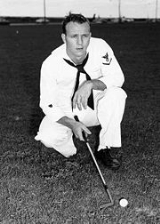
Arnold Palmer

Encyclopedia
Professional golfer
In golf the distinction between amateurs and professionals is rigorously maintained. An amateur who breaches the rules of amateur status may lose his or her amateur status. A golfer who has lost his or her amateur status may not play in amateur competitions until amateur status has been reinstated;...
, who is generally regarded as one of the greatest players in the history of men's professional golf
Professional golfer
In golf the distinction between amateurs and professionals is rigorously maintained. An amateur who breaches the rules of amateur status may lose his or her amateur status. A golfer who has lost his or her amateur status may not play in amateur competitions until amateur status has been reinstated;...
. He has won numerous events on both the PGA Tour
PGA Tour
The PGA Tour is the organizer of the main men's professional golf tours in the United States and North America...
and Champions Tour
Champions Tour
The Champions Tour, a golf tour run by the PGA Tour, hosts a series of events annually in the United States and the United Kingdom for golfers 50 years of age and older. Many of the PGA Tour's most successful golfers have gone on to play on the Champions Tour.The Senior PGA Championship, founded in...
, dating back to 1955. Nicknamed "The King," he is one of golf's most popular stars and its most important trailblazer, because he was the first superstar of the sport's television
Television
Television is a telecommunication medium for transmitting and receiving moving images that can be monochrome or colored, with accompanying sound...
age, which began in the 1950s. He is part of "The Big Three" in golf, along with Jack Nicklaus
Jack Nicklaus
Jack William Nicklaus , nicknamed "The Golden Bear", is an American professional golfer. He won 18 career major championships on the PGA Tour over a span of 25 years and is widely regarded as one of the greatest professional golfers of all time. In addition to his 18 Majors, he was runner-up a...
and Gary Player
Gary Player
Gary Player DMS; OIG is a South African professional golfer. With his nine major championship victories, he is widely regarded as one of the greatest players in the history of golf. He was inducted into the World Golf Hall of Fame in 1974. Player has won 165 tournaments on six continents over six...
, who are widely credited with popularizing and commercialising the sport around the world.
Palmer won the PGA Tour Lifetime Achievement Award
PGA Tour Lifetime Achievement Award
Created in 1996, the PGA Tour Lifetime Achievement Award honors individuals who have made an outstanding contribution to the PGA Tour over an extended period of time through their actions on and off the golf course....
in 1998, and in 1974 was inducted into the World Golf Hall of Fame
World Golf Hall of Fame
The World Golf Hall of Fame is located at World Golf Village near St. Augustine, Florida, in the United States, and it is unusual among sports halls of fame in that a single site serves both men and women. It is supported by a consortium of 26 golf organizations from all over the world.The Hall of...
.
Early life
Palmer was born in Latrobe, PennsylvaniaLatrobe, Pennsylvania
Latrobe is a city in Westmoreland County, Pennsylvania in the United States, approximately southeast of Pittsburgh.The city population was 7,634 as of the 2000 census . It is located near the Pennsylvania's scenic Chestnut Ridge. Latrobe was incorporated as a borough in 1854, and as a city in 1999...
. He learned golf from his father, Deacon Palmer, who was head professional and greenskeeper at Latrobe Country Club, allowing young Arnold to accompany his father as he maintained the course. He attended Wake Forest University
Wake Forest University
Wake Forest University is a private, coeducational university in the U.S. state of North Carolina, founded in 1834. The university received its name from its original location in Wake Forest, north of Raleigh, North Carolina, the state capital. The Reynolda Campus, the university's main campus, is...
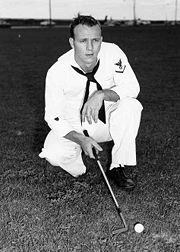
, on a golf scholarship. He left upon the death of close friend Bud Worsham and enlisted in the United States Coast Guard
United States Coast Guard
The United States Coast Guard is a branch of the United States Armed Forces and one of the seven U.S. uniformed services. The Coast Guard is a maritime, military, multi-mission service unique among the military branches for having a maritime law enforcement mission and a federal regulatory agency...
, where he served for three years and had some time to continue to hone his golf skills. Palmer returned to college and competitive golf. His win in the 1954 U.S. Amateur made him decide to try the pro tour for a while, and he and new bride Winifred Walzer (whom he had met at a Pennsylvania tournament) traveled the circuit for 1955.
Rise to superstardom
Palmer won the 1955 Canadian Open in his rookie season, and raised his game status for the next several seasons.Palmer's charisma was a major factor in establishing golf as a compelling television event in the 1950s and 1960s, setting the stage for the popularity it enjoys today. His first major championship win at the 1958 Masters Tournament
1958 Masters Tournament
The 1958 Masters Tournament was contested from April 3 to April 6 at Augusta National Golf Club. It was the 22nd Masters Tournament. 86 players entered the tournament and 43 of them made the cut at five-over-par ....
cemented his position as one of the leading stars in golf, and by 1960 he had signed up as pioneering sports agent Mark McCormack
Mark McCormack
Mark Hume McCormack was an American lawyer, sports agent for professional athletes and a prolific writer...
's first client. In later interviews, McCormack listed five attributes that made Palmer especially marketable: his good looks; his relatively modest background (his father was a greenskeeper before rising to be club professional and Latrobe was a humble club); the way he played golf, taking risks and wearing his emotions on his sleeve; his involvement in a string of exciting finishes in early televised tournaments; and his affability.
Palmer is also credited by many for securing the status of The Open Championship
The Open Championship
The Open Championship, or simply The Open , is the oldest of the four major championships in professional golf. It is the only "major" held outside the USA and is administered by The R&A, which is the governing body of golf outside the USA and Mexico...
(British Open) among U.S. players. After Ben Hogan
Ben Hogan
William Ben Hogan was an American golfer, generally considered one of the greatest players in the history of the game...
won that championship in 1953, few American professionals had travelled to play in The Open, due to its travel requirements, relatively small prize purses, and the style of its links
Links (golf)
A links is the oldest style of golf course, first developed in Scotland. The word "links" comes from the Scots language and refers to an area of coastal sand dunes and sometimes to open parkland. It also retains this more general meaning in the Scottish English dialect...
courses (radically different from most American courses). Palmer was convinced by his business partner Mark McCormack
Mark McCormack
Mark Hume McCormack was an American lawyer, sports agent for professional athletes and a prolific writer...
that success in the Open -– to emulate the feats of Bobby Jones
Bobby Jones (golfer)
Robert Tyre "Bobby" Jones Jr. was an American amateur golfer, and a lawyer by profession. Jones was the most successful amateur golfer ever to compete on a national and international level...
, Walter Hagen
Walter Hagen
Walter Charles Hagen was a major figure in golf in the first half of the 20th century. His tally of eleven professional majors is third behind Jack Nicklaus and Tiger Woods . He won the U.S. Open twice, and in 1922 he became the first native-born American to win the British Open, which he went on...
, Sam Snead
Sam Snead
Samuel Jackson Snead was an American professional golfer who was one of the top players in the world for most of four decades. Snead won a record 82 PGA Tour events including seven majors. He failed to win a U.S...
and Hogan before him –- would truly make him a global sporting star, not simply a leading American golfer. In particular, Palmer travelled to Scotland
Scotland
Scotland is a country that is part of the United Kingdom. Occupying the northern third of the island of Great Britain, it shares a border with England to the south and is bounded by the North Sea to the east, the Atlantic Ocean to the north and west, and the North Channel and Irish Sea to the...
in 1960, having already won both the Masters and U.S. Open, to try to emulate Hogan's feat of 1953, of winning all three in a single year. He failed, losing out to Kel Nagle
Kel Nagle
Kelvin David George Nagle is an Australian professional golfer best known for winning The Open Championship in 1960. He won at least one tournament each year from 1949 to 1975.Nagle was born in North Sydney...
by a single shot, but his subsequent Open wins in the early 1960s convinced many American pros that a trip to Britain would be worth the effort, and certainly secured Palmer's popularity among British and European fans, not just American ones.
Palmer won seven major championships
Men's major golf championships
The men's major golf championships, commonly known as the Major Championships, and often referred to simply as the majors, are the four most prestigious annual tournaments in professional golf...
:
- The Masters: 1958, 1960, 1962, 1964
- U.S. OpenU.S. Open (golf)The United States Open Championship, commonly known as the U.S. Open, is the annual open golf tournament of the United States. It is the second of the four major championships in golf, and is on the official schedule of both the PGA Tour and the European Tour...
: 1960 - The Open ChampionshipThe Open ChampionshipThe Open Championship, or simply The Open , is the oldest of the four major championships in professional golf. It is the only "major" held outside the USA and is administered by The R&A, which is the governing body of golf outside the USA and Mexico...
: 1961, 1962
Palmer's most prolific years were 1960–1963, when he won 29 PGA Tour events in four seasons. In 1960, he won the Hickok Belt
Hickok Belt
The S. Rae Hickok Professional Athlete of the Year award, known as the Hickok Belt, was a trophy awarded for 27 years to the top professional athlete of the year in the United States...
as the top professional athlete of the year and Sports Illustrated
Sports Illustrated
Sports Illustrated is an American sports media company owned by media conglomerate Time Warner. Its self titled magazine has over 3.5 million subscribers and is read by 23 million adults each week, including over 18 million men. It was the first magazine with circulation over one million to win the...
magazine's "Sportsman of the Year
Sportsman of the Year
Since its inception in 1954, Sports Illustrated magazine has annually presented the "Sportsman of the Year" award to "the athlete or team whose performance that year most embodies the spirit of sportsmanship and achievement." Both Americans and non-Americans are eligible, though in the past the...
" award. He built up a wide fan base, often referred to as "Arnie's Army", and in 1967 he became the first man to reach one million dollars in career earnings on the PGA Tour. By the late 1960s Jack Nicklaus
Jack Nicklaus
Jack William Nicklaus , nicknamed "The Golden Bear", is an American professional golfer. He won 18 career major championships on the PGA Tour over a span of 25 years and is widely regarded as one of the greatest professional golfers of all time. In addition to his 18 Majors, he was runner-up a...
and Gary Player had both acquired clear ascendancy in their rivalry, but Palmer won a PGA Tour event every year from 1955 to 1971 inclusive, and in 1971 he enjoyed a revival, winning four events.
Palmer won the Vardon Trophy
Vardon Trophy
The Vardon Trophy is awarded annually by the PGA of America to the PGA Tour's leader in scoring average. When the award was first given in 1937, it was awarded on the basis of a points system. No award was given from 1942–1946 due to World War II. In 1947, the PGA began awarding it for low...
for lowest scoring average four times: 1961, 1962, 1964, and 1967. He played on six Ryder Cup
Ryder Cup
The Ryder Cup is a biennial golf competition between teams from Europe and the United States. The competition is jointly administered by the PGA of America and the PGA European Tour, and is contested every two years, the venue alternating between courses in the United States and Europe...
teams: 1961, 1963, 1965, 1967, 1971, and 1973. He was the last playing captain in 1963, and captained the team again in 1975.
Palmer was eligible for the Senior PGA Tour (now the Champions Tour
Champions Tour
The Champions Tour, a golf tour run by the PGA Tour, hosts a series of events annually in the United States and the United Kingdom for golfers 50 years of age and older. Many of the PGA Tour's most successful golfers have gone on to play on the Champions Tour.The Senior PGA Championship, founded in...
) from its first season in 1980, and he was one of the marquee names who helped it to become successful. He won ten events on the tour, including five senior majors
Senior major golf championships
Men's professional senior golf is for players aged 50 and above. Golf differs from all other sports in having lucrative competitions for this age group. The leading senior tour is the U.S. based Champions Tour, which was established in 1980 . It has established a roster of five major championships...
.
Palmer won the first World Match Play Championship in England, an event which was originally organized by McCormack to showcase his stable of players. Their partnership was one of the most significant in the history of sports marketing. Long after he ceased to win tournaments, Palmer remained one of the highest earners in golf due to his appeal to sponsors and the public.
In 2004, he competed in The Masters for the last time, marking his 50th consecutive appearance in that event. After missing the cut at the 2005 U.S. Senior Open by 21 shots, he announced that he would not enter any more senior majors. Since 2007, Palmer has served as the honorary starter for the Masters. He retired from tournament golf on October 13, 2006, when he withdrew from the Champions Tours' Administaff Small Business Classic
Administaff Small Business Classic
The Insperity Championship is a golf tournament on the Champions Tour. The tournament was founded in 2004 as the Administaff Small Business Classic. It is played annually in October in The Woodlands, Texas at the Woodlands Country Club. From 2004 to 2007 it was played in Spring, Texas at the...
after four holes due to dissatisfaction with his own play. He played the remaining holes but did not keep score. Palmer's legacy was reaffirmed by an electrifying moment during the 2004 Bay Hill Invitational. Standing over 200 yards from the water-guarded 18th green, Palmer, who is known for his aggressive play, lashed his second shot onto the green with a driver. The shot thrilled his loyal gallery and energized the excitable Palmer. He turned to his grandson and caddie, Sam Saunders
Sam Saunders (golfer)
Sam Saunders is an American professional golfer and the grandson of Arnold Palmer.Saunders attended Clemson University, but skipped his senior season to turn pro. In 2011, he played a total of thirteen events between the PGA Tour and the Nationwide Tour, where his finished tenth in Panama...
, and gave him a prolonged shimmy and playful jeering in celebration of the moment.
Golf businesses
Palmer has had a diverse golf-related business career, including owning the Bay Hill Club and LodgeBay Hill Club and Lodge
The Bay Hill Club and Lodge is a private golf resort located in Bay Hill, near Orlando, Florida. It has been owned by Arnold Palmer since 1974. The club is the host to the annual Arnold Palmer Invitational on the PGA Tour.- External links :**...
, which is the venue for the PGA Tour's Arnold Palmer Invitational (renamed from the Bay Hill Invitational in 2007), helping to found The Golf Channel
The Golf Channel
Golf Channel, known as The Golf Channel before the July 2008 dropping of The, is an American cable television network with coverage focused on the game of golf. Founded in Birmingham, Alabama, the American headquarters and studio are currently located in Orlando, Florida...
, and negotiating the deal to build the first golf course in the People's Republic of China
People's Republic of China
China , officially the People's Republic of China , is the most populous country in the world, with over 1.3 billion citizens. Located in East Asia, the country covers approximately 9.6 million square kilometres...
. This led to the formation of Palmer Course Design in 1972, which was renamed Arnold Palmer Design Company when the company moved to Orlando Florida in 2006. Palmer's design partner was Ed Seay. The Palmer-Seay team has designed over 200 courses around the world. Since 1971 he has owned Latrobe Country Club, where his father used to be the club professional. The licensing, endorsements, spokesman associations and commercial partnerships built by Palmer and McCormack are managed by Arnold Palmer Enterprises.
Legacy
In 2000, Palmer was ranked the sixth greatest player of all time in Golf DigestGolf Digest
Golf Digest is a monthly golf magazine published by Condé Nast Publications in the United States. It is a generalist golf publication covering recreational golf and men's and women's competitive golf. Condé Nast Publications also publishes the more specialized , and Golf World Business. The...
magazine's rankings.
According to Golf Digest
Golf Digest
Golf Digest is a monthly golf magazine published by Condé Nast Publications in the United States. It is a generalist golf publication covering recreational golf and men's and women's competitive golf. Condé Nast Publications also publishes the more specialized , and Golf World Business. The...
, Palmer made $1,861,857 in 734 PGA Tour career starts over 53 years; he earned an estimated $30 million off the course in 2008.
He now resides near his golf course, Arnold Palmer's Bay Hill Country Club and Lodge, in Orlando, Florida which was originally designed by Dick Wilson.
Palmer's grandson, Sam Saunders
Sam Saunders (golfer)
Sam Saunders is an American professional golfer and the grandson of Arnold Palmer.Saunders attended Clemson University, but skipped his senior season to turn pro. In 2011, he played a total of thirteen events between the PGA Tour and the Nationwide Tour, where his finished tenth in Panama...
, is a professional golfer. Saunders grew up playing at Bay Hill, and won the Club Championship there at age 15. He attended Clemson University
Clemson University
Clemson University is an American public, coeducational, land-grant, sea-grant, research university located in Clemson, South Carolina, United States....
on a golf scholarship and turned pro in 2008. Saunders stated that Palmer's family nickname is "Dumpy".
An avid pilot
Aviator
An aviator is a person who flies an aircraft. The first recorded use of the term was in 1887, as a variation of 'aviation', from the Latin avis , coined in 1863 by G. de la Landelle in Aviation Ou Navigation Aérienne...
for over 50 years, Palmer thought he would pilot a plane for the last time on January 31, 2011. He flew from Palm Springs, California
Palm Springs, California
Palm Springs is a desert city in Riverside County, California, within the Coachella Valley. It is located approximately 37 miles east of San Bernardino, 111 miles east of Los Angeles and 136 miles northeast of San Diego...
to Orlando, Florida
Orlando, Florida
Orlando is a city in the central region of the U.S. state of Florida. It is the county seat of Orange County, and the center of the Greater Orlando metropolitan area. According to the 2010 US Census, the city had a population of 238,300, making Orlando the 79th largest city in the United States...
in his Cessna Citation X
Cessna Citation X
The Cessna Citation X is a long-range medium business jet aircraft. The Citation X is powered by two Rolls-Royce turbofan engines and is built by the Cessna Aircraft Company in Wichita, Kansas. It is the fastest production civilian jet in the world. The Citation brand of business jets encompasses...
. His pilot's medical certificate
Medical certifications for pilots
Every pilot, in order to legally exercise the privileges of his or her pilot license or certificate, must have one of three types of medical certification, which are governed by the civil aviation authority which issued his or her license or certificate. Each certificate must be issued by a doctor...
expired that day and he chose not to renew it. However, public FAA records show he was issued a new third class medical
Medical certifications for pilots
Every pilot, in order to legally exercise the privileges of his or her pilot license or certificate, must have one of three types of medical certification, which are governed by the civil aviation authority which issued his or her license or certificate. Each certificate must be issued by a doctor...
in May of 2011.
Amateur wins (26)
- 1946 WPIAL Championship, PIAA Championship
- 1947 WPIAL Championship, PIAA Championship, Western Pennsylvania Junior, Western Pennsylvania Amateur
- 1948 Southern Conference Championship, Sunnehanna Invitational, Western Pennsylvania Junior
- 1950 Southern Intercollegiate, Western Pennsylvania Amateur, Greensburg Invitational
- 1951 Western Pennsylvania Amateur, Worsharn Memorial
- 1952 Western Pennsylvania Amateur, Greensburg Invitational
- 1953 Ohio Amateur, Cleveland Amateur, Greensburg Invitational, Mayfield Heights Open, Evergreen Pitch and Putt Invitational
- 1954 U.S. Amateur, Ohio Amateur, All-American Amateur, Atlantic Coast Conference Championship, Bill Waite Memorial
Amateur major wins (1)
| Year | Championship | Winning Score | Runner-up |
|---|---|---|---|
| 1954 | U.S. Amateur | 1 up |  Robert Sweeny Jr. Robert Sweeny Jr. |
Results timeline
| Tournament | 1948 | 1949 | 1950 | 1951 | 1952 | 1953 | 1954 |
|---|---|---|---|---|---|---|---|
| U.S. Amateur | R256 | R64 | R256 | DNP | DNP | R16 | 1 |
DNP = Did not play
R256, R128, R64, R32, R16, QF, SF = Round in which player lost in match play
Green background for wins. Yellow background for top-10
Source:
PGA Tour wins (62)
| No. | Date | Tournament | Winning Score | Margin of Victory |
Runner(s)-up |
|---|---|---|---|---|---|
| 1 | Aug 20, 1955 | Canadian Open | 4 strokes | United States Jack Burke, Jr. |
|
| 2 | Jul 1, 1956 | Insurance City Open | Playoff | United States Ted Kroll |
|
| 3 | Jul 29, 1956 | Eastern Open | 2 strokes | United States Dow Finsterwald Dow Finsterwald Dow Henry Finsterwald, Sr. is an American professional golfer who is best known for winning the 1958 PGA Championship. He won 11 Tour titles between 1955 and 1963, played on four Ryder Cup teams, and served as non-playing captain for the 1977 U.S. Ryder Cup team.Finsterwald was born and raised in... |
|
| 4 | Feb 25, 1957 | Houston Open | 1 stroke | United States Doug Ford Doug Ford (golfer) Douglas Michael Ford, Sr. born Fortunato is an American professional golfer and two-time major golf champion.Ford was born in West Haven, Connecticut. He turned professional in 1949 and won for the first time in 1952 at the Jacksonville Open.The win in Jacksonville was an unusual one... |
|
| 5 | Mar 31, 1957 | Azalea Open Invitational Azalea Open Invitational The Azalea Open Invitational was a golf tournament on the PGA Tour. It was last played in 1971. It was an official PGA Tour event in 1945 and from 1949 to 1970.It was also played under the names of the Azalea Open and the Wilmington Azalea Open.... |
1 stroke | United States Dow Finsterwald Dow Finsterwald Dow Henry Finsterwald, Sr. is an American professional golfer who is best known for winning the 1958 PGA Championship. He won 11 Tour titles between 1955 and 1963, played on four Ryder Cup teams, and served as non-playing captain for the 1977 U.S. Ryder Cup team.Finsterwald was born and raised in... |
|
| 6 | Jun 9, 1957 | Rubber City Open Invitational Rubber City Open Invitational The Rubber City Open Invitational, first played as the Rubber City Open in 1954, was the first PGA Tour event to be held at the storied Firestone Country Club in Akron, Ohio... |
Playoff | United States Doug Ford Doug Ford (golfer) Douglas Michael Ford, Sr. born Fortunato is an American professional golfer and two-time major golf champion.Ford was born in West Haven, Connecticut. He turned professional in 1949 and won for the first time in 1952 at the Jacksonville Open.The win in Jacksonville was an unusual one... |
|
| 7 | Oct 30, 1957 | San Diego Open Invitational | 1 stroke |  Canada Al Balding Canada Al BaldingAl Balding Allan George Balding was a Canadian professional golfer, who won four events on the PGA Tour. In 1955 he became the first Canadian to win a PGA Tour event in the United States; Canadians Ken Black and Jules Huot had won PGA Tour events in Canada in the 1930s.Balding was born in Toronto,... |
|
| 8 | Oct 20, 1958 | St. Petersburg Open Invitational St. Petersburg Open Invitational The St. Petersburg Open Invitational, first played as the St. Petersburg Open, was a PGA Tour event that was held at three St. Petersburg, Florida, U.S. area clubs for 29 years from 1930 until 1964. The clubs that hosted the event were: St... |
1 stroke | Canada Al Balding Al Balding Allan George Balding was a Canadian professional golfer, who won four events on the PGA Tour. In 1955 he became the first Canadian to win a PGA Tour event in the United States; Canadians Ken Black and Jules Huot had won PGA Tour events in Canada in the 1930s.Balding was born in Toronto,... , United States Dow FinsterwaldDow Finsterwald Dow Henry Finsterwald, Sr. is an American professional golfer who is best known for winning the 1958 PGA Championship. He won 11 Tour titles between 1955 and 1963, played on four Ryder Cup teams, and served as non-playing captain for the 1977 U.S. Ryder Cup team.Finsterwald was born and raised in... |
|
| 9 | Apr 6, 1958 | Masters Tournament | 1 stroke | United States Doug Ford Doug Ford (golfer) Douglas Michael Ford, Sr. born Fortunato is an American professional golfer and two-time major golf champion.Ford was born in West Haven, Connecticut. He turned professional in 1949 and won for the first time in 1952 at the Jacksonville Open.The win in Jacksonville was an unusual one... , United States Fred HawkinsFred Hawkins Fred Hawkins is an American professional golfer who played on the PGA Tour from the mid 1940s to the mid 1960s.Hawkins was born in Antioch, Illinois. He attended the University of Illinois and the Texas State School of Mines and Metallurgy . He turned professional in 1947... |
|
| 10 | Jun 29, 1958 | Pepsi Championship Pepsi Championship The Pepsi Championship, also known as the Pepsi-Boys Club Open, was a golf tournament on the PGA Tour that was played at Pine Hollow Country Club in East Norwich, New York for a single year — 1958... |
5 strokes | United States Jay Hebert |
|
| 11 | Jan 25, 1959 | Thunderbird Invitational Thunderbird Invitational The Thunderbird Invitational was a golf tournament on the PGA Tour from 1954 to 1959 and was the direct predecessor of today's Bob Hope Chrysler Classic. It was played in Palm Springs, California.-Winners:*1959 Arnold Palmer*1958 Ken Venturi... |
Playoff | United States Jimmy Demaret Jimmy Demaret James Newton Demaret was an American professional golfer. He won 31 PGA Tour events in a long career between 1935 and 1957, and was the first three-time winner of the Masters.... , United States Ken VenturiKen Venturi Kenneth Venturi is an American former professional golfer and golf broadcaster.-Early years and amateur career:Venturi was born in San Francisco, California. He learned golf from an early age, and developed his game at Harding Park Golf Course and other public courses in the area... |
|
| 12 | May 11, 1959 | Oklahoma City Open Invitational Oklahoma City Open Invitational The Oklahoma City Open Invitational was a golf tournament on the PGA Tour that played at various clubs in Oklahoma City. The tournament first played in the 1920s under the name Oklahoma City Open.... |
2 strokes | United States Bob Goalby Bob Goalby Robert George Goalby is a former American professional golfer on the PGA Tour, who won the 1968 Masters Tournament, his lone major championship among 11 Tour wins achieved between 1958 and 1971.... |
|
| 13 | Nov 29, 1959 | West Palm Beach Open Invitational West Palm Beach Open Invitational The West Palm Beach Open Invitational, first played as The West Palm Beach Open, was a PGA Tour event in the late 1950s and early 1960s. It was held at the West Palm Beach Country Club, now known as the West Palm Beach Golf Course, an 18-hole, par-72 championship course established in 1921 and in... |
Playoff | United States Gay Brewer Gay Brewer Gay Robert Brewer, Jr. was an American professional golfer who played on the PGA Tour and won the 1967 Masters Tournament.... , United States Pete CooperPete Cooper (golfer) Richard Bernice "Pete" Cooper was an American professional golfer on the PGA Tour in the 1940s and 1950s; he was best known for winning the 1976 PGA Seniors' Championship.Cooper turned professional in 1938... |
|
| 14 | Feb 7, 1960 | Palm Springs Desert Golf Classic | 3 strokes | United States Fred Hawkins Fred Hawkins Fred Hawkins is an American professional golfer who played on the PGA Tour from the mid 1940s to the mid 1960s.Hawkins was born in Antioch, Illinois. He attended the University of Illinois and the Texas State School of Mines and Metallurgy . He turned professional in 1947... |
|
| 15 | Feb 28, 1960 | Texas Open Invitational | 2 strokes | United States Doug Ford Doug Ford (golfer) Douglas Michael Ford, Sr. born Fortunato is an American professional golfer and two-time major golf champion.Ford was born in West Haven, Connecticut. He turned professional in 1949 and won for the first time in 1952 at the Jacksonville Open.The win in Jacksonville was an unusual one... , United States Frank StranahanFrank Stranahan Frank Richard Stranahan was a successful amateur golf champion. Stranahan was also the number one power lifter in his weight class from 1945 to 1954 and he became known on the golf course and off as the "Toledo strongman" long before the modern game of golf and fitness... |
|
| 16 | Mar 6, 1960 | Baton Rouge Open Invitational Baton Rouge Open Invitational The Baton Rouge Open Invitational, first played as The Baton Rouge Open, was a PGA Tour event that was played in Baton Rouge, Louisiana in the 1950s and early 1960s. It was played at the Baton Rouge Country Club every year except 1961; that year course renovations were taking place and the event... |
7 strokes | United States Jay Hebert, United States Ron Reif, United States Doug Sanders Doug Sanders George Douglas Sanders is a former American professional golfer who won twenty PGA Tour events during his career.-Early years:Sanders was born in Cedartown, Georgia. He grew up in a poor family, and picked cotton as a teenager... |
|
| 17 | Mar 13, 1960 | Pensacola Open Invitational | 1 stroke | United States Doug Sanders Doug Sanders George Douglas Sanders is a former American professional golfer who won twenty PGA Tour events during his career.-Early years:Sanders was born in Cedartown, Georgia. He grew up in a poor family, and picked cotton as a teenager... |
|
| 18 | Apr 10, 1960 | Masters Tournament | 1 stroke | United States Ken Venturi Ken Venturi Kenneth Venturi is an American former professional golfer and golf broadcaster.-Early years and amateur career:Venturi was born in San Francisco, California. He learned golf from an early age, and developed his game at Harding Park Golf Course and other public courses in the area... |
|
| 19 | Jun 18, 1960 | U.S. Open U.S. Open (golf) The United States Open Championship, commonly known as the U.S. Open, is the annual open golf tournament of the United States. It is the second of the four major championships in golf, and is on the official schedule of both the PGA Tour and the European Tour... |
2 strokes | United States Jack Nicklaus Jack Nicklaus Jack William Nicklaus , nicknamed "The Golden Bear", is an American professional golfer. He won 18 career major championships on the PGA Tour over a span of 25 years and is widely regarded as one of the greatest professional golfers of all time. In addition to his 18 Majors, he was runner-up a... |
|
| 20 | Aug 7, 1960 | Insurance City Open Invitational | Playoff | United States Bill Collins Bill Collins (golfer) William R. Collins was an American professional golfer who played on the PGA Tour in the 1950s and 1960s and the Senior PGA Tour in the 1980s.... , United States Jack FleckJack Fleck Jack Fleck is an American professional golfer best known for winning the 1955 U.S. Open. He is the oldest living U.S. Open champion.... |
|
| 21 | Nov 27, 1960 | Mobile Sertoma Open Invitational Mobile Sertoma Open Invitational The Mobile Sertoma Open Invitational was a PGA Tour event that was played at the Mobile Municipal Golf Course in Mobile, Alabama in the late 1950s and the early 1960s. Today, the course is known as Azalea City Golf Course.-Winners:... |
2 strokes | United States Johnny Pott |
|
| 22 | Jan 15, 1961 | San Diego Open Invitational | Playoff | Canada Al Balding Al Balding Allan George Balding was a Canadian professional golfer, who won four events on the PGA Tour. In 1955 he became the first Canadian to win a PGA Tour event in the United States; Canadians Ken Black and Jules Huot had won PGA Tour events in Canada in the 1930s.Balding was born in Toronto,... |
|
| 23 | Feb 12, 1961 | Phoenix Open Invitational | Playoff | United States Doug Sanders Doug Sanders George Douglas Sanders is a former American professional golfer who won twenty PGA Tour events during his career.-Early years:Sanders was born in Cedartown, Georgia. He grew up in a poor family, and picked cotton as a teenager... |
|
| 24 | Feb 26, 1961 | Baton Rouge Open Invitational Baton Rouge Open Invitational The Baton Rouge Open Invitational, first played as The Baton Rouge Open, was a PGA Tour event that was played in Baton Rouge, Louisiana in the 1950s and early 1960s. It was played at the Baton Rouge Country Club every year except 1961; that year course renovations were taking place and the event... |
7 strokes | United States Wes Ellis Wes Ellis Wesley Ellis, Jr. was an American professional golfer who played on the PGA Tour in the 1950s, 1960s and 1970s.... |
|
| 25 | Apr 30, 1961 | Texas Open Invitational | 1 stroke | Canada Al Balding Al Balding Allan George Balding was a Canadian professional golfer, who won four events on the PGA Tour. In 1955 he became the first Canadian to win a PGA Tour event in the United States; Canadians Ken Black and Jules Huot had won PGA Tour events in Canada in the 1930s.Balding was born in Toronto,... |
|
| 26 | Jun 25, 1961 | Western Open Western Open The Western Open, a professional golf tournament, was first played in 1899. At the time of its 2006 playing, the Western Open was the 3rd oldest active PGA Tour tournament, after the British Open and U.S. Open... |
2 strokes | United States Sam Snead Sam Snead Samuel Jackson Snead was an American professional golfer who was one of the top players in the world for most of four decades. Snead won a record 82 PGA Tour events including seven majors. He failed to win a U.S... |
|
| 27 | Jul 14, 1961 | The Open Championship The Open Championship The Open Championship, or simply The Open , is the oldest of the four major championships in professional golf. It is the only "major" held outside the USA and is administered by The R&A, which is the governing body of golf outside the USA and Mexico... |
1 stroke |  Wales Dai Rees Wales Dai ReesDai Rees David James Rees, CBE was one of the Britain's leading golfers either side of World War II.The winner of many prestigious tournaments in Britain, Europe and farther afield, Rees is best remembered as the captain of the Great Britain Ryder Cup team which defeated the United States at Lindrick Golf... |
|
| 28 | Feb 4, 1962 | Palm Springs Golf Classic | 3 strokes | United States Jay Hebert, United States Gene Littler Gene Littler Gene Alec Littler is an American professional golfer. Known for a solid temperament and nicknamed "Gene the Machine" for his smooth rhythmical swing, he once said that, "Golf is not a game of great shots. It's a game of the best misses. The people who win make the smallest mistakes."-Early years... |
|
| 29 | Feb 11, 1962 | Phoenix Open Invitational | 12 strokes | United States Billy Casper Billy Casper William Earl Casper, Jr. is an American professional golfer who was one of the most prolific tournament winners on the PGA Tour from the mid 1950s to the mid 1970s.-Early years:... , United States Don FairfieldDon Fairfield Donald W. Fairfield is an American professional golfer who played on the PGA Tour and the Senior PGA Tour.Fairfield was born in Kansas, but grew up in Jacksonville, Illinois. He served in the U.S. Air Force.... , United States Bob McCallisterBob McCallister Robert McCallister is an American professional golfer who played on the PGA Tour and the Senior PGA Tour.McCallister was born in Toledo, Ohio... |
|
| 30 | Apr 9, 1962 | Masters Tournament | Playoff | United States Dow Finsterwald Dow Finsterwald Dow Henry Finsterwald, Sr. is an American professional golfer who is best known for winning the 1958 PGA Championship. He won 11 Tour titles between 1955 and 1963, played on four Ryder Cup teams, and served as non-playing captain for the 1977 U.S. Ryder Cup team.Finsterwald was born and raised in... ,  South Africa Gary Player South Africa Gary PlayerGary Player Gary Player DMS; OIG is a South African professional golfer. With his nine major championship victories, he is widely regarded as one of the greatest players in the history of golf. He was inducted into the World Golf Hall of Fame in 1974. Player has won 165 tournaments on six continents over six... |
|
| 31 | Apr 29, 1962 | Texas Open Invitational | 1 stroke | United States Joe Campbell Joe Campbell (golfer) Joe E. Campbell is an American professional golfer who played on the PGA Tour in the late 1950s and 1960s.Campbell was born in Anderson, Indiana. He attended Purdue University where he was a member of the golf team as well as a co-captain of the basketball team. He won the 1955 NCAA Championship... , United States Gene LittlerGene Littler Gene Alec Littler is an American professional golfer. Known for a solid temperament and nicknamed "Gene the Machine" for his smooth rhythmical swing, he once said that, "Golf is not a game of great shots. It's a game of the best misses. The people who win make the smallest mistakes."-Early years... , United States Mason RudolphMason Rudolph Edgar Mason Rudolph was an American golfer who won five times on the PGA Tour.-Early years and amateur career:... , United States Doug SandersDoug Sanders George Douglas Sanders is a former American professional golfer who won twenty PGA Tour events during his career.-Early years:Sanders was born in Cedartown, Georgia. He grew up in a poor family, and picked cotton as a teenager... |
|
| 32 | May 6, 1962 | Tournament of Champions | 1 stroke | United States Billy Casper Billy Casper William Earl Casper, Jr. is an American professional golfer who was one of the most prolific tournament winners on the PGA Tour from the mid 1950s to the mid 1970s.-Early years:... |
|
| 33 | May 13, 1962 | Colonial National Invitation | Playoff | United States Johnny Pott |
|
| 34 | Jul 13, 1962 | The Open Championship The Open Championship The Open Championship, or simply The Open , is the oldest of the four major championships in professional golf. It is the only "major" held outside the USA and is administered by The R&A, which is the governing body of golf outside the USA and Mexico... |
6 strokes |  Australia Kel Nagle Australia Kel NagleKel Nagle Kelvin David George Nagle is an Australian professional golfer best known for winning The Open Championship in 1960. He won at least one tournament each year from 1949 to 1975.Nagle was born in North Sydney... |
|
| 35 | Aug 12, 1962 | American Golf Classic American Golf Classic The American Golf Classic was a tournament on the PGA Tour from 1961 to 1976. It was the third event to be played at the storied Firestone Country Club in Akron, Ohio after the Rubber City Open Invitational and the 1960 PGA Championship.-Winners:... |
5 strokes | United States Mason Rudolph Mason Rudolph Edgar Mason Rudolph was an American golfer who won five times on the PGA Tour.-Early years and amateur career:... |
|
| 36 | Jan 7, 1963 | Los Angeles Open | 3 strokes | Canada Al Balding Al Balding Allan George Balding was a Canadian professional golfer, who won four events on the PGA Tour. In 1955 he became the first Canadian to win a PGA Tour event in the United States; Canadians Ken Black and Jules Huot had won PGA Tour events in Canada in the 1930s.Balding was born in Toronto,... , South Africa Gary PlayerGary Player Gary Player DMS; OIG is a South African professional golfer. With his nine major championship victories, he is widely regarded as one of the greatest players in the history of golf. He was inducted into the World Golf Hall of Fame in 1974. Player has won 165 tournaments on six continents over six... |
|
| 37 | Feb 12, 1963 | Phoenix Open Invitational | 1 stroke | South Africa Gary Player Gary Player Gary Player DMS; OIG is a South African professional golfer. With his nine major championship victories, he is widely regarded as one of the greatest players in the history of golf. He was inducted into the World Golf Hall of Fame in 1974. Player has won 165 tournaments on six continents over six... |
|
| 38 | Mar 10, 1963 | Pensacola Open Invitational | 2 strokes | Harold Kneece, South Africa Gary Player Gary Player Gary Player DMS; OIG is a South African professional golfer. With his nine major championship victories, he is widely regarded as one of the greatest players in the history of golf. He was inducted into the World Golf Hall of Fame in 1974. Player has won 165 tournaments on six continents over six... |
|
| 39 | Jun 16, 1963 | Thunderbird Classic Invitational | Playoff | United States Paul Harney Paul Harney Paul Harney was an American professional golfer and golf course owner who spent part of his career as a full-time PGA Tour player, but mostly was a club professional, part-time Tour player, and owner-operator of his own course.... |
|
| 40 | Jul 1, 1963 | Cleveland Open Invitational | Playoff | United States Tommy Aaron Tommy Aaron Thomas Dean Aaron is a former American professional golfer who was a member of the PGA Tour during the 1960s, 1970s and 1980s. Aaron is best known for winning the 1973 Masters Tournament.- Early years :... , United States Tony LemaTony Lema Anthony David "Tony" Lema was an American professional golfer, who rose to fame in the beginning of golf's modern era, but had his young life and career cut short in an aircraft accident. His most prestigious victory was the 1964 British Open.-Biography:Lema was born in Oakland, California, to... |
|
| 41 | Jul 29, 1963 | Western Open Western Open The Western Open, a professional golf tournament, was first played in 1899. At the time of its 2006 playing, the Western Open was the 3rd oldest active PGA Tour tournament, after the British Open and U.S. Open... |
Playoff | Julius Boros Julius Boros Julius Nicholas Boros was a Hungarian-American professional golfer.-Early years:Boros was born in Bridgeport, Connecticut... , United States Jack NicklausJack Nicklaus Jack William Nicklaus , nicknamed "The Golden Bear", is an American professional golfer. He won 18 career major championships on the PGA Tour over a span of 25 years and is widely regarded as one of the greatest professional golfers of all time. In addition to his 18 Majors, he was runner-up a... |
|
| 42 | Oct 6, 1963 | Whitemarsh Open Invitational | 1 stroke | United States Lionel Hebert Lionel Hebert Lionel P. Hebert was an American golfer. He won five times on the PGA Tour including the 1957 PGA Championship, the last to be held at match play. His older brother Jay won the same event at stroke play in 1960. Lionel also played on the 1957 Ryder Cup team... |
|
| 43 | Apr 12, 1964 | Masters Tournament | 6 strokes | United States Dave Marr Dave Marr David Francis Marr, Jr. was an American professional golfer and sportscaster, best known for winning the 1965 PGA Championship.-Early years:... , Jack Nicklaus Jack Nicklaus Jack William Nicklaus , nicknamed "The Golden Bear", is an American professional golfer. He won 18 career major championships on the PGA Tour over a span of 25 years and is widely regarded as one of the greatest professional golfers of all time. In addition to his 18 Majors, he was runner-up a... |
|
| 44 | May 18, 1964 | Oklahoma City Open Invitational Oklahoma City Open Invitational The Oklahoma City Open Invitational was a golf tournament on the PGA Tour that played at various clubs in Oklahoma City. The tournament first played in the 1920s under the name Oklahoma City Open.... |
2 strokes | United States Lionel Hebert Lionel Hebert Lionel P. Hebert was an American golfer. He won five times on the PGA Tour including the 1957 PGA Championship, the last to be held at match play. His older brother Jay won the same event at stroke play in 1960. Lionel also played on the 1957 Ryder Cup team... |
|
| 45 | Apr 25, 1965 | Tournament of Champions | 3 strokes | United States Chi Chi Rodriguez |
|
| 46 | Jan 31, 1966 | Los Angeles Open | 3 strokes | United States Miller Barber Miller Barber Miller Barber is an American professional golfer who enjoyed significant success on the PGA Tour in the 1960s and 1970s, and a greater degree of success on the Senior PGA Tour in the 1980s.-Career:... , United States Paul HarneyPaul Harney Paul Harney was an American professional golfer and golf course owner who spent part of his career as a full-time PGA Tour player, but mostly was a club professional, part-time Tour player, and owner-operator of his own course.... |
|
| 47 | Apr 18, 1966 | Tournament of Champions | Playoff | United States Gay Brewer Gay Brewer Gay Robert Brewer, Jr. was an American professional golfer who played on the PGA Tour and won the 1967 Masters Tournament.... |
|
| 48 | Nov 20, 1966 | Houston Champions International | 1 stroke | United States Gardner Dickinson |
|
| 49 | Jan 29, 1967 | Los Angeles Open | 5 strokes | United States Gay Brewer Gay Brewer Gay Robert Brewer, Jr. was an American professional golfer who played on the PGA Tour and won the 1967 Masters Tournament.... |
|
| 50 | Feb 19, 1967 | Tucson Open Invitational | 1 stroke | United States Chuck Courtney Chuck Courtney (golfer) Charles Courtney is an American professional golfer who played on the PGA Tour in the 1960s and 1970s.Courtney was born in Minneapolis, Minnesota and raised in San Diego, California... |
|
| 51 | Aug 13, 1967 | American Golf Classic American Golf Classic The American Golf Classic was a tournament on the PGA Tour from 1961 to 1976. It was the third event to be played at the storied Firestone Country Club in Akron, Ohio after the Rubber City Open Invitational and the 1960 PGA Championship.-Winners:... |
3 stroke | United States Doug Sanders Doug Sanders George Douglas Sanders is a former American professional golfer who won twenty PGA Tour events during his career.-Early years:Sanders was born in Cedartown, Georgia. He grew up in a poor family, and picked cotton as a teenager... |
|
| 52 | Sep 24, 1967 | Thunderbird Classic Thunderbird Classic The Thunderbird Classic was a golf tournament on the PGA Tour from 1962 to 1968. It was played at two locations, the Upper Montclair Country Club in Clifton, New Jersey in 1962 and 1966-1968 and the Westchester Country Club in Rye, New York in 1963-1965.... |
1 stroke | United States Charles Coody Charles Coody Billy Charles Coody is an American professional golfer, best known for winning the 1971 Masters Tournament.Coody was born in Stamford, Texas and raised in Abilene, Texas... , United States Jack NicklausJack Nicklaus Jack William Nicklaus , nicknamed "The Golden Bear", is an American professional golfer. He won 18 career major championships on the PGA Tour over a span of 25 years and is widely regarded as one of the greatest professional golfers of all time. In addition to his 18 Majors, he was runner-up a... , United States Art Wall, Jr.Art Wall, Jr. Arthur Jonathan Wall, Jr. was an American golfer.Wall was born in Honesdale, Pennsylvania. He attended Duke University, graduating in 1949 with a business degree.... |
|
| 53 | Feb 14, 1968 | Bob Hope Desert Classic | Playoff | United States Deane Beman Deane Beman Deane R. Beman is an American professional golfer, golf administrator, and golf course architect.Beman was born in Washington, D.C. and graduated from the University of Maryland, College Park, where he played for the varsity golf team. Following graduation, Beman had a career in the insurance... |
|
| 54 | Sep 15, 1968 | Kemper Open | 4 strokes | Australia Bruce Crampton Bruce Crampton Bruce Crampton is an Australian professional golfer.Crampton was born in Sydney, New South Wales, and attended Kogarah High School from 1948-1950. He turned professional in 1953.... , United States Art Wall, Jr.Art Wall, Jr. Arthur Jonathan Wall, Jr. was an American golfer.Wall was born in Honesdale, Pennsylvania. He attended Duke University, graduating in 1949 with a business degree.... |
|
| 55 | Nov 30, 1969 | Heritage Golf Classic | 3 strokes | United States Dick Crawford, United States Bert Yancey Bert Yancey Albert Winsborough Yancey was an American professional golfer, who played on the PGA Tour and the Senior PGA Tour.... |
|
| 56 | Dec 7, 1969 | Danny Thomas-Diplomat Classic Danny Thomas-Diplomat Classic The Danny Thomas-Diplomat Classic was a golf tournament on the PGA Tour that played from December 4-7, 1969 at south Florida's Diplomat Presidential Country Club located between Miami and Fort Lauderdale. Arnold Palmer won the tournament, which earned him $25,000. It was the last event of the year,... |
2 strokes | United States Gay Brewer Gay Brewer Gay Robert Brewer, Jr. was an American professional golfer who played on the PGA Tour and won the 1967 Masters Tournament.... |
|
| 57 | Jul 26, 1970 1970 PGA Tour The 1970 PGA Tour season was played from January 8 to December 13. The season consisted of 45 official money events. Billy Casper won the most tournaments, four, and there were six first-time winners. The tournament results and award winners are listed below.... |
National Four-Ball Championship PGA Players (with United States Jack NicklausJack Nicklaus Jack William Nicklaus , nicknamed "The Golden Bear", is an American professional golfer. He won 18 career major championships on the PGA Tour over a span of 25 years and is widely regarded as one of the greatest professional golfers of all time. In addition to his 18 Majors, he was runner-up a... ) |
3 strokes | Australia Bruce Crampton Bruce Crampton Bruce Crampton is an Australian professional golfer.Crampton was born in Sydney, New South Wales, and attended Kogarah High School from 1948-1950. He turned professional in 1953.... & United States Orville MoodyOrville Moody Orville James Moody was an American professional golfer who won numerous tournaments in his career. He won the 1969 U.S. Open, the last champion in the 20th century to win through local and sectional qualifying.... , United States Gardner Dickinson & United States Sam SneadSam Snead Samuel Jackson Snead was an American professional golfer who was one of the top players in the world for most of four decades. Snead won a record 82 PGA Tour events including seven majors. He failed to win a U.S... , United States George ArcherGeorge Archer George William Archer was an American golfer who won twelve events on the PGA Tour, including one major championship.Archer was born in San Francisco, California and was raised just south in the city of San Mateo... & United States Bobby NicholsBobby Nichols Robert Herman Nichols is an American professional golfer, best known for winning the 1964 PGA Championship.Nichols was born in Louisville, Kentucky. He attended St. Xavier High School in Louisville and later played golf at Texas A&M University were his team won the Southwest Conference Championship... |
|
| 58 | Feb 14, 1971 1971 PGA Tour The 1971 PGA Tour season was played from January 7 to December 12. The season consisted of 44 official money events. Lee Trevino won the most tournaments, six, and there were 10 first-time winners. The tournament results and award winners are listed below.... |
Bob Hope Desert Classic | Playoff | United States Raymond Floyd Raymond Floyd Raymond Loran "Ray" Floyd is an American professional golfer who has won numerous tournaments on both the PGA Tour and Champions Tour.... |
|
| 59 | Mar 14, 1971 1971 PGA Tour The 1971 PGA Tour season was played from January 7 to December 12. The season consisted of 44 official money events. Lee Trevino won the most tournaments, six, and there were 10 first-time winners. The tournament results and award winners are listed below.... |
Florida Citrus Invitational | 1 stroke | United States Julius Boros Julius Boros Julius Nicholas Boros was a Hungarian-American professional golfer.-Early years:Boros was born in Bridgeport, Connecticut... |
|
| 60 | Jul 25, 1971 1971 PGA Tour The 1971 PGA Tour season was played from January 7 to December 12. The season consisted of 44 official money events. Lee Trevino won the most tournaments, six, and there were 10 first-time winners. The tournament results and award winners are listed below.... |
Westchester Classic | 5 strokes | United States Gibby Gilbert Gibby Gilbert C.L. "Gibby" Gilbert II is an American professional golfer who has won tournaments on both the PGA Tour and Champions Tour.... , United States Hale IrwinHale Irwin Hale S. Irwin is an American professional golfer. He is one of the few players in history to have won three U.S. Opens and was one of the world's leading golfers for much of the 1970s and 1980s. He has also developed a career as a golf course architect.Irwin was born in Joplin, Missouri, but was... |
|
| 61 | Aug 1, 1971 1971 PGA Tour The 1971 PGA Tour season was played from January 7 to December 12. The season consisted of 44 official money events. Lee Trevino won the most tournaments, six, and there were 10 first-time winners. The tournament results and award winners are listed below.... |
National Team Championship National Team Championship The National Team Championship, which was played under a variety of names, was a golf tournament on the PGA Tour from 1965 to 1972.It was only considered an official event in 1970 and 1971.-Tournament hosts:... (with United States Jack NicklausJack Nicklaus Jack William Nicklaus , nicknamed "The Golden Bear", is an American professional golfer. He won 18 career major championships on the PGA Tour over a span of 25 years and is widely regarded as one of the greatest professional golfers of all time. In addition to his 18 Majors, he was runner-up a... ) |
6 strokes | United States Julius Boros Julius Boros Julius Nicholas Boros was a Hungarian-American professional golfer.-Early years:Boros was born in Bridgeport, Connecticut... & United States Bill CollinsBill Collins (golfer) William R. Collins was an American professional golfer who played on the PGA Tour in the 1950s and 1960s and the Senior PGA Tour in the 1980s.... ,  New Zealand Bob Charles New Zealand Bob CharlesBob Charles (golfer) Sir Robert James Charles, ONZ, KNZM, CBE is a New Zealand professional golfer whose achievements over five decades rank him among the most successful left-handed golfers of all time, being the first lefty to win a golf major, winning more than 70 titles, and beating his age twice during a... & Australia Bruce DevlinBruce Devlin Bruce William Devlin is an Australian professional golfer, sportscaster and golf course designer.Devlin was born in Armidale, Australia. He turned pro in 1961 and joined the PGA Tour in 1962 after an amateur career in Australia which included a win at the Australian Amateur in 1959... |
|
| 62 | Feb 11, 1973 1973 PGA Tour The 1973 PGA Tour season was played from January 4 to December 1. The season consisted of 48 official money events. Jack Nicklaus won the most tournaments, seven, and there were seven first-time winners. The tournament results and award winners are listed below.-Tournament results:The following... |
Bob Hope Desert Classic | 2 strokes | United States Jack Nicklaus Jack Nicklaus Jack William Nicklaus , nicknamed "The Golden Bear", is an American professional golfer. He won 18 career major championships on the PGA Tour over a span of 25 years and is widely regarded as one of the greatest professional golfers of all time. In addition to his 18 Majors, he was runner-up a... , United States Johnny MillerJohnny Miller John Laurence Miller is an American professional golfer who played on the PGA Tour. He was one of the top players in the world during the mid-1970s; he ranked second in the world on Mark McCormack's world golf rankings in both 1974 and 1975 behind Jack Nicklaus. He is currently the lead golf... |
Source:
Other wins (18)
- 1955 Colombian OpenColombian OpenThe Colombian Open, or Abierto de Colombia, is a golf tournament on the Colombian Tour that was first played in 1945. It has also on occasion been an event on the Tour de las Americas....
- 1956 Panama OpenPanama OpenThe Panama Open was a golf tournament played from 1938 to 1982. The name was revived in 1996, when it was an unofficial event on the Canadian Tour...
- 1958 Long Island OpenLong Island OpenThe Long Island Open is a professional golf tournament played on Long Island, New York. It is sponsored by the Long Island Golf Association and was first held in 1922 at the Cherry Valley Club in Garden City, New York. Al Brosch won a record ten titles between 1939 and 1959, a record that stands...
- 1960 Canada Cup (with Sam SneadSam SneadSamuel Jackson Snead was an American professional golfer who was one of the top players in the world for most of four decades. Snead won a record 82 PGA Tour events including seven majors. He failed to win a U.S...
) - 1962 Canada Cup (with Sam SneadSam SneadSamuel Jackson Snead was an American professional golfer who was one of the top players in the world for most of four decades. Snead won a record 82 PGA Tour events including seven majors. He failed to win a U.S...
) - 1963 Australian Wills Masters Tournament, Canada Cup (with Jack NicklausJack NicklausJack William Nicklaus , nicknamed "The Golden Bear", is an American professional golfer. He won 18 career major championships on the PGA Tour over a span of 25 years and is widely regarded as one of the greatest professional golfers of all time. In addition to his 18 Majors, he was runner-up a...
) - 1964 Piccadilly World Match Play Championship (England, but not a European Tour event at that time), Canada Cup (with Jack NicklausJack NicklausJack William Nicklaus , nicknamed "The Golden Bear", is an American professional golfer. He won 18 career major championships on the PGA Tour over a span of 25 years and is widely regarded as one of the greatest professional golfers of all time. In addition to his 18 Majors, he was runner-up a...
) - 1966 Australian OpenAustralian Open (golf)The Australian Open is one of the principal annual golf tournaments on the PGA Tour of Australasia, and also the OneAsia Tour since its formation in 2009. The event was first played in 1904 and takes place toward the end of each year...
, Canada Cup (with Jack NicklausJack NicklausJack William Nicklaus , nicknamed "The Golden Bear", is an American professional golfer. He won 18 career major championships on the PGA Tour over a span of 25 years and is widely regarded as one of the greatest professional golfers of all time. In addition to his 18 Majors, he was runner-up a...
), PGA Team Championship (with Jack NicklausJack NicklausJack William Nicklaus , nicknamed "The Golden Bear", is an American professional golfer. He won 18 career major championships on the PGA Tour over a span of 25 years and is widely regarded as one of the greatest professional golfers of all time. In addition to his 18 Majors, he was runner-up a...
) - 1967 Piccadilly World Match Play Championship (England, but not a European Tour event at that time), World Cup (with Jack NicklausJack NicklausJack William Nicklaus , nicknamed "The Golden Bear", is an American professional golfer. He won 18 career major championships on the PGA Tour over a span of 25 years and is widely regarded as one of the greatest professional golfers of all time. In addition to his 18 Majors, he was runner-up a...
) - 1971 Lancome TrophyTrophée LancômeThe Trophée Lancôme was a professional golf tournament which was staged in France from 1970 to 2003.Gaëtan Mourgue D'Algue, a French golf enthusiast from Saint-Nom-la-Bretèche, hoped to popularize the then little-known sport of Golf in France during the early 1960s...
(France, but not a European Tour event at that time) - 1975 Spanish Open (European Tour), Penfold PGA Championship (European Tour)
- 1980 Canadian PGA ChampionshipCanadian PGA ChampionshipThe PGA Championship of Canada is a golf tournament organized by the PGA of Canada. It was first played in 1912 as the Canadian PGA Championship. It was a Nationwide Tour event from 2001 to 2005. It was also an event on the Canadian Tour. Stan Leonard holds the record with eight victories...
Senior PGA Tour wins (10)
- 19801980 Senior PGA TourThe 1980 Senior PGA Tour was the first season of the Senior PGA Tour . The season consisted of only four official money events with purses totalling $475,000, including two majors...
(1) PGA Seniors' Championship - 19811981 Senior PGA TourThe 1981 Senior PGA Tour was the second season since the Senior PGA Tour officially began in 1980 . The season consisted of seven official money events with purses totalling $1,024,000, including two majors. Miller Barber won the most tournaments, three...
(1) U.S. Senior Open - 19821982 Senior PGA TourThe 1982 Senior PGA Tour was the third season since the Senior PGA Tour officially began in 1980 . The season consisted of 11 official money events with purses totalling $1,597,500, including two majors. Miller Barber won the most tournaments, three...
(2) Marlboro Classic, Denver Post Champions of Golf - 19831983 Senior PGA TourThe 1983 Senior PGA Tour was the fourth season since the Senior PGA Tour officially began in 1980 . The season consisted of 16 official money events with purses totalling $2,612,000, including two majors. Don January won the most tournaments, six...
(1) Boca Grove Seniors Classic - 19841984 Senior PGA TourThe 1984 Senior PGA Tour was the fifth season since the Senior PGA Tour officially began in 1980 . The season consisted of 22 official money events with purses totalling $4,366,000, including four majors. Miller Barber won the most tournaments, four...
(3) General Foods PGA Seniors' Championship, Senior Tournament Players Championship, Quadel Seniors ClassicQuadel Seniors ClassicThe Quadel Seniors Classic was a golf tournament on the Champions Tour from 1983 to 1985. It was played in Boca Raton, Florida at the Boca Grove Plantation.The purse for the 1985 tournament was US$200,000, with $30,000 going to the winner... - 19851985 Senior PGA TourThe 1985 Senior PGA Tour was the sixth season since the Senior PGA Tour officially began in 1980 . The season consisted of 24 official money events with purses totalling $5,005,000, including two majors. Peter Thomson won the most tournaments, nine...
(1) Senior Tournament Players Championship - 19881988 Senior PGA TourThe 1988 Senior PGA Tour was the ninth season since the Senior PGA Tour officially began in 1980 . The season consisted of 34 official money events with purses totalling $10,370,000, including three majors. Bob Charles and Gary Player won the most tournaments, five...
(1) Crestar ClassicCrestar ClassicThe Crestar Classic was a golf tournament on the Champions Tour from 1983 to 1990. It was played in Manakin-Sabot, Virginia at the Hermitage Country Club. In 1988, it was the last professional victory for golf legend Arnold Palmer....
Senior majors
Senior major golf championships
Men's professional senior golf is for players aged 50 and above. Golf differs from all other sports in having lucrative competitions for this age group. The leading senior tour is the U.S. based Champions Tour, which was established in 1980 . It has established a roster of five major championships...
are shown in bold.
Other senior wins (5)
- 1984 Doug Sanders Celebrity Pro-Am
- 1986 Union Mutual Classic
- 1990 Senior Skins Game
- 1992 Senior Skins Game
- 1993 Senior Skins Game
Wins (7)
| Year | Championship | 54 Holes | Winning Score | Margin | Runner(s)-up |
|---|---|---|---|---|---|
| 1958 1958 Masters Tournament The 1958 Masters Tournament was contested from April 3 to April 6 at Augusta National Golf Club. It was the 22nd Masters Tournament. 86 players entered the tournament and 43 of them made the cut at five-over-par .... |
Masters Tournament | Tied for lead | −4 (70–73–68–73=284) | 1 stroke | United States Doug Ford Doug Ford (golfer) Douglas Michael Ford, Sr. born Fortunato is an American professional golfer and two-time major golf champion.Ford was born in West Haven, Connecticut. He turned professional in 1949 and won for the first time in 1952 at the Jacksonville Open.The win in Jacksonville was an unusual one... , United States Fred HawkinsFred Hawkins Fred Hawkins is an American professional golfer who played on the PGA Tour from the mid 1940s to the mid 1960s.Hawkins was born in Antioch, Illinois. He attended the University of Illinois and the Texas State School of Mines and Metallurgy . He turned professional in 1947... |
| 1960 1960 Masters Tournament The 1960 Masters Tournament was contested from April 7 to April 10 at Augusta National Golf Club. It was the 24th Masters Tournament. 83 players entered the tournament and 45 of them made the cut at six-over-par .... |
Masters Tournament (2) | 1 shot lead | −6 (67–73–72–70=282) | 1 stroke | United States Ken Venturi Ken Venturi Kenneth Venturi is an American former professional golfer and golf broadcaster.-Early years and amateur career:Venturi was born in San Francisco, California. He learned golf from an early age, and developed his game at Harding Park Golf Course and other public courses in the area... |
| 1960 | U.S. Open U.S. Open (golf) The United States Open Championship, commonly known as the U.S. Open, is the annual open golf tournament of the United States. It is the second of the four major championships in golf, and is on the official schedule of both the PGA Tour and the European Tour... |
7 shot deficit | −4 (72–71–72–65=280) | 2 strokes | United States Jack Nicklaus Jack Nicklaus Jack William Nicklaus , nicknamed "The Golden Bear", is an American professional golfer. He won 18 career major championships on the PGA Tour over a span of 25 years and is widely regarded as one of the greatest professional golfers of all time. In addition to his 18 Majors, he was runner-up a... |
| 1961 1961 Open Championship The 1961 Open Championship was a golf competition held at Royal Birkdale Golf Club. The competition was won by Arnold Palmer.-First round:-Second round:... |
The Open Championship The Open Championship The Open Championship, or simply The Open , is the oldest of the four major championships in professional golf. It is the only "major" held outside the USA and is administered by The R&A, which is the governing body of golf outside the USA and Mexico... |
1 shot lead | −8 (70–73–69–72=284) | 1 stroke | Wales Dai Rees Dai Rees David James Rees, CBE was one of the Britain's leading golfers either side of World War II.The winner of many prestigious tournaments in Britain, Europe and farther afield, Rees is best remembered as the captain of the Great Britain Ryder Cup team which defeated the United States at Lindrick Golf... |
| 1962 1962 Masters Tournament The 1962 Masters Tournament was contested from April 5 to April 9 at Augusta National Golf Club. It was the 26th Masters Tournament. 109 players entered the tournament and 51 of them made the cut at five-over-par . The cut was changed this year to low 44 plus ties.Arnold Palmer won his third... |
Masters Tournament (3) | 2 shot lead | −8 (70–66–69–75=280) | Playoff 1 | South Africa Gary Player Gary Player Gary Player DMS; OIG is a South African professional golfer. With his nine major championship victories, he is widely regarded as one of the greatest players in the history of golf. He was inducted into the World Golf Hall of Fame in 1974. Player has won 165 tournaments on six continents over six... , United States Dow FinsterwaldDow Finsterwald Dow Henry Finsterwald, Sr. is an American professional golfer who is best known for winning the 1958 PGA Championship. He won 11 Tour titles between 1955 and 1963, played on four Ryder Cup teams, and served as non-playing captain for the 1977 U.S. Ryder Cup team.Finsterwald was born and raised in... |
| 1962 1962 Open Championship The 1962 Open Championship was a golf competition held at Royal Troon Golf Club. The competition was won by Arnold Palmer.-First round:-Second round:... |
The Open Championship The Open Championship The Open Championship, or simply The Open , is the oldest of the four major championships in professional golf. It is the only "major" held outside the USA and is administered by The R&A, which is the governing body of golf outside the USA and Mexico... (2) |
5 shot lead | −12 (71–69–67–69=276) | 6 strokes | Australia Kel Nagle Kel Nagle Kelvin David George Nagle is an Australian professional golfer best known for winning The Open Championship in 1960. He won at least one tournament each year from 1949 to 1975.Nagle was born in North Sydney... |
| 1964 1964 Masters Tournament The 1964 Masters Tournament was contested from April 9 to April 12 at Augusta National Golf Club. It was the 28th Masters Tournament. 96 players entered the tournament and 48 of them made the cut at four-over-par .... |
Masters Tournament (4) | 5 shot lead | −12 (69–68–69–70=276) | 6 strokes | United States Dave Marr Dave Marr David Francis Marr, Jr. was an American professional golfer and sportscaster, best known for winning the 1965 PGA Championship.-Early years:... , United States Jack Nicklaus |
1 Defeated Gary Player & Dow Finsterwald in 18-hole playoff – Palmer (68), Player (71), Finsterwald (77)
Results timeline
| Tournament | 1953 | 1954 | 1955 | 1956 | 1957 | 1958 | 1959 |
|---|---|---|---|---|---|---|---|
| The Masters | DNP | DNP | T10 | 21 | T7 | 1 | 3 |
| U.S. Open U.S. Open (golf) The United States Open Championship, commonly known as the U.S. Open, is the annual open golf tournament of the United States. It is the second of the four major championships in golf, and is on the official schedule of both the PGA Tour and the European Tour... |
CUT | CUT | T21 | 7 | CUT | T23 | T5 |
| The Open Championship The Open Championship The Open Championship, or simply The Open , is the oldest of the four major championships in professional golf. It is the only "major" held outside the USA and is administered by The R&A, which is the governing body of golf outside the USA and Mexico... |
DNP | DNP | DNP | DNP | DNP | DNP | DNP |
| PGA Championship PGA Championship The PGA Championship is an annual golf tournament conducted by the PGA of America as part of the PGA Tour. It is one of the four major championships in men's professional golf, and is the golf season's final major, usually played in mid-August, customarily four weeks after The Open Championship... |
DNP | DNP | DNP | DNP | DNP | T40 | T14 |
| Tournament | 1960 | 1961 | 1962 | 1963 | 1964 | 1965 | 1966 | 1967 | 1968 | 1969 |
|---|---|---|---|---|---|---|---|---|---|---|
| The Masters | 1 | T2 | 1 | T9 | 1 | T2 | T4 | 4 | CUT | 27 |
| U.S. Open U.S. Open (golf) The United States Open Championship, commonly known as the U.S. Open, is the annual open golf tournament of the United States. It is the second of the four major championships in golf, and is on the official schedule of both the PGA Tour and the European Tour... |
1 | T14 | 2 | T2 | T5 | CUT | 2 | 2 | 59 | T6 |
| The Open Championship The Open Championship The Open Championship, or simply The Open , is the oldest of the four major championships in professional golf. It is the only "major" held outside the USA and is administered by The R&A, which is the governing body of golf outside the USA and Mexico... |
2 | 1 | 1 | T26 | DNP | 16 | T8 | DNP | T10 | DNP |
| PGA Championship PGA Championship The PGA Championship is an annual golf tournament conducted by the PGA of America as part of the PGA Tour. It is one of the four major championships in men's professional golf, and is the golf season's final major, usually played in mid-August, customarily four weeks after The Open Championship... |
T7 | T5 | T17 | T40 | T2 | T33 | T6 | T14 | T2 | WD |
| Tournament | 1970 | 1971 | 1972 | 1973 | 1974 | 1975 | 1976 | 1977 | 1978 | 1979 |
|---|---|---|---|---|---|---|---|---|---|---|
| The Masters | T36 | T18 | T33 | T24 | T11 | T13 | CUT | T24 | T37 | CUT |
| U.S. Open U.S. Open (golf) The United States Open Championship, commonly known as the U.S. Open, is the annual open golf tournament of the United States. It is the second of the four major championships in golf, and is on the official schedule of both the PGA Tour and the European Tour... |
T54 | T24 | 3 | T4 | T5 | T9 | T50 | T19 | CUT | T59 |
| The Open Championship The Open Championship The Open Championship, or simply The Open , is the oldest of the four major championships in professional golf. It is the only "major" held outside the USA and is administered by The R&A, which is the governing body of golf outside the USA and Mexico... |
12 | DNP | T7 | T14 | DNP | T16 | T55 | 7 | T34 | DNP |
| PGA Championship PGA Championship The PGA Championship is an annual golf tournament conducted by the PGA of America as part of the PGA Tour. It is one of the four major championships in men's professional golf, and is the golf season's final major, usually played in mid-August, customarily four weeks after The Open Championship... |
T2 | T18 | T16 | CUT | T28 | T33 | T15 | T19 | CUT | CUT |
| Tournament | 1980 | 1981 | 1982 | 1983 | 1984 | 1985 | 1986 | 1987 | 1988 | 1989 |
|---|---|---|---|---|---|---|---|---|---|---|
| The Masters | T24 | CUT | 47 | T36 | CUT | CUT | CUT | CUT | CUT | CUT |
| U.S. Open U.S. Open (golf) The United States Open Championship, commonly known as the U.S. Open, is the annual open golf tournament of the United States. It is the second of the four major championships in golf, and is on the official schedule of both the PGA Tour and the European Tour... |
63 | CUT | CUT | T60 | DNP | DNP | DNP | DNP | DNP | DNP |
| The Open Championship The Open Championship The Open Championship, or simply The Open , is the oldest of the four major championships in professional golf. It is the only "major" held outside the USA and is administered by The R&A, which is the governing body of golf outside the USA and Mexico... |
CUT | T23 | T27 | T56 | CUT | DNP | DNP | CUT | DNP | CUT |
| PGA Championship PGA Championship The PGA Championship is an annual golf tournament conducted by the PGA of America as part of the PGA Tour. It is one of the four major championships in men's professional golf, and is the golf season's final major, usually played in mid-August, customarily four weeks after The Open Championship... |
T72 | 76 | CUT | T67 | CUT | T65 | CUT | T65 | CUT | T63 |
| Tournament | 1990 | 1991 | 1992 | 1993 | 1994 | 1995 | 1996 | 1997 | 1998 | 1999 |
|---|---|---|---|---|---|---|---|---|---|---|
| The Masters | CUT | CUT | CUT | CUT | CUT | CUT | CUT | CUT | CUT | CUT |
| U.S. Open U.S. Open (golf) The United States Open Championship, commonly known as the U.S. Open, is the annual open golf tournament of the United States. It is the second of the four major championships in golf, and is on the official schedule of both the PGA Tour and the European Tour... |
DNP | DNP | DNP | DNP | CUT | DNP | DNP | DNP | DNP | DNP |
| The Open Championship The Open Championship The Open Championship, or simply The Open , is the oldest of the four major championships in professional golf. It is the only "major" held outside the USA and is administered by The R&A, which is the governing body of golf outside the USA and Mexico... |
CUT | DNP | DNP | DNP | DNP | CUT | DNP | DNP | DNP | DNP |
| PGA Championship PGA Championship The PGA Championship is an annual golf tournament conducted by the PGA of America as part of the PGA Tour. It is one of the four major championships in men's professional golf, and is the golf season's final major, usually played in mid-August, customarily four weeks after The Open Championship... |
CUT | CUT | CUT | CUT | CUT | DNP | DNP | DNP | DNP | DNP |
| Tournament | 2000 | 2001 | 2002 | 2003 | 2004 |
|---|---|---|---|---|---|
| The Masters | CUT | CUT | CUT | CUT | CUT |
| U.S. Open U.S. Open (golf) The United States Open Championship, commonly known as the U.S. Open, is the annual open golf tournament of the United States. It is the second of the four major championships in golf, and is on the official schedule of both the PGA Tour and the European Tour... |
DNP | DNP | DNP | DNP | DNP |
| The Open Championship The Open Championship The Open Championship, or simply The Open , is the oldest of the four major championships in professional golf. It is the only "major" held outside the USA and is administered by The R&A, which is the governing body of golf outside the USA and Mexico... |
DNP | DNP | DNP | DNP | DNP |
| PGA Championship PGA Championship The PGA Championship is an annual golf tournament conducted by the PGA of America as part of the PGA Tour. It is one of the four major championships in men's professional golf, and is the golf season's final major, usually played in mid-August, customarily four weeks after The Open Championship... |
DNP | DNP | DNP | DNP | DNP |
DNP = Did not play
WD = Withdrew
CUT = missed the half-way cut
"T" indicates a tie for a place
Green background for wins. Yellow background for top-10.
Summary of performances
- Starts – 142
- Wins – 7
- 2nd place finishes – 10
- Top 3 finishes – 19
- Top 5 finishes – 26
- Top 10 finishes – 38
- Longest streak of top-10s in majors – 6
Wins (5)
| Year | Championship | Winning Score | Margin | Runner(s)-up |
|---|---|---|---|---|
| 1980 | PGA Seniors' Championship | +1 (72–69–73–75=289) | Playoff1 | United States Paul Harney Paul Harney Paul Harney was an American professional golfer and golf course owner who spent part of his career as a full-time PGA Tour player, but mostly was a club professional, part-time Tour player, and owner-operator of his own course.... |
| 1981 | U.S. Senior Open United States Senior Open The U.S. Senior Open is one of the major championships in men's senior golf. It was first played in 1980 and is administered by the United States Golf Association and is recognized as a major championship by both the Champions Tour and the European Seniors Tour... |
+9 (72–76–68–73=289) | Playoff2 | United States Billy Casper Billy Casper William Earl Casper, Jr. is an American professional golfer who was one of the most prolific tournament winners on the PGA Tour from the mid 1950s to the mid 1970s.-Early years:... , United States Bob Stone |
| 1984a | General Foods PGA Seniors' Championship (2) | −6 (69–63–79–71=282) | 2 strokes | United States Don January Don January Donald Ray January is an American professional golfer.January was born in Plainview, Texas, and graduated from Sunset High School in Dallas... |
| 1984 | Senior Players Championship Senior Players Championship The Senior Players Championship is one of the five major championships on golf's Champions Tour. Unlike the U.S. Senior Open, the Senior PGA Championship and the Senior British Open, it is not recognized as a major by the European Seniors Tour, and is not part of that tour's schedule. The inaugural... |
−12 (72–68–67–69=276) | 3 strokes | Australia Peter Thomson |
| 1985 | Senior Players Championship Senior Players Championship The Senior Players Championship is one of the five major championships on golf's Champions Tour. Unlike the U.S. Senior Open, the Senior PGA Championship and the Senior British Open, it is not recognized as a major by the European Seniors Tour, and is not part of that tour's schedule. The inaugural... (2) |
−14 (67–71–68–68=274) | 11 strokes | United States Miller Barber Miller Barber Miller Barber is an American professional golfer who enjoyed significant success on the PGA Tour in the 1960s and 1970s, and a greater degree of success on the Senior PGA Tour in the 1980s.-Career:... , United States Lee ElderLee Elder Robert Lee Elder is an American golfer. He is best remembered for becoming the first African-American to play in the Masters Tournament in 1975.-Background and family:... , United States Gene LittlerGene Littler Gene Alec Littler is an American professional golfer. Known for a solid temperament and nicknamed "Gene the Machine" for his smooth rhythmical swing, he once said that, "Golf is not a game of great shots. It's a game of the best misses. The people who win make the smallest mistakes."-Early years... , United States Charles OwensCharles Owens (golfer) Charles Owens is an American professional golfer who has played on the PGA Tour and the Senior PGA Tour.Owens was born in Winter Haven, Florida. He played football at Florida A&M University and served in the U.S. Army... |
a This was the January edition of the tournament.
1 Palmer won this with a birdie on the first playoff hole.
2 Won in an 18-hole playoff, Palmer shot a (70) to Stone's (74) and Casper's (77).
See also
- Arnold Palmer Center for Golf History
- Arnold Palmer Tournament GolfArnold Palmer Tournament GolfArnold Palmer Tournament Golf is a golf video game for the Sega "Genesis" or "MegaDrive".It was known as in Japan. It is one of the early Sega sports games where a celebrity athlete's name was added to the title when it was localized from Japan...
(video game) - Golfers with most PGA Tour winsGolfers with most PGA Tour winsThis is a list of golfers who have won five or more official money events on the PGA Tour.Players under 50 years of age are shown in bold. On his 50th birthday a golfer becomes eligible to compete on the Champions Tour, and he is unlikely to add to his tally of PGA Tour wins after that date This is...
- Golfers with most major championship wins
- Most PGA Tour wins in a yearMost PGA Tour wins in a yearThe following is a list of all occasions on which a golfer has won eight or more tournaments on the PGA Tour in a year. It is complete through 2010.Byron Nelson's record 18 victories came in a year when many potential rivals would have been in the armed forces...
- Longest PGA Tour win streaksLongest PGA Tour win streaksThe following represents the golfers who have won at least 3 consecutive starts in PGA Tour events. Note that in some cases the players have competed in and failed to win non-PGA Tour events in between these events.Sources:*ESPN *PGA TOUR 2007 Guide...
- Most wins in one PGA Tour eventMost wins in one PGA Tour eventThe following are the golfers who have won at least five times in a single PGA Tour event.Source: Official website Notability: -Multiple winners:The following golfers have won more than one event at least five times.5 events...
- Golfers with most Champions Tour winsGolfers with most Champions Tour winsThis is a list of all the golfers who have won ten or more official events on the U.S. based Champions Tour, the leading golf tour in the world for men aged 50 and above. The list is up-to-date through August 7, 2011.-See also:...
- Golfers with most Champions Tour major championship winsGolfers with most Champions Tour major championship winsThis article lists all the men who have won senior golf's major championships. The tallies do not include wins in the Senior PGA Championship and the Senior British Open before they became Champions Tour majors. The five majors are shown in the order in which they are currently played each year....
- List of celebrities who own wineries and vineyards
- Arnold Palmer (drink)Arnold Palmer (drink)An Arnold Palmer is a beverage consisting of 1/2 iced tea and 1/2 lemonade named for golfer Arnold Palmer. It is often called a half and half.- Variations :...
External links
- Arnold Palmer – Profile at Golflegends
- Arnold Palmer Invitational – PGA Tour event
- Arnold Palmer Design Company
- Arnold Palmer Hospital for Children
- Bay Hill Club and Lodge – Palmer's winter home course
- Latrobe Country Club – Palmer's summer home course
- Arnold Palmer Tee – Palmer's namesake half iced tea and half lemonade drink