

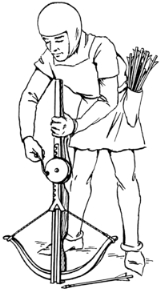
Arbalest

Encyclopedia

Middle Ages
The Middle Ages is a periodization of European history from the 5th century to the 15th century. The Middle Ages follows the fall of the Western Roman Empire in 476 and precedes the Early Modern Era. It is the middle period of a three-period division of Western history: Classic, Medieval and Modern...
Europe
Europe
Europe is, by convention, one of the world's seven continents. Comprising the westernmost peninsula of Eurasia, Europe is generally 'divided' from Asia to its east by the watershed divides of the Ural and Caucasus Mountains, the Ural River, the Caspian and Black Seas, and the waterways connecting...
an crossbow
Crossbow
A crossbow is a weapon consisting of a bow mounted on a stock that shoots projectiles, often called bolts or quarrels. The medieval crossbow was called by many names, most of which derived from the word ballista, a torsion engine resembling a crossbow in appearance.Historically, crossbows played a...
. A large weapon
Weapon
A weapon, arm, or armament is a tool or instrument used with the aim of causing damage or harm to living beings or artificial structures or systems...
, the arbalest had a steel
Steel
Steel is an alloy that consists mostly of iron and has a carbon content between 0.2% and 2.1% by weight, depending on the grade. Carbon is the most common alloying material for iron, but various other alloying elements are used, such as manganese, chromium, vanadium, and tungsten...
prod ("bow"). Since an arbalest was much larger than earlier crossbow
Crossbow
A crossbow is a weapon consisting of a bow mounted on a stock that shoots projectiles, often called bolts or quarrels. The medieval crossbow was called by many names, most of which derived from the word ballista, a torsion engine resembling a crossbow in appearance.Historically, crossbows played a...
s, and because of the greater compressive strength
Compressive strength
Compressive strength is the capacity of a material or structure to withstand axially directed pushing forces. When the limit of compressive strength is reached, materials are crushed. Concrete can be made to have high compressive strength, e.g...
of steel
Steel
Steel is an alloy that consists mostly of iron and has a carbon content between 0.2% and 2.1% by weight, depending on the grade. Carbon is the most common alloying material for iron, but various other alloying elements are used, such as manganese, chromium, vanadium, and tungsten...
, it had a greater force. The strongest windlass
Windlass
The windlass is an apparatus for moving heavy weights. Typically, a windlass consists of a horizontal cylinder , which is rotated by the turn of a crank or belt...
-pulled arbalests could have up to 22 kN (5000 lbf
Pound-force
The pound force is a unit of force in some systems of measurement including English engineering units and British gravitational units.- Definitions :...
) strength and be accurate up to 900 m. A skilled arbalestier (arblaster) could shoot two bolt
Quarrel
A quarrel or bolt is the term for the ammunition used in a crossbow. The name "quarrel" is derived from the French carré, "square", referring to the fact that they typically have square heads. Although their length varies, they are typically shorter than traditional arrows.Bolts and arrows have...
s per minute.
The term arbalest is sometimes used interchangeably with crossbow. 'Arbalest' is Medieval French corruption from the Roman name arcuballista for crossbow; Modern French uses the word arbalète, which is linguistically one step further from the stem (disappearance of the s phoneme in the last syllable before t). The word applies for both crossbow and arbalest (the latter may be referred to as heavy crossbow, but an actual heavy crossbow may not be the same as an arbalest). In some cases, the word has been used to refer to the people who actually used the weapon.