
All Topics  
Anthurium

 
Anthurium

   Email Print
   Bookmark   Link


Anthurium


Anthurium (Schott
Heinrich Wilhelm Schott

Heinrich Wilhelm Schott was an Austrian Empire botanist well-known for his extensive work on the aroids .He was born in Brno, Moravia and died in Sch?nbrunn Palace, Vienna, Austria....
, 1829), is a large genus of about 600- 800 (possibly 1,000) species, belonging to the arum family (Araceae
Araceae

Araceae is a family of monocotyledonous flowering plants in which flowers are borne on a type of inflorescence called a spadix. The spadix is usually accompanied by, and sometimes partially enclosed in, a spathe or leaf-like hood....
). Anthurium can also be called "Flamingo Flower" or "Boy Flower", both referring to the structure of the spathe and spadix.

TROPICOS lists 1901 types, although some of these are duplicates. It is one of the largest and probably the most complex genus of this family; certainly it is one of the most variable.


Discussion
Ask a question about 'Anthurium'
Start a new discussion about 'Anthurium'
Answer questions from other users
Full Discussion Forum


Recent Posts


Encyclopedia


Anthurium (Schott
Heinrich Wilhelm Schott

Heinrich Wilhelm Schott was an Austrian Empire botanist well-known for his extensive work on the aroids .He was born in Brno, Moravia and died in Sch?nbrunn Palace, Vienna, Austria....
, 1829), is a large genus of about 600- 800 (possibly 1,000) species, belonging to the arum family (Araceae
Araceae

Araceae is a family of monocotyledonous flowering plants in which flowers are borne on a type of inflorescence called a spadix. The spadix is usually accompanied by, and sometimes partially enclosed in, a spathe or leaf-like hood....
). Anthurium can also be called "Flamingo Flower" or "Boy Flower", both referring to the structure of the spathe and spadix.

TROPICOS lists 1901 types, although some of these are duplicates. It is one of the largest and probably the most complex genus of this family; certainly it is one of the most variable. Many species are undoubtedly not yet described and new ones are being found every year. The species has neotropical distribution; mostly in wet tropical mountain forest of Central America
Central America

Central America is a central geography region of the Americas. It is the southernmost, isthmus portion of the North American continent, which connects with South America on the southeast....
 and South America
South America

South America is the southern continent of the Americas, situated entirely in the Western Hemisphere and mostly in the Southern Hemisphere, with a relatively small portion in the Northern Hemisphere....
, but some in semi-arid environments. Most species occur in Panama
Panama

Panama, officially the Republic of Panama , is the southernmost country of Central America and, in turn, North America. Situated on an isthmus connecting North and South America, some categorize it as a transcontinental nation....
, Colombia
Colombia

Colombia , officially the Republic of Colombia , is a country in north-western South America. Colombia is bordered to the east by Venezuela and Brazil; to the south by Ecuador and Peru; to the north by the Caribbean Sea; to the north west by Panama; and to the west by the Pacific Ocean....
, Brazil
Brazil

Brazil , officially the Federative Republic of Brazil , is a country in South America. It is the List of countries and outlying territories by total area country by geographical area, occupying nearly half of South America, the List of countries by population country, and the fourth most populous democracy in the world....
, the Guiana
Guiana

The Guiana Shield is one of the three cratons of the South American Plate. It is a 1.7 billion year old Precambrian geological formation in northeast South America that forms a portion of the northern coast....
 Shield and Ecuador
Ecuador

Ecuador , officially the , literally, "Republic of the equator") is a representative democratic republic in South America, bordered by Colombia on the north, by Peru on the east and south, and by the Pacific Ocean to the west....
. According to the work of noted aroid botanist Dr. Tom Croat of the Missouri Botanical Garden, this genus is not found in Asia. Some species have been introduced into Asian rain forests, but are not endemic.

Growth habits


Anthurium grows in many forms, mostly evergreen, bushy or climbing epiphyte
Epiphyte

File:Cadzow oak epiphyte 2.JPGAn epiphyte is an organism that grows upon or attaches to a living plant. Epiphyte is one of the subdivisions of the Raunki?r plant life-form....
s with roots that can hang from the canopy all the way to the floor of the rain forest. There are also many terrestrial forms which are found as understory plants, as well as hemiepiphytic forms. A hemiepiphyte is a plant capable of beginning life as a seed and sending roots to the soil, or beginning as a terrestrial plant that climbs a tree and then sends roots back to the soil. They occur also as lithophyte
Lithophyte

Lithophytes are a type of plant that grows in or on Rock . Lithophytes feed off moss, nutrients in rain water, litter, and even their own dead tissue....
s. Some are only found in association with arboreal ant
Ant

Ants are Eusociality insects of the family Formicidae, and along with the related wasps and bees, they belong to the order Hymenoptera. Ants evolution from wasp-like ancestors in the mid-Cretaceous period between 110 and 130 million years ago and Evolutionary radiation after the rise of flowering plants....
 colonies or growing on rocks in midstream (such as Anthurium amnicola).

The stems are short to elongate with a length between 15 and 30 cm. The simple leaves come in many shapes; most leaves are to be found at the end of the stems, although terrestrial plants show less of this pachycaul tendency. Leaves may be spatulate, rounded, or obtuse at the apex. They may be borne erect or spreading in a rosette, with a length that may surpass 100 cm in some of the larger species (such as Anthurium angamarcanum). The upper surface of the leaf may be matte, semiglossy, or fully glossy, and the leaf texture may range from leathery to fragile and papery. The leaves
Leaf

In botany, a leaf is an above-ground plant Organ specialized for photosynthesis. For this purpose, a leaf is typically flat and thin, to expose the cells containing chloroplast to light over a broad area, and to allow light to penetrate fully into the tissues....
 are petiolate
Petiole (botany)

In botany, the petiole is the small stalk attaching the leaf blade to the Plant stem. The petiole usually has the same internal structure as the stem....
 and possess a structure called the geniculum, which is unique to the genus Anthurium. The geniculum allows the plant to swivel its leaves towards the sun, much in the same manner as sunflower
Sunflower

The sunflower is an annual plant in the family Asteraceae and native to the Americas, with a large flowering head . The stem can grow as high as 3 meters , and the flower head can reach 30 cm in diameter with the "large" seeds....
s. In drier environments, the leaves can form a bird's-nest shaped rosette that enables the plant to collect falling debris, and thus water and natural fertilizer. Terrestrial growers or epiphytes often have cordate leaves; others grow as vine
Vine

A vine is any plant of genus Grape or, by extension, any similar climbing or trailing plant. The word, derived from Latin vinea, referred to the grape-bearing variety....
s with rosettes of lanceolate leaves, and still others have many-lobed leaves.

Flowering and fruiting


Anthurium flowers are small (about 3 mm) and develop crowded in a spike
Raceme

A raceme is a type of inflorescence that is unbranched and indeterminate growth and bears pedicellate flowers — flowers having short floral stalks called Pedicel s — along the axis....
 on a fleshy axis, called a spadix
Spadix

In botany, a spadix is a type of raceme: an inflorescence with small flowers crowded on a thickened, fleshy axis. The term is applied to certain monocotyledons, especially members of the Family Araceae called arums or aroids....
, a characteristic of the Araceae. The flowers on the spadix are often divided sexually with a sterile band separating male from female flowers. This spadix can take on many forms (club-shaped, tapered, spiraled, and globe-shaped) and colors (white, green, purple, red, pink, or a combination).

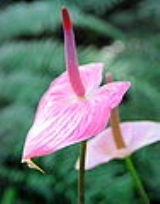
The spadix is part of an inflorescence, the outer portion of which is known as the spathe. The spathe may be a single color (yellow, green, or white) or possibly multicolored including burgundy and red. That sometimes colorful, solitary spathe
Spathe

Spathe may refer to:*A hood-like bract, found along with a spadix, of inflorescences on plants in the arum family *A leaf-like bract subtending an inflorescence in various Genus in the dayflower family ...
 is a showy modified bract
Bract

In botany, a bract is a modified or specialized leaf. Bracts are ordinarily associated with reproductive structures . They are ordinarily reduced in size relative to foliage leaves, or of a different color or texture from foliage leaves, or both....
 that can be somewhat leathery in texture. Anthurium grown for the florist trade generally have highly coloured spathes and spadices. There are no flowers on the spathe as is sometimes thought; flowers are found solely on the spadix. The spathe can vary in color from pale green to white, rose, orange or shiny red (such as A. andrenaum). The color changes between the bud stage and the anthesis, (the time the flower expands). Thus the color might change from pale green to reddish purple to reddish brown.

The flowers are hermaphrodite
Hermaphrodite

A hermaphrodite is an organism having both male and female reproductive organs. In many species, hermaphroditism is a common part of the life-cycle, enabling a form of sexual reproduction in which partners are not separated into distinct male and female types of individual....
, containing male and female flowers. The fruit
Fruit

The term fruit has different meanings dependent on context, and the term is not synonymous in food preparation and biology. In botany, which is the scientific study of plants, fruits are the ripened Ovary of flowering plants....
s are usually berries with one to multiple seeds on an infructescence that may be pendant or erect depending on species. Anthurium berries may range in colour from bright red to black, and may also be bicoloured or shaded. The flowers of Anthurium give off a variety of fragrances, each attracting a variety of specific pollinators.

Several species are popular in the florist trade as pot plants or cut flowers and for interior decoration. They include forms such as A. crystallinum f peltifolium with its large, velvety, darkgreen leaves and silvery white venation. Most hybrids are based on A. andreanum or A. scherzerianum because of their colorful spathes. Anthurium can also be called "Flamingo Flower" or "Boy Flower", both referring to the structure of the spathe and spadix.

Growing Anthurium

Like other Aroids, many species of Anthurium can be grown as houseplants, or outdoors in mild climates in shady spots. They thrive in moist soils with high organic matter. In milder climates the plants can be grown in pots of soil. Indoors plants thrive at temperatures between 60-72 degrees and at lower light than other house plants. Wiping the leaves off with water will remove any dust and insects. Plant in pots with good root systems. Will benefit from a weak fertilizer solution ever other week. In the case of vining or climbing Anthuriums, the plants benefit from being provided with a totem to climb.

Propagation


As with most Aroids, new plants can be grown by taking stems cuttings with at least two joints. Cuttings can be then rooted in pots of sand and peat moss mixtures. These pots then should be placed in greenhouses with bottom heat of 70-75 degrees. During the rooting process they should be kept out of direct sunlight. Once rooted the plants can be transplanted to larger pots or directly outside in milder climates. A second way to propigate Anthurium is to take stem cuttings particularly from trailing varieties and place them in water. In four to five weeks the plant should develop roots and can be transferred to pots. The final method is through direct planting of mature seed or berries.

Species


For a full list, see List of Anthurium species
List of Anthurium species

This is a list of Anthurium species:Anthurium is a large genus of flowering plants from the arum family *Anthurium acaule...


Such a large genus cannot be described by a few general terms. Schott
Heinrich Wilhelm Schott

Heinrich Wilhelm Schott was an Austrian Empire botanist well-known for his extensive work on the aroids .He was born in Brno, Moravia and died in Sch?nbrunn Palace, Vienna, Austria....
, in his book Prodromus Systematis Aroidearum (1860), grouped the then known 183 species in 28 sections. In 1905 Engler revised these sections into 18 sections. In 1983 Croat & Sheffer came up with the following sections:

Belolonchium
Calomystrium
Cardiolonchium
Chamaerepium
Cordatopunctatum
Dactylophyllium
Decurrentia
Digitinervium
Digitinervium

Digitinervium is a section of the genus Anthurium. It is a small, natural section consisting of plants with thick leaf blades, glandular-punctate on the lower surfaces, with well-defined basal veins, normally occurring in pairs and extending past the middle of the blade....

Gymnopodium
Gymnopodium (Anthurium section)

Gymnopodium is a section within the genus Anthurium. It is composed of the extremely rare Cuban species Anthurium gymnopus. Plants of this section are of somewhat scandent habit, with medium to long internodes, deciduous cataphylls, and somewhat leathery, suborbicular leaf blades....

Leptanthurium
Pachyneurium
Pachyneurium

Pachyneurium is a section within the genus Anthurium. It is the largest section, containing the "birdsnest" Anthuriums. Plants of the section are terrestrial, with a rosette growth habit of dense, deeply rooted stems, and long lanceolate to oblanceolate leaves....
 
Polyphyllium
Polyneurium
Porphyrochitonium
Porphyrochitonium

Anthurium sect. Porphyrochitonium is a section within the genus Anthurium, comprised of about 250 species. Plants of this section are typified by Anthurium scherzerianum....
 
Schizoplacium
Semaeophyllium
Tetraspermium
Urospadix
Xialophyllium

Images


External links