
All Topics  
Angel shark


   Email Print
   Bookmark   Link


Angel shark


The angel sharks are an unusual genus of shark
Shark

Sharks are a type of fish with a full Cartilage skeleton and a highly Streamlines, streaklines and pathlinesd body. They respire with the use of five to seven gill slits....
s with flattened bodies and broad pectoral fins that give them a strong resemblance to skates and rays
Batoidea

Batoidea is a superorder of Chondrichthyes containing more than 500 described species in thirteen families. They are commonly known as rays, but that term is also used specifically for batoids in the order Rajiformes, the "true rays"....
. The 16-odd known species are in the genus Squatina, the only genus in its family, Squatinidae, and order Squatiniformes. They occur worldwide in temperate and tropical seas. Most species inhabit shallow temperate or tropical seas, but one species inhabits deeper water, down to .

Appearance and biology
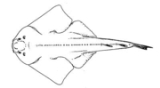
While the forward part of the angel shark's body is broad and flattened, the rear part retains a muscular appearance more typical of other sharks.


Discussion
Ask a question about 'Angel shark'
Start a new discussion about 'Angel shark'
Answer questions from other users
Full Discussion Forum


Encyclopedia


The angel sharks are an unusual genus of shark
Shark

Sharks are a type of fish with a full Cartilage skeleton and a highly Streamlines, streaklines and pathlinesd body. They respire with the use of five to seven gill slits....
s with flattened bodies and broad pectoral fins that give them a strong resemblance to skates and rays
Batoidea

Batoidea is a superorder of Chondrichthyes containing more than 500 described species in thirteen families. They are commonly known as rays, but that term is also used specifically for batoids in the order Rajiformes, the "true rays"....
. The 16-odd known species are in the genus Squatina, the only genus in its family, Squatinidae, and order Squatiniformes. They occur worldwide in temperate and tropical seas. Most species inhabit shallow temperate or tropical seas, but one species inhabits deeper water, down to .

Appearance and biology


While the forward part of the angel shark's body is broad and flattened, the rear part retains a muscular appearance more typical of other sharks. The eyes and spiracle
Spiracle

Spiracles are small openings on the surface of some animals that usually lead to respiratory systems.In elasmobranchs , a spiracle is found behind each eye, and is often used to pump water through the gills while the animal is at rest ....
s are on top, and the five gill
Gill

A gill is an anatomical structure found in many aquatic ecosystem organisms. It is a respiration organ whose function is the extraction of oxygen from water and the excretion of carbon dioxide....
 slits are on bottom. Both the pectorals and the pelvic fins are large and held horizontally. There are two dorsal fin
Dorsal fin

A wikt:dorsal fin is a fin located on the backs of some fish, whales, dolphins, and porpoises, as well as the ichthyosaurs. Its main purpose is to stabilize the animal against rolling and assist in sudden turns....
s, no anal fin, and unusually for sharks, the lower lobe of the caudal fin is longer than the upper lobe. Most types grow to a length of 1.5 m (5 ft), with the Japanese angel shark
Japanese angel shark

The Japanese angelshark, Squatina japonica, is an angel shark of the family Squatinidae found in the western Pacific from Japan, the Yellow Sea, Korea, northern China, and the Philippines between latitudes 41st parallel north and 19th parallel north....
, Squatina japonica, known to reach 2 m. Angel sharks possess extensible jaws that can rapidly snap upwards to capture prey, and have long, needle-like teeth. They bury themselves in sand or mud lying in wait for prey, which includes fish
Fish

A fish is any marine biology vertebrate animal that is typically ectothermic , covered with scale , and equipped with two sets of paired fins and several unpaired fins....
, crustacean
Crustacean

Crustaceans are a large group of arthropods, comprising almost 52,000 described species , and are usually treated as a subphylum . They include various familiar animals, such as crabs, lobsters, crayfish, shrimp, krill and barnacles....
s, and various types of mollusks. They are ovoviviparous
Ovoviviparity

Ovoviviparous, also known as oviviparous, animals develop within Egg s that remain within the mother's body up until they hatch or are about to hatch....
, producing litters of up to 13 pups.

Behavior

Although they are not normally aggressive, they do bite when stepped on or handled. If they are left alone they will not attack.

Commercial value

The sharks were long considered of no commercial interest, but in 1978, Michael Wagner
Michael Wagner

Infobox Writer for more information see...
, a fish processor in Santa Barbara, California
Santa Barbara, California

Santa Barbara is a city in Santa Barbara County, California, United States. Situated on an east-west trending section of coastline, the only such section on the west coast, between the steeply-rising Santa Ynez Mountains and the sea, and having a Mediterranean climate, it is called California's "South Coast", and is also sometimes referred to...
, began to promote angel sharks, and 310 metric tons were taken off California
California

California is a U.S. state on the West Coast of the United States of the United States, along the Pacific Ocean. It is bordered by Oregon to the north, Nevada to the east, Arizona to the southeast, and to the south the Mexico state of Baja California....
 in 1984. The fishery devastated the population and is now regulated.

Angel sharks have historically been heavily fished but education has played a role in reducing over fishing of these slow-reproducing chondrichthyes. In April 2008 the UK Government afforded the angel shark full protection under the Wildlife and Countryside Act.

Species

  • Sawback angelshark
    Sawback angelshark

    The sawback angelshark, Squatina aculeata, is an angel shark of the family Squatinidae found in the subtropical eastern Atlantic and western Mediterranean, Morocco, Senegal, Guinea to Nigeria, Gabon to Angola between latitudes 43rd parallel north and 19th parallel south, at depths of between 30 and 500 m....
    , Squatina aculeata Cuvier, 1829
  • African angelshark
    African angelshark

    The African angelshark, Squatina africana, is an angel shark of the family Squatinidae found in the tropical and warm temperate waters of the western Indian Ocean from Tanzania to the eastern Cape Province coast of South Africa between latitudes 4th parallel south and 32nd parallel south, at depths down to 500 m....
    , Squatina africana Regan, 1908
  • Argentine angelshark
    Argentine angelshark

    The Argentine angelshark, Squatina argentina, is an angel shark of the family Squatinidae found in the subtropical waters of the southwest Atlantic from southern Brazil to Argentina between latitudes 19th parallel south and 53rd parallel south, at depths of between 50 and 320 m....
    , Squatina argentina (Marini, 1930)
  • Chilean angelshark
    Chilean angelshark

    The Chilean angelshark, Squatina armata, is an angel shark of the family Squatinidae found in the subtropical waters of Chile. Its length is up to 1.03 m, although the holotype is lost....
    , Squatina armata (Philippi, 1887)
  • Australian angelshark
    Australian angelshark

    The Australian angelshark, Squatina australis, is an angel shark of the family Squatinidae found in the subtropical waters of southern Australia from Western Australia to New South Wales between latitudes 18th parallel south and 41st parallel south, at depths down to 255 m ....
    , Squatina australis Regan, 1906
  • Pacific angelshark
    Pacific angelshark

    The Pacific angelshark, Squatina californica, is an angel shark of the family Squatinidae found in the subtropical waters of the eastern Pacific from southeastern Alaska to the Gulf of California between latitudes 60th parallel north and 22nd parallel north, at depths down to 200 m....
    , Squatina californica Ayres, 1859
  • Sand devil
    Sand devil

    The sand devil or Atlantic angel shark, Squatina dumeril, is an angel shark of the family Squatinidae found in the subtropical outer continental shelf and upper slopes of the western Atlantic from southern New England to the Gulf of Mexico, Jamaica, Venezuela and Colombia between latitudes 43rd parallel north and 9th parallel north...
    , Squatina dumeril Lesueur, 1818
  • Taiwan angelshark
    Taiwan angelshark

    The Taiwan angelshark, Squatina formosa, is an angel shark of the family Squatinidae found around Taiwan between latitudes 24th parallel north and 22nd parallel north, at depths of between 185 and 220 m....
    , Squatina formosa Shen & Ting, 1972
  • Angular angel shark
    Angular angel shark

    The angular angel shark, Squatina guggenheim, is an angel shark of the family Squatinidae found off southern Brazil and Argentina at depths of between 4 and 265 m....
    , Squatina guggenheim Marini, 1936
  • Japanese angelshark, Squatina japonica Bleeker, 1858
  • Clouded angelshark
    Clouded angelshark

    The clouded angelshark, Squatina nebulosa, is an angel shark of the family Squatinidae found in the northwest Pacific from the southeastern Sea of Japan to Taiwan, including Japan, Korea, and China, between latitudes 47th parallel north and 22nd parallel north....
    , Squatina nebulosa Regan, 1906
  • Smoothback angelshark
    Smoothback angelshark

    The smoothback angelshark, Squatina oculata, is an angel shark of the family Squatinidae found in the eastern Atlantic from the Mediterranean and Morocco to Angola, between latitudes 47th parallel north and 28th parallel south....
    , Squatina oculata Bonaparte, 1840
  • Squatina punctata
    Squatina punctata

    Squatina punctata, is an angel shark of the family Squatinidae found in the southwest Atlantic from southern Brazil to Argentina, at depths of from 10 to 80 m....
     Marini, 1936
  • Squatina squatina
    Squatina squatina

    The angelshark, Squatina squatina, is an angel shark of the family Squatinidae found in the northeast Atlantic from southern Norway, Sweden and the Shetland Islands to Morocco and west Sahara, including the Canary Islands and the Mediterranean between latitudes 65th parallel north and 15th parallel north, at depths down to 150 metre....
     (Linnaeus, 1758)
  • Ornate angelshark
    Ornate angelshark

    The ornate angelshark, Squatina tergocellata, is an angel shark of the family Squatinidae endemic to southeast Australia between latitudes 30th parallel south and 35th parallel south, at depths of between 130 and 400 metre....
    , Squatina tergocellata McCulloch, 1914
  • Ocellated angelshark
    Ocellated angelshark

    The ocellated angelshark, Squatina tergocellatoides, is an angel shark of the family Squatinidae found only from the Taiwan Straits in the western Pacific between latitudes 28th parallel north and 22nd parallel north and in northern Malaysia....
    , Squatina tergocellatoides Chen, 1963
  • Eastern Australian angelshark
    Eastern Australian angelshark

    The Eastern Australian angelshark, Squatina sp.A, is an angel shark of the family Squatinidae found off eastern Australia, at depths of between 130 and 315 m....
    , Squatina sp. A (provisional scientic name)
  • Western Australian angelshark
    Western Australian angelshark

    The Western Australian angelshark, Squatina sp.B, is an angel shark of the family Squatinidae found on the tropical outer continental shelf off northern Western Australia, at depths of between 130 and 310 m....
    , Squatina sp. B (provisional scientic name)
  • Cortez angelshark
    Cortez angelshark

    The Cortez angelshark, Squatina sp, is an undescribed taxon angel shark of the family Squatinidae. It is presumed to be ovoviviparous....
    , Squatina sp. (provisional scientic name)


See also

  • List of sharks
    List of sharks

    Shark classificationSharks belong to the superorder Selachimorpha in the subclass Elasmobranchii in the class Chondrichthyes. It is a fish. The Elasmobranchii also include batoidea and skate s; the Chondrichthyes also include Chimaeras....
  • List of prehistoric cartilaginous fish
    List of prehistoric cartilaginous fish

    This list of prehistoric cartilaginous fish is an attempt to create a comprehensive listing of all Genus that have ever been included in the class chondrichthyes and are known from the fossil record....


External links

  • OceanFootage
  • (also a reference)