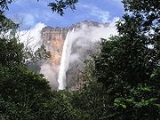
Angel Falls (indigenous name:
Parakupa-vena or
Kerepakupai merú which means
the fall from the highest point, in Pemon language; Spanish:
Salto Ángel) is the world's highest
waterfallA waterfall is a place where flowing water rapidly drops in elevation as it flows over a steep region or a cliff.-Formation :Typically, a river flows over a large step in the rocks that may have been formed by a fault line. As it increases its velocity at the edge of the waterfall, it plucks...
, with a height of 979 m (3,212 ft) and a clear drop of 807 m (2,647 ft). It is located in the
Canaima National ParkCanaima National Park is a 30,000 km² park in south-eastern Venezuela that borders Brazil and Guyana. It is located in the state of Bolívar, and roughly occupies the same area as the Gran Sabana region.The park was established on the 12 June 1962...
(Spanish: Parque Nacional Canaima), a UNESCO World Heritage site, in the
Gran SabanaThe Gran Sabana is an important natural attraction in Venezuela and is located in the south of Bolívar State on the Venezuelan-Brazilian border, approximately 1,400 km from Caracas...
region of Bolivar State,
VenezuelaVenezuela , officially titled Bolivarian Republic of Venezuela , is a tropical country on the northern coast of South America. It is a continental mainland with numerous islands located off its coastline in the Caribbean Sea...
.
The height of the falls is so great that before getting anywhere near the ground, the water is atomized by the strong winds and turned into
mistMist is a phenomenon of small droplets suspended in air. It can occur as part of natural weather or volcanic activity, and is common in cold air above warmer water, in exhaled air in the cold, and in a steam room of a sauna. It can also be created artificially with aerosol canisters if the...
. The mist can be felt a mile away. The base of the falls feeds into the Kerep River (alternatively known as the Rio Gauya), which flows into the Churun River, a tributary of the Carrao River.
In the indigenous Pemon language Angel Falls is called
Kerepakupai merú meaning "waterfall of the deepest place". The falls are sometimes referred to as
Churun-meru, an error, since that name corresponds to another waterfall in the
Canaima National ParkCanaima National Park is a 30,000 km² park in south-eastern Venezuela that borders Brazil and Guyana. It is located in the state of Bolívar, and roughly occupies the same area as the Gran Sabana region.The park was established on the 12 June 1962...
. Churun in the Pemon language means "thunder".
Exploration
Sir
Walter RaleighSir Walter Raleigh, Lord Lieutenant of Cornwall was a English aristocrat, writer, poet, soldier, courtier, and explorer.Raleigh was born to a Protestant family in Devon, the son of Walter Raleigh and Catherine Champernowne...
described what was possibly a tepuy (table top mountain), and he is sometimes said to have discovered Angel Falls, but these claims are considered "far-fetched". They were spotted in 1912 by the Venezuelan explorer
Ernesto Sanchez La Cruz Ernesto Sanchez La Cruz was a Venezuelan explorer who in 1910 became the second non-indigenous person to see the Angel Falls. He spent the rest of his life in South America.Angel Falls is one of the biggest free falling waterfalls in the world with a clear drop of 807 meters . It is located...
, but he did not publicize his discovery. They were not known to the outside world until American aviator
Jimmie AngelJames James Crawford Angel was an American aviator after whom Angel Falls in Venezuela, the highest waterfall in the world, is named....
flew over them on 16 November 1933 on a flight while he was searching for a valuable ore bed.
Returning on October 9, 1937, Angel tried to land his Flamingo monoplane "El Rio Caroni" atop Auyan-tepui, but the plane was damaged when the wheels sunk into the marshy ground, and he and his three companions, including his wife Marie, were forced to descend the tepui on foot. It took them 11 days to make their way back to civilization, but news of their adventure spread, and the waterfall was named "Angel Falls" in his honor.
Angel's plane remained on top of the tepuy for 33 years before being lifted out by helicopter. It was restored at the Aviation Museum in
MaracayMaracay is a city in central Venezuela and is the capital and most important city of the Aragua State. Most of it falls under the jurisdiction of the Girardot Municipality. The population as per the 2001 census was 750.000...
and now sits outdoors on the front of the airport at
Ciudad BolívarCiudad Bolívar is the capital of Venezuela's southeastern Bolivar State. It was founded with the name Angostura in 1764, renamed in 1846, and, as of 2005, had an estimated population of 338,250....
.
The first recorded person to reach the river that feeds the falls was
LatviaLatvia , officially the Republic of Latvia is a country in the Baltic region of Northern Europe. It is bordered to the north by Estonia , to the south by Lithuania , to the east by the Russian Federation , and to the southeast by Belarus . Across the Baltic Sea to the west lies Sweden...
n explorer
Aleksandrs LaimeAleksandrs Laime was a famous Latvian-born explorer. He is most noted for being the first recorded human to reach Angel Falls, located in Venezuela, by foot...
, also known as Alejandro Laime to the native Pemon tribe. He made the ascent of Auyan-tepui in 1955. He also reached Angel's plane on the same trip, 18 years after the crash landing. He gave the river feeding the falls the name Gauja after a river in Latvia, but the Pemon-given name of the river, Kerep, is still widely used.
Laime also was the first to clear a trail that leads from the Churun river to the base of the falls. On the way, there is a viewpoint commonly used to capture the falls in photographs. It is named "Mirador Laime" ("Laime's Viewpoint" in
SpanishSpanish or Castilian is a Romance language in the Ibero-Romance group that originated in northern Spain and gradually spread in the Kingdom of Castile, evolving into the principal language of government and trade in the Iberian peninsula...
) in his honor. This trail is used now mostly for tourists, to lead them from the Isla Raton camp to the small clearing.
The official height of the falls was determined by a
National Geographic SocietyThe National Geographic Society , headquartered in Washington, D.C. in the United States, is one of the largest non-profit scientific and educational institutions in the world. Its interests include geography, archaeology and natural science, the promotion of environmental and historical...
survey carried out by American journalist Ruth Robertson in 1949.
A book by David Nott,
Angels Four, chronicles the first successful climb up the face of
AuyantepuiAuyantepui , which in the language of the native Pemon people means "Devil's Mountain", is the most visited and famous tepui in Venezuela...
to the top of the falls.
Tourism
Angel Falls is one of
VenezuelaVenezuela , officially titled Bolivarian Republic of Venezuela , is a tropical country on the northern coast of South America. It is a continental mainland with numerous islands located off its coastline in the Caribbean Sea...
's top tourist attractions, but even today a trip to the falls is not a simple affair. The falls are located in an isolated jungle region of Venezuela, and a flight from
CaracasCaracas is the capital and largest city of Venezuela. It is located in the north of the country, following the contours of the narrow Caracas Valley on the Venezuelan coastal mountain range . The valley's temperatures are springlike. Terrain suitable for building lies between 760 and 910 m above...
or
Ciudad BolívarCiudad Bolívar is the capital of Venezuela's southeastern Bolivar State. It was founded with the name Angostura in 1764, renamed in 1846, and, as of 2005, had an estimated population of 338,250....
is required to reach Canaima camp, the starting point for river trips to the base of the falls.
It is also possible to purchase a package that includes an aerial flyby of the falls. The falls cannot be seen on cloudy days, and there is no guarantee visitors will see them.
River trips generally take place from June to December, when the rivers are deep enough for the wooden curiaras used by the Pemon Indian guides. During the dry season (December to March) there is less water than is seen in some photos, but it is also more likely that the top will not be clouded.