
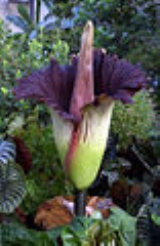
Amorphophallus is a large genus of some 170 tropical and subtropical tuberous herbaceous plants from the Arum family (
AraceaeAraceae are a family of monocotyledonous flowering plants in which flowers are borne on a type of inflorescence called a spadix. The spadix is usually accompanied by, and sometimes partially enclosed in, a spathe or leaf-like bract. Also known as the Arum family, members are often colloquially...
). A few species are edible as "
famine foodA famine food or poverty food is any inexpensive or readily-available foodstuff used to nourish people in times of extreme poverty or starvation, as during a war or famine...
s" after careful preparation to remove irritating chemicals.
Amorphophallus is a large genus of some 170 tropical and subtropical tuberous herbaceous plants from the Arum family (
AraceaeAraceae are a family of monocotyledonous flowering plants in which flowers are borne on a type of inflorescence called a spadix. The spadix is usually accompanied by, and sometimes partially enclosed in, a spathe or leaf-like bract. Also known as the Arum family, members are often colloquially...
). A few species are edible as "
famine foodA famine food or poverty food is any inexpensive or readily-available foodstuff used to nourish people in times of extreme poverty or starvation, as during a war or famine...
s" after careful preparation to remove irritating chemicals.
Distribution
These are typical lowland plants, growing in the tropical and subtropical zones of the paleotropics, from West Africa to the Pacific Islands. None of them are found in the Americas although a remarkably similar but not closely related genus,
DracontiumDracontium is a flowering plant similar to Amorphophallus. It can be distinguished on the basis of its inflorescence, which is smaller and unisexual. The tuber is large, similar to that of Amorphophallus but rounder, with no central and circular scar mark. When the plant begins to flower, the tuber...
, has evolved there. Most species are
endemicEndemism is the ecological state of being unique to a defined geographic location, such as an island, nation or other defined zone, or habitat type; organisms that are indigenous to a place are not endemic to it if they are also found elsewhere. For example, all species of lemur are endemic to the...
. They grow preferentially on disturbed grounds, such as
secondary forestA secondary forest is a forest or woodland area which has re-grown after a major disturbance such as fire, insect infestation, timber harvest or windthrow, until a long enough period has passed so that the effects of the disturbance are no longer evident...
s.
Description
These small to massive plants grow from a subterranean
tuberTubers are various types of modified plant structures that are enlarged to store nutrients. They are used by plants to survive the winter or dry months and provide energy and nutrients for regrowth during the next growing season and they are a means of asexual reproduction...
,
Amorphophallus tubers vary greatly from species to species, from the quite uniformally globose
tuberTubers are various types of modified plant structures that are enlarged to store nutrients. They are used by plants to survive the winter or dry months and provide energy and nutrients for regrowth during the next growing season and they are a means of asexual reproduction...
of
A. konjacKonjac , also known as konjak, konjaku, konnyaku potato, devil's tongue, voodoo lily, snake palm, or elephant yam , is a plant of the genus Amorphophallus...
to the elongated tubers of
A. longituberosus and
A. macrorhizus to the bizarre clustered rootstock of
A. coaetaneus. From the top of this tuber a single
leafA leaf is an organ of a vascular plant, as defined in botanical terms, and in particular in plant morphology. Foliage is a mass noun that refers to leaves as a feature of plants....
, which can be several metres across in larger species, is produced atop a trunk like
petioleIn botany, the petiole is the stalk attaching the leaf blade to the stem. The petiole usually has the same internal structure as the stem. Outgrowths appearing on each side of the petiole are called stipules. Leaves lacking a petiole are called sessile, or clasping when they partly surround the...
followed, on maturity, by a single
inflorescenceAn inflorescence is a group or cluster of flowers arranged on a stem that is composed of a main branch or a complicated arrangement of branches. Strictly, it is the part of the shoot of seed plants where flowers are formed and which is accordingly modified...
. This leaf consists of a vertical leaf stalk and a horizontal blade, which may consist of a number of small leaflets. The leaf lasts one growing season. The
peduncleIn botany, a peduncle is a stem supporting an inflorescence, or after fecundation, an infructescence.The peduncle is a stem, usually green and without leaves, though sometimes colored or supporting small leaves...
(the primary flower stalk) can be long or short.
As is typical of the
ArumArum is a genus of about 25 species of flowering plants in the family Araceae, native to Europe, northern Africa, and western Asia, with the highest species diversity in the Mediterranean region....
family, these species develop an
inflorescenceAn inflorescence is a group or cluster of flowers arranged on a stem that is composed of a main branch or a complicated arrangement of branches. Strictly, it is the part of the shoot of seed plants where flowers are formed and which is accordingly modified...
consisting of an elongate or ovate spathe (a sheathing bract) which usually envelops the
spadixIn botany, a spadix is a type of spike inflorescence having small flowers borne on a fleshy stem. Spadix are typical of the Family Araceae known as arums or aroids...
(a flower spike with a fleshy axis). The spathe can have different colors, but mostly brownish-purple or whitish-green. On the inside, they contain ridges or warts, functioning as insect traps.
The plants are monoecious. The spadix has tiny flowers: female flowers, no more than a pistil, at the bottom, then male flowers, actually a group of stamens, and then a blank sterile area. This last part, called 'the appendix', consists of sterile flowers, called staminodes, and can be especially large. There is no corolla.
Once the spathe opens, pollination must happen the same day. The
inflorescenceAn inflorescence is a group or cluster of flowers arranged on a stem that is composed of a main branch or a complicated arrangement of branches. Strictly, it is the part of the shoot of seed plants where flowers are formed and which is accordingly modified...
, in many species, emits a scent of decaying flesh, in order to attract insects, though a number of species give off a pleasant odor. Through a number of ingenious insect traps, pollinating insects are kept inside the spathe to deposit pollen on the female flowers, which stay receptive for only one day, while the male flowers are still closed. These open the next day, but by then the female flowers are no longer receptive and so self-pollination is avoided. The male flowers shower the trapped insects with pollen. Once the insects escape, they can then pollinate another flower.
Amorphophallus species are used as food plants by the
larvaA larva is a distinct juvenile form many animals undergo before metamorphosis into adults. Animals with indirect development such as insects, amphibians, or cnidarians typically have a larval phase of their life cycle...
e of some
LepidopteraLepidoptera is a large order of insects that includes moths and butterflies . It is one of the most widespread and widely recognizable insect orders in the world, encompassing moths and the three superfamilies of butterflies, skipper butterflies, and moth-butterflies...
(
butterflyA butterfly is a mainly day-flying insect of the order Lepidoptera, which includes the butterflies and moths. Like other holometabolous insects, the butterfly's life cycle consists of four parts: egg, larva, pupa and adult. Most species are diurnal. Butterflies have large, often brightly coloured...
and
mothA moth is an insect closely related to the butterfly, both being of the order Lepidoptera. Moths form the majority of this order; there are thought to be 150,000 to 250,000 different species of moth , with thousands of species yet to be described...
) species including
Palpifer sexnotatusPalpifer is a genus of moths of the family Hepialidae. There are 10 described species found in south and east Asia and parts of Mexico.- Species :*P. falkneri - Nepal*P. hopponis - Taiwan*P. madurensis - Madura*P. murinus - India...
and
Palpifer sordidaPalpifer is a genus of moths of the family Hepialidae. There are 10 described species found in south and east Asia and parts of Mexico.- Species :*P. falkneri - Nepal*P. hopponis - Taiwan*P. madurensis - Madura*P. murinus - India...
.
The pollinated flowers then develop a globose
berryThe botanical definition of a berry is a fleshy fruit produced from a single ovary. Grapes are an example. The berry is the most common type of fleshy fruit in which the entire ovary wall ripens into an edible pericarp. They may have one or more carpels with a thin covering and fleshy interiors....
as a
fruitIn broad terms, a fruit is a structure of a plant that contains its seeds.The term has different meanings dependent on context. In non-technical usage, such as food preparation, fruit normally means the fleshy seed-associated structures of certain plants that are sweet and edible in the raw state,...
. These can be red, orange-red, white, white and yellow, or blue.
The species
Amorphophallus titanum, corpse flower or titan arum, is the world's largest unbranched
inflorescenceAn inflorescence is a group or cluster of flowers arranged on a stem that is composed of a main branch or a complicated arrangement of branches. Strictly, it is the part of the shoot of seed plants where flowers are formed and which is accordingly modified...
. It can reach a height of 2.5 m and a width of 1.5 m. A runner-up is
Amorphophallus gigas, which is taller, but has a somewhat smaller flower.
Amorphophallus konjac tubers are used to make , a Japanese thickening agent and edible jelly containing
glucomannanGlucomannan is a water-soluble polysaccharide that is considered a dietary fiber. Glucomannan is a food additive used as an emulsifier and thickener. Products containing glucomannan, marketed under a variety of brand names, are also sold as nutritional supplements for constipation, obesity, high...
.
Some species are called voodoo lily, as are some species of
TyphoniumTyphonium is a genus in the Araceae family endemic to tropical Asia, the South Pacific, and Australia. It consists of approximately 50 species that are typically found growing in wooded areas.-Selected species:*Typhonium acetosella...
(also in the Araceae).
Species
External links
- List of Amorphophallus species with photos from the International Aroid Society
- CATE genus page
- Amorphophallus in Brunken, U., Schmidt, M., Dressler, S., Janssen, T., Thiombiano, A. & Zizka, G. 2008. West African plants - A Photo Guide. Forschungsinstitut Senckenberg, Frankfurt/Main.