
See Also

American Quarter Horse

The American Quarter Horse is a breed of horse Horse

The horse is a large odd-toed ungulate [i] mammal [i], one of ten modern species of the genus Equus [i] ... 

 originally bred for sprinting short distances, typically races of a quarter mile or less. Also known as "America's Horse," the Quarter Horse is the most popular breed in the United States, and is the largest breed society in the world, with over 3.2 million Quarter Horses registered worldwide. It is commonly believed to be the world's fastest horse over short distances, and has been clocked at 55 mph. Today, the American Quarter Horse is well known both as a race horse and for its performance in rodeo Rodeo

Rodeo is a traditional North America [i]n sport with influences from the history of Mexican [i] ' ... 

s and horse shows.

Discussions

  Discussion Features

   Ask a question about 'American Quarter Horse'

   Start a new discussion about 'American Quarter Horse'

   Answer questions about 'American Quarter Horse'

   'American Quarter Horse' discussion forum


Encyclopedia

The American Quarter Horse is a breed of horse Horse

The horse is a large odd-toed ungulate [i] mammal [i], one of ten modern species of the genus Equus [i]... 

 originally bred for sprinting short distances, typically races of a quarter mile or less. Also known as "America's Horse," the Quarter Horse is the most popular breed in the United States, and is the largest breed society in the world, with over 3.2 million Quarter Horses registered worldwide.

It is commonly believed to be the world's fastest horse over short distances, and has been clocked at 55 mph. Today, the American Quarter Horse is well known both as a race horse and for its performance in rodeo Rodeo

Rodeo is a traditional North America [i]n sport with influences from the history of Mexican [i] ' ... 

s and horse shows. The compact body of the Quarter Horse is well-suited to the intricate and speedy maneuvers required in roping, reining, cutting, working cow horse and other western-style events, especially those involving live cattle. The versatile Quarter Horse is also shown in English disciplines, driving Horse-drawn vehicle

Throughout history and before, there has been a huge number of types of horse-drawn vehicle.... 

, and many other equestrian activities.

Breed History


Colonial Era

In the 1600s, American colonists on the eastern seaboard began to cross imported English horses with "native" horses such as the Chickasaw Chickasaw

The Chickasaws are a Native American [i] people of the United States [i] ... 

 .

One of the most famous of these early imports was Janus, a Thoroughbred Thoroughbred

[i] often mistakenly thought to have been developed in [[17th century]... 

 who was the grandson of the Godolphin Arabian Godolphin Arabian

The Godolphin Arabian, also known as the Godolphin Barb, was one of three horse [i]s which were th ... 

. He was foaled in 1746, and imported to colonial Virginia in 1756. The influence of Thoroughbreds like Janus contributed genes crucial to the developement of the colonial "Quarter Miler," or "Quarter Mile Horse." This was a speedy working man's racer, sometimes referred to as the "Celebrated American Quarter Running Horse." The resulting horse was small, hardy, and quick, and was used as a work horse during the week and a race horse on the weekends.

As flat racing became popular with the colonists, the Quarter Miler gained even more popularity as a sprinter over courses that, by necessity, were shorter than the classic racecourses of England, and were often no more than a straight stretch of road or flat piece of open land. When matched against a Thoroughbred Thoroughbred

[i] often mistakenly thought to have been developed in [[17th century]... 

, local sprinters often won. As the Thoroughbred breed became established in America, many colonial Quarter Mile mares were included in the original American stud books, starting a long association between the Thoroughbred breed and what would later become officially known as the "Quarter Horse," named after the distance at which it excelled.

Westward Expansion

In the 1800s, pioneers heading West needed a hardy, willing horse. On the Great Plains Great Plains

The Great Plains is the broad expanse of prairie [i] and steppe [i] which lies east of the Rocky Mountains [i] ... 

, settlers encountered horses that descended from the Spanish stock Hernán Cortés Hernán Cortés

Hernn Corts, Marqus del Valle de Oaxaca was the conquistador [i] who conquered the Aztec empire [i] ... 

 and other Conquistadors had introduced into the viceroyalty of New Spain New Spain

Viceroyalty of New Spain was the name of the viceroy [i]-ruled territories of the Spanish Empire [i] in ... 

, which today includes the Southwestern United States and Mexico Mexico

The United Mexican States, generally known as Mexico is a country [i] located in North America [i] ... 

. These horses of the west included herds of feral Feral

A feral animal or plant is one that has escaped from domestication [i] and returned, partly or wholly, t ... 

 animals known as Mustangs, as well as horses domesticated by Native Americans Indigenous peoples of the Americas

The term Indigenous peoples of the Americas encompasses the inhabitants of the Americas [i] before the European discovery of the Americas [i] ... 

, including the Comanche Comanche

The Comanche are a Native American [i] group whose historical rang ... 

, Shoshoni Shoshone

This article deals with the Shoshone Native American [i] tribe. ... 

 and Nez Perce Nez Perce

The Nez Perce or Nez Perc are a tribe [i] of Native Americans [i] ... 

 tribes. As the colonial Quarter Mile Horse was crossed with these western horses, the pioneers found that the new crossbred had innate "cow sense," a natural instinct for working with cattle, making it popular with cattlemen on ranches Ranch

A Ranch is an area of landscape, including buildings and structures, given primarily to the grazing of l... 

.

Development of the Quarter Horse as a distinct breed

Early foundation sires of Quarter horse type included Steel Dust, foaled 1843; Shiloh , foaled 1844; Traveler, shipped to Texas in 1889; and the Thoroughbred sire, Peter McCue, foaled 1895.
The first horse registered was Wimpy, a descendant of the King Ranch foundation sire Old Sorrel. Major foundation sires registered by the AQHA included King, Peppy, Leo, Poco Bueno, Three Bars , and Joe Hancock. Other thoroughbred sires seen in early Quarter Horse pedigrees include King Plaudit, Blob, Johnny Dial, Top Deck, Vandy, and Truckle Feature.

Since the American Quarter Horse formally established itself as a breed, the AQHA stud book has remained open to Thoroughbreds. Quarter Horse/Thoroughbred crosses are entered into the registry as "Appendix Quarter Horses." These animals are popular for Quarter Horse Racing and for Jumping and Hunter events. After meeting a series of conformational and performance criteria, these Appendix Quarter Horses can obtain permanent registration numbers. Since American Quarter Horse/Thoroughbred crosses continue to have an opportunity to enter the official registry of the American Quarter Horse breed, this is creating a continual gene flow from the Thoroughbred breed into the American Quarter Horse breed, which has been influential in altering many of the characteristics that typified the breed in the early years of its formation.


Quarter Horses Today

The American Quarter Horse is best-known today as a show horse, race horse, ranch horse, rodeo competitor and all-around family horse. Quarter horses dominate rodeo Rodeo

Rodeo is a traditional North America [i]n sport with influences from the history of Mexican [i] ' ... 

 events such as barrel racing Barrel racing

Barrel racing, is a rodeo [i] event that features a horse [i] or barrel racer and one rider, runnin ... 

, calf roping, and team roping Team roping

External Links
  • ... 

    ; and gymkhana or O-Mok-See. Other stock horse events such as cutting and reining are open to all breeds but also dominated by American Quarter Horse. Large purses allow top competitors to earn over a million dollars in some of these events.


The breed is not only well-suited for western events and cattle work; at the race track the American Quarter Horse offers a wide assortment of parimutuel races with purses as high as two million dollars per race. Quarter Horses have also been trained to compete in dressage Dressage

Dressage is a path and destination of competitive horse training [i], with competitions held at all lev ... 

 and generally are good jumpers. They are also used for recreational trail riding and in mounted police Mounted police

Mounted police are police [i] who patrol on horse [i]back.... 

 units.

The American Quarter Horse has also been exported worldwide. European nations such as Germany and Italy have imported large numbers of Quarter Horses. Next to the United States , the second largest registry of Quarter Horses is in Brazil, followed by Australia. With the internationalization of the discipline of reining and its acceptance as one of the official seven events of the World Equestrian Games, there is a growing international interest in Quarter Horses. Countries like Japan, Switzerland and Israel that did not have a traditional stock horse industry have begun to compete with American Quarter Horses in their own country and abroad.

Breed Characteristics


The modern American Quarter Horse has a small, short, refined head with a straight profile, and a strong, well-muscled body, featuring a broad chest and powerful hindquarters. They usually stand 14-16 hands high, although some may grow as tall as 17 hands.

There are two main body types: the stock type and the racing type. The stock horse type is shorter, more compact, stocky and well muscled, yet agile. The racing Quarter Horse is built to sprint short distances ranging from 220 - 870 yards, and therefore is somewhat taller and smoother muscled than the stock type, more closely resembling the Thoroughbred Thoroughbred

[i] often mistakenly thought to have been developed in [[17th century]... 

.

Quarter Horses shown in-hand in "halter" competition are larger horses, with a muscular appearance, small heads with wide jowls, and refined muzzles. Reining and cutting horses are smaller, with quick, agile movement and very powerful hindquarters. Western pleasure show horses are often slightly taller, with a relatively level topline and smooth gaits. Quarter Horse racehorses Horse racing

Horse racing is an equestrian [i] sport [i] which has been practiced over the centuries; t ... 

 have long legs and are much leaner than their "stock horse" counterparts. The show hunter type is similar to the running type Quarter Horse, although some are taller, slimmer, and have an even more Thoroughbred-like appearance. However, all Quarter Horses have speed, stamina, power, and a great willingness to please.

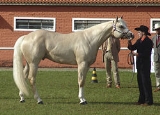
Quarter Horses come in nearly all colors. The most prominent color is sorrel Sorrel

The common sorrel, or spinach dock, is a perennial [i] herb [i], which grows abund ... 

 . Other recognized colors are bay, black, brown, buckskin, dun Dun

Dun is now used both as a generic term for a fort and also for a specific variety of atlantic roundhouse [i] ... 

, red dun, gray, grullo Grullo

Grullo is a color of horses [i], characterized by smoky or mouse-colored hairs on the body, often with s ... 

, palomino Palomino

Palomino is a coat color in horse [i]s, consisting of a gold coat and white or flaxen mane and tail. ... 

, red roan, blue roan, bay roan, perlino, and cremello Cremello

Cremello is a color of horse [i] consisting of a cream-colored body with a cream or white mane and tail. ... 

. In the past, spotted or pinto colors were excluded, but now with the advent of DNA testing to verify parentage, the registry accepts all colors and prints as long as parents are registered.

Genetic Diseases

Two genetic diseases are of concern to Quarter Horse breeders:
  • Hyperkalemic periodic paralysis , which is caused by an autosomal dominant gene linked to the stallion Impressive. It is characterized by uncontrollable muscle twitching and substantial muscle weakness or paralysis among affected horses. Because it is a dominant gene, only one parent has to have the gene for it to be transmitted to offspring. There is a DNA test for HYPP, the AQHA American Quarter Horse Association

    The American Quarter Horse Association, based in Amarillo, Texas [i], is an international organization d ... 

     requires testing and is now limiting registration of some horses who possess the gene.
  • Hereditary Equine Regional Dermal Asthenia , also known as hyperelastosis cutis . This is caused by a recessive gene Recessive gene

    In genetics [i], the term "recessive gene" refers to an allele [i] that causes a phenotype [i] that is o ... 

    , and thus, unlike HYPP, HERDA can only be transmitted if both parents carry the gene. When a horse has this disease, there is a collagen defect that results in the layers of skin not being held firmly together. Thus, when the horse is ridden under saddle or suffers trauma to the skin, the outer layer often splits or separates from the deeper layer, or it can tear off completely. It rarely heals without disfiguring scars. Sunburn can also be a concern. In dramatic cases, says Rashmir, the skin can split along the back and even roll down the sides, with the horse literally being skinned alive. Most horses with HYPP are euthanized for humane reasons between the age of two and four years. The very hotly debated and controversial theory, put forth by researchers at Cornell University Cornell University

    Cornell University is a private [i] research university [i] located in Ithaca, New York [i] ... 

     and Mississippi State University Mississippi State University

    name=Mississippi State University

... 

 is that the sire line of the great foundation stallion Poco Bueno is implicated as the origin of the disease. There currently is no DNA test for HERDA, but active research is ongoing to try and pinpoint the gene.

  • Though the reason is not fully understood, as "crop out" Quarter Horses with Paint markings were not allowed to be registered for many years, it is also believed that some Quarter Horses may also carry the gene for Lethal White Syndrome. There is also a DNA test for this condition.

Notes


See also

  • Dash For Cash, American Quarter Horse racehorse.
  • Impressive
  • Denhardt, Robert Moorman. Foundation Sires of the American Quarter Horse, University of Oklahoma Press, 1997. ISBN 0-8061-2947-6


American Paint Horse American Paint Horse

The American Paint Horse is a breed of horse [i] which is a specific type of stock horse developed in th ... 


External links


Categories: