

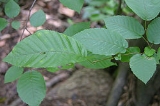
American Hornbeam

Encyclopedia
Carpinus caroliniana is a small hardwood
tree in the genus
Carpinus
. American hornbeam is also occasionally known as blue-beech, ironwood, or musclewood. It is native to eastern North America, from Minnesota and southern Ontario east to Maine, and south to eastern Texas and northern Florida. It also grows in Canada (southwest Quebec and southeast Ontario), Mexico (central and southern), Guatemala, and western Honduras.
 It is a small tree reaching heights of 10–15 m, rarely 20 m, and often has a fluted and crooked trunk. The bark is smooth and greenish-grey, becoming shallowly fissured in old trees. The leaves are alternate, 3–12 cm long, with prominent veins giving a distinctive corrugated texture, and a serrated margin. The male and female catkin
s appear in spring at the same time as the leaves. The fruit is a small 7–8 mm long nut, partially surrounded by a three- to seven-pointed leafy involucre
2–3 cm long; it matures in autumn. The seeds often do not germinate till the spring of the second year after maturating.
There are two subspecies
, which intergrade extensively where they meet:
It is a shade-loving tree, which prefers moderate soil fertility
and moisture. It has a shallow, wide-spreading root system. The wood is heavy and hard, and is used for tool handles, longbows, walking sticks
, walking canes and golf club
s. The leaves are eaten by the caterpillars of some Lepidoptera
, for example the Io moth (Automeris io).
Hardwood
Hardwood is wood from angiosperm trees . It may also be used for those trees themselves: these are usually broad-leaved; in temperate and boreal latitudes they are mostly deciduous, but in tropics and subtropics mostly evergreen.Hardwood contrasts with softwood...
tree in the genus
Genus
In biology, a genus is a low-level taxonomic rank used in the biological classification of living and fossil organisms, which is an example of definition by genus and differentia...
Carpinus
Hornbeam
Hornbeams are relatively small hardwood trees in the genus Carpinus . Though some botanists grouped them with the hazels and hop-hornbeams in a segregate family, Corylaceae, modern botanists place the hornbeams in the birch subfamily Coryloideae...
. American hornbeam is also occasionally known as blue-beech, ironwood, or musclewood. It is native to eastern North America, from Minnesota and southern Ontario east to Maine, and south to eastern Texas and northern Florida. It also grows in Canada (southwest Quebec and southeast Ontario), Mexico (central and southern), Guatemala, and western Honduras.
Catkin
A catkin or ament is a slim, cylindrical flower cluster, with inconspicuous or no petals, usually wind-pollinated but sometimes insect pollinated . They contain many, usually unisexual flowers, arranged closely along a central stem which is often drooping...
s appear in spring at the same time as the leaves. The fruit is a small 7–8 mm long nut, partially surrounded by a three- to seven-pointed leafy involucre
Involucre
Involucre may refer to* involucral bract, a bract, bract pair, or whorl of bracts surrounding a flower or inflorescence* a term sometimes misused for the cupule surrounding developing nuts in the Fagaceae...
2–3 cm long; it matures in autumn. The seeds often do not germinate till the spring of the second year after maturating.
There are two subspecies
Subspecies
Subspecies in biological classification, is either a taxonomic rank subordinate to species, ora taxonomic unit in that rank . A subspecies cannot be recognized in isolation: a species will either be recognized as having no subspecies at all or two or more, never just one...
, which intergrade extensively where they meet:
- Carpinus caroliniana subsp. caroliniana. Atlantic coastal plainAtlantic Coastal PlainThe Atlantic coastal plain has both low elevation and low relief, but it is also a relatively flat landform extending from the New York Bight southward to a Georgia/Florida section of the Eastern Continental Divide, which demarcates the plain from the ACF River Basin in the Gulf Coastal Plain to...
north to Delaware, and lower Mississippi Valley west to eastern Texas. Leaves mostly smaller, 3–9 cm long, and relatively broader, 3–6 cm broad. - Carpinus caroliniana subsp. virginiana. Appalachian MountainsAppalachian MountainsThe Appalachian Mountains #Whether the stressed vowel is or ,#Whether the "ch" is pronounced as a fricative or an affricate , and#Whether the final vowel is the monophthong or the diphthong .), often called the Appalachians, are a system of mountains in eastern North America. The Appalachians...
and west to Minnesota and south to Arkansas. Leaves mostly larger, 8–12 cm long, and relatively narrower, 3.5–6 cm broad.
It is a shade-loving tree, which prefers moderate soil fertility
Fertile soil
Fertile soil has the following properties:*It is rich in nutrients necessary for basic plant nutrition, including nitrogen, phosphorus and potassium....
and moisture. It has a shallow, wide-spreading root system. The wood is heavy and hard, and is used for tool handles, longbows, walking sticks
Walking stick
A walking stick is a device used by many people to facilitate balancing while walking.Walking sticks come in many shapes and sizes, and can be sought by collectors. Some kinds of walking stick may be used by people with disabilities as a crutch...
, walking canes and golf club
Golf club (equipment)
A golf club is used to hit a golf ball in a game of golf. Each club is composed of a shaft with a grip and a clubhead. Woods are mainly used for long-distance fairway or tee shots; irons, the most versatile class, are used for a variety of shots; Hybrids that combine design elements of woods and...
s. The leaves are eaten by the caterpillars of some Lepidoptera
Lepidoptera
Lepidoptera is a large order of insects that includes moths and butterflies . It is one of the most widespread and widely recognizable insect orders in the world, encompassing moths and the three superfamilies of butterflies, skipper butterflies, and moth-butterflies...
, for example the Io moth (Automeris io).
Description
Common along the borders of streams and swamps, loves a deep moist soil. Varies from shrub to small tree, and ranges throughout the United States east of the Rocky Mountains.- Bark: On old trees near the base, furrowed. Young trees and branches smooth, dark bluish gray, sometimes furrowed, light and dark gray. Branchlets at first pale green, changing to reddish brown, ultimately dull gray.
- Wood: Light brown, sapwood nearly white; heavy, hard, close-grained, very strong. Used for levers, handles of tools. Sp. gr., 0.7286; weight 45.41 lbs.
- Winter buds: Ovate, acute, chestnut brown, one-eighth of an inch long. Inner scales enlarge when spring growth begins. No terminal bud is formed.
- Leaves: Alternate, two to four inches long, ovate-oblong, rounded, wedge-shaped, or rarely subcordate and often unequal at base, sharply and doubly serrate, acute or acuminate. They come out of the bud pale bronze green and hairy; when full grown they are dull deep green above, paler beneath; feather-veined, midrib and veins very prominent on under side. In autumn bright red, deep scarlet and orange. PetiolesPetiole (botany)In botany, the petiole is the stalk attaching the leaf blade to the stem. The petiole usually has the same internal structure as the stem. Outgrowths appearing on each side of the petiole are called stipules. Leaves lacking a petiole are called sessile, or clasping when they partly surround the...
short, slender, hairy. Stipules caducous. - Flowers: April. Monœcious, apetalous, the staminate naked in pendulous aments. The staminate ament buds are axillary and form in the autumn and during the winter resemble leaf-buds, only twice as large; these aments begin to lengthen very early in the spring, when full grown are about one and one-half inches long. The staminate flower is composed of three to twenty stamens crowded on a hairy torus, adnate to the base of a broadly ovate, acute boot-shaped scale, green below the middle, bright red at apex. The pistillate aments are one-half to three-fourths of an inch long with ovate, acute, hairy, green scales and bright scarlet styles.
- Fruit: Clusters of involucres, hanging from the ends of leafy branches. Each involucre slightly incloses a small oval nut. The involucres are short stalked, usually three-lobed, though one lobe is often wanting; halberd-shaped, coarsely serrate on one margin, or entire.