All Topics  
Almaden Research Center


   Email Print
   Bookmark   Link


Almaden Research Center


ipt type="text/javascript">DisplayLink("http://www.almaden.ibm.com", "IBM's Almaden Research Center") in San Jose, California
San Jose, California

San Jose or San Jos? is the List of cities in California city in California and the List of United States cities by population in the United States....
 is one of IBM's Its scientists perform basic and applied research in computer science
Computer science

Computer science is the study of the theoretical foundations of information and computation, and of practical techniques for their implementation and application in computer systems....
, services, storage systems, physical sciences, and materials science and technology.


Discussion
Ask a question about 'Almaden Research Center'
Start a new discussion about 'Almaden Research Center'
Answer questions from other users
Full Discussion Forum


Encyclopedia


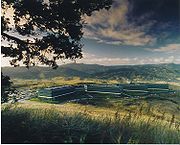
The IBM Almaden Research Center

in San Jose, California
San Jose, California

San Jose or San Jos? is the List of cities in California city in California and the List of United States cities by population in the United States....
 is one of IBM's Its scientists perform basic and applied research in computer science
Computer science

Computer science is the study of the theoretical foundations of information and computation, and of practical techniques for their implementation and application in computer systems....
, services, storage systems, physical sciences, and materials science and technology. Opened in 1986, the Almaden lab continues the IBM Research legacy started in San Jose more than 50 years ago. Nearly all of Almaden’s approximately 500 Research employees are in technical functions and more than half of these hold Ph.D.s. The lab is home to 10 IBM Fellow
IBM Fellow

An IBM Fellow is an appointed position at IBM made by IBM?s CEO. Typically only 4 or 5 IBM Fellows are appointed each year, at the annual Corporate Technical Recognition Event event in May or June....
s, 10 IBM Distinguished Engineers, nine IBM Master Inventors and 17 members of the IBM Academy of Technology.

Almaden is located on nearly 700 acres in the hills above Silicon Valley; the site was chosen because of its close proximity to Stanford University, UC Berkeley and other collaborative academic institutions. Research at the lab is organized into four areas: Science and Technology, Computer Science, Storage Systems, and Service Research.

IBM Almaden Science and Technology

develops new technologies that are critical to IBM’s business and that enable a deeper understanding of the underlying science. One focus is on chemical materials and processes, such as advanced photoresists for high-resolution lithography and dielectric materials. A second set of programs explores new materials and concepts for future technologies, such as novel nonvolatile memory cells based on magnetic-tunnel-junctions or organic electronics. Almaden scientists also conduct fundamental research in scientific areas aimed at expanding knowledge for continued growth of the IT industry's core technologies and to create the base for new IT paradigms. The lab is home to the specialized Scanning Tunneling Microscope that IBM Fellow Don Eigler built and then used to position individual atoms in 1989. Almaden scientists have made advances in nanotechnology, magnetic thin films, spin physics, quantum computing, quantum cryptography and the computer simulation of biological molecules and materials dynamics.

IBM Almaden Computer Science


provides technologies and solutions for computing, data management and internet applications. Research areas include advanced database solutions, middleware systems and technology for knowledge management, user design for human-computer interaction, Web technologies, content management, services-oriented architectures and e-commerce, e-utilities and computer science principles and methodologies. The group's core strengths include data management, knowledge management and content management. They have created helpdesk solutions, search technologies, knowledge management solutions, human-computer interaction solutions, cryptography protocols, data mining algorithms and more.

IBM Almaden Storage Systems

conducts research in storage appliances, controllers and networks, storage and systems management software and parallel file systems. Storage systems are increasingly becoming central to the emerging world of connected networks and pervasive devices. Storage requirements are growing at an explosive rate and, increasingly, they must provide high performance and 24/7 availability, along with low total cost of ownership. Some estimate that 70 percent of future IT spending will go toward storage systems. The group has made significant contributions to IBM products such as Shark and Tivoli Storage Manager, helped create the iSCSI industry standard and invented the technologies underlying the new TotalStorage Volume Controller and TotalStorage SAN File System products.

IBM Almaden Service Research

studies the human side of doing business, addressing the large-scale, people- and information-intensive challenges that enterprises face in today’s global economy. By understanding these challenges from the perspectives of people, practices, communication and technology, companies can identify new opportunities to generate revenue, save money, and improve workers' lives. Service researchers span a variety of disciplines including computer science, economics, anthropology and sociology.

Service represents over 75 percent of the U.S. economy; companies are seizing new business opportunities by building more efficient IT systems, streamlining their business processes and embracing the internet, which leads to an enormous need for innovation in services. Unfortunately, there is a shortage of individuals with comprehensive knowledge of business, people and information technology - the combination most needed to provide effective services. Moreover, there are few focused efforts aimed at preparing people for this new environment or even understanding it. As services become an increasingly larger part of the global economy, IBM has joined with other corporations and universities to develop a new academic curriculum, (SSME), to provide the skills necessary to satisfy the growing need for service workers.

IBM Almaden Research Center Milestones


Pre-Almaden Milestones (San Jose Lab):

1952
  • IBM establishes its first research group in San Jose at 99 Notre Dame Avenue, a converted printing facility


1956
  • Invented/developed the first commercial hard-disk drive – Random Access Method of Accounting and Control (RAMAC)


1970
  • Invented the relational database
    Relational database

    A relational database is a database that groups data using common attributes found in the data set. The resulting "clumps" of organized data are much easier for people to understand....
     concept


1974
  • Developed Structure Query Language (SQL
    SQL

    SQL is a database computer language designed for the retrieval and management of data in relational database management systems , database schema creation and modification, and database object access control management....
    ) for relational databases


1975
  • Developed the pioneering System R
    System R

    IBM System R is a database system built as a research project at IBM San Jose Research in the 1970s. System R was a seminal project: it was the first implementation of SQL , which has since become the standard relational data query language....
     relational database management system
  • First superconductivity found in a polymer – polysulfur nitride: one-half degree above absolute zero


1979
  • Invented extendible hashing, a widely used method for rapid access to dynamic database files


1981
  • Demonstrated the first inkjet printer
    Inkjet printer

    File:Canon BJ-10v Lite inkjet printer with Scale.JPGInkjet printers operate by propelling variably-sized droplets of liquid or molten material onto almost any sized page....


1982
  • Invented the family of "chemically-amplified" photoresist
    Photoresist

    Photoresist is a light-sensitive material used in several industrial processes, such as photolithography and photoengraving to form a patterned coating on a surface....
     materials used by the entire semiconductor industry


Almaden Milestones:

1977
  • Decision made to build new laboratory; location selected


1983
  • Construction begins on IBM Almaden Research Center


1986
  • IBM Almaden Research Center dedicated
  • Developed Distributed Relational Database Architecture protocol & algorithms that allow databases to scale efficiently to very large sizes by adding more processors


1988
  • Developed the "query graph model" data structure that allowed DB2
    DB2

    * Aston Martin DB2, an English sports car* Dark Beginning 2, a Yu-Gi-Oh! Trading Card Game booster pack* IBM DB2, in computing, a relational database management system, more recently coined a "data server" by IBM...
     to be extended to handle a wide variety of new data types
  • First to propose "Fast-Write" for disk controllers
  • First Scanning Tunneling Microscope
    Scanning tunneling microscope

    Scanning tunneling microscope is a powerful technique for viewing surfaces at the atomic level. Its development in 1981 earned its inventors, Gerd Binnig and Heinrich Rohrer , the Nobel Prize in Physics in 1986....
     (STM) image of an organic molecule: benzene
    Benzene

    Benzene, or benzol, is an organic compound chemical compound and a known carcinogen with the molecular formula Carbon6Hydrogen6....
     ring
  • Developed the "Hagar" disk array, the first industrial RAID
    RAID

    RAID is an acronym first defined by David A. Patterson , Garth A. Gibson and Randy Katz at the University of California, Berkeley in 1987 to describe a Redundant Array of Inexpensive Disks, a technology that allowed computer users to achieve mainframe-class storage reliability from low-cost and less reliable PC-class disk-drive componen...
     data-storage prototype
  • Working with thallium-based material, Almaden scientists report the highest superconducting transition temperature for a bulk material & thin film (125K)


1989
  • Developed the ARIES
    Aričs

    The Ari?s was a France automobile manufactured by a company in Asni?res-sur-Seine from 1903 to 1938. The first cars were two-cylinder and four-cylinder vehicles built 20 chassis at a time in a large factory....
     algorithm for recovering data efficiently and effectively from failures within the database system
  • First to position individual atoms one at a time: I-B-M written in xenon
    Xenon

    Xenon is a chemical element represented by the chemical symbol Xe. Its atomic number is 54. A colorless, heavy, odorless noble gas, xenon occurs in the Earth's atmosphere in trace amounts....
     atoms using a STM
  • 1-gigabit data-density magnetic recording demonstration


1990
  • Single-peak nuclear magnetic resonance seen in C-60 (buckminsterfullerene); first proof of the suspected symmetric, soccer ball shape for C-60
  • Discovered that the exchange coupling between two ferromagnetic films through a very thin non-magnetic metal spacer layer oscillates as the thickness of the spacer layer increases
  • C-60 on gold surface imaged using a STM


1991
  • Single-atom switch created
  • As an internal project, developed technologies for backup-restore and archive-retrieve functions for heterogeneous data that ultimately led to today's Tivoli Storage Manager (TSM) product


1993
  • Quantum corral created
  • Introduced zoned recording with sector servo and No-ID sector format for efficient layout of information on the disk
  • Discovered single-wall carbon nanotubes


1994
  • Invented the first data mining algorithms
  • Published the first technical paper that links to a World Wide Web
    World Wide Web

    The World Wide Web is a very large set of interlinked hypertext documents accessed via the Internet. With a Web browser, one can view Web pages that may contain writing, s, videos, and other multimedia and navigate between them using hyperlinks....
     animation: a hyper-media file showing fracture-tip instabilities in a million-atom 2-D notched solid under tension
  • Multilevel optical disk announced
  • Developed the improved TrackPoint III pointing device (and then the TrackPoint IV in 1997)
  • Announced first spin-valve Giant Magnetorisitive (GMR
    GMR

    GMR may refer to the following:* GMR group - an Indian infrastruture developer based in Hyderabad , India* Libya's Great Manmade River.* Galapagos Marine Reserve....
    ) head: world’s most sensitive read head


1995
  • 3-gigabit data-density magnetic recording demonstration
  • Played a central role in the unification of two competing DVD formats
  • Created the easy-to-use Chemical Kinetics Simulator. Used worldwide in academia, industry and government; some 30,000 copies have been downloaded under a no-cost license


1996
  • Method created to generate an infinite number of provably difficult problems, useful in developing public-key cryptography
  • Analyzed web-page-linking for the first time, leading to the concepts of hubs and authorities, advanced search technologies, large-scale text analytics technologies and tools
  • 5-gigabit data-density magnetic recording demonstration


1997
  • World’s first public-key encryption scheme created with a mathematically proven uniform level of protection
  • Developed the ScrollPoint Mouse, which uses TrackPoint technology to enable easy, intuitive document and web-page scrolling
  • 11.6-gigabit data-density magnetic recording demonstration


1998
  • Announced the IBM Microdrive
    Microdrive

    The Microdrive is a brand name for a miniature, 1-inch hard disk designed to fit in a CompactFlash Type II slot. The release of similar drives by other makers has led to them often being referred to as 'microdrives'....
     -- the world’s smallest disk drive -- with capacities of 340 megabytes and 1 gigabyte
  • Proposed the concept of managing data over Ethernet using Internet protocols that would become the Internet Small Computer System Interface (iSCSI) industry standard
  • Developed the General Parallel File System (GPFS), which large supercomputer clusters use to manage hundreds of terabytes and to read/write at several gigabytes per second
  • Linked macro-, meso- and microscopic material dynamics computer simulations seamlessly to model the rapid brittle fracture of a 100-million-atom slab of silicon
  • Proposed the concept of a Storage Area Network (SAN)-wide file system with policy-based storage management, resulting in IBM's SAN File System product that debuted in 2003
  • Using GPFS on part of the Accelerated Strategic Computing Initiative (ASCI
    ASCI

    ASCI or Asci may refer to:* Asci, the plural of Ascus, in fungal anatomy* Accelerated Strategic Computing Initiative* American Society for Clinical Investigation...
    ) White supercomputer, one terabyte of random data is sorted in a world record 17 minutes, 37 seconds -- three times faster than before


1999
  • 35.3-gigabit data-density magnetic recording demonstration
  • Exploited our strengths in database and computational chemistry to create key technologies for IBM’s DiscoveryLink product,
a system for integrated access to life sciences data sources
  • IBM’s DB2 Universal Database shatters Windows NT
    Windows NT

    Windows NT is a family of operating systems produced by Microsoft, the first version of which was released in July 1993. It was originally designed to be a powerful high-level-language-based, processor-independent, multiprocessing, multiuser operating system with features comparable to Unix....
     scalability barrier with the industry’s first-ever one-terabyte Transaction Processing Performance Council (TPC)-D benchmark on Windows NT


2000
  • Quantum mirage observed
  • Developed optical device that efficiently shapes a Gaussian laser beam into a flat intensity profile and propagates great distances
  • 5-qubit quantum computer demonstrated by executing quantum "order-finding" algorithm
  • Demonstrated holographic data storage
    Holographic data storage

    Holographic data storage is a potential replacement technology in the area of high-capacity data storage currently dominated by magnetic and conventional optical data storage....
     density of 254-gigabits per square inch -- 80 times that of a DVD
  • IBM awarded the National Medal of Technology
    National Medal of Technology

    The National Medal of Technology and Innovation is an honor granted by the President of the United States to American inventors and innovators that have made significant contributions to the development of new and important technology....
     for its leadership in developing and commercializing data storage technology


2001
  • IBM ships disk drives with new “antiferromagnetically coupled” magnetic media; also known as pixie dust
  • 7-qubit quantum computer demonstrates Shor's algorithm
    Shor's algorithm

    Shor's algorithm, first introduced by mathematician Peter Shor, is a quantum computer algorithm for integer factorization. On a quantum computer, to factor an integer , Shor's algorithm takes polynomial time in , specifically , demonstrating that integer factorization is in the complexity class BQP....
     by factoring 15
  • Magnetic resonance force microscope measures world's smallest force: 820 zeptonewtons


2002
  • Hippocratic Database proposed to enhance privacy of sensitive personal data
  • Created the molecule cascade -- first nanoscale circuit to demonstrate necessary computing qualities
  • An unprecedented billion-atom computer simulation showed the creation and entanglement of dislocations
that work-harden a ductile metal into a brittle material
  • Created the Almaden Service Research function


2003
  • IBM and the European Organization for Nuclear Research (CERN
    CERN

    The European Organization for Nuclear Research , known as CERN , , is the world's largest particle physics laboratory, situated in the northwest suburbs of Geneva on the France-Switzerland border, established in 1954 in science....
    ) announced a collaboration to build a huge DataGrid based on IBM's innovative Storage Tank storage virtualization software


2004
  • Created with Stanford University
    Stanford University

    Leland Stanford Junior University, commonly referred to as Stanford University or Stanford, is a private university research university located in Stanford, California, California, United States....
     the IBM-Stanford Center for Spintronic Science and Applications ()
to research and develop new types of circuits that exploit the quantum spin properties of electrons
  • Imaged a single electron spin with a magnetic resonance force microscope, a major milestone toward achieving 3-D atom-scale magnetic resonance imaging
  • Measured the energy required to flip the spin of a single electron using a new STM technique


2005
  • Announced the Interoperable Health Information Infrastructure, a prototype medical information exchange system to enable industry collaboration and accelerate development of a standards-based national healthcare information system
  • Installed two-rack Blue Gene system at Almaden; ported General Parallel File System (GPFS) to Blue Gene
    Blue Gene

    Blue Gene is a computer architecture project designed to produce several supercomputers, designed to reach operating speeds in the FLOPS range, and currently reaching sustained speeds of nearly 500 FLOPS....
  • Installed prototype version of GPFS on the Blue Gene system at the San Diego Supercomputing Center
  • The President of the United States
    President of the United States

    The President of the United States is the head of state and head of government of the United States and is the highest political official in the United States by influence and recognition....
     named IBM a winner of the U.S. National Medal of Technology, acknowledging over 40 years of IBM semiconductor
    Semiconductor

    A semiconductor is a material that has electrical conductivity between those of a Electrical conductor and an electrical insulation; it can vary over that wide range either permanently or dynamically....
     leadership


2006
  • Used high-index immersion techniques to create the smallest, high-quality line patterns ever made – ridges and spaces each only 29.9-nanometers wide – with deep-ultraviolet (193-nanometer ) optical lithography
  • Demonstrated 16X higher areal magnetic tape density
  • Launched research initiative, focused on understanding the workings of the human brain
and ultimately mechanizing cognition
  • Honored with IBM awards for projects including Intelligent Document Gateway; Business Insights Workbench; Component Business Modeling; Service Science, Management and Engineering (SSME); and End-User Services and Call Centers
  • Provided key technology building blocks in support of company-wide Innovation Jam for IBMers, clients, partners and families


2007
  • First measured a property called in individual atoms. This fundamental measurement determines an atom’s ability to store information; eventually, it may be possible to build structures consisting of small clusters of atoms, or even individual atoms, which could reliably store magnetic information. Such a storage capability would enable nearly 30,000 feature length movies or the entire contents of YouTube – millions of videos estimated to be more than 1,000 trillion bits of data – to fit in a device the size of an iPod.
  • Using Magnetic Resonance Force Microscopy, demonstrated , a key advancement on the path of 3D imaging at the atomic scale. Such imaging could ultimately provide a better understanding of how proteins function, which in turn may lead to more efficient drug discovery and development.
  • Introduced , powered by advanced algorithms that can interpret incomplete queries and find information buried in emails such as phone numbers, people, meetings, presentations, documents, images and more.


2008
  • Measured the ; this fundamental measurement provides important information for designing future atomic-scale devices: computer chips, miniaturized storage devices, and more.
  • Announced significant breakthroughs in a completely new technology - (so named because data “races” around a wire nanoscale “track”) - which could lead to solid state electronic devices with no moving parts, and therefore more durable, capable of holding far more data in the same amount of space than is possible today

External links