
Home      Discussion      Topics      Dictionary      Almanac
Signup       Login
All's Well That Ends Well

All's Well That Ends Well

Overview
All's Well That Ends Well is a play by William Shakespeare
William Shakespeare
William Shakespeare was an English poet and playwright, widely regarded as the greatest writer in the English language and the world's pre-eminent dramatist. He is often called England's national poet and the "Bard of Avon"...

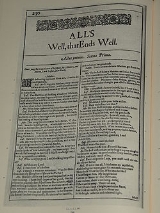
. It is believed to have been written between 1604 and 1605, and was originally published in the First Folio
First Folio
Mr. William Shakespeares Comedies, Histories, & Tragedies. is the 1623 published collection of William Shakespeare's plays. Modern scholars commonly refer to it as the First Folio....

in 1623.
Discussion
Ask a question about 'All's Well That Ends Well'
Start a new discussion about 'All's Well That Ends Well'
Answer questions from other users
Full Discussion Forum
 
Quotations

'T were all oneThat I should love a bright particular star,And think to wed it.

Helena, scene i

The hind, that would be mated by the lion,Must die for love.

Helena, scene i

Our remedies oft in ourselves do lie,Which we ascribe to Heaven.

Helena, scene i

His good remembrance, sir,Lies richer in your thoughts, than on his tomb;So in approof lives not his epitaph,As in your royal speech.

Bertram, scene ii

Service is no heritage.

Clown, scene iii

He must needs go, that the devil drives.

Clown, scene iii

My friends were poor, but honest.

Helena, scene iii

Great floods have flownFrom simple sources; and great seas have dried,When miracles have by the greatest been denied.Oft expectation fails, and most oft thereWhere most it promises.

Helena, scene i

I will show myself highly fed, and lowly taught.

Clown, scene ii
Encyclopedia
All's Well That Ends Well is a play by William Shakespeare
William Shakespeare
William Shakespeare was an English poet and playwright, widely regarded as the greatest writer in the English language and the world's pre-eminent dramatist. He is often called England's national poet and the "Bard of Avon"...

. It is believed to have been written between 1604 and 1605, and was originally published in the First Folio
First Folio
Mr. William Shakespeares Comedies, Histories, & Tragedies. is the 1623 published collection of William Shakespeare's plays. Modern scholars commonly refer to it as the First Folio....

in 1623.

Though originally the play was classified as one of Shakespeare's comedies
Shakespearean comedy
In the First Folio, the plays of William Shakespeare were grouped into three categories: comedies, histories, and tragedies."Comedy", in its Elizabethan usage, had a very different meaning from modern comedy...

, the play is now considered by some critics to be one of his problem plays
Problem plays (Shakespeare)
In Shakespeare studies, the term problem plays normally refers to three plays that William Shakespeare wrote between the late 1590s and the first years of the seventeenth century: All's Well That Ends Well, Measure for Measure and Troilus and Cressida, although some critics would extend the term to...

, so named because they cannot be neatly classified as tragedy or comedy.

Characters

  • King of France
  • Duke of Florence
    Florence
    Florence is the capital city of the Italian region of Tuscany and of the province of Florence. It is the most populous city in Tuscany, with approximately 370,000 inhabitants, expanding to over 1.5 million in the metropolitan area....

  • Bertram, Count of Rousillon
    Roussillon
    Roussillon is one of the historical counties of the former Principality of Catalonia, corresponding roughly to the present-day southern French département of Pyrénées-Orientales...

  • Countess of Rousillon, Mother to Bertram
  • Lavatch, a Clown
    Clown
    Clowns are comic performers stereotypically characterized by the grotesque image of the circus clown's colored wigs, stylistic makeup, outlandish costumes, unusually large footwear, and red nose, which evolved to project their actions to large audiences. Other less grotesque styles have also...

     in her household
  • Helena, a Gentlewoman
    Gentlewoman
    A gentlewoman in the original and strict sense is a woman of good family, analogous to the Latin generosus and generosa...

     protected by the Countess
  • Lafew, an old Lord
  • Parolles, a follower of Bertram
  • An Old Widow of Florence, surnamed Capilet
  • Diana, Daughter to the Widow
  • Steward to the Countess of Rousillon
  • Violenta and Mariana, Neighbours and Friends to the Widow
  • A Page
  • Soldiers, Servants, Gentlemen, and Courtiers

  • Synopsis


    Helena, the orphan daughter of a famous physician, is the ward of the Countess of Rousillon, and hopelessly in love with the son of the Countess, Count Bertram, who has been sent to the court of the King of France. Despite her beauty and worth, Helena has no hope of attracting Bertram, since she is of low birth and he is a nobleman. However, when word comes that the King is ill, she goes to Paris and, using her father's arts, cures the fistula
    Fistula
    In medicine, a fistula is an abnormal connection or passageway between two epithelium-lined organs or vessels that normally do not connect. It is generally a disease condition, but a fistula may be surgically created for therapeutic reasons.-Locations:Fistulas can develop in various parts of the...

     from which he suffers. In return, she is given the hand of any man in the realm; she chooses Bertram. Her new husband is appalled at the match, however, and shortly after their marriage flees France, accompanied only by a scoundrel named Parolles, to fight in the army of the Duke of Florence.

    Helena is sent home to the Countess, and receives a letter from Bertram informing her that he will never be her true spouse unless she can get his family ring from his finger, and become pregnant with his child—neither of which, he declares, will ever come to pass. The wise Countess, who loves Helena and approves of the match, tries to comfort her, but the distraught young woman departs Rousillon, planning to make a religious pilgrimage.

    Meanwhile, in Florence, Bertram has become a general in the Duke's army. Helena comes to the city, and discovers that her husband is trying to seduce Diana, the virginal daughter of a kindly widow. Diana wishes to stay a virgin, and so Helena helps her trick Bertram; he gives Diana his ring as a token of his love, and when he comes to her room at night, Helena is in the bed, and they have sex without his realising that it is Helena. At the same time, two lords in the army expose Parolles as a coward and a villain, and he falls out of Bertram's favour. Meanwhile, false messengers have come to the camp bearing word that Helena is dead, and with the war drawing to a close, Bertram decides to return to France. Unknown to him, Helena follows, accompanied by Diana and the Widow.

    In Rousillon, everyone is mourning Helena as dead. The King is visiting, and consents to a marriage between Bertram and the daughter of an old, faithful lord, named Lafew. However, he notices a ring on Bertram's finger that formerly belonged to Helena—it was a gift from the King after she saved his life. (Helena gave the ring to Diana in Florence, and she in turn gave it to her would-be lover.) Bertram is at a loss to explain where it came from, but just then Diana and her mother appear to explain the trickery—followed by Helena, who informs her husband that both his conditions have been fulfilled. Bertram accepts Helena as his true wife, but in many productions he still seems unhappy.

    Sources


    The play is based on a tale (3.9) of Boccaccio
    Giovanni Boccaccio
    Giovanni Boccaccio was an Italian author and poet, a friend, student, and correspondent of Petrarch, an important Renaissance humanist and the author of a number of notable works including the Decameron, On Famous Women, and his poetry in the Italian vernacular...

    's The Decameron
    The Decameron
    The Decameron, also called Prince Galehaut is a 14th-century medieval allegory by Giovanni Boccaccio, told as a frame story encompassing 100 tales by ten young people....

    . Shakespeare may have read an English translation of the tale in William Painter
    William Painter
    William Painter was an English author and translator.William Painter was a native of Kent. He matriculated at St John's College, Cambridge, in 1554. In 1561 he became clerk of the ordnance in the Tower of London, a position in which he appears to have amassed a fortune out of the public funds...

    's Palace of Pleasure.

    The name of the play expresses the proverb
    Proverb
    A proverb is a simple and concrete saying popularly known and repeated, which expresses a truth, based on common sense or the practical experience of humanity. They are often metaphorical. A proverb that describes a basic rule of conduct may also be known as a maxim...

     All's well that ends well, which means that problems do not matter so long as the outcome is good.

    Performance history


    No records of the early performances of All's Well That Ends Well have been found. In 1741 the work was played at Goodman's Fields
    Goodman's Fields Theatre
    Two 18th century theatres bearing the name Goodman's Fields Theatre were located on Ayliffe Street, Whitechapel, London. The first opened on 31 October 1727 in a small shop by Thomas Odell, deputy Licenser of Plays. The first play performed was George Farquhar's The Recruiting Officer. Henry...

    , with a later transfer to Drury Lane
    Theatre Royal, Drury Lane
    The Theatre Royal, Drury Lane is a West End theatre in Covent Garden, in the City of Westminster, a borough of London. The building faces Catherine Street and backs onto Drury Lane. The building standing today is the most recent in a line of four theatres at the same location dating back to 1663,...

    . Rehearsals at Drury Lane started in October 1741 but William Milward (1702–1742), playing the king, was taken ill, and the opening was delayed until the following 22 January. Peg Woffington
    Margaret Woffington
    Margaret "Peg" Woffington was a well-known Irish actress in Georgian London.- Early life :Woffington was born of humble origins in Dublin. Her father is thought to have been a bricklayer, and after his death, the family became impoverished...

    , playing Helena, fainted on the first night and her part was read. Milward was taken ill again on 2 February and died on 6 February. This, together with unsubstantiated tales of more illnesses befalling other actresses during the run, gave the play an "unlucky" reputation, similar to that attached to Macbeth
    Macbeth
    The Tragedy of Macbeth is a play by William Shakespeare about a regicide and its aftermath. It is Shakespeare's shortest tragedy and is believed to have been written sometime between 1603 and 1607...

    , and this may have had curtailed the number of subsequent revivals.

    Henry Woodward (1714–1777) popularised the part of Parolles in the era of David Garrick
    David Garrick
    David Garrick was an English actor, playwright, theatre manager and producer who influenced nearly all aspects of theatrical practice throughout the 18th century and was a pupil and friend of Dr Samuel Johnson...

    . Sporadic performances followed in the ensuing decades, with an operatic version at Covent Garden
    Royal Opera House
    The Royal Opera House is an opera house and major performing arts venue in Covent Garden, central London. The large building is often referred to as simply "Covent Garden", after a previous use of the site of the opera house's original construction in 1732. It is the home of The Royal Opera, The...

     in 1832.

    The play, with plot elements drawn from romance
    Romance (genre)
    As a literary genre of high culture, romance or chivalric romance is a style of heroic prose and verse narrative that was popular in the aristocratic circles of High Medieval and Early Modern Europe. They were fantastic stories about marvel-filled adventures, often of a knight errant portrayed as...

     and the ribald tale
    Ribaldry
    Ribaldry is humorous entertainment that ranges from bordering on indelicacy to gross indecency. It is also referred to as "bawdiness", "gaminess" or "bawdry"....

     depends on gender role conventions, both as expressed (Bertram) and challenged (Helena). With evolving conventions of gender roles, Victorian objections centred on the character of Helena, who was variously deemed predatory, immodest and both "really despicable" and a "doormat" by Ellen Terry
    Ellen Terry
    Dame Ellen Terry, GBE was an English stage actress who became the leading Shakespearean actress in Britain. Among the members of her famous family is her great nephew, John Gielgud....

    , who also – and rather contradictorily – accused her of "hunt[ing] men down in the most undignified way". Terry's friend George Bernard Shaw
    George Bernard Shaw
    George Bernard Shaw was an Irish playwright and a co-founder of the London School of Economics. Although his first profitable writing was music and literary criticism, in which capacity he wrote many highly articulate pieces of journalism, his main talent was for drama, and he wrote more than 60...

     greatly admired Helena's character, comparing her with the New Woman
    New Woman
    The New Woman was a feminist ideal that emerged in the late 19th century. The New Woman pushed the limits set by male-dominated society, especially as modeled in the plays of Norwegian Henrik Ibsen . "The New Woman sprang fully armed from Ibsen's brain," according to a joke by Max Beerbohm...

     figures such as Nora in Henrik Ibsen
    Henrik Ibsen
    Henrik Ibsen was a major 19th-century Norwegian playwright, theatre director, and poet. He is often referred to as "the father of prose drama" and is one of the founders of Modernism in the theatre...

    's A Doll's House
    A Doll's House
    A Doll's House is a three-act play in prose by the Norwegian playwright Henrik Ibsen. It premièred at the Royal Theatre in Copenhagen, Denmark, on 21 December 1879, having been published earlier that month....

    . The editor of the Arden Shakespeare volume summed up 19th century repugnance: "everyone who reads this play is at first shocked and perplexed by the revolting idea that underlies the plot."

    In 1896 Frederick S. Boas
    Frederick S. Boas
    Frederick Samuel Boas was an English scholar of early modern drama. He was born on 24 July 1862, the eldest son of Hermann Boas of Belfast. He attended Clifton College as a scholar and went up to Balliol College, Oxford, in 1881. During his time at Balliol his tutor was David George Ritchie...

     coined the term "problem play" to include the unpopular work, grouping it with Hamlet
    Hamlet
    The Tragical History of Hamlet, Prince of Denmark, or more simply Hamlet, is a tragedy by William Shakespeare, believed to have been written between 1599 and 1601...

    , Troilus and Cressida
    Troilus and Cressida
    Troilus and Cressida is a tragedy by William Shakespeare, believed to have been written in 1602. It was also described by Frederick S. Boas as one of Shakespeare's problem plays. The play ends on a very bleak note with the death of the noble Trojan Hector and destruction of the love between Troilus...

    and Measure for Measure
    Measure for Measure
    Measure for Measure is a play by William Shakespeare, believed to have been written in 1603 or 1604. It was classified as comedy, but its mood defies those expectations. As a result and for a variety of reasons, some critics have labelled it as one of Shakespeare's problem plays...

    .

    Critical comment


    There is no evidence that All's Well was popular in Shakespeare's own lifetime, and it has remained one of his lesser-known plays ever since, in part due to its odd mixture of fairy tale
    Fairy tale
    A fairy tale is a type of short story that typically features such folkloric characters, such as fairies, goblins, elves, trolls, dwarves, giants or gnomes, and usually magic or enchantments. However, only a small number of the stories refer to fairies...

     logic, gender role reversals and cynical realism. Helena's love for the seemingly unlovable Bertram is difficult to explain on the page, but in performance it can be made acceptable by casting an actor of obvious physical attraction or by playing him as a naive and innocent figure not yet ready for love although, as both Helena and the audience can see, capable of emotional growth. This latter interpretation also assists at the point in the final scene in which Bertram suddenly switches from hatred to love in just one line. This is considered a particular problem for actors trained to admire psychological realism. However, some alternative readings emphasise the "if" in his equivocal promise: "If she, my liege, can make me know this clearly, I'll love her dearly, ever, ever dearly." Here, there has been no change of heart at all. Productions like the National Theatre's 2009 run, have Bertram make his promise seemingly normally, but then end the play hand-in-hand with Helena, staring out at the audience with a look of "aghast bewilderment" suggesting he only relented to save face in front of the King.

    Many critics consider that the truncated ending is a drawback, with Bertram's conversion so sudden. Various explanations have been given for this. There is (as always) possibly missing text. Some suggest that Bertram's conversion is meant to be sudden and magical in keeping with the 'clever wench performing tasks to win an unwilling higher born husband' theme of the play. Some consider that Bertram is not meant to be contemptible, merely a callow youth learning valuable lessons about values.

    Many directors have taken the view that when Shakespeare wrote a comedy, he did intend there to be a happy ending, and accordingly that is the way the concluding scene should be staged. Jonathan Miller
    Jonathan Miller
    Sir Jonathan Wolfe Miller CBE is a British theatre and opera director, author, physician, television presenter, humorist and sculptor. Trained as a physician in the late 1950s, he first came to prominence in the 1960s with his role in the comedy revue Beyond the Fringe with fellow writers and...

     in his acclaimed BBC version in 1981 had his Bertram (Ian Charleson
    Ian Charleson
    Ian Charleson was a Scottish stage and film actor. He is best known internationally for his starring role as Olympic athlete and missionary Eric Liddell, in the Oscar-winning 1981 film Chariots of Fire. He is also well known for his portrayal of Rev...

    ) give Helena a tender kiss and speak wonderingly.

    It could be argued that the conditional phrasing of Bertram's surrender is possibly a comic reference to the earlier seemingly impossible tasks that he set Helena. Now he is promising to love her 'ever, ever dearly' if she fulfils the much simpler one of explaining how all this came about.

    Despite his outrageous actions, Bertram can come across as beguiling; sadly, the filming of the 1967 RSC
    Royal Shakespeare Company
    The Royal Shakespeare Company is a major British theatre company, based in Stratford-upon-Avon, Warwickshire, England. The company employs 700 staff and produces around 20 productions a year from its home in Stratford-upon-Avon and plays regularly in London, Newcastle-upon-Tyne and on tour across...

     performance with Ian Richardson
    Ian Richardson
    Ian William Richardson CBE was a Scottish actor best known for his portrayal of the Machiavellian Tory politician Francis Urquhart in the BBC's House of Cards trilogy. He was also a leading Shakespearean stage actor....

     as Bertram has been lost, but by various accounts (The New Cambridge Shakespeare, 2003 etc.) he managed to make Bertram sympathetic, even charming. Ian Charleson's Bertram was cold and egotistical but still attractive. Richard Monette's 1992 Bertram, David Snellgrove, was young and unformed.

    One character that has been admired is that of the old Countess of Rousillon, which Shaw
    George Bernard Shaw
    George Bernard Shaw was an Irish playwright and a co-founder of the London School of Economics. Although his first profitable writing was music and literary criticism, in which capacity he wrote many highly articulate pieces of journalism, his main talent was for drama, and he wrote more than 60...

     thought "the most beautiful old woman's part ever written". Modern productions are often promoted as vehicles for great mature actresses; examples in recent decades have starred Judi Dench
    Judi Dench
    Dame Judith Olivia "Judi" Dench, CH, DBE, FRSA is an English film, stage and television actress.Dench made her professional debut in 1957 with the Old Vic Company. Over the following few years she played in several of William Shakespeare's plays in such roles as Ophelia in Hamlet, Juliet in Romeo...

     and Peggy Ashcroft
    Peggy Ashcroft
    Dame Peggy Ashcroft, DBE was an English actress.-Early years:Born as Edith Margaret Emily Ashcroft in Croydon, Ashcroft attended the Woodford School, Croydon and the Central School of Speech and Drama...

    , who delivered a performance of "entranc[ing]...worldly wisdom and compassion" in Trevor Nunn
    Trevor Nunn
    Sir Trevor Robert Nunn, CBE is an English theatre, film and television director. Nunn has been the Artistic Director for the Royal Shakespeare Company, the Royal National Theatre, and, currently, the Theatre Royal, Haymarket. He has directed musicals and dramas for the stage, as well as opera...

    's sympathetic, "Chekhovian
    Anton Chekhov
    Anton Pavlovich Chekhov was a Russian physician, dramatist and author who is considered to be among the greatest writers of short stories in history. His career as a dramatist produced four classics and his best short stories are held in high esteem by writers and critics...

    " staging at Stratford
    Royal Shakespeare Company
    The Royal Shakespeare Company is a major British theatre company, based in Stratford-upon-Avon, Warwickshire, England. The company employs 700 staff and produces around 20 productions a year from its home in Stratford-upon-Avon and plays regularly in London, Newcastle-upon-Tyne and on tour across...

     in 1982. In the BBC Television Shakespeare
    BBC Television Shakespeare
    The BBC Television Shakespeare was a set of television adaptations of the plays of William Shakespeare, produced by the BBC between 1978 and 1985.-Origins:...

     production she was played by Celia Johnson
    Celia Johnson
    Dame Celia Elizabeth Johnson DBE was an English actress.She began her stage acting career in 1928, and subsequently achieved success in West End and Broadway productions. She also appeared in several films, including the romantic drama Brief Encounter , for which she received a nomination for the...

    , dressed and posed as Rembrandt's portrait of Margaretha de Geer.

    External links