

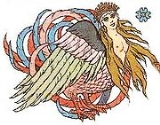
Alkonost

Encyclopedia
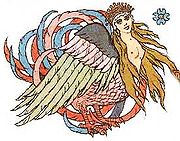
Siren
In Greek mythology, the Sirens were three dangerous mermaid like creatures, portrayed as seductresses who lured nearby sailors with their enchanting music and voices to shipwreck on the rocky coast of their island. Roman poets placed them on an island called Sirenum scopuli...
of Greek myth. The alkonost lays her eggs on a beach and then rolls them into the sea. When the alkonost's eggs hatch, a thunderstorm
Thunderstorm
A thunderstorm, also known as an electrical storm, a lightning storm, thundershower or simply a storm is a form of weather characterized by the presence of lightning and its acoustic effect on the Earth's atmosphere known as thunder. The meteorologically assigned cloud type associated with the...
sets in and the sea becomes so rough that it is untravelable. The name of the alkonost came from a Greek
Greeks
The Greeks, also known as the Hellenes , are a nation and ethnic group native to Greece, Cyprus and neighboring regions. They also form a significant diaspora, with Greek communities established around the world....
demigoddess whose name was Alcyone
Alcyone
In Greek mythology, Alcyone was the daughter of Aeolus, either by Enarete or Aegiale. She married Ceyx, son of Eosphorus, the Morning Star....
. In Greek mythology, Alcyone was transformed by the gods into a kingfisher.