

Alauda

Encyclopedia
Alauda is a genus
of lark
s with four species found across much of Europe
, Asia
and in the mountains of north Africa
, and one species (the Raso Lark
) endemic
to the islet of Raso in the Cape Verde Islands.
These birds are 14–18 cm long and live in cultivation
, heath
, natural steppe
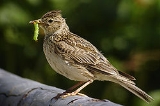
and other open habitats. Their characteristic songs are delivered in flight. They are fairly undistinguished: streaked brown above and pale below, with a short, blunt, erectile crest. In flight, they display a short tail and short broad wings. The tail and the rear edge of the wings are edged with white.
Their diet consists of seeds, supplemented with insects in the breeding season. They nest on the ground in tufts of grass
, with 3-6 egg
s per clutch. They form flock
s when not breeding.
Genus
In biology, a genus is a low-level taxonomic rank used in the biological classification of living and fossil organisms, which is an example of definition by genus and differentia...
of lark
Lark
Larks are passerine birds of the family Alaudidae. All species occur in the Old World, and in northern and eastern Australia; only one, the Shore Lark, has spread to North America, where it is called the Horned Lark...
s with four species found across much of Europe
Europe
Europe is, by convention, one of the world's seven continents. Comprising the westernmost peninsula of Eurasia, Europe is generally 'divided' from Asia to its east by the watershed divides of the Ural and Caucasus Mountains, the Ural River, the Caspian and Black Seas, and the waterways connecting...
, Asia
Asia
Asia is the world's largest and most populous continent, located primarily in the eastern and northern hemispheres. It covers 8.7% of the Earth's total surface area and with approximately 3.879 billion people, it hosts 60% of the world's current human population...
and in the mountains of north Africa
Africa
Africa is the world's second largest and second most populous continent, after Asia. At about 30.2 million km² including adjacent islands, it covers 6% of the Earth's total surface area and 20.4% of the total land area...
, and one species (the Raso Lark
Raso Lark
The Raso Lark is a small passerine bird with a highly restricted range, being found only on Raso islet in the Cape Verde Islands...
) endemic
Endemic (ecology)
Endemism is the ecological state of being unique to a defined geographic location, such as an island, nation or other defined zone, or habitat type; organisms that are indigenous to a place are not endemic to it if they are also found elsewhere. For example, all species of lemur are endemic to the...
to the islet of Raso in the Cape Verde Islands.
These birds are 14–18 cm long and live in cultivation
Tillage
Tillage is the agricultural preparation of the soil by mechanical agitation of various types, such as digging, stirring, and overturning. Examples of human-powered tilling methods using hand tools include shovelling, picking, mattock work, hoeing, and raking...
, heath
Heath (habitat)
A heath or heathland is a dwarf-shrub habitat found on mainly low quality acidic soils, characterised by open, low growing woody vegetation, often dominated by plants of the Ericaceae. There are some clear differences between heath and moorland...
, natural steppe
Steppe
In physical geography, steppe is an ecoregion, in the montane grasslands and shrublands and temperate grasslands, savannas, and shrublands biomes, characterized by grassland plains without trees apart from those near rivers and lakes...
and other open habitats. Their characteristic songs are delivered in flight. They are fairly undistinguished: streaked brown above and pale below, with a short, blunt, erectile crest. In flight, they display a short tail and short broad wings. The tail and the rear edge of the wings are edged with white.
Their diet consists of seeds, supplemented with insects in the breeding season. They nest on the ground in tufts of grass
Grass
Grasses, or more technically graminoids, are monocotyledonous, usually herbaceous plants with narrow leaves growing from the base. They include the "true grasses", of the Poaceae family, as well as the sedges and the rushes . The true grasses include cereals, bamboo and the grasses of lawns ...
, with 3-6 egg
Egg (biology)
An egg is an organic vessel in which an embryo first begins to develop. In most birds, reptiles, insects, molluscs, fish, and monotremes, an egg is the zygote, resulting from fertilization of the ovum, which is expelled from the body and permitted to develop outside the body until the developing...
s per clutch. They form flock
Flock (birds)
A flock is a group of birds conducting flocking behavior in flight, or while foraging. The term is akin to the herd amongst mammals. The benefits of aggregating in flocks are varied and flocks will form explicitly for specific purposes...
s when not breeding.
Species in taxonomic order
- SkylarkSkylarkThe Skylark is a small passerine bird species. This lark breeds across most of Europe and Asia and in the mountains of north Africa. It is mainly resident in the west of its range, but eastern populations are more migratory, moving further south in winter. Even in the milder west of its range,...
, Alauda arvensis - Japanese SkylarkJapanese SkylarkThe Japanese Skylark is a species of lark in the Alaudidae family.It is endemic to Japan.-References:* BirdLife International 2004. . Downloaded on 24 July 2007....
, Alauda japonica - Oriental SkylarkOriental SkylarkThe Oriental Skylark , also known as the Oriental Lark or Small Skylark, is a species of skylark found in South Asia and Southeast Asia...
, Alauda gulgula - Raso Skylark, Alauda razae