
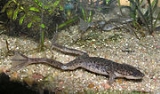
African dwarf frogs can be found all around
AfricaAfrica is the world's second-largest and second most-populous continent, after Asia. At about 30.2 million km² including adjacent islands, it covers 6% of the Earth's total surface area and 20.4% of the total land area. With a billion people in 61 territories, it accounts for about 14.8% of the...
, spreading from tropical to subtropical areas but the vast majority of them are from the
Congo regionThe Congo River is the largest river in Western Central Africa. Its overall length of 4,700 km makes it the second longest in Africa .-Background:...
. The African Dwarf Frog is an aquatic animal living nearly all of its life entirely underwater, but needs to rise to the surface to breathe air because they have lungs and not gills, as most aquatic animals do. They absorb oxygen through diffussion using specially adapted skin.
African dwarf frogs can be found all around
AfricaAfrica is the world's second-largest and second most-populous continent, after Asia. At about 30.2 million km² including adjacent islands, it covers 6% of the Earth's total surface area and 20.4% of the total land area. With a billion people in 61 territories, it accounts for about 14.8% of the...
, spreading from tropical to subtropical areas but the vast majority of them are from the
Congo regionThe Congo River is the largest river in Western Central Africa. Its overall length of 4,700 km makes it the second longest in Africa .-Background:...
. The African Dwarf Frog is an aquatic animal living nearly all of its life entirely underwater, but needs to rise to the surface to breathe air because they have lungs and not gills, as most aquatic animals do. They absorb oxygen through diffussion using specially adapted skin. They are fairly small in size and do not weigh more than a few ounces. They vary slightly in color but for the most part they are earth toned. These frogs'
life expectancyLife expectancy is the expected number of years of life remaining at a given age. It is denoted by e
x, which means the average number of subsequent years of life for someone now aged x, according to a particular mortality experience...
can range anywhere from 5 to 18 years.
Behavior
African Dwarf Frogs are very active and rarely will they sit still for any period of time, unless they are lethargic and want to not move as much to get air. Sometimes they will just float with arms and legs spread out, drifting on the surface. They prefer to spend time in the shallow
riverA river is a natural watercourse, usually freshwater, flowing toward an ocean, a lake, a sea or another river. In a few cases, a river simply flows into the ground or dries up completely before reaching another body of water...
s,
creeksA stream is a flowing body of water with a current, confined within a bed and stream banks. Depending on its locale or certain characteristics, a stream may be referred to as a branch, brook, beck, burn, creek, kill, lick, rill, river syke, bayou, rivulet, or run...
, and
pondA pond is an inland body of standing water, either natural or man-made, that is usually smaller than a lake. A wide variety of man-made bodies of water are classified as ponds, including water gardens designed for aesthetic ornamentation, fish ponds designed for commercial fish breeding, and solar...
s in the African
forestA forest is an area with a high density of trees. There are many definitions of a forest, based on the various criteria. These plant communities presently cover approximately 9.4% of the Earth's surface in many different regions and function as habitats for organisms, hydrologic flow modulators,...
. Here they can move around unrestricted and not have to worry about how deep they go. African dwarf frogs are generally peaceful with
animalAnimals are a major group of mostly multicellular, eukaryotic organisms of the kingdom Animalia or Metazoa. Their body plan eventually becomes fixed as they develop, although some undergo a process of metamorphosis later on in their life. Most animals are motile, meaning they can move spontaneously...
s of their own size but their
dietIn nutrition, the diet is the sum of food consumed by a person or other organism. Dietary habits are the habitual decisions an individual or culture makes when choosing what foods to eat. Although humans are omnivores, each culture holds some food preferences and some food taboos. Individual...
sometimes includes smaller animals. Other
fishA fish is any aquatic vertebrate animal that is typically ectothermic , covered with scales, and equipped with two sets of paired fins and several unpaired fins...
are known to eat the
eggsIn most birds and reptiles, an egg is the zygote, resulting from fertilization of the ovum. To enable incubation the egg is usually kept within a favourable temperature range as it nourishes and protects the growing embryo. When the embryo is adequately developed it breaks out of the egg in the...
of these
frogFrogs are amphibians in the order Anura , formerly referred to as Salientia . Most frogs are characterized by long hind legs, a short body, webbed digits , protruding eyes and the absence of a tail...
s. African dwarf frogs spend most of their time eating or playing near the bottom, where they feel safe from predators and can keep cool in the African heat. These frogs find a safe hiding place near the bottom to sleep. Most frogs will sleep up to twelve hours a day, if there is no potential of predators.
Laying Eggs
MaleMale refers to the sex of an organism, or part of an organism, which produces small mobile gametes, called spermatozoa. Each spermatozoon can fuse with a larger female gamete or ovum, in the process of fertilization...
s are slim and will develop a small gland behind each of their front legs; this gland is not understood very well but is believed to play some part in
matingIn biology, mating is the pairing of opposite-sex or hermaphroditic organisms for copulation and, in social animals, also to raise their offspring. For animals, mating methods include random mating, disassortative mating, assortative mating, or a mating pool....
. Males are the ones known to “sing” or “hum” during mating or when excited. Only males are known to do this, although they will sometimes “hum” even if there is no intention of mating. The
femaleFemale is the sex of an organism, or a part of an organism, which produces mobile ova .- Defining Characteristics :The ova are defined as the larger gametes in a heterogamous reproduction system, while the smaller, usually motile gamete, the spermatozoon, is produced by the male...
s of this species are 20% larger than males when fully mature. They have
pearThe pear is a tree of genus Pyrus and also the name of the tree's edible pomaceous fruit. The pear is classified within Maloideae, a subfamily within Rosaceae...
-shaped bodies as their
abdomenIn vertebrates such as mammals the abdomen constitutes the part of the body between the thorax and pelvis. The region enclosed by the abdomen is termed the abdominal cavity...
s will fill with eggs as they reach a mating stage. Another distinction is that females will have slightly larger tails than males.
Mating
African dwarf frogs mate during what is called
amplexusAmplexus is a form of pseudocopulation in which a male amphibian grasps a female with his front legs as part of the mating process...
. In amplexus, the male grabs the female around the
abdomenIn vertebrates such as mammals the abdomen constitutes the part of the body between the thorax and pelvis. The region enclosed by the abdomen is termed the abdominal cavity...
just in front of her back legs. Amplexus usually happens at night after one or more nights of “humming” by the male. During amplexus, the female does all the
swimmingSwimming is biologically propelled motion through a liquid medium. Swimming has evolved a number of times in a range of organisms ranging from arthropods to fish to molluscs.-Basic swimming – jellyfish:...
. The female lays her eggs on the surface of the water, one at a time while towing the male. She will swim to the bottom between layings. The male is fertilizing the eggs during this time by releasing
spermThe term sperm is derived from the Greek word sperma and refers to the male reproductive cells. In the types of sexual reproduction known as anisogamy and oogamy, there is a marked difference in the size of the gametes with the smaller one being termed the "male" or sperm cell...
into the water. Amplexus can last for several hours. When the female has laid all her eggs she signals the male to release her by going motionless. After several minutes of being motionless the male will release the female and she will return to her normal behavior.
Size
The African dwarf frog can range in size but most commonly are found to be 1 inch to 2 inches long; though on rare occasion there have been some that have grown up to 4–5 inches. The females are larger than the males by about 20 percent. Males usually weigh about 60 grams and females can weigh up to 200 grams. The large difference in size and weight is largely due in part to the females carrying hundreds of eggs in her abdomen.
Food and diet
African dwarf frogs do not have teeth, so rather than the usual chewing, they swallow their food whole. Favorite foods include
blood wormBlood worm or bloodworm is an ambiguous term and can refer to:*The larva of a non-biting midge containing hemoglobin*The polychaete Glycera, often used for fishing bait...
s,
water fleaWater flea is a generic term for a number of small aquatic crustacea characterised by their jumping or jerky mode of swimming. The characteristic of the water flea is that the main part of the body is enclosed by a kind of shell...
s, store bought food specified for them, and
shrimpShrimp are swimming, decapod crustaceans classified in the infraorder Caridea, found widely around the world in both fresh and salt water. Adult shrimp are filter feeding benthic animals living close to the bottom. They can live in schools and can swim rapidly backwards. Shrimp are an important...
, although these frogs will also eat
mosquitoMosquito is a common insect in the family Culicidae...
larvaA larva is a young form of animal with indirect development, going through or undergoing metamorphosis ....
e, black worms, small fish, and small
earthwormEarthworm is the common name for the largest members of Oligochaeta in the phylum Annelida. In classical systems they were placed in the order Opisthopora, on the basis of the male pores opening posterior to the female pores, even though the internal male segments are anterior to the female...
s. And on rare occasions these frogs will eat water
snailThe word snail is a common name for almost all members of the molluscan class Gastropoda that have coiled shells in the adult stage. When the word snail is used in a general sense, it includes sea snails, land snails and freshwater snails. Snails lacking a shell or having only a very small one are...
s and brittle
shellA seashell, also known as a sea shell, or simply as a shell, is the common name for a hard, protective outer layer, a shell, or in some cases a "test", that was created by a sea creature, a marine organism. The shell is part of the body of a marine animal. In most cases a shell is an exoskeleton,...
s. African dwarf frogs are bottom-feeders and one will rarely see them eat anything from the surface of the water.
African dwarf frogs as pets
African dwarf frogs are commonly found as pets. They first became popular as pets in the 1960s and have spread to the pet trade all over the world. African Dwarf frogs make great pets because they are low maintenance.They should be fed at least 5 times a week and their water should be changed once every two weeks or so depending on the size of the tank they are kept in. Be careful when buying them as some people have accidentally been given an
African Clawed FrogThe African clawed frog is a species of South African aquatic frog of the genus Xenopus. It can grow up to a length of 5 in with a flattened head and body, but no external ear or tongue...
, ACF, instead. The easiest way to tell the difference between ACFs and ADFs is by looking at the feet. African Dwarf Frogs will have webbing on the front and rear feet whereas African Clawed Frogs will only have webbed feet on the rear legs.
ADFs are compatible with bottom feeders and algae eaters. Some tropical fish can be used as tank mates although some are too aggressive and will fight or injure the frogs. Also, these frogs are slow eaters and it is not uncommon for fish mates to eat all the food while the frogs go hungry. These frogs can and will eventually adapt to eat fish flakes. Appropriate foods include blood worms (frozen or dried), brine shrimp, and cut up earthworms (purchased from a store, not taken from your garden) . If you choose to keep ADF's with fish one effective method for feeding them is to purchase a small glass or heavy plastic container whose opening is just large enough for the frogs to enter. The frogs food can then be placed in the container and sunk to the bottom of the tank. Many fish will not realize the food is there and the frogs will be able to eat in peace.
These frogs are fully aquatic and therefor do not require any terrestrial surface within their tank. The bottom of the tank should be lined with smooth gravel or sand. The reason for this is that these frogs have sensitive skin and spend a lot of time on the bottom, where rough rocks or pebbles could irritate the skin and cause discomfort. Stacked or large objects in the tank should be secure since African dwarf frogs are very active and could accidentally knock them over.
Because of their size 1.5 inches, a one gallon tank can hold 1–2 frogs. A five gallon tank can hold up to three. Larger tanks follow this same proportion (3 frogs to every 5 gallons). These frogs breathe from the surface of the water and it is not uncommon to see them swimming quickly to the surface and zooming back down to the ground. Because of this any tank you purchase should be short enough for them to reach the surface without strain. The height of a 5 gallon tank is appropriate. These frogs do jump so it is important that whatever tank they are kept in is covered. African dwarf frogs should not be placed in a tank with a light that is on for more than twelve hours a day as they are very cyclical animals. These frogs prefer to live in water that is 76–78 degrees Fahrenheit but can live in normal house temperature. A thermometer and appropriate sized heater should be purchased to ensure these temperatures are being maintained.