

Active SETI

Encyclopedia
Pioneer plaque
The Pioneer plaques are a pair of gold-anodized aluminium plaques which were placed on board the 1972 Pioneer 10 and 1973 Pioneer 11 spacecraft, featuring a pictorial message, in case either Pioneer 10 or 11 are intercepted by extraterrestrial life...
may also be considered an active SETI message. Active SETI is also known as METI (Messaging to Extra-Terrestrial Intelligence), or positive SETI. Active SETI is contrasted to passive SETI
SETI
The search for extraterrestrial intelligence is the collective name for a number of activities people undertake to search for intelligent extraterrestrial life. Some of the most well known projects are run by the SETI Institute. SETI projects use scientific methods to search for intelligent life...
, which only searches for signals, without any attempt to send them.
The term METI was coined by Russian scientist Alexander Zaitsev, who denoted the clear-cut distinction between Active SETI and METI:
The
science known as SETI deals with searching for messages from aliens. METI science deals with the creation of messages to aliens. Thus, SETI and METI proponents have quite different perspectives. SETI scientists are in a position to address only the local question “does Active SETI make sense?” In other words, would it be reasonable, for SETI success, to transmit with the object of attracting ETI’s attention? In contrast to Active SETI, METI pursues not a local and lucrative impulse, but a more global and unselfish one – to overcome the Great Silence in the Universe, bringing to our extraterrestrial neighbors the long-expected annunciation “You are not alone!”
Rationale for METI
In the paper Rationale for METI transmission of the information into the Cosmos is treated as one of the pressing needs of an advanced civilization. This view is not universally accepted, and it does not agree to those who are against the transmission of interstellar radio messages.Radio Message construction
The lack of an established communications protocolCommunications protocol
A communications protocol is a system of digital message formats and rules for exchanging those messages in or between computing systems and in telecommunications...
is a challenge for METI.
First of all, while trying to synthesize an Interstellar Radio Message (IRM), we should bear in mind that Extraterrestrials will first deal with a physical phenomenon and, only after that, perceive the information. At first, ET's receiving system will detect the radio signal; then, the issue of extraction of the received information and comprehension of the obtained message will arise. Therefore, above all, the Constructor of an IRM should be concerned about the ease of signal determination. In other words,
the signal should have maximum openness, which is understood here as an antonym of the term security. This branch of signal synthesis can be named anticryptography.
Also characteristics of the radio signal such as wavelength, type of polarization, and modulation have to be considered.
Over galactic distances, the interstellar medium induces some scintillation effects and artificial modulation of electromagnetic signals. This modulation is higher at lower frequencies and is a function of the sky direction. Over large distances, the depth of the modulation can exceed 100%, making any METI signal very difficult to decode.
Error correction
In METI research it is implied that any message must have some redundancy, although the exact amount of redundancy and message formats are still in great dispute.Using ideograms instead of binary sequence already offers some improvement against noise resistance. In faxlike transmissions ideograms will be spread on many lines. This increases its resistance against short bursts of noise like radio frequency interference or
interstellar scintillation.
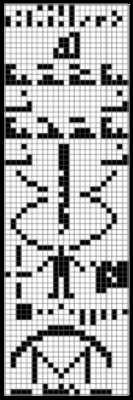
One format approach proposed for interstellar messages was to use the product of two prime numbers to construct an image. Unfortunately, this method works only if all the bits are present. As an example, the message sent by Frank Drake from Arecibo in 1974 did not have any feature to support mechanisms to cope with the inevitable noise degradation of the interstellar medium.
Error correction tolerance rates for previous METI messages
- Arecibo Message (1974) : 8.9% (one page)
- Evpatoria message (1999) : 44% (23 separate pages)
- Evpatoria message (2003) : 46% (one page, estimated)
Examples
The 1999 Cosmic CallCosmic Call
Cosmic Call was the name of two interstellar radio messages that were sent from RT-70 in Yevpatoria in 1999 and 2003 to various nearby stars. The messages were designed with noise resistant format and characters....
transmission was far from being optimal (from our Terrestrial point of view) as it was essentially a monochromatic signal spiced with a supplementary information. Additionally, the message had a very small modulation index overall, a condition not viewed as being optimal for interstellar communication.
- Over the 370,967 bits (46,371 bytes) sent some 314,239 were “1” and 56,768 were “0” creating a ratio of 5.54 times more “1” than “0”.
- Since frequency shift keying modulation scheme was used, most of the time the signal will be on the “0” frequency.
- In addition, “0” tend to be send in long stretch (white lines in the message).
Realized projects
These projects have targeted stars between 20 and 69 light-years from the Earth. The exception is the Arecibo messageArecibo message
The Arecibo message was broadcast into space a single time via frequency modulated radio waves at a ceremony to mark the remodeling of the Arecibo radio telescope on 16 November 1974. It was aimed at the globular star cluster M13 some 25,000 light years away because M13 was a large and close...
, which targeted globular cluster M13, approximately 24,000 light-years away.
The first message to reach its destination will be A Message From Earth
A Message From Earth
A Message from Earth is a high-powered digital radio signal that was sent on 9 October 2008 towards Gliese 581 c, a large terrestrial extrasolar planet orbiting the red dwarf star Gliese 581. The signal is a digital time capsule containing 501 messages that were selected through a competition on...
, which should reach Gliese 581
Gliese 581
Gliese 581 is a red dwarf star with spectral type M3V, located 20.3 light years away from Earth in the constellation Libra. Its estimated mass is about a third of that of the Sun, and it is the 89th closest known star system to the Sun. Observations suggest that the star has at least six planets:...
in Libra
Libra (constellation)
Libra is a constellation of the zodiac. Its name is Latin for weighing scales, and its symbol is . It is fairly faint, with no first magnitude stars, and lies between Virgo to the west and Scorpius to the east.-Notable features:]...
in 2029.
- The Morse Message (1962)The Morse Message (1962)In 1962, a radio message in Morse code was transmitted from EPR in 1962 and directed to planet Venus. The word "MIR" was transmitted from the EPR on November 19, 1962, and the words "LENIN" and "SSSR" ) on November 24, 1962, respectively. All three words were sent using the Morse code. In...
- Arecibo MessageArecibo messageThe Arecibo message was broadcast into space a single time via frequency modulated radio waves at a ceremony to mark the remodeling of the Arecibo radio telescope on 16 November 1974. It was aimed at the globular star cluster M13 some 25,000 light years away because M13 was a large and close...
(1974) - Cosmic Call 1 (1999)
- Teen Age MessageTeen Age MessageThe Teen Age Message was a METI message, transmitted from the Yevpatoria Planetary Radar to 6 nearby Sun-like stars during August–September 2001. Unlike the previous digital-only Messages, Arecibo-1974 and Cosmic Call 1, the TAM has complex, three-section structure with different forms of...
(2001) - Cosmic Call 2 (2003)
- Across the UniverseAcross the Universe (message)Across the Universe is an interstellar radio message consisting of the song "Across the Universe" by The Beatles that was transmitted on 4 February 2008, at 00:00 UTC by NASA in the direction of the star Polaris...
(2008) - A Message From EarthA Message From EarthA Message from Earth is a high-powered digital radio signal that was sent on 9 October 2008 towards Gliese 581 c, a large terrestrial extrasolar planet orbiting the red dwarf star Gliese 581. The signal is a digital time capsule containing 501 messages that were selected through a competition on...
(2008) - Hello From EarthHello From EarthHELLO FROM EARTH is an Interstellar Radio Message . It was sent from the 70-meter dish at NASA Deep Space Station 43 , at midday on Friday 28 August 2009...
(2009) - RuBisCo StarsRuBisCo StarsRuBisCo Stars is an interstellar radio message sent from the Arecibo radio telescope on November 7, 2009. The message contained the genetic code for the RuBisCO protein used by terrestrial plants to perform photosynthesis. It was sent to three nearby stars .-External links:* * *...
(2009)
Current transmissions on route
Stars to which messages were sent, are the following:| Name | Designation | Constellation | Date sent | Arrival date | Message |
|---|---|---|---|---|---|
| Messier 13 Messier 13 Messier 13 or M13 is a globular cluster of about 300,000 stars in the constellation of Hercules.... |
NGC 6205 | Hercules Hercules (constellation) Hercules is a constellation named after Hercules, the Roman mythological hero adapted from the Greek hero Heracles. Hercules was one of the 48 constellations listed by the 2nd century astronomer Ptolemy, and it remains one of the 88 modern constellations today... |
November 16, 1974 | approx. 27000 | Arecibo Message Arecibo message The Arecibo message was broadcast into space a single time via frequency modulated radio waves at a ceremony to mark the remodeling of the Arecibo radio telescope on 16 November 1974. It was aimed at the globular star cluster M13 some 25,000 light years away because M13 was a large and close... |
| Altair | Alpha Aql | Aquila Aquila (constellation) Aquila is a stellar constellation. Its name is Latin for 'eagle' and it is commonly represented as such. In mythology, Aquila was owned by the Roman god Jupiter and performed many tasks for him.... |
August 15 1983 | 1999 | Altair (Morimoto - Hirabayashi) Message |
| Spica Spica Spica is the brightest star in the constellation Virgo, and the 15th brightest star in the nighttime sky. It is 260 light years distant from Earth... |
Alpha Vir | Virgo Aquila (constellation) Aquila is a stellar constellation. Its name is Latin for 'eagle' and it is commonly represented as such. In mythology, Aquila was owned by the Roman god Jupiter and performed many tasks for him.... |
August 1997 | 2247 | NASDA Cosmic-College |
| 16 Cyg A 16 Cygni 16 Cygni or 16 Cyg is a triple star system approximately 70 light-years away from Earth in the constellation of Cygnus. It consists of two Sun-like yellow dwarf stars, 16 Cygni A and 16 Cygni B, together with a red dwarf, 16 Cygni C... |
HD Henry Draper Catalogue The Henry Draper Catalogue is an astronomical star catalogue published between 1918 and 1924, giving spectroscopic classifications for 225,300 stars; it was later expanded by the Henry Draper Extension , published between 1925 and 1936, which gave classifications for 46,850 more stars, and by the... 186408 |
Cygnus Cygnus (constellation) Cygnus is a northern constellation lying on the plane of the Milky Way. Its name is the Latinized Hellenic word for swan. One of the most recognizable constellations of the northern summer and autumn, it features a prominent asterism known as the Northern Cross... |
May 24, 1999 | November 2069 | Cosmic Call Cosmic Call Cosmic Call was the name of two interstellar radio messages that were sent from RT-70 in Yevpatoria in 1999 and 2003 to various nearby stars. The messages were designed with noise resistant format and characters.... 1 |
| 15 Sge 15 Sagittae 15 Sagittae is a 6th magnitude star in the constellation Sagitta. In 2002, a brown dwarf, 15 Sge b, was discovered around 15 Sge.-15 Sagittae B:... |
HD Henry Draper Catalogue The Henry Draper Catalogue is an astronomical star catalogue published between 1918 and 1924, giving spectroscopic classifications for 225,300 stars; it was later expanded by the Henry Draper Extension , published between 1925 and 1936, which gave classifications for 46,850 more stars, and by the... 190406 |
Sagitta Sagitta Sagitta is a constellation. Its name is Latin for "arrow", and it should not be confused with the larger constellation Sagittarius, the archer. Although ancient, it is insignificant, for it has no star brighter than the 4th magnitude and is the third smallest of all constellations... |
June 30, 1999 | February 2057 | Cosmic Call Cosmic Call Cosmic Call was the name of two interstellar radio messages that were sent from RT-70 in Yevpatoria in 1999 and 2003 to various nearby stars. The messages were designed with noise resistant format and characters.... 1 |
| HD Henry Draper Catalogue The Henry Draper Catalogue is an astronomical star catalogue published between 1918 and 1924, giving spectroscopic classifications for 225,300 stars; it was later expanded by the Henry Draper Extension , published between 1925 and 1936, which gave classifications for 46,850 more stars, and by the... 178428 |
Sagitta Sagitta Sagitta is a constellation. Its name is Latin for "arrow", and it should not be confused with the larger constellation Sagittarius, the archer. Although ancient, it is insignificant, for it has no star brighter than the 4th magnitude and is the third smallest of all constellations... |
June 30, 1999 | October 2067 | Cosmic Call Cosmic Call Cosmic Call was the name of two interstellar radio messages that were sent from RT-70 in Yevpatoria in 1999 and 2003 to various nearby stars. The messages were designed with noise resistant format and characters.... 1 |
|
| Gl 777 Gliese 777 Gliese 777, often abbreviated as Gl 777 or GJ 777, is a yellow subgiant approximately 52 light-years away in the constellation of Cygnus. The system is also a binary star system made up of two stars and possibly a third... |
HD Henry Draper Catalogue The Henry Draper Catalogue is an astronomical star catalogue published between 1918 and 1924, giving spectroscopic classifications for 225,300 stars; it was later expanded by the Henry Draper Extension , published between 1925 and 1936, which gave classifications for 46,850 more stars, and by the... 190360 |
Cygnus Cygnus (constellation) Cygnus is a northern constellation lying on the plane of the Milky Way. Its name is the Latinized Hellenic word for swan. One of the most recognizable constellations of the northern summer and autumn, it features a prominent asterism known as the Northern Cross... |
July 1, 1999 | April 2051 | Cosmic Call Cosmic Call Cosmic Call was the name of two interstellar radio messages that were sent from RT-70 in Yevpatoria in 1999 and 2003 to various nearby stars. The messages were designed with noise resistant format and characters.... 1 |
| HD Henry Draper Catalogue The Henry Draper Catalogue is an astronomical star catalogue published between 1918 and 1924, giving spectroscopic classifications for 225,300 stars; it was later expanded by the Henry Draper Extension , published between 1925 and 1936, which gave classifications for 46,850 more stars, and by the... 197076 |
Delphinus Delphinus Delphinus is a constellation in the northern sky, close to the celestial equator. Its name is Latin for dolphin. Delphinus was one of the 48 constellations listed by the 2nd century astronomer Ptolemy, and it remains among the 88 modern constellations recognized by the International Astronomical... |
August 29, 2001 | February 2070 | Teen Age Message Teen Age Message The Teen Age Message was a METI message, transmitted from the Yevpatoria Planetary Radar to 6 nearby Sun-like stars during August–September 2001. Unlike the previous digital-only Messages, Arecibo-1974 and Cosmic Call 1, the TAM has complex, three-section structure with different forms of... |
|
| 47 UMa 47 Ursae Majoris 47 Ursae Majoris is a solar analog, yellow dwarf star approximately 46 light-years away from Earth in the constellation of Ursa Major. , it has been confirmed that three Jupiter-like extrasolar planets orbit the star... |
HD Henry Draper Catalogue The Henry Draper Catalogue is an astronomical star catalogue published between 1918 and 1924, giving spectroscopic classifications for 225,300 stars; it was later expanded by the Henry Draper Extension , published between 1925 and 1936, which gave classifications for 46,850 more stars, and by the... 95128 |
Ursa Major Ursa Major Ursa Major , also known as the Great Bear, is a constellation visible throughout the year in most of the northern hemisphere. It can best be seen in April... |
September 3, 2001 | July 2047 | Teen Age Message Teen Age Message The Teen Age Message was a METI message, transmitted from the Yevpatoria Planetary Radar to 6 nearby Sun-like stars during August–September 2001. Unlike the previous digital-only Messages, Arecibo-1974 and Cosmic Call 1, the TAM has complex, three-section structure with different forms of... |
| 37 Gem | HD Henry Draper Catalogue The Henry Draper Catalogue is an astronomical star catalogue published between 1918 and 1924, giving spectroscopic classifications for 225,300 stars; it was later expanded by the Henry Draper Extension , published between 1925 and 1936, which gave classifications for 46,850 more stars, and by the... 50692 |
Gemini Gemini (constellation) Gemini is one of the constellations of the zodiac. It was one of the 48 constellations described by the 2nd century astronomer Ptolemy and it remains one of the 88 modern constellations today. Its name is Latin for "twins", and it is associated with the twins Castor and Pollux in Greek mythology... |
September 3, 2001 | December 2057 | Teen Age Message Teen Age Message The Teen Age Message was a METI message, transmitted from the Yevpatoria Planetary Radar to 6 nearby Sun-like stars during August–September 2001. Unlike the previous digital-only Messages, Arecibo-1974 and Cosmic Call 1, the TAM has complex, three-section structure with different forms of... |
| HD Henry Draper Catalogue The Henry Draper Catalogue is an astronomical star catalogue published between 1918 and 1924, giving spectroscopic classifications for 225,300 stars; it was later expanded by the Henry Draper Extension , published between 1925 and 1936, which gave classifications for 46,850 more stars, and by the... 126053 |
Virgo Virgo (constellation) Virgo is one of the constellations of the zodiac. Its name is Latin for virgin, and its symbol is . Lying between Leo to the west and Libra to the east, it is the second largest constellation in the sky... |
September 3, 2001 | January 2059 | Teen Age Message Teen Age Message The Teen Age Message was a METI message, transmitted from the Yevpatoria Planetary Radar to 6 nearby Sun-like stars during August–September 2001. Unlike the previous digital-only Messages, Arecibo-1974 and Cosmic Call 1, the TAM has complex, three-section structure with different forms of... |
|
| HD Henry Draper Catalogue The Henry Draper Catalogue is an astronomical star catalogue published between 1918 and 1924, giving spectroscopic classifications for 225,300 stars; it was later expanded by the Henry Draper Extension , published between 1925 and 1936, which gave classifications for 46,850 more stars, and by the... 76151 |
Hydra Hydra (constellation) Hydra is the largest of the 88 modern constellations, measuring 1303 square degrees. It has a long history, having been included among the 48 constellations listed by the 2nd century astronomer Ptolemy. It is commonly represented as a water snake... |
September 4, 2001 | May 2057 | Teen Age Message Teen Age Message The Teen Age Message was a METI message, transmitted from the Yevpatoria Planetary Radar to 6 nearby Sun-like stars during August–September 2001. Unlike the previous digital-only Messages, Arecibo-1974 and Cosmic Call 1, the TAM has complex, three-section structure with different forms of... |
|
| HD Henry Draper Catalogue The Henry Draper Catalogue is an astronomical star catalogue published between 1918 and 1924, giving spectroscopic classifications for 225,300 stars; it was later expanded by the Henry Draper Extension , published between 1925 and 1936, which gave classifications for 46,850 more stars, and by the... 193664 |
Draco Draco (constellation) Draco is a constellation in the far northern sky. Its name is Latin for dragon. Draco is circumpolar for many observers in the northern hemisphere... |
September 4, 2001 | January 2059 | Teen Age Message Teen Age Message The Teen Age Message was a METI message, transmitted from the Yevpatoria Planetary Radar to 6 nearby Sun-like stars during August–September 2001. Unlike the previous digital-only Messages, Arecibo-1974 and Cosmic Call 1, the TAM has complex, three-section structure with different forms of... |
|
| HIP 4872 | Cassiopeia Cassiopeia (constellation) Cassiopeia is a constellation in the northern sky, named after the vain queen Cassiopeia in Greek mythology, who boasted about her unrivalled beauty. Cassiopea was one of the 48 constellations listed by the 2nd century Greek astronomer Ptolemy, and it remains one of the 88 modern constellations today... |
July 6, 2003 | April 2036 | Cosmic Call Cosmic Call Cosmic Call was the name of two interstellar radio messages that were sent from RT-70 in Yevpatoria in 1999 and 2003 to various nearby stars. The messages were designed with noise resistant format and characters.... 2 |
|
| HD Henry Draper Catalogue The Henry Draper Catalogue is an astronomical star catalogue published between 1918 and 1924, giving spectroscopic classifications for 225,300 stars; it was later expanded by the Henry Draper Extension , published between 1925 and 1936, which gave classifications for 46,850 more stars, and by the... 245409 |
Orion Orion (constellation) Orion, often referred to as The Hunter, is a prominent constellation located on the celestial equator and visible throughout the world. It is one of the most conspicuous, and most recognizable constellations in the night sky... |
July 6, 2003 | August 2040 | Cosmic Call Cosmic Call Cosmic Call was the name of two interstellar radio messages that were sent from RT-70 in Yevpatoria in 1999 and 2003 to various nearby stars. The messages were designed with noise resistant format and characters.... 2 |
|
| 55 Cnc 55 Cancri 55 Cancri , also cataloged Rho1 Cancri or abbreviated 55 Cnc, is a binary star approximately 41 light-years away from Earth in the constellation of Cancer... |
HD Henry Draper Catalogue The Henry Draper Catalogue is an astronomical star catalogue published between 1918 and 1924, giving spectroscopic classifications for 225,300 stars; it was later expanded by the Henry Draper Extension , published between 1925 and 1936, which gave classifications for 46,850 more stars, and by the... 75732 |
Cancer Cancer (constellation) Cancer is one of the twelve constellations of the zodiac. Its name is Latin for crab and it is commonly represented as such. Its symbol is . Cancer is small and its stars are faint... |
July 6, 2003 | May 2044 | Cosmic Call Cosmic Call Cosmic Call was the name of two interstellar radio messages that were sent from RT-70 in Yevpatoria in 1999 and 2003 to various nearby stars. The messages were designed with noise resistant format and characters.... 2 |
| HD 10307 HD 10307 HD 10307 is a star similar to the sun in mass, temperature and metal content, situated about 41 light-years from Earth in the constellation Andromeda... |
Andromeda Andromeda (constellation) Andromeda is a constellation in the northern sky. It is named after Andromeda, the princess in the Greek legend of Perseus who was chained to a rock to be eaten by the sea monster Cetus... |
July 6, 2003 | September 2044 | Cosmic Call Cosmic Call Cosmic Call was the name of two interstellar radio messages that were sent from RT-70 in Yevpatoria in 1999 and 2003 to various nearby stars. The messages were designed with noise resistant format and characters.... 2 |
|
| 47 UMa 47 Ursae Majoris 47 Ursae Majoris is a solar analog, yellow dwarf star approximately 46 light-years away from Earth in the constellation of Ursa Major. , it has been confirmed that three Jupiter-like extrasolar planets orbit the star... |
HD Henry Draper Catalogue The Henry Draper Catalogue is an astronomical star catalogue published between 1918 and 1924, giving spectroscopic classifications for 225,300 stars; it was later expanded by the Henry Draper Extension , published between 1925 and 1936, which gave classifications for 46,850 more stars, and by the... 95128 |
Ursa Major Ursa Major Ursa Major , also known as the Great Bear, is a constellation visible throughout the year in most of the northern hemisphere. It can best be seen in April... |
July 6, 2003 | May 2049 | Cosmic Call Cosmic Call Cosmic Call was the name of two interstellar radio messages that were sent from RT-70 in Yevpatoria in 1999 and 2003 to various nearby stars. The messages were designed with noise resistant format and characters.... 2 |
| Polaris Polaris Polaris |Alpha]] Ursae Minoris, commonly North Star or Pole Star, also Lodestar) is the brightest star in the constellation Ursa Minor. It is very close to the north celestial pole, making it the current northern pole star.... |
HIP 11767 | Ursa Minor Ursa Minor Ursa Minor , also known as the Little Bear, is a constellation in the northern sky. Like the Great Bear, the tail of the Little Bear may also be seen as the handle of a ladle, whence the name Little Dipper... |
February 4, 2008 | 2439 | Across the Universe Across the Universe (message) Across the Universe is an interstellar radio message consisting of the song "Across the Universe" by The Beatles that was transmitted on 4 February 2008, at 00:00 UTC by NASA in the direction of the star Polaris... |
| Gliese 581 Gliese 581 Gliese 581 is a red dwarf star with spectral type M3V, located 20.3 light years away from Earth in the constellation Libra. Its estimated mass is about a third of that of the Sun, and it is the 89th closest known star system to the Sun. Observations suggest that the star has at least six planets:... |
HIP 74995 | Libra Libra (constellation) Libra is a constellation of the zodiac. Its name is Latin for weighing scales, and its symbol is . It is fairly faint, with no first magnitude stars, and lies between Virgo to the west and Scorpius to the east.-Notable features:]... |
October 9, 2008 | 2029 | A Message From Earth A Message From Earth A Message from Earth is a high-powered digital radio signal that was sent on 9 October 2008 towards Gliese 581 c, a large terrestrial extrasolar planet orbiting the red dwarf star Gliese 581. The signal is a digital time capsule containing 501 messages that were selected through a competition on... |
| Gliese 581 Gliese 581 Gliese 581 is a red dwarf star with spectral type M3V, located 20.3 light years away from Earth in the constellation Libra. Its estimated mass is about a third of that of the Sun, and it is the 89th closest known star system to the Sun. Observations suggest that the star has at least six planets:... |
HIP 74995 | Libra Libra (constellation) Libra is a constellation of the zodiac. Its name is Latin for weighing scales, and its symbol is . It is fairly faint, with no first magnitude stars, and lies between Virgo to the west and Scorpius to the east.-Notable features:]... |
August 28, 2009 | 2030 | Hello From Earth Hello From Earth HELLO FROM EARTH is an Interstellar Radio Message . It was sent from the 70-meter dish at NASA Deep Space Station 43 , at midday on Friday 28 August 2009... |
| GJ 83.1 TZ Arietis TZ Arietis is a red dwarf star in the constellation Aries. It is too faint to be seen by the naked eye, although it lies relatively close to our Sun at a distance of about 14.5 light years. It is a flare star, which means it can suddenly increase in brightness for short periods of time.-External... |
GJ 83.1 | Aries Aries (constellation) Aries is one of the constellations of the zodiac, located between Pisces to the west and Taurus to the east. Its name is Latin for ram, and its symbol is , representing a ram's horns... |
November 7, 2009 | 2024 | RuBisCo Stars RuBisCo Stars RuBisCo Stars is an interstellar radio message sent from the Arecibo radio telescope on November 7, 2009. The message contained the genetic code for the RuBisCO protein used by terrestrial plants to perform photosynthesis. It was sent to three nearby stars .-External links:* * *... |
| Teegarden's Star Teegarden's star Teegarden's Star, also known as SO J025300.5+165258, is an M-type red dwarf star or brown dwarf in the constellation Aries, located about 12 light years from the Solar System. Despite its proximity to Earth it is a dim magnitude 15 and can only be seen through large telescopes. This star was found... |
SO J025300.5+165258 | Aries Aries (constellation) Aries is one of the constellations of the zodiac, located between Pisces to the west and Taurus to the east. Its name is Latin for ram, and its symbol is , representing a ram's horns... |
November 7, 2009 | 2022 | RuBisCo Stars RuBisCo Stars RuBisCo Stars is an interstellar radio message sent from the Arecibo radio telescope on November 7, 2009. The message contained the genetic code for the RuBisCO protein used by terrestrial plants to perform photosynthesis. It was sent to three nearby stars .-External links:* * *... |
| Kappa1 Ceti Kappa1 Ceti Kappa1 Ceti is a yellow dwarf star approximately 30 light-years away in the constellation of Cetus. The star was discovered to have a rapid rotation, roughly once every nine days. Though there are no extrasolar planets confirmed to be orbiting the star, Kappa1 Ceti is considered a good candidate... |
GJ 137 | Cetus | November 7, 2009 | 2039 | RuBisCo Stars RuBisCo Stars RuBisCo Stars is an interstellar radio message sent from the Arecibo radio telescope on November 7, 2009. The message contained the genetic code for the RuBisCO protein used by terrestrial plants to perform photosynthesis. It was sent to three nearby stars .-External links:* * *... |
Potential risk
Active SETI has been heavily criticized due to the perceived risk of revealing the location of the Earth to alien civilizations, without some process of prior international consultation. Notable among its critics is scientist and science fiction author David BrinDavid Brin
Glen David Brin, Ph.D. is an American scientist and award-winning author of science fiction. He has received the Hugo, Locus, Campbell and Nebula Awards.-Biography:...
, particularly in his article/"expose" Shouting at the Cosmos.
However, Russian and Soviet radio engineer and astronomer Alexander L. Zaitsev has argued against these fears: see Sending and Searching for Interstellar Messages and Detection Probability of Terrestrial Radio Signals by a Hostile Super-civilization. Indeed, Zaitsev argues that we should consider the risks of NOT reaching out to extraterrestrial civilizations: see Making a Case for METI.
To lend a quantitative basis to discussions of the risks of transmitting deliberate messages from Earth, the SETI Permanent Study Group of the International Academy of Astronautics http://iaaseti.org adopted in 2007 a new analytical tool, the San Marino Scale
San Marino Scale
In exopolitics, the San Marino Scale is a suggested scale for assessing risks associated with deliberate transmissions from Earth aimed to possible extraterrestrial intelligent life. The scale was suggested by Iván Almár at a conference in San Marino in 2005...
http://iaaseti.org/smiscale.htm. Developed by Prof. Ivan Almar and Prof. H. Paul Shuch
H. Paul Shuch
Dr. H. Paul Shuch is an American scientist and engineer who has coordinated radio amateurs to help in the search for extraterrestrial intelligence.-Overview:...
, the San Marino Scale evaluates the significance of transmissions from Earth as a function of signal intensity and information content. Its adoption suggests that not all such transmissions are created equal, thus each must be evaluated on a case-by-case basis before establishing blanket international policy regarding Active SETI.
Beacon proposal
One proposal for a 10 billion watt interstellar SETI beacon was dismissed by Robert A. Freitas Jr. to be infeasible for a pre-Type I civilization on the Kardashev scaleKardashev scale
The Kardashev scale is a method of measuring an advanced civilization's level of technological advancement. The scale is only theoretical and in terms of an actual civilization highly speculative; however, it puts energy consumption of an entire civilization in a cosmic perspective. It was first...
. As a result it has been suggested that civilizations must advance into Type I before mustering the energy required for reliable contact with other civilizations.
However, this 1980s technical argument assumes omni-directional beacons which may not be the best way to proceed on many technical grounds. Advances in consumer electronics have made possible transmitters that simultaneously transmit many narrow beams, covering the million or so nearest stars but not the spaces between. This multibeam approach can reduce the power and cost to levels that are reasonable with current mid-2000s Earth technology.
Once civilizations have discovered each others' locations, the energy requirements for maintaining contact and exchanging information can be significantly reduced through the use of highly directional transmission technologies.
In 1974, the Arecibo Observatory
Arecibo Observatory
The Arecibo Observatory is a radio telescope near the city of Arecibo in Puerto Rico. It is operated by SRI International under cooperative agreement with the National Science Foundation...
transmitted a message toward the M13 globular cluster
Messier 13
Messier 13 or M13 is a globular cluster of about 300,000 stars in the constellation of Hercules....
about 25,000 light-years away, for example, and the use of larger antennas or shorter wavelengths would allow transmissions of the same energy to be focused on even more remote targets, such as those attempted by Active SETI.
External links
- Interstellar Radio Messages
- ActiveSETI.org
- Making a Case for METI
- Should We Shout Into the Darkness?
- Error Correction Schemes In Active SETI
- The Evpatoria Messages
- Encounter 2001 Message
- METI: Messaging to Extra-Terrestrial Intelligence
- The Pros and Cons of METI from Centauri Dreams
- Classification of interstellar radio messages