

Achelata

Encyclopedia
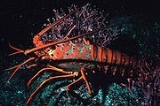
The Achelata is an infra-order of the reptant Decapoda
. It contains the spiny lobster
s (Palinuridae), the slipper lobster
s (Scyllaridae) and the furry lobster
s (Synaxidae, sometimes included in Palinuridae). The name "Achelata" derives from the fact that all the members of this group lack the claws that are found on almost all other decapods (from the Greek
, = "not", , chela = "claw"). They are further united by the great enlargement of the first antennae
, by the special Phyllosoma
form of the larva
, and by a number of other characters.
Decapoda
The decapods or Decapoda are an order of crustaceans within the class Malacostraca, including many familiar groups, such as crayfish, crabs, lobsters, prawns and shrimp. Most decapods are scavengers. It is estimated that the order contains nearly 15,000 species in around 2,700 genera, with...
. It contains the spiny lobster
Spiny lobster
Spiny lobsters, also known as langouste or rock lobsters, are a family of about 45 species of achelate crustaceans, in the Decapoda Reptantia...
s (Palinuridae), the slipper lobster
Slipper lobster
Slipper lobsters are a family of decapod crustaceans found in all warm oceans and seas. Despite their name, they are not true lobsters, but are more closely related to spiny lobsters and furry lobsters. Slipper lobsters are instantly recognisable by their enlarged antennae, which project forward...
s (Scyllaridae) and the furry lobster
Furry lobster
Furry lobsters are small decapod crustaceans, closely related to the slipper lobsters and spiny lobsters. The antennae are not as enlarged as in spiny and slipper lobsters, and the body is covered in short hairs, hence the name furry lobster...
s (Synaxidae, sometimes included in Palinuridae). The name "Achelata" derives from the fact that all the members of this group lack the claws that are found on almost all other decapods (from the Greek
Greek language
Greek is an independent branch of the Indo-European family of languages. Native to the southern Balkans, it has the longest documented history of any Indo-European language, spanning 34 centuries of written records. Its writing system has been the Greek alphabet for the majority of its history;...
, = "not", , chela = "claw"). They are further united by the great enlargement of the first antennae
Antenna (biology)
Antennae in biology have historically been paired appendages used for sensing in arthropods. More recently, the term has also been applied to cilium structures present in most cell types of eukaryotes....
, by the special Phyllosoma
Phyllosoma
The phyllosoma is the larval stage of spiny, slipper and coral lobsters , and represents one of the most significant characteristics that unify them into the taxon Achelata...
form of the larva
Crustacean larvae
Crustaceans may pass through a number of larval and immature stages between hatching from their eggs and reaching their adult form. Each of the stages is separated by a moult, in which the hard exoskeleton is shed to allow the animal to grow...
, and by a number of other characters.