

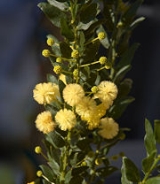
Acacia paradoxa

Encyclopedia
Acacia paradoxa is a plant in the Fabaceae
family. Its common names include kangaroo thorn, prickly wattle, hedge wattle and paradox acacia. This is a large shrub
up to 3 metres tall and wide. It is dense with foliage; the leaves are actually enlarged petioles
known as phyllodes. They are crinkly and the new ones are covered in hairs. The bush is also full of long spines. It flowers in small, bright yellow spherical flower heads and the fruits are brown pods 4 to 7 cm long.
The spiny 'stipulles' which grow at the base of the phyllodes deter livestock from feeding on or too close to the plant.
Kangaroo thorn is widely spread across Australia, regenerating from seed after disturbances, such as bush fire. Small birds, including wrens, use this plant as shelter and dwelling, while it is relied upon as a food source for moths, butterfiles and other insects, and birds feed on its seeds.
This plant is native to Australia, but has been introduced to other continents. In the United States, kangaroo thorn is a well-known noxious weed in California.
Fabaceae
The Fabaceae or Leguminosae, commonly known as the legume, pea, or bean family, is a large and economically important family of flowering plants. The group is the third largest land plant family, behind only the Orchidaceae and Asteraceae, with 730 genera and over 19,400 species...
family. Its common names include kangaroo thorn, prickly wattle, hedge wattle and paradox acacia. This is a large shrub
Shrub
A shrub or bush is distinguished from a tree by its multiple stems and shorter height, usually under 5–6 m tall. A large number of plants may become either shrubs or trees, depending on the growing conditions they experience...
up to 3 metres tall and wide. It is dense with foliage; the leaves are actually enlarged petioles
Petiole (botany)
In botany, the petiole is the stalk attaching the leaf blade to the stem. The petiole usually has the same internal structure as the stem. Outgrowths appearing on each side of the petiole are called stipules. Leaves lacking a petiole are called sessile, or clasping when they partly surround the...
known as phyllodes. They are crinkly and the new ones are covered in hairs. The bush is also full of long spines. It flowers in small, bright yellow spherical flower heads and the fruits are brown pods 4 to 7 cm long.
The spiny 'stipulles' which grow at the base of the phyllodes deter livestock from feeding on or too close to the plant.
Kangaroo thorn is widely spread across Australia, regenerating from seed after disturbances, such as bush fire. Small birds, including wrens, use this plant as shelter and dwelling, while it is relied upon as a food source for moths, butterfiles and other insects, and birds feed on its seeds.
This plant is native to Australia, but has been introduced to other continents. In the United States, kangaroo thorn is a well-known noxious weed in California.