


Aalborghus Castle

Encyclopedia
Castle
A castle is a type of fortified structure built in Europe and the Middle East during the Middle Ages by European nobility. Scholars debate the scope of the word castle, but usually consider it to be the private fortified residence of a lord or noble...
in Aalborg
Aalborg
-Transport:On the north side of the Limfjord is Nørresundby, which is connected to Aalborg by a road bridge Limfjordsbroen, an iron railway bridge Jernbanebroen over Limfjorden, as well as a motorway tunnel running under the Limfjord Limfjordstunnelen....
, Denmark
Denmark
Denmark is a Scandinavian country in Northern Europe. The countries of Denmark and Greenland, as well as the Faroe Islands, constitute the Kingdom of Denmark . It is the southernmost of the Nordic countries, southwest of Sweden and south of Norway, and bordered to the south by Germany. Denmark...
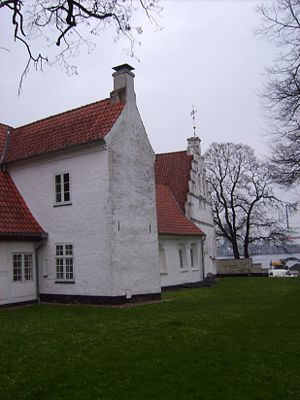
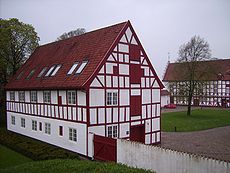
. It is a half-timbered (bindingsværk) castle built by King Christian III from 1539 to around 1555 initially as a fortification. Soon it became the seat of the king's provincial governors in Northern Jutland
Northern Jutland
Northern Jutland is the name for the region north of the Kongeå in Jutland. The region south of the Kongeå is called Southern Jutland . Both territories have had own ting assemblies in the Middle Ages ....
, and after the introduction of absolutism
Absolutism (European history)
Absolutism or The Age of Absolutism is a historiographical term used to describe a form of monarchical power that is unrestrained by all other institutions, such as churches, legislatures, or social elites...
, became used by the State County of Northern Jutland for taxes.
A building had pre-existed at the site before Christian III's castle. It stood south of the castle and is mentioned in the first documentation of Aalborghus, dating back to 1340. It was owned by Margrethe I and was the death place of King Hans in 1513 who died in a horse riding accident.
Frederick I of Denmark
Frederick I of Denmark and Norway was the King of Denmark and Norway. The name is also spelled Friedrich in German, Frederik in Danish, and Fredrik in Swedish and Norwegian...
had originally intended to destroy the initial building around 1530 and moving to a different site to convert Aalborg's Franciscan
Franciscan
Most Franciscans are members of Roman Catholic religious orders founded by Saint Francis of Assisi. Besides Roman Catholic communities, there are also Old Catholic, Anglican, Lutheran, ecumenical and Non-denominational Franciscan communities....
monastery into a castle. However he left the decision to his son Christian III, who later decided to demolish the original in 1539 and contracted the royal architect Morten Bussert to build a new fortified castle north of the old site, near the Liim Fjord. A barrier wall was built alongside the fjord, and later in 1633, Christian IV built a north wing facing the port, which was used as a granary for the storage of food supplies such as corn. A western wing was built to the same effect later, holding other supplies such as meats and fish.
The southern facing wing was created between 1808 and 1809 but all that remains today of the original castle is the east wing.
Between 1954 and 1964 the old granaries underwent full renovation by the Royal Inspector of Listed Buildings, Leopold Teschl, who converted them into council offices.